The nonchalant cherubs of Raphael’s “Sistine Madonna” (1513) have become two of the most ubiquitous faces of Renaissance art in popular culture. Part of their charm lies in their aloof, innocent expressions. These seem detached and independent of the masterpiece that inspired them.
It’s not surprising, then, to discover that the two were a late addition to the painting—an outer layer in the compositional process. There are no confirmed sources about what inspired the cherubs, but accounts say that Raphael saw two children peeking through a window and so loved their expressions that he added them to the painting.
Throughout his tragically brief 37 years, Raffaello Sanzio da Urbino (1483–1520), known as Raphael, painted more than 30 Madonnas. Though many of his latest works were largely painted by his apprentices, the “Sistine Madonna” is believed by many restorers and scholars to be the last Madonna painted entirely by his own hand.
Five hundred years later, the inspiration and legacy surrounding the painting have revealed new layers of Raphael’s professional growth that informed the painting.
Vision and Perspective
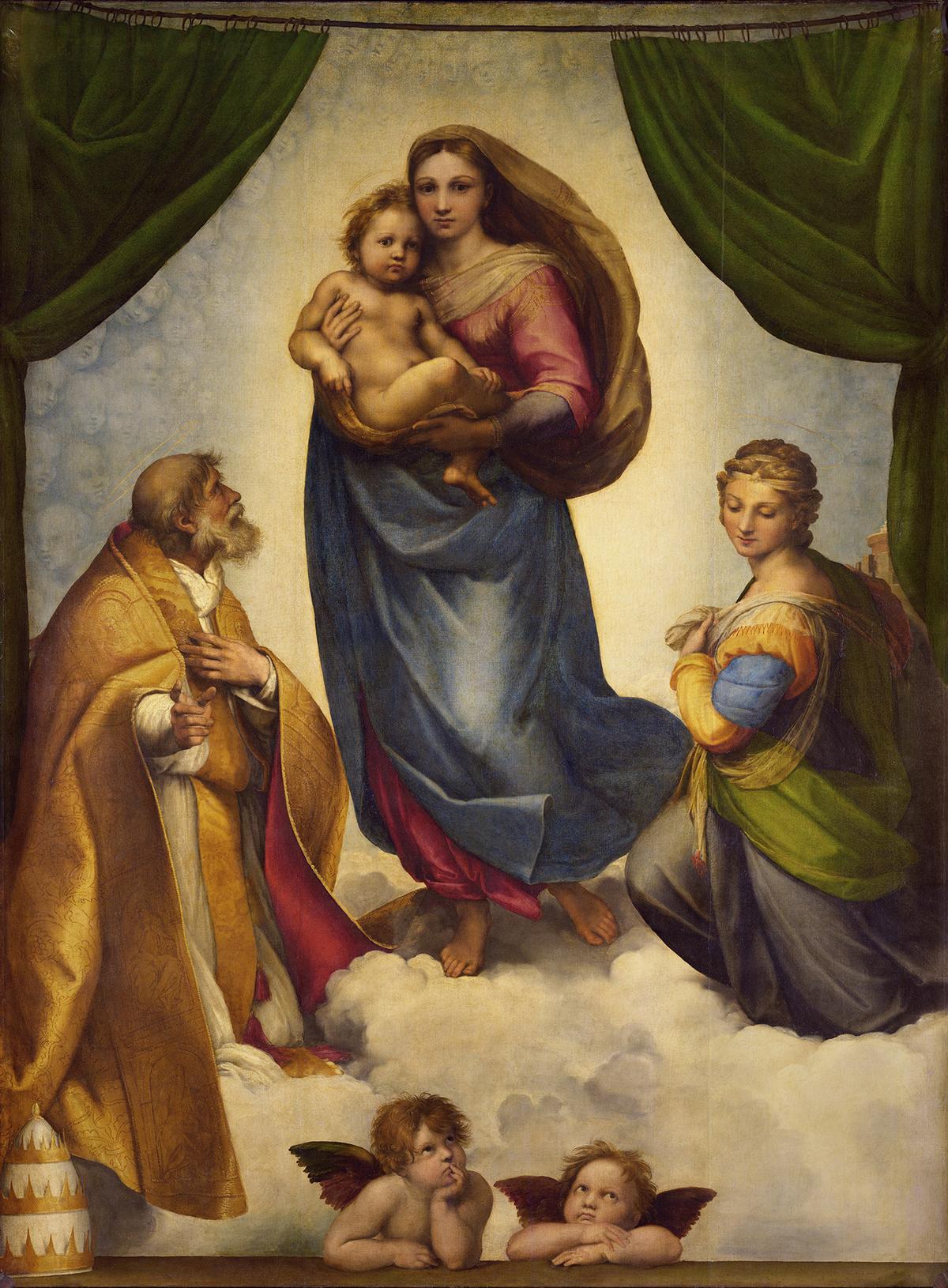
"Sistine Madonna," circa 1512–1513, by Raphael. Oil on canvas; 106 1/10 inches by 79 1/10 inches. Old Masters Picture Gallery, Dresden, Germany. Public Domain
Commissioned by Pope Julius II (1443–1513), the painting would stand 106 by 79 inches and be placed above the altar of the San Sisto Chapel in Piacenza. In addition to the Madonna and Child, the painting also needed to include the chapel’s patron saints, Sixtus II and Barbara. The size and placement of the frame would give the figures a life-size appearance, standing tall above the altar behind an ornate choir screen and crucifix.
Raphael took all of these elements into consideration when he prepared his initial sketches. He created the scene in the popular tradition of St. Luke’s vision of Mary appearing in the heavens—the legend that established St. Luke as the patron saint of artists. By this time, Raphael had already painted more than two dozen Madonnas, and his stylistic evolution was clear to both his friends and his rivals.
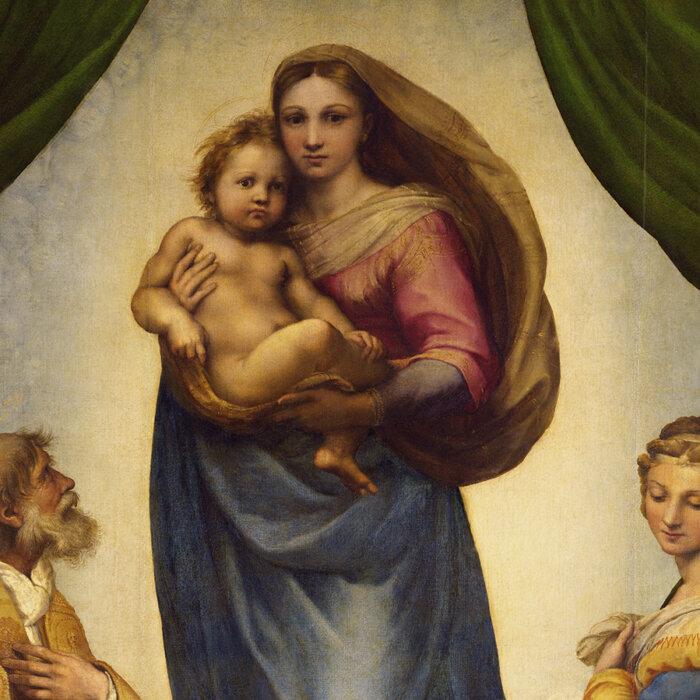

Adding to the narrative tension is the fact that both patron saints assigned to the commission were martyrs. Saint Sixtus II, at the left, looks up at Mary in urgency, with one hand reaching toward his heart and the other pointing in warning toward the crucifix. St. Barbara, at the right, sits in front of the tower in which she was locked away before her execution for converting to Christianity. Unlike Mary and Sixtus, her expression is calm, gazing down to the bottom of the painting at the last subjects—the two cherubs. They, in turn, look back up at Mary, unbothered by the dark fates surrounding the others.
Raphael’s triangulation of each character’s gaze redirects the viewer’s attention around the scene, creating a magnetic, hypnotic effect necessary to draw focus to the most subtle and powerful detail of his vision. The clouds that surround the figures are not composed of billowing vapor but of hundreds of faint, angelic faces materializing to watch over Mary and the Christ Child.
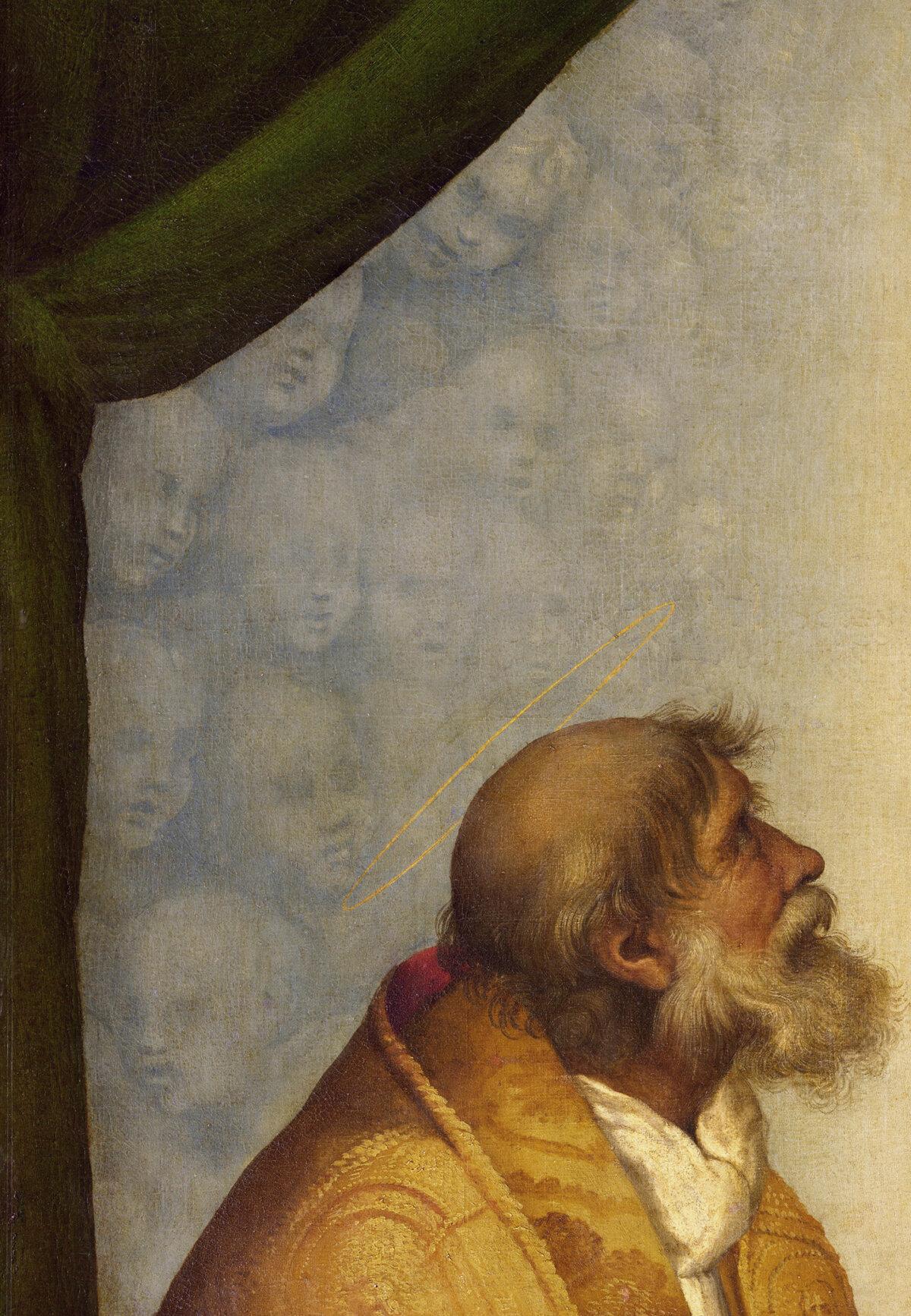
A detail of the cherub faces in the clouds from "Sistine Madonna," circa 1512–1513, by Raphael. Public Domain
Green curtains frame the scene, giving the viewers the impression of a stage or large window revealing the drama. And yet, every detail of this vision—containing so much foreshadowed tragedy—is bathed in soft, radiant light. By softening and balancing the darker subject matter, the cyclical and harmonious composition exemplifies Raphael’s articulation of the Neoplatonic ideal: All subjects originate from and return to a singular eternal source. It was his refinement in this lofty capacity that standardized his approach for later centuries and inspired both the Pre-Raphaelite and post-Raphaelite movements.
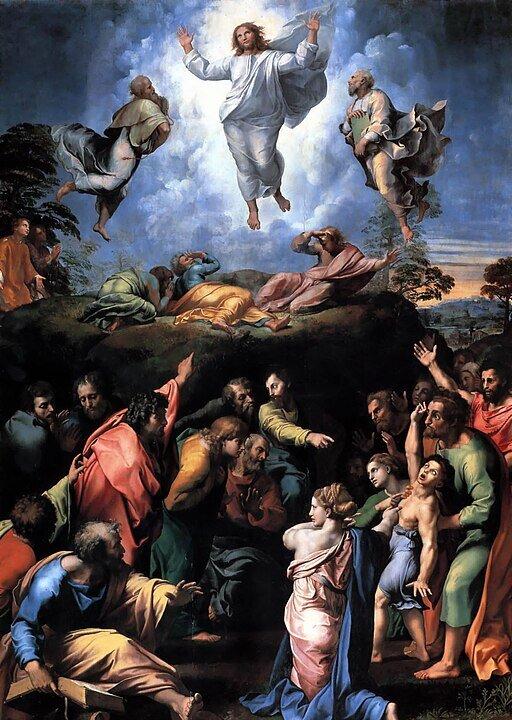
"Transfiguration," 1520, by Raphael. Oil on panel; 160 inches by 110 inches. Pinacoteca Vaticana. Public Domain
The Gifted Pupil
Raphael’s father recognized that his young son’s potential far exceeded his own but died long before he would see it blossom. After taking over his father’s studio at age 11, Raphael entered the workshop of Urbino’s renowned painter Pietro Perugino (1446–1523). During these years, Raphael’s progress was so rapid that their paintings became difficult to distinguish.The precise moment when the student surpassed his master is strikingly clear in their similar versions of “The Marriage of the Virgin” (1504). Raphael’s heightened sense of depth and narrative foreshadowed his trajectory away from the stiff, stoic images of the 15th century toward the more emotionally charged and dynamic trends underway in Florence. After seeing sketches by Leonardo da Vinci and Michelangelo, Raphael was determined to join their ranks.
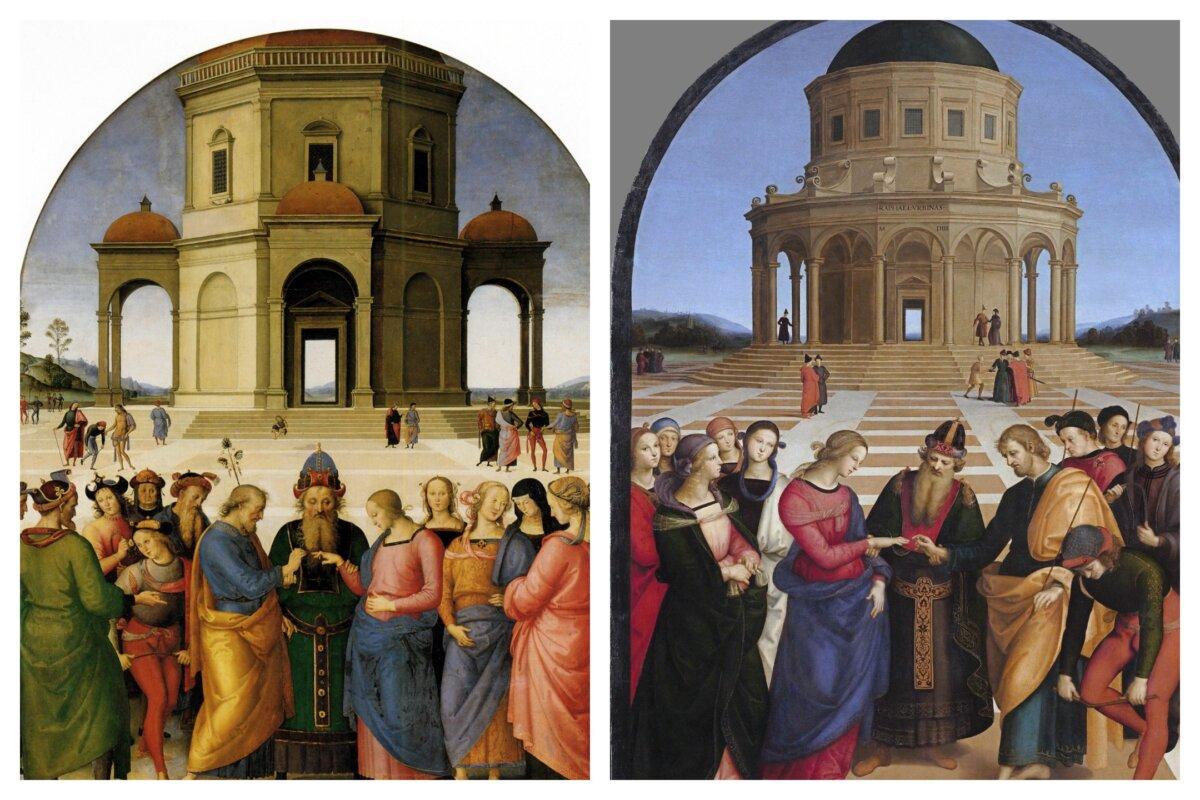
(Left) “The Marriage of the Virgin,” 1504, by Pietro Perugino. Oil on wood; 92 inches by 73 inches. Musée des Beaux-Arts de Caen, France. (Right) “The Marriage of the Virgin,” 1504, by Raphael. Oil on panel; 68 ¾ inches by 46 3/8 inches. Pinacoteca di Brera, Milan. Public Domain
Contemporary biographer Giorgio Vasari (1511–1574) stressed that these years in Florence transformed Raphael’s approach so profoundly that his earlier work seemed that of a different painter. In 1504, Raphael visited Leonardo’s studio and saw the “Mona Lisa,” which compelled him to emulate its softer lines and “sfumato” shading in place of Perugino’s two-dimensional aesthetic.
While working on the stanza frescoes in Rome, he snuck into the Sistine Chapel to see what Michelangelo had kept a guarded secret. According to Vasari, the imposing figures so inspired Raphael that he immediately scraped off and repainted his own “Isaiah” with a more muscular stature.
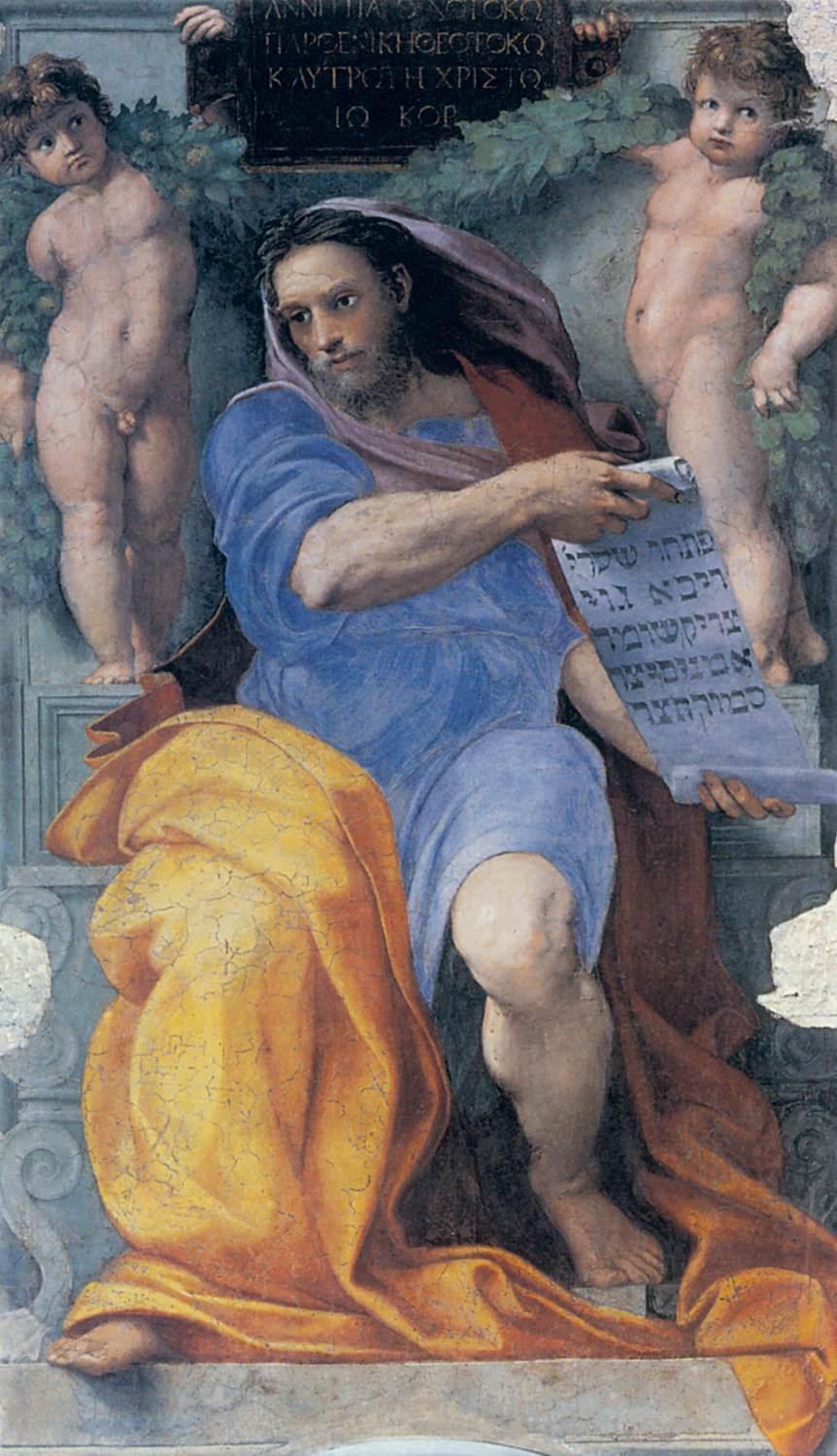
“Isaiah,” 1511–1512, by Raphael. Fresco at the Basilica of Saint Augustine of Hippo in the Campus Martius, Rome. Public Domain
A Forthright Madonna
Scanning through Raphael’s collection of Madonnas reveals a beautiful array of settings, poses, and colors, but all with similar calm and tranquil expressions. The “Sistine Madonna” is the first to look directly toward the viewer with her eyes fearful but her posture confident, as if bracing for the difficult path ahead. Viewed in the context of the church for which it was commissioned, she appears to look straight toward the crucifix atop the choir screen. Her baby’s eyes follow in the same direction, an eerie foreshadowing of his destiny to come.The “Sistine Madonna” was purchased in 1754 from the San Sisto Chapel by Augustus III, king of Poland and elector of Saxony, for the fantastic price of 25,000 scudi—an extraordinary sum worth an estimated $1.2 million to $1.5 million today. At that time, it was the highest price ever paid for a painting.
The work was hidden away during WWII for safekeeping from the Nazis, only to be stolen by the Soviets. It was returned to Dresden in 1955 to improve diplomatic relations, and it remains in the Gemäldegalerie Alte Meister. Legend says that when Augustus III brought it home, he moved his throne aside to place it prominently in the best light and proclaimed, “Make room for the great Raphael!”
What arts and culture topics would you like us to cover? Please email ideas or feedback to [email protected]