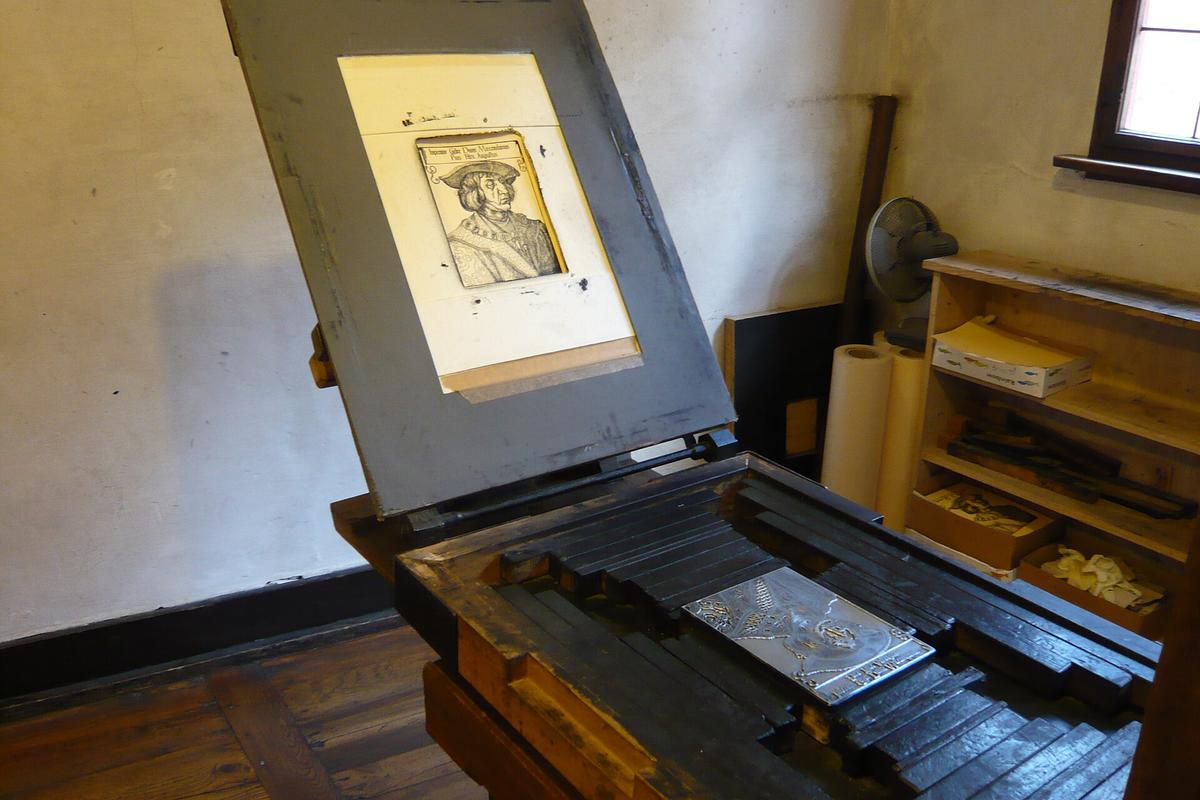
In Victor Hugo’s novel “The Hunchback of Notre Dame,” the archdeacon Frollo picks up a book from his desk, points out the window to the cathedral, and puts forth the proposition, “This will kill that.” He refers to the tremendous potential of the recently invented printing press to disseminate knowledge across cities and cultures with an impact that would overshadow the greatest architectural masterpieces.
Portrait of a Prodigy
At age 13, Dürer’s talent was already undeniable. As a goldsmith, his father had trained the boy in the typical practice of silverpoint drawing. Using the silver stylus on pigmented paper meant that the artist couldn’t erase or make corrections without marring the image. The medium required precision. By copying his reflection in a mirror, Dürer created what is still recognized as the youngest self-portrait to date. His inscription in the top right corner foreshadowed another legacy—his thorough documentation of his creative process and growth.
Trading Patronage for Plato
One of humanity’s longest-running, recurrent obsessions is the end of the world. As Europe approached the end of the 15th century, this hysteria was coupled with the threat of the Ottoman Empire’s potential invasion. Dürer’s creative instincts saw more opportunity than doom in the public’s fixation. He took full advantage of his talents and resources to design an intricately illustrated Book of Revelation (1498). The exposure and profits from this undertaking further shaped Dürer’s preference for prints over painting.Before Dürer, even the most celebrated artists were dependent on patrons for their livelihood. Although Leonardo da Vinci, Michelangelo, and Raphael had to compete for commissions in Florence, Italy, and in Rome, Dürer often declined commissions for large-scale paintings. The profits couldn’t compete with what he earned by selling prints. His wife and family helped by traveling to sell his prints, which secured his creative and financial independence to explore the subjects he found most compelling.
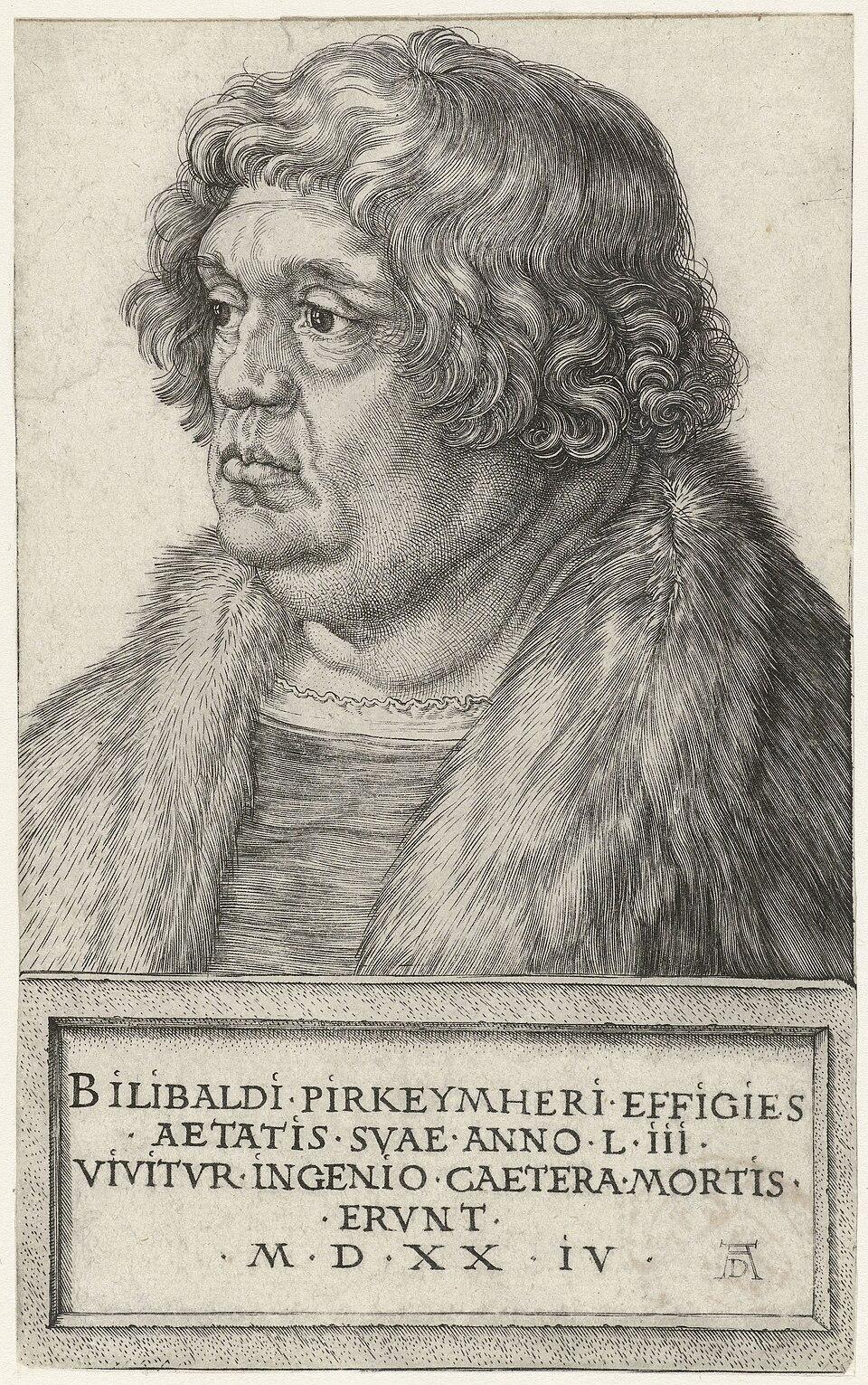
By this time, Dürer had traveled to Italy and brought back not only new developments in drawing and painting techniques, but also the writings of Plato and Vitruvius. His intellectual appetite was fed by the growing humanist movement in Nuremberg and the library of his close friend, the scholar and translator Willibald Pirckheimer. With an abundance of Greek, Latin, and Hebrew texts available to him, Dürer was inspired to share these rediscovered intellects beyond Italy and across Northern Europe by synthesizing their teachings into his prints.
Enigmatic Melancholy
Among his later works may be the most intensely studied, debated, and reinterpreted print in art history. For more than 500 years, “Melencolia I” (1514) has evaded a consensus about the true identity of its angelic subject, the meaning of its title, and the connection between its various symbolic images. Some claim that the angel is a female representation of melancholy, beauty, or geometry. Some have suggested that it’s Dürer himself, as he frequently painted himself as both primary and background subjects.
Another interpretation is that the figure is the archangel Metatron, based on Dürer’s known study of Christian Kabbalah. Where interpretations converge is in the understanding that the image presents a state of meditation or exploration of the various disciplines and philosophies to which Dürer was so devoted.

The “I” or “1” in the title is often ascribed to Dürer’s contemporary, Heinrich Cornelius Agrippa (1486–1535), who described the three states of melancholy in his work “De Occulta Philosophia.” He defined the first state of melancholy as belonging to the creative mindset of poets and artists. The angel sits in deep contemplation with a crucible for alchemy and various woodworking tools scattered over the floor. These tools for shaping the physical, visible world are placed at the angel’s feet.
Above the angel’s head are tools for understanding the more abstract, invisible aspects of the world: a bell, an hourglass, a scale, and a magic square—a mathematical puzzle in which each row of numbers in any direction have the same total. Dürer’s elevation of mathematics is also evident in the curious eight-sided shape to the angel’s left.
Although its shape may seem random, it has impressed artists and mathematicians enough to be classified 500 years later as “Dürer’s Solid.” The precision behind its construction is perhaps the best evidence of every detail in the scene being not at all random, but conceived and executed with such genius that it remains daunting to fully calculate.
The one clear symbol is tucked away in the bottom right corner just below the angel’s robe. It is Dürer’s monogram, and it remains as significant a contribution to art history as any of his masterpieces. He wasn’t the first artist to use a monogram as a symbol of authenticity for his works, but the degree to which he used it throughout his printmaking paved the way for modern trademark law. His success and reputation were such that twice he was forced to sue other artists for plagiarizing his work. His innovation embraced not only new technologies and new intellectual philosophies, but also practical legal strategies for protecting his legacy.
Esoteric Yet Universal
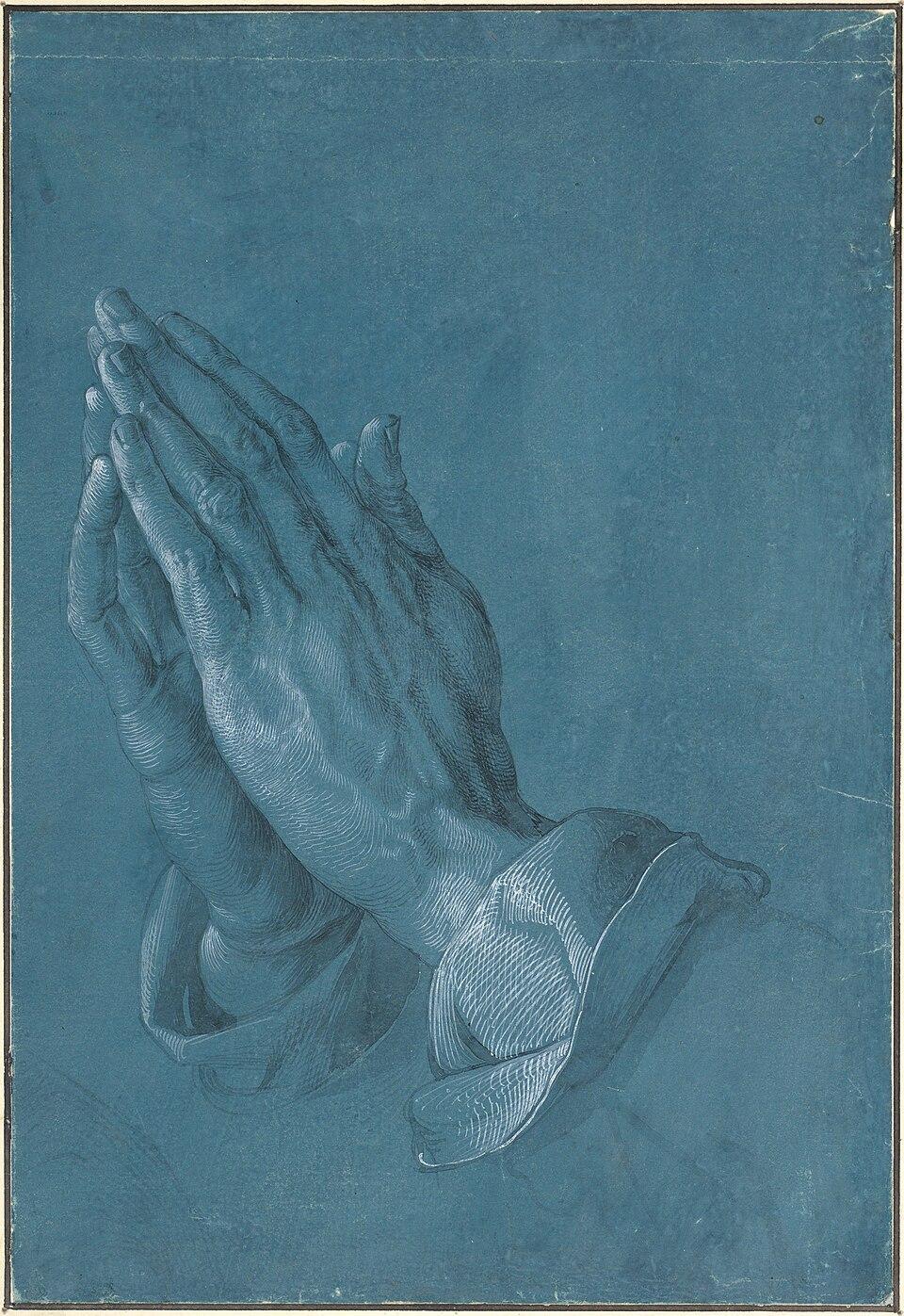
Despite Dürer’s seemingly otherworldly genius, one of his works has been reproduced most ubiquitously. It remains his most simply inspiring creation—his “Praying Hands” (1508). A dubious but nonetheless beloved origin story behind the iconic drawing claims that Dürer and his younger brother Albert both wished to pursue careers in the arts but knew that their father couldn’t afford the schooling for them both. They made a pact: They flipped a coin and the winner would begin his studies while the other worked in the mines to help cover the costs. After four years they would trade places.Dürer won the coin toss, went to school, and triumphantly returned home four years later. He kept his word and offered to take his brother’s place in the mines. His brother then revealed that his hands had been so badly worn and damaged by the physical labor that he couldn’t possibly hope to draw or paint with the dexterity needed for the arts. In tears, he insisted that Dürer pursue a career in the arts for the both of them. Dürer awoke later that night to see his brother bowed in prayer with his worn hands gently pressed together.
After his untimely death from malaria in 1528, Dürer was elevated to almost mythical status for the conviction with which he led Northern Europe into its Renaissance. How his creative genius and the printing press expounded one another’s influence remains one of history’s most inspired unions. Centuries later, Nuremberg and the St. Johannis Cemetery were nearly destroyed during World War II, yet Dürer’s grave survived and saw the city rebuilt to its former glory.