This copy is for your personal, non-commercial use only. Distribution and use of this material are governed by our Subscriber Agreement and by copyright law. For non-personal use or to order multiple copies, please contact The Epoch Times Reprints.
A print of “The Birth of Old Glory,” 1917, after a painting by Edward Percy Moran. Betsy Ross, who is credited with sewing the first United States flag, is depicted showing the flag to George Washington. Library of Congress. Public Domain
On June 14, 1777, the Continental Congress declared “that the Flag of the thirteen United States be thirteen stripes, alternate red and white; that the Union be thirteen stars, white on a blue field, representing a new constellation.” Influenced by the growing number of celebrations of that date around the country, in 1916 President Woodrow Wilson proclaimed June 14 a national Flag Day.
The real credit for Flag Day, however, goes to a Waubeka, Wisconsin, schoolteacher—Bernard J. Cigrand. Calling June 14 the “flag’s birthday,” in 1885 the 18-year-old Cigrand asked his students at the Stony Hill School to write an essay on what the flag meant to them. From that point on, Cigrand gave more than 2,100 talks to audiences about the flag, its importance, and the need to make June 14 its special day of honor.
Schoolteacher Bernard J. Cigrand. Public Domain
In many ways, of course, every day in the United States is Flag Day. Plenty of government agencies, schools, businesses, and homes sport flags year-round. Pickups zip down the highway with flags waving from the truck’s bed, and some towns and car dealerships fly flags large enough to blanket a football field. Americans wear flag lapel pins on their shirts and blouses, send letters through the mail with flag stamps, and wave miniature flags at international sporting events. U.S. Embassy flags dot the globe, and even on the moon there are the remains of six American flags. The Flag Manufacturers Association of America reports sales of more than 150 million flags annually.
This American fascination with the flag has long influenced our arts and broader culture as well.
Songs
Given that our national anthem, “The Star-Spangled Banner,” is centered on our flag, it’s hardly surprising that our musical heritage is rich with songs about Old Glory.
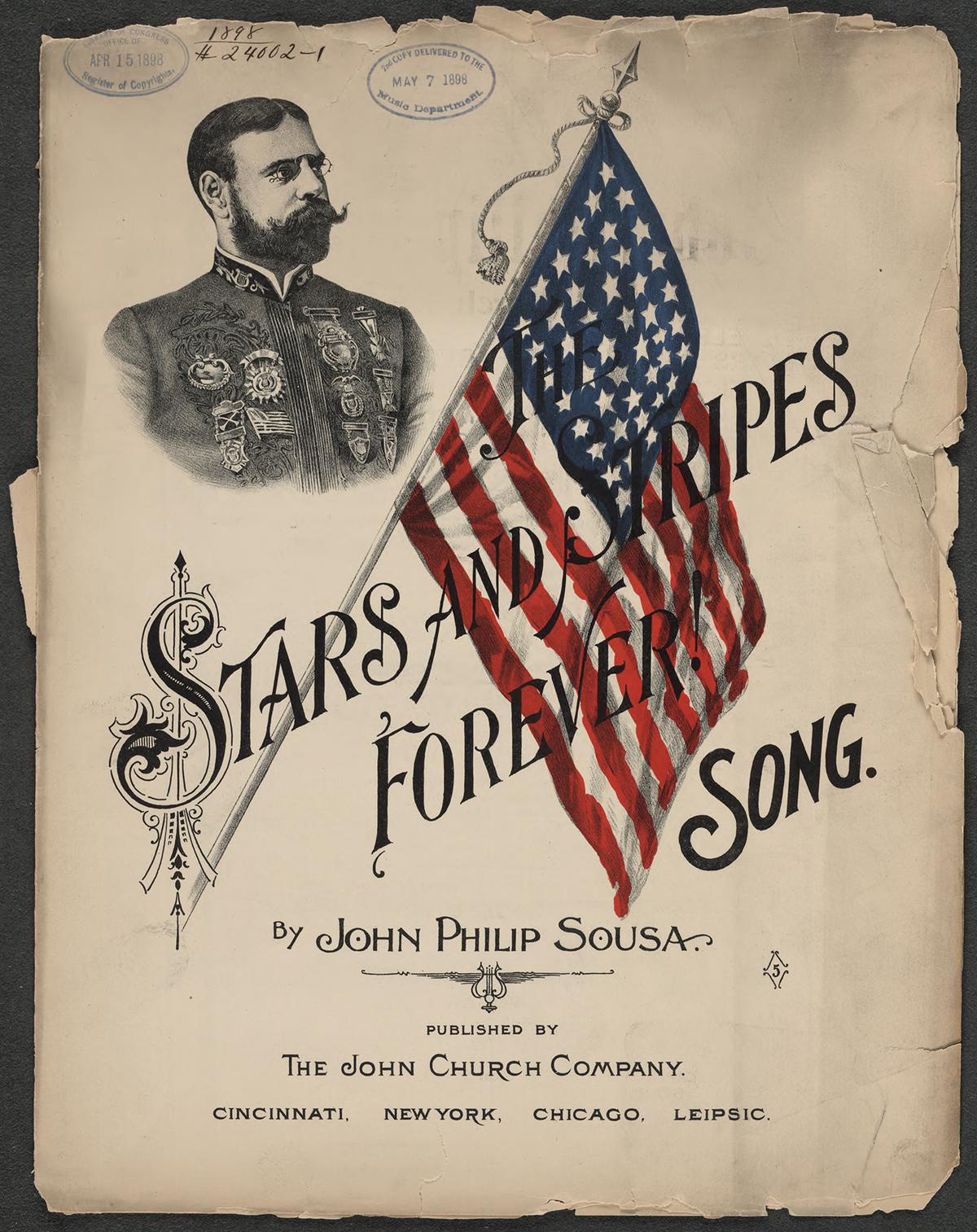
In 1896, for instance, America’s premier bandmaster and composer of the time, John Philip Sousa, received word in Europe that his good friend and business associate, David Blakely, had died. As he crossed the Atlantic to resume his place as head of the band that he and Blakely had founded, the grieving Sousa mentally composed a piece in honor of his friend, then formally drew up the sheet music on his arrival. “Stars and Stripes Forever” proved extremely popular, and more so once Sousa added lyrics centered on the flag’s place in America’s story.
Cover for “The Stars and Stripes Forever!" song sheet music by John Philip Sousa, 1898. Library of Congress. Public Domain
More than 90 years later, Sousa’s piece was proclaimed the “official National March of the United States of America.”
Early 20th-century musicians composed a cornucopia of songs about the flag. One of the most popular of these was George M. Cohan’s 1906 hit, “You’re a Grand Old Flag.” Part of the Broadway show “George Washington Jr.,” it was the first song from a musical to sell over a million copies in sheet music, and it remains a part of our patriotic songbag today.
The first page of the sheet music for "You're a Grand Old Flag." Library of Congress. Public Domain
Country songwriters have frequently placed the flag front and center in their music. Johnny Cash’s “Ragged Old Flag” features a journey through American history and its wars via the flag, then notes:
And she’s getting threadbare and wearing thinBut she’s in good shape for the shape she’s in‘Cause she’s been through the fire beforeAnd I believe she can take a whole lot more
Cover of Johnny Cash’s 1974 album “Ragged Old Flag.” Internet Archive. Public Domain
Singer-songwriters like Charlie Daniels, Toby Keith, and Brad Paisley all wrote and performed hit songs as well about Old Glory.
Poems
Having served as a volunteer nurse in Washington for part of the Civil War, Walt Whitman was profoundly affected by the casualties who passed through the hospital wards. He was also a strong advocate for the Union, and some of his poems written at the time and afterward used the flag as a vehicle for his emotions and patriotism. The best-known of these is his 1867 “Thick-Sprinkled Bunting” in which he tells of a time when the American flag will become the “flag of man”:
Thick-sprinkled bunting! Flag of stars!
Long yet your road, fateful flag!—long yet your road, and lined with bloody death!
For the prize I see at issue, at last is the world!
All its ships and shores I see, interwoven with your threads, greedy banner!
—Dream‘d again the flags of kings, highest borne, to flaunt unrival‘d?
O hasten, flag of man! O with sure and steady step, passing highest flags of kings,
Walk supreme to the heavens, mighty symbol—run up above them all,
Flag of stars! thick-sprinkled bunting!
Regarding its take on global affairs, “Thick-Sprinkled Bunting” is even more applicable to the years since World War II than it was to the post-Civil War era.
Another familiar poem from the Civil War that featured the flag is John Greenleaf Whittier’s “Barbara Frietchie.” Set in September 1862, the poem begins with Confederate troops marching through Frederick, Maryland, before engaging in battle with Union forces at Antietam. When they try to shoot down a flag hanging from a window, the elderly Frietchie waves the flag at them and famously says: “‘Shoot, if you must, this old gray head/ But spare your country’s flag,’ she said.”
Barbara Frietchie waves the flag in an 1867 engraving. Public Domain
Later, after Frietchie dies of old age, the poet notes: “Over Barbara Frietchie’s grave/ Flag of Freedom and Union, wave!”
Men, women, and children of our present century continue to compose verse about the American flag. On the website “Betsy Ross and the American Flag,” along with its helpful history, rules and facts about the flag, and games for children are several dozen poems written by men, women, and children paying honor to the Stars and Stripes. Here, once again, is evidence of the love felt by Americans for their flag.
The Making of ‘Old Glory’
A print of Betsy Ross sewing the American flag, circa 1908, after a painting by G. Liebscher. Library of Congress. Public Domain
Snapshots of this love affair are many and varied. There are the images of Betsy Ross and the iconic WWII photo of the Marines raising the flag on Iwo Jima and the bronze monument in Arlington, Virginia, that memorializes that historic moment. There are many children’s books about the Stars and Stripes. Spectators stand and face the flag at the playing of the national anthem before many sporting events. And there’s the young Michigan woman who spent untold hours making a replica of the flag from pennies.
One man who belongs in this company and who surely would stand shoulder-to-shoulder with Bernard Cigrand as an ardent promoter of the flag was William Driver of Salem, Massachusetts.
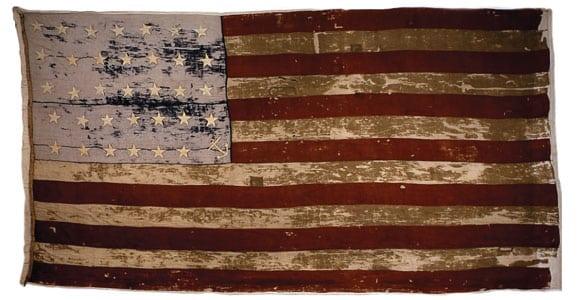
A sailor since his early teen years, at age 21 Driver assumed command of the Charles Doggett. Before he weighed anchor in 1824, his mother and some friends presented him with a large, handsewn American flag with 24 stars. Driver called the flag “Old Glory,” the first American known to do so, and set out to sea.
Captain William Driver’s 1824 “Old Glory” flag that accompanied him on his numerous voyages around the world. Public Domain
Over the next 13 years, Driver sailed to China, India, islands in the South Pacific, and other faraway places. Always, Old Glory accompanied him on these long and often dangerous voyages. When his wife died from cancer in 1837, Driver took his three children and moved to Nashville, Tennessee, where he continued to display the flag with its additional stars.
During the Civil War when Confederates demanded that Driver hand over his precious banner—which he had by then hidden—the story has it that he replied, “If you want my flag, you’ll have to take it over my dead body.” He kept his flag and his life. And when Union forces seized control of the city, Driver had the thrill of seeing “Old Glory” run up the pole at the Capitol building.
Songbook cover “America and Old Glory” with patriotic songs written by William H. Barnes and composed by Henry S. Sawyer, 1898. New York Public Library. Public Domain
In 1873, Driver bequeathed this personal treasure to his daughter, Mary Jane Roland, saying: “This is my old ship flag Old Glory. I love it as a mother loves her child; take it and cherish it as I have always cherished it; for it has been my steadfast friend and protector in all parts of the world—savage, heathen, and civilized.”
Today, Driver’s Old Glory makes its home in the Smithsonian.
The Emblem of the Land We Love
The iconic photograph “Raising the Flag on Iwo Jima” by Joe Rosenthal of the Associated Press on Feb. 23, 1945. Public Domain
All of these people and millions more have looked at the Stars and Stripes, and seen a country with all its promises and dreams.
And that flag still moves hearts today. On the blog Seasoned Spouse, Lizann Lightfoot, wife to a Marine, tells of living on a base in Spain where the American flag was permitted to fly only on Independence Day. The family did hang the flag from a wall in their living room. Of a visit to the American Embassy in Madrid, Lightfoot writes: “I will never forget the thrill of excitement when we walked down the street to the American Embassy consulate and saw 3 American flags hanging overhead! I didn’t even realize how much I had missed the American flag. Even our young children were excited to see ‘a real flag of America.’ There it was, a symbol of freedom, strength, and … home.”
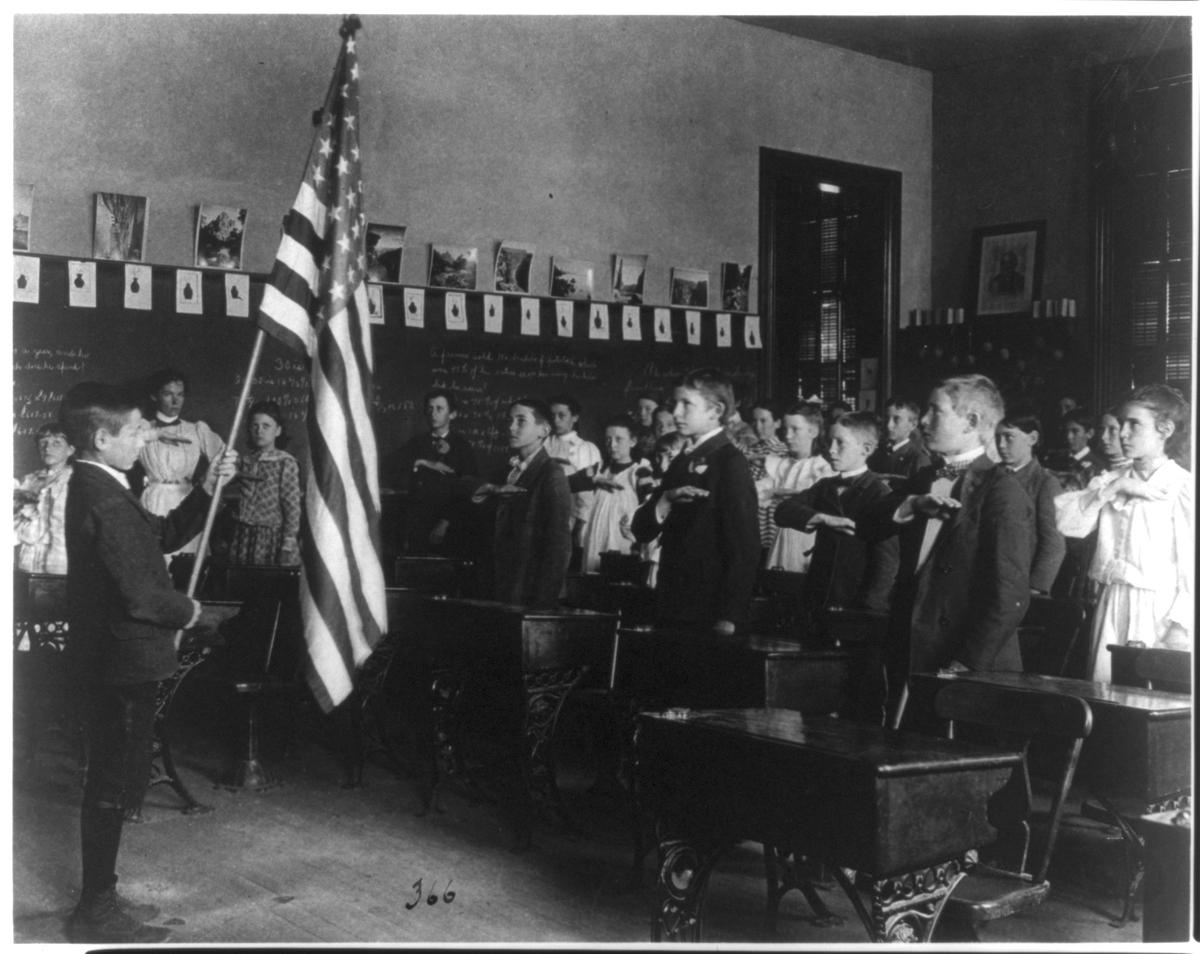
Students recite the Pledge of Allegiance in 1899. Public domain
This is why schoolchildren are taught to recite: “I pledge allegiance to the Flag of the United States of America and to the Republic for which it stands, one nation under God, indivisible, with liberty and justice for all.” The flag in that pledge symbolizes our republic, our liberties, and our past, present, and future.
Just as importantly for all Americans, that flag means home.
What arts and culture topics would you like us to cover? Please email ideas or feedback to [email protected]
Jeff Minick has four children and a passel of grandkids. He has written two novels, “Amanda Bell” and “Dust on Their Wings,” as well as “Learning as I Go” and “Movies Make the Man.” You’ll find more of his writing at JeffMinick.substack.com.