In our new series, “The Art of Virtue,” we use traditional art to introduce each of the four Cardinal Virtues of prudence, justice, fortitude, and temperance; and the three theological virtues of faith, hope, and charity. We hope that the visual guidance in these historic artworks will nourish our innate goodness today.
Since time immemorial, great world leaders and religious, philosophical, and literary figures have guided us to live a virtuous life. The works of artists and architects alike are moral guides using a centuries-old visual language of motifs. These works can help us be the best versions of ourselves.
The word “virtue” was first used around the 12th century. According to the Online Etymology Dictionary, “virtue” originates from “vertu,” which is an Anglo-French and Old French word meaning a “moral life and conduct … a particular moral excellence.” Some two centuries later, in the early 14th century, the term “Cardinal Virtues” was introduced to classify the four classical virtues—prudence, justice, fortitude, and temperance. The Latin root of the word “cardinal” is “cardo,” which means “pivotal” or “that on which something turns or depends.” Moral life and conduct therefore depend on the Cardinal Virtues, sometimes referred to as natural virtues.
Prudence
The virtue of prudence is included in the Declaration of Independence:“Prudence, indeed, will dictate that governments long established should not be changed for light and transient causes; and, accordingly, all experience has shown, that mankind are more disposed to suffer, while evils are sufferable, than to right themselves by abolishing the forms to which they are accustomed.”
Simply put: Prudence is the ability to discern good from evil and take the right course of action. According to the Bill of Rights Institute, “prudent leaders are guided by principles to help them make practical decisions in difficult circumstances about what is wise and for the common good.”

”Allegory of Prudence,” 1645, by Simon Vouet. Oil on canvas; 45 7/8 inches by 35 5/8 inches. Fabre Museum, Montpellier, France. Artists often depicted the four Cardinal Virtues of allegorically as Prudence, Justice, Fortitude, and Temperance to inspire viewers. Public Domain
Exercising prudence comes with life experience and practice, and it walks hand in hand with other virtues. Proverbs 8:12–14 states: “I Wisdom dwell with prudence.” Anglo-Irish poet John Denham (1615–1669) wrote in “Of Prudence”:
Wisdom’s first progress is to take a view What’s decent or indecent, false or true. He’s truly prudent who can separate Honest from vile, and still adhere to that.
Sculpting Prudence
Florentine ceramicist Andrea della Robbia (1435–1525) created a circular glazed terracotta tondo of Prudence, around 1475. Since ancient times, the circle has symbolized eternity; and this circular composition, called a tondo, was popular in Renaissance Florence. Della Robbia’s tondo belonged to a decorative scheme of the four virtues, which included Faith, Justice, and Temperance.Every element della Robbia molded into the terracotta virtue is instructive. He rendered Prudence as a young woman gazing into a handheld mirror, with a snake moving up her body to gaze at itself. She is Janus-faced; that is, a head with two faces—one facing forward and the other looking back. “Janus-faced” can also mean two polar-opposite character traits. On the back of her head is the face of an old man. The youthful face of Prudence represents the present, and the old man’s face indicates the knowledge and life experience that has led to her wisdom.

Prudence, circa 1475, by Andrea della Robbia. Glazed terracotta; 64 3/4 inches. Joseph Pulitzer Bequest, 1921; Metropolitan Museum of Art, New York. Public Domain
Prudence asks us to unconditionally look within to truly know ourselves, and the mirror that she holds symbolizes this self-reflection. The snake represents the wisdom needed to be prudent, and take the right action. The snake motif alludes to the biblical expression “be ye therefore wise as serpents” (Matthew 10:16).
Della Robbia even wove meaningful motifs throughout the garland framing Prudence; many of his works include such garlands. According to London’s Victoria & Albert Museum, the lemons represent salvation, the grapes and cucumbers represent the resurrection, and the quinces and pine cones symbolize virtue and immortality.
The meaning of these motifs can be traced back through the centuries. For example, Pliny (around A.D. 24–A.D. 59) admired the quince tree’s ability to grow from cuttings, so the quince alludes to immortality. Bunches of grapes symbolize the wine Jesus served at the Last Supper. And, the lemon tree flourishes in full sunlight. That, along with the fruit’s healing nature—particularly its traditional use as an antidote for poison—led to the lemon’s being the motif of salvation.
The style of della Robbia’s Prudence echoes that of the same Cardinal Virtue that his uncle, Luca della Robbia (around 1400 to 1482), created around 1461 for the ceiling of the Cardinal of Portugal Chapel in St. Minias on the Mountain, in Florence, Italy. Luca’s Prudence has the same classical motifs as Andrea’s but with the addition of angel wings. Luca’s Prudence sways in a pool of water, whereas Andrea’s Prudence appears static in the waters. The water could symbolize purity, cleansing, and also self-reflection due to its ability to reflect images like Prudence’s mirror in both works.

Prudence, circa 1461–1462, by Luca della Robbia. Cardinal of Portugal Chapel in St. Minias on the Mountain, Florence, Italy. Original photo by Zairon, cropped by The Epoch Times/CC BY 4.0 International Deed

The ceiling of the Cardinal of Portugal Chapel in St. Minias on the Mountain, Florence, Italy. Luca della Robbia created the tondo sculpture of Prudence (L). Zairon/CC BY 4.0 International Deed
Weaving Prudence
A splendiferous allegory of Prudence hangs in Spain’s Tapestry Museum, at the Royal Palace of La Granja of San Ildefonso. It’s part of “The Honors” tapestry series that features nine allegorical panels—“Fortune,” “Prudence,” “Wisdom,” “Justice,” “Vice,” “Fame,” “Honor,” “Faith,” and “Nobility.” Together, they illustrate the noble character required to rule and moral teachings that include the perils of vice. Preeminent Flemish artist Pieter Coecke van Aelst (1502–1550) created the panels for the coronation of Charles V as the emperor of the Holy Roman Empire in 1520.Coecke van Aelst’s monumental series use both classical and religious motifs and figures to demonstrate good conduct and character.
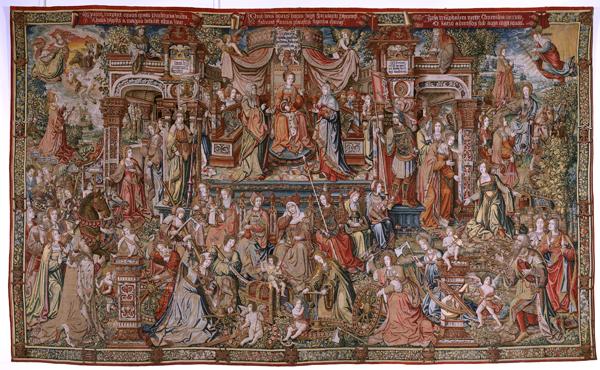
“The Honors: Prudence,” circa 1550, by Pieter van Aelst, probably after the circle of Bernard van Orley and Jan Gossaert. Tapestry of gold, silver, silk, and wool; 193 inches by 322 7/8 inches. Tapestry Museum, Royal Palace of La Granja de San Ildefonso, Spain. Paul M.R. Maeyaert/CC BY-SA 4.0
Coecke van Aelst steeped the detailed panels in meaning. The Prudence allegorical tapestry scene is set in a theater. An enthroned Prudence takes center stage. A snake wraps itself around her hand, symbolizing the wisdom that Prudence needs to debate with Faith and Reason, who flank her. The snake motif again alludes to “be ye therefore wise as serpents,” just like della Robbia’s Prudence. Reason holds a trio of mirrors representing memory (past), intelligence (present), and providence (future)—three virtues of Prudence. An inscription on the canopy above her throne reinforces the motifs’ meanings and summarizes the characteristics of Prudence: “Preterita recolo presentia ordino futura prevideo” (“I gather up the past, I arrange the present, I foresee the future”).

A detail of “The Honors: Prudence,” circa 1550, by Pieter van Aelst, probably after the circle of Bernard van Orley and Jan Gossaert. This detail shows Prudence enthroned and flanked by Faith and Reason. Tapestry of gold, silver, silk, and wool. Tapestry Museum, Royal Palace of La Granja de San Ildefonso, Spain. Paul M.R. Maeyaert/CC BY-SA 4.0
Prudence embodies many virtues, including intelligence, caution, circumspection, intellect, providence, docility, and memory. These seven stand as finely dressed personifications at the foot of the stage. Each carries objects relating to their identity. For instance, Caution holds a convex mirror reflecting an image of a fox and a monk’s cloak, perhaps symbolizing the popular medieval morality tales of Reynard the Fox. The stories often show the fox tricking other animals.
Painting Prudence
Around 1550, Titian (about 1488–1576) painted a puzzling allegory of Prudence. He chose different motifs from the earlier works described.Titian painted three male portrait busts on canvas. A bearded adult in the center is flanked by an old bearded man and a fresh-faced youth; both gaze out past the edges of the painting. Below these men, he repeated the composition but depicted three animal heads: a wolf, a lion, and a dog. A Latin inscription above the three men translates to “Learning from Yesterday, Today acts prudently, lest by his action he spoil Tomorrow.”

“An Allegory of Prudence,” circa 1550, by Titian. Oil on canvas; 29 3/4 inches by 27 inches. National Gallery, London. Public Domain
The three men relate to the Ages of Man: youth, adulthood, and old age. And these, in turn, also relate to Yesterday (youth), Today (adulthood), and Tomorrow (old age) in the painting’s inscription.
Titian may have been aware of historic representations of Prudence, such as a small mid-14th-century marble bust featuring a trio of faces on one head. According to the Metropolitan Museum of Art in New York City, it’s a rare “Vultus Trifrons“ or ”An Allegory of Prudence.” Catholic artists in the 15th and 17th centuries sculpted the “Vultus Trifrons” to symbolize the Holy Trinity. Student Zoe Goedecke wrote in her senior capstone essay for Portland State University: “Criticism against the tricephalic depictions began in the fifteenth century, which includes St. Antoninus of Florence’s ‘Summa Theologica,’ where he writes, ‘Painters ... are blameworthy when they paint things which are against the faith, when they make an image of the Trinity one person with three heads, which is monstrous in the nature of things.’”
These tricephalic works were denounced and most were destroyed, first after the Council of Trent (1545–1563) and later by Pope Urban VIII in 1628.

"Vultus Trifrons" or an "Allegory of Prudence," circa 1340–1355, by Pacio Bertini da Firenze and Giovanni Bertini da Firenze or another follower of Tino da Camaino. Carrara marble; 8 7/8 inches by 4 15/16 inches. Robert Lehman Collection, 1975; Metropolitan Museum of Art, New York City. Public Domain
As an allegory, the sculpted faces reflect the three dispositions of Prudence—memory, intelligence, and providence, which again refer to the past, present, and future, respectively. They also relate to the Ages of Man (a common theme at the time), and the rites of passage through youth, adulthood, and old age. “The merging of the notions of virtue and the human life cycle coincided with a more nuanced understanding of human nature as well as a focus on the individual,” The Met website states.
Experts believe that Titian’s three-headed wolf-lion-dog creature is mentioned in fellow Venetian Giovanni Pierio Valeriano’s 1556 book “Hieroglyphica.” The creature can be traced back to a Hellenistic Egyptian temple statue of Serapis. According to London’s National Gallery, it’s the “embodiment of Time: the voracious wolf representing the past which devours the memory of all things, the vigorous lion representing the present, the dog representing the future, bounding forward, ever full of deceitful hope.”
Titian’s painting shows that wisdom today (represented in adulthood and the lion) comes only from the knowledge and experience gained in the past (the youth and wolf), and with such wisdom there’s foresight, which is pictured (as old age and a dog). Wisdom and foresight make prudent action possible.
All these artworks about prudence emphasize self-reflection, using our past experiences and knowledge to evaluate any given situation with wisdom before taking the right course of action. That action may be a hard path to take, but the prudent person understands that it is wisdom applied with faith and reason that guides the most righteous of actions.
The Bible quotations are from the King James version.
In the next installment of “The Art of Virtue,” we explore the art of the Cardinal Virtue of justice.
What arts and culture topics would you like us to cover? Please email ideas or feedback to [email protected]