This copy is for your personal, non-commercial use only. Distribution and use of this material are governed by our Subscriber Agreement and by copyright law. For non-personal use or to order multiple copies, please contact The Epoch Times Reprints.
Prince’s Palace of Monaco: Juxtaposition of Medieval and Classical Styles
In this installment of ‘Larger Than Life: Architecture Through the Ages,’ we visit an immense fortress-like royal residence with distinct design details.
The watch towers and keeps of the original Monaco fortress loom large against a backdrop of rock. The castle's narrow and tall loop, or arched, windows denote medieval origins and contrast with the later 16th-century Italian Renaissance designs. These additions are indicated by the more symmetrical palace sections that feature lengthy "arcades," or contiguous arched exterior passageways. Atop the arcade is a second-floor veranda supported by multiple columns. Phillip Minnis/Shutterstock
What is now referred to as the Prince’s Palace of Monaco began as a characteristic medieval fortification perched conspicuously on the Rocher de Monaco, or Rock of Monaco, overlooking the Mediterranean Sea. From 1191 to the 1500s, the structure’s architecture was indicative of a castle design, with battlements sporting machicolation openings between supporting corbels, watchtowers, keeps, and arched or slit windows.
However, when the sovereign city-state in Western Europe determined that the fortress needed to become the sumptuous royal residence, a section was transformed. It was architecturally renovated to reflect primarily Italian Renaissance style, which is based on classical Roman design elements. Highly embellished baroque influences were added as well.
The evolution of architectural styles can be seen in the comparison between the original medieval fortress structure, which lacks balance, and the symmetrical design of the palace. A convoluted and tumultuous history spanning almost 1,000 years has resulted in many architectural and design alterations to this impressive structure, making it worth studying.
Italian Renaissance architectural elements are presented in the main entryway gate and façade that face the palace’s grand square. A series of classically proportioned, arched windows rest on balustrades that are topped with pediments and flanked by decorative columns. The baroque main gateway—the entryway's pièce de résistance—features a massive arch with distinct columns and an elaborate broken pediment that incorporates sculptures, a keystone, and heraldic coat of arms. Felix Lipov/Shutterstock
Adorned in regal red, the centerpiece of the palace's throne room is—of course—a throne. Made of sculpted and gilded wood, the throne area is also covered in a red silk canopy that has been embroidered with gold thread and topped with a gilded crown. Above the chair is the sovereign family’s coat of arms. On this ceremonial room’s ceiling and the arched, vaulted spaces around the ceiling are also enormous and elaborately detailed 16th-century frescoes portraying events in Homer’s “Odyssey.” Felix Lipov/Shutterstock
Referred to as the Galerie d'Hercule (Gallery of Hercules), this extensive, vaulted-ceiling arcade showcases 16th-century frescoes. They meticulously depict scenes from Hercules’s “labors,” or the tasks he had to complete. The covered arched arcade, also called a loggia, provides protected walkways to the palace’s staterooms. Marble columns sit atop a railing of marble balustrades. An intricately tiled, richly hued floor with a repeating pattern coordinates with the frescoes. Andrei Antipov/Shutterstock
Each of the multiple state apartments in the palace is named. This one, the Green Antechamber, like many of the state apartments, is used for receptions and ceremonies. A 17th-century Monaco royal, Honoré II, brought an abundance of art into the palace to add color and interest to the building's interior. Today, some of the paintings displayed on the Green Antechamber's blue-green walls are by artists Jacopo Bassano, Orazio de Ferrari, and Philippe de Champaigne. Black furnishings, tapestry upholstery, and a black-and-white checkerboard floor further enhance the décor. Monegasque/Shutterstock
Court officials greet guests in the Officer's Room before they meet the Prince of Monaco. Against a backdrop of patterned wallpaper are paintings in gilded frames showcasing city and port scenes. The room’s tray, or recessed, ceiling is decorated with a floral pattern and trimmed in molding with a gilded rope design. The paneled chair railing that encircles the room is also trimmed in a gilded paint. The marble fireplace, flooring hues, and design scheme harmonize with the room’s walls and ceiling. Felix Lipov/Shutterstock
In the palace’s main courtyard is the 17th-century Chapelle Saint-Jean-Baptiste de Monaco, or royal chapel. Its cupola and tower are tiled in deep red terracotta and topped with a silver cross. Kiev.Victor/Shutterstock
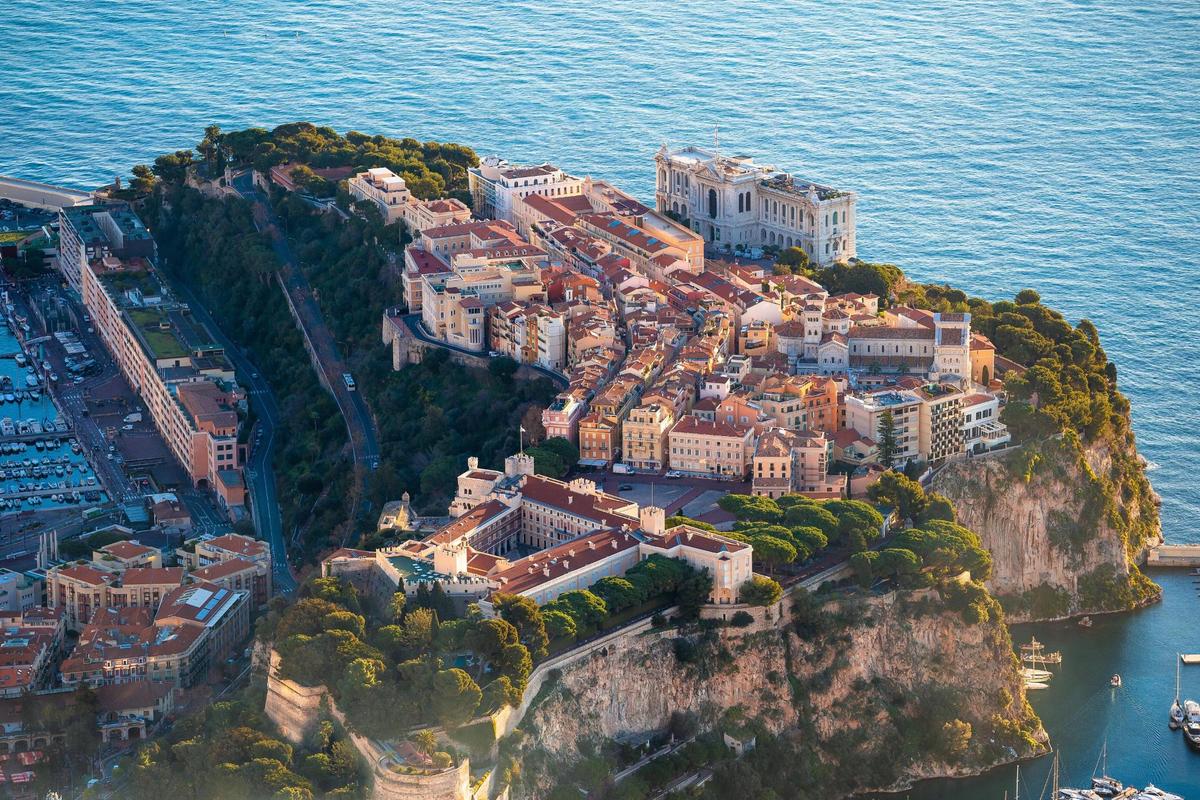
When one views it from the air, it's easy to understand why an imposing fortress was built on the high rocky cliff overlooking Monaco’s port and the Mediterranean Sea. Royal guards once scanned the waters looking for approaching enemies, but now the country’s royalty and guests enjoy vast views from the palace. xbrchx/Shutterstock
What arts and culture topics would you like us to cover? Please email ideas or feedback to [email protected]
A 30-plus-year writer-journalist, Deena C. Bouknight works from her Western North Carolina mountain cottage and has contributed articles on food culture, travel, people, and more to local, regional, national, and international publications. She has written three novels, including the only historical fiction about the East Coast’s worst earthquake. Her website is DeenaBouknightWriting.com