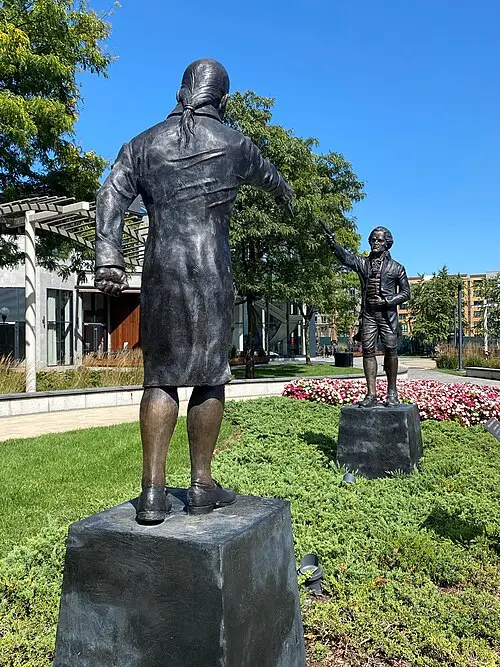
On Sept. 22, 1842, two men squared off to fight a duel on the Mississippi River’s Bloody Island. It wasn’t an island at all, but a large sandbar outside the laws of both Illinois and Missouri, and so a popular place for contests like this one.
The challenger was James Shields, the Illinois state auditor, whom the other principal in the duel had mocked in a local paper, the Sangamo Journal, under the pen name “Rebecca.” After deriding Shields’s decisions regarding the closure of a bank, “Rebecca” had added insult to injury by poking fun at his pursuit of women, writing:
“His very features, in the ecstatic agony of his soul, spoke audibly and distinctly—‘Dear girls, it is distressing, but I cannot marry you all. Too well I know how much you suffer; but do, do remember, it is not my fault that I am so handsome and so interesting.’”
Shields discovered the identity of “Rebecca” and challenged him to a contest on the field of honor. As was the custom, his opponent chose the weapons, which in this case were large cavalry broadswords. As Shields faced his opponent, the strong, lanky man who towered over him by eight inches or more, suddenly swiped at an overhanging tree branch, thereby demonstrating his reach and his strength. Wisely, the seconds intervened, convincing both men to call off what clearly was an unequal contest.
Missed Shots and Handshakes
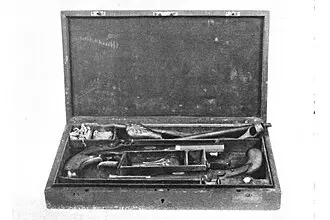
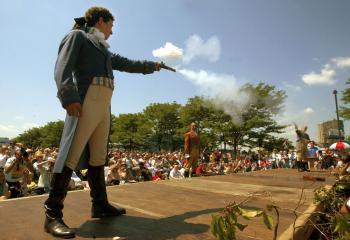
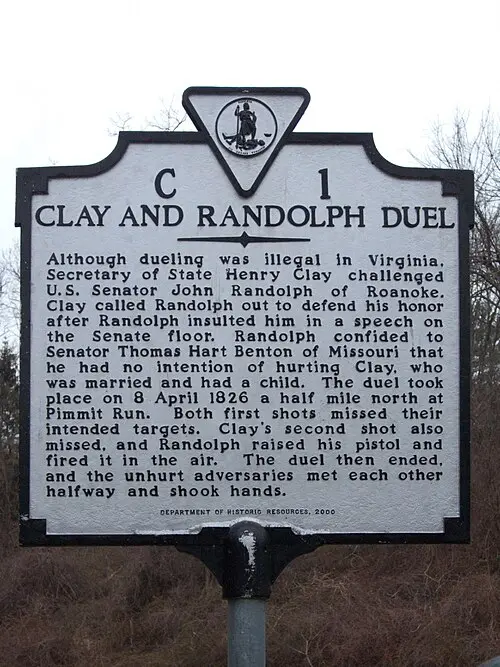
This Lincoln–Shields showdown is more typical than not of these combats of personal honor in 18th- and 19th-century America. First, both men walked away from the contest alive and unharmed. In an American Heritage Magazine article, historian Thomas Fleming notes that “only one in five duelists was killed” in these contests. The pistols of the day were inaccurate, even at nine or 10 paces, and quite often, as happened with Lincoln, the seconds would intervene and work out a compromise satisfying both sides before blood was shed.In 1826, for instance, U.S. Sen. John Randolph of Virginia, a fiery speaker and impetuous by nature, openly insulted the John Quincy Adams administration in the Senate, calling the president and his secretary of state, Henry Clay, “the Calvinist and the blackleg.” A blackleg was slang for a card cheat, and Clay was well-known for his love of card games.
Politics and Gunpowder
Lincoln’s Bloody Island incident also exhibits the frequent connection between politics, the press, and pistols. A political quarrel exacerbated by a ladling on of personal insults could easily end with two armed men ready to kill each other. After all, the most famous duel in American history brought to the field of fire U.S. Vice President Aaron Burr and former Secretary of the Treasury Alexander Hamilton, with their mutual dislike inflamed by insults printed in a newspaper.In 1838, for instance, New York newspaper editor James Watson Webb accused Maine congressman Jonathan Cilley of corruption. Cilley responded publicly that Webb was corrupt. When Kentucky congressman William Graves delivered a letter to Cilley on the editor’s behalf demanding an “explanation,” Cilley refused, claiming that Webb was no “gentleman.”
From there, Graves intuited that Cilley was implying that he, Graves, wasn’t a gentleman either, and so he demanded satisfaction. The two men met for a duel and fired two shots apiece with no harm being done. The contest might have ended, but Graves’s second, Virginia congressman Henry Wise, encouraged a third exchange, and Cilley died on the spot.
Appalled by this event, Congress then passed a law in 1839 outlawing dueling in the District of Columbia.
Northern Disdain Versus Southern Comfort
Finally, these cases and so many others reveal a distinct regional difference in ideas of honor, satisfaction, and personal combat.Though the first duel recorded in English America occurred in Plymouth Colony only a year after the Pilgrims had landed, it was more of a fight than a duel with prescribed rules. And the two survivors, both servants, were sentenced to be chained together for 24 hours. New England and other northern states like Pennsylvania frowned on dueling even as colonies. Ben Franklin, himself, famously spoke out against it as a “murderous practice” that solved nothing.
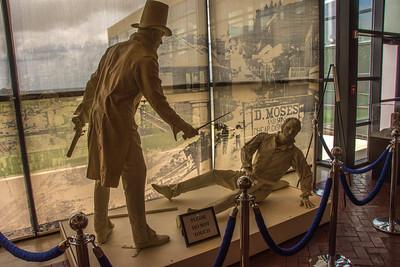
The South was different.
The Code of Honor and Its Demise
Complications set in when Ayers and others search for reasons to explain this discrepancy. Speculation ranges from the depredations of slaveholders to a more lawless atmosphere to the ethnicity and social class of the South’s settlers. All of these explanations and more were undoubtedly at work in the culture.Regarding the formal duel, however, Ayers and other interested historians always bring up the concept of honor. Ayers furnishes an excellent formula for how this code of honor operated.
“Contemporaries who described Southerners as gracious and hospitable described men who adhered to honorable conduct, but so did those who described Southerners as touchy and belligerent. Honor led people in the South to pay particular attention to manners, to ritualized evidence of respect. When that respect was not forthcoming between men, no matter how small or imagined the offense, the offended party would demand satisfaction. The most common way of obtaining it was through fighting a duel, an “affair of honor.”
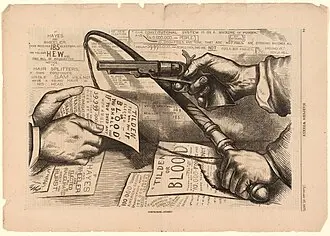
Ayers makes a point that would seem to buttress this premier regard for honor as the chief force driving men to pistols and rituals of life and death. Ayers notes: “In part, it was the South’s deep loyalty to honor that helped spawn secession and the Civil War.” John Brown’s Raid in Harper’s Ferry, the constant attacks in the press by abolitionists, and the election of Lincoln—all were an “affront to Southern honor.” When Lincoln called for troops to suppress the rebellion, states in the upper South that had not yet seceded felt honor-bound to do so.
For Southerners, honor and satisfaction were not only the heart and soul of the duel but a part of statecraft as well.
State laws against dueling, pressure from the press, from evangelical ministers, and from women—and the gradual realization that, while honor mattered, dueling rarely satisfied it—all helped finish off the formal duel. By the end of the Civil War, it had all but vanished from American culture, with the last recorded duel taking place in 1889. Neither participant on the field of honor that day was hurt. They shared a handshake and champagne afterward, and the papers that reported it played the story largely as a farce.
Gentlemen across the country finally took to heart Ben Franklin’s thoughts on the subject: “A man says something, which a man tells him is a lie—they fight; but which ever is killed, the point in dispute remains unsettled.”