I am sitting on the front porch of a shotgun shack staring out at an ominous darkness on the horizon. A black blizzard grows and draws nearer, swallowing up the sparse plant life of the open range, erasing a truck until it begins to engulf me as the low whisper of wind rises to a roar. I turn my head and I can see that the entire yard is fading into a swirl of dust and that the house behind me is being battered as well. This is the Dust Bowl. Although it’s almost a century in the past, a virtual reality headset brings it to life with wicked effectiveness. Welcome to Tulsa, Oklahoma.
Tulsa lies along the famous Route 66, the iconic American road from Chicago to Los Angeles. This road, which is celebrating its 100th anniversary in 2026, was the site of many road trips before President Dwight Eisenhower’s highway system was built. Back during the Dust Bowl it was the “Mother Road,” a term John Steinbeck coined in his classic book “The Grapes of Wrath.” The environmental disaster that ruined farms and the farmers who owned them left folks scrambling west for work in California. These days are gone but not forgotten.
One of the figures of the time was an Oklahoman songwriter and voice of the working man, Woody Guthrie. If you ever sang “This Land Is Your Land,” you are familiar with his work. A colorful character, he followed the Okies west himself. Today, a towering mural of Guthrie and his guitar marks the side of the brick Woody Guthrie Center in the heart of Tulsa.
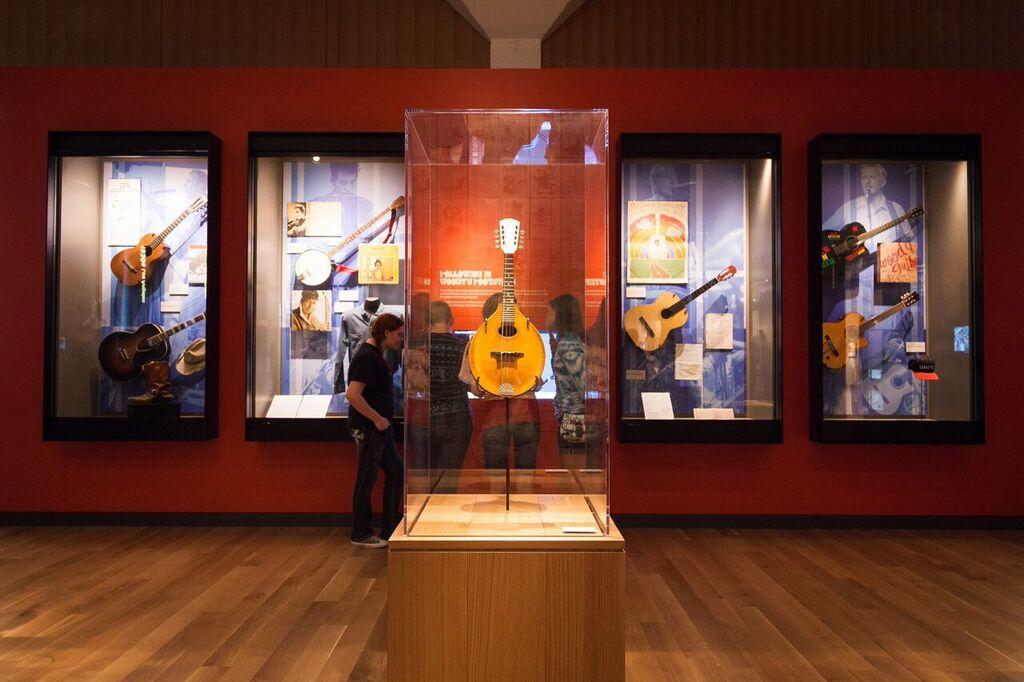
The Dust Bowl virtual reality experience sets the tone for Guthrie’s formative years of struggle, extreme poverty, and family tragedy—his mother was institutionalized and his sister died in a fire. At 14, he was already working odd jobs. The exhibits follow him to California with the Okies, then on to New York City, where his folk music brought him notoriety. Among the exhibits are his instruments plus a vast collection of personal history, letters, artifacts, and photos. Start your visit with a 15-minute biographical film featuring recordings of his songs.
The Folk Singer Next Door
But he isn’t the only folk troubadour in town. Right next door is the Bob Dylan Center. Wait, what? The legendary genius, a Minnesota native who has lived in Greenwich Village and Woodstock, New York, and now has a home in Malibu, California, has his dedicated space in Tulsa—and for good reasons.Fans knew—and many of us perhaps learned from seeing the biopic “A Complete Unknown”—that Dylan greatly admired Guthrie. For years, Dylan frequently visited and sang to him when he became institutionalized—for what was mistaken at first for schizophrenia or alcoholism but later understood to be Huntington’s disease. Additionally, the Dylan archives and collection were acquired in 2016 by the George Kaiser Family Foundation founded by the namesake billionaire George Kaiser, a Tulsa native and one of the biggest philanthropists in the United States. Finally, its location in the American heartland compelled Dylan’s blessing; he had visited the Guthrie Center, and the quality and care of the collection impressed him.
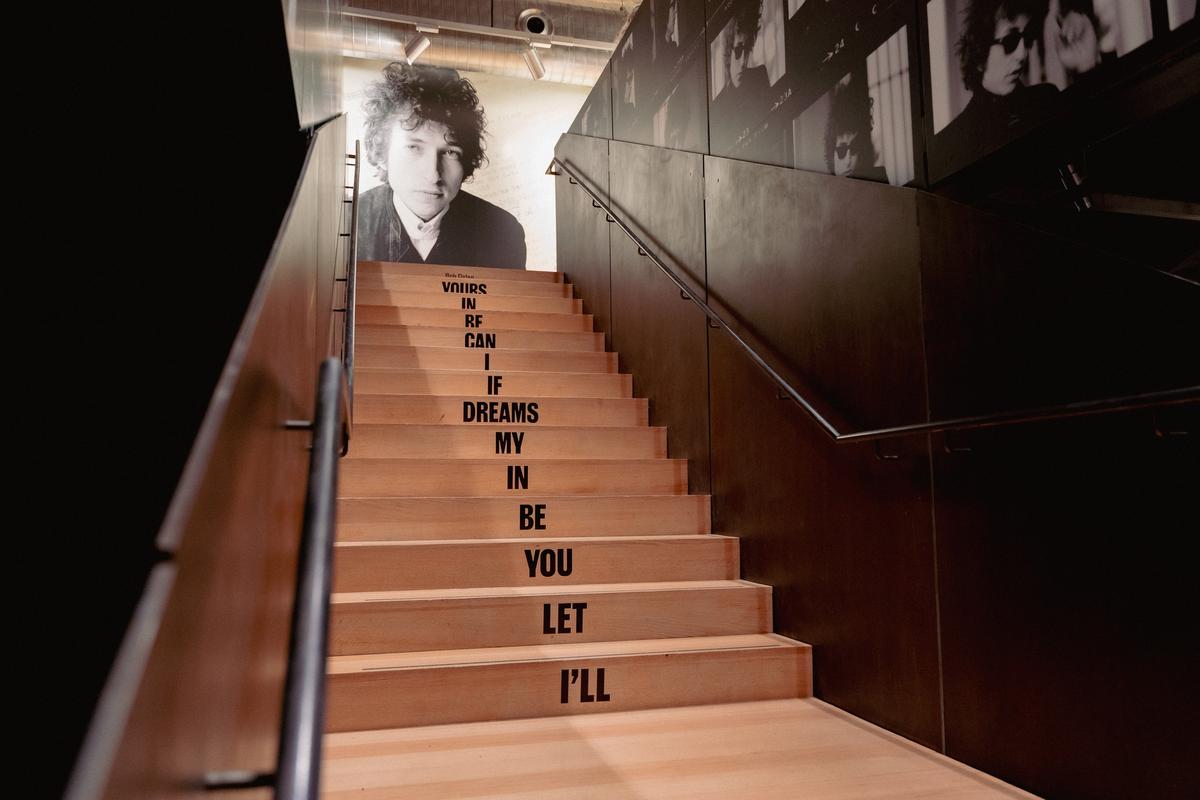
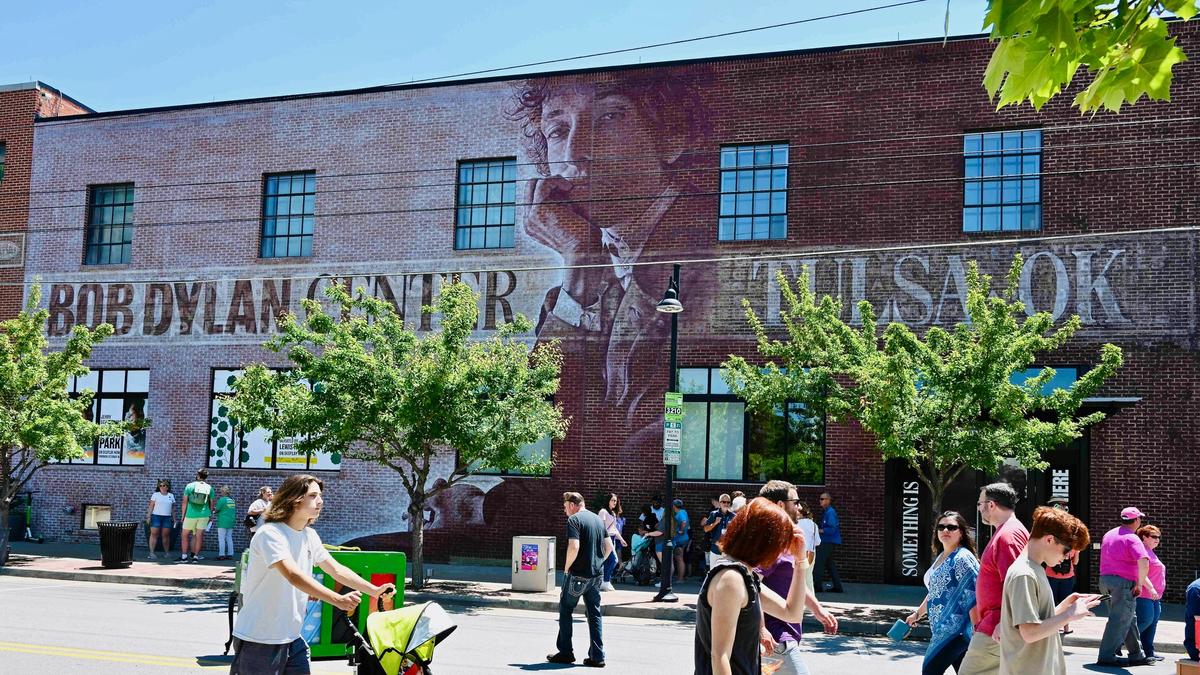
In the first salon lies a scattering of boxes to sit upon as you watch a Dylan video montage projected on the walls that includes excerpts from two Martin Scorsese documentaries. Interviews and documentary footage appear in varying scales—full floor-to-ceiling shots, smaller images and fragments of them adjacent or overlapping. A large metal musical staff bends out from the wall, with flowing pages of sheet music like a jet stream of song curling out into space.
In those few minutes I felt that I understood Dylan more than I had my entire life. All the other articles I’d seen about getting to the root of who he is or taking his life apart like some sort of dissection seemed misdirected. A quote on the wall in the lobby, tantalizingly simple, seemed to say it best: “Life isn’t about finding yourself or finding anything. Life is about creating yourself and creating things.”
The rest of the exhibition spaces were chock-full of artifacts, interviews, album covers, photos, instruments, notebook pages filled with lyrics and ideas in his tiny scrawl, fan mail, and a virtual jukebox of his songs. In a small theater I watched his performance at the 1965 Newport Folk Festival, when he shocked fans—for better and for worse—by coming on stage with an electric guitar to mark a new direction in his music.
Hard History
More history awaits down the street a bit, but a dark page of it. The Greenwood Rising Black Wall Street History Center is aptly named to honor and celebrate “Black Wall Street,” which once thrived in the Greenwood district right outside the center’s doors and was reborn years later. But central to the story is the 1921 race riot also known as the Tulsa Race Massacre. At the center, I sat in a barber’s chair before a mirror across the wall, where a virtual barber appeared to cut my hair in the reflection as he chatted with two coworkers, a conversation that painted the picture of a successful community but with a sense of foreboding.Still Cool in August
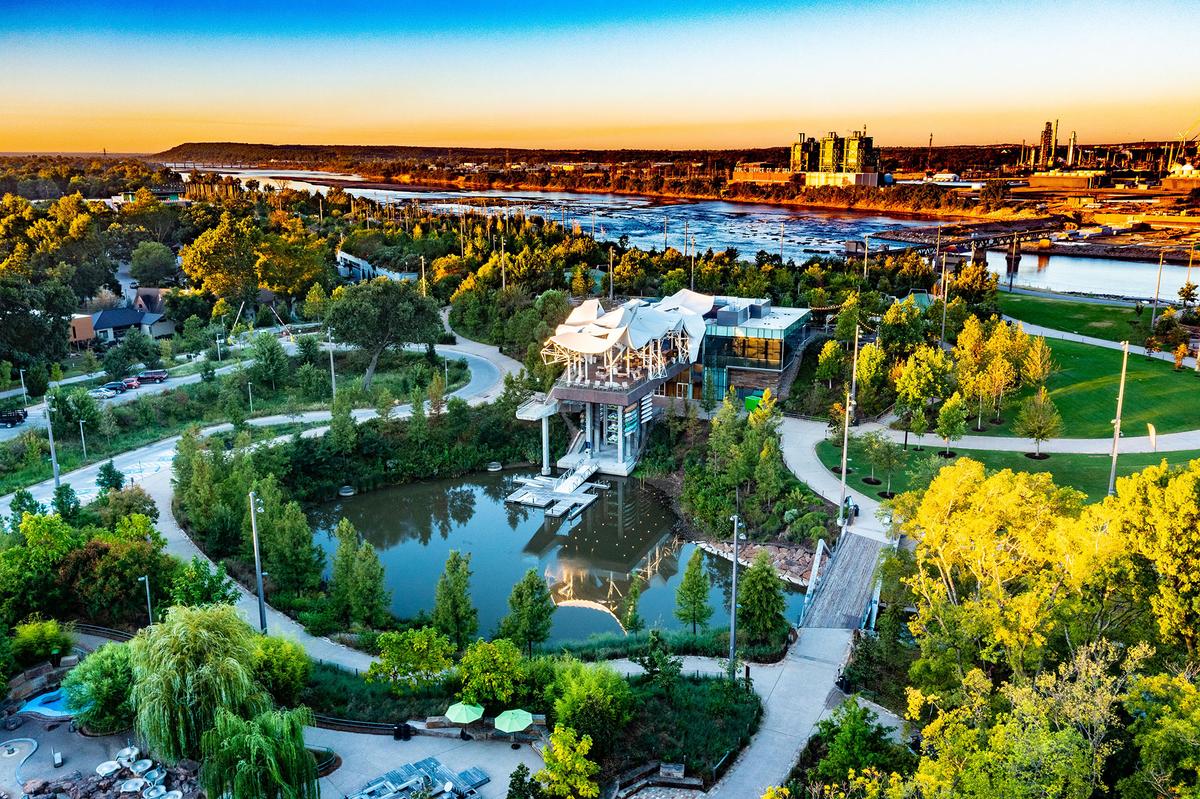
What I didn’t expect in Tulsa was a lush oasis along the banks of the Arkansas River, belying the city’s dusty past. This is Gathering Place, another George Kaiser Family Foundation project. This 66 1/2-acre riverfront park features walking paths, multiple gardens, thousands of trees, wooden decks and terraces, ponds, a skate park, and the Discovery Lab of 57,000 square feet, a hands-on-learning children’s museum dedicated to science, technology, engineering, arts, and math. Kaiser has a great interest in making opportunities for young people.
“No child is responsible for the circumstances of his or her birth,” he has said.
At the other end of the park is Williams Lodge, a lovely air-conditioned pavilion with floors of Wildhorse Swirl stone—a rare regional sandstone—ridged wood ceilings, and a wall of glass offering panoramic park views. Visitors lounge on abundant eccentric chairs and benches or refresh themselves with a bit of ice cream, candy, or drinks at Redbud Cafe. The lodge won an American Architecture Award in 2025.
More Kicks on Route 66
There are so many other surprises. Visit the Route 66 Historical Village, a free open-air museum where volunteers will chat with you about the train depot. It features a Frisco 4500 Meteor steam locomotive, 145-foot oil derrick, a recreation of an old gas station, and more. You’ll find plenty of photo ops with Route 66 signage. Route 66 is celebrating its centennial in 2026.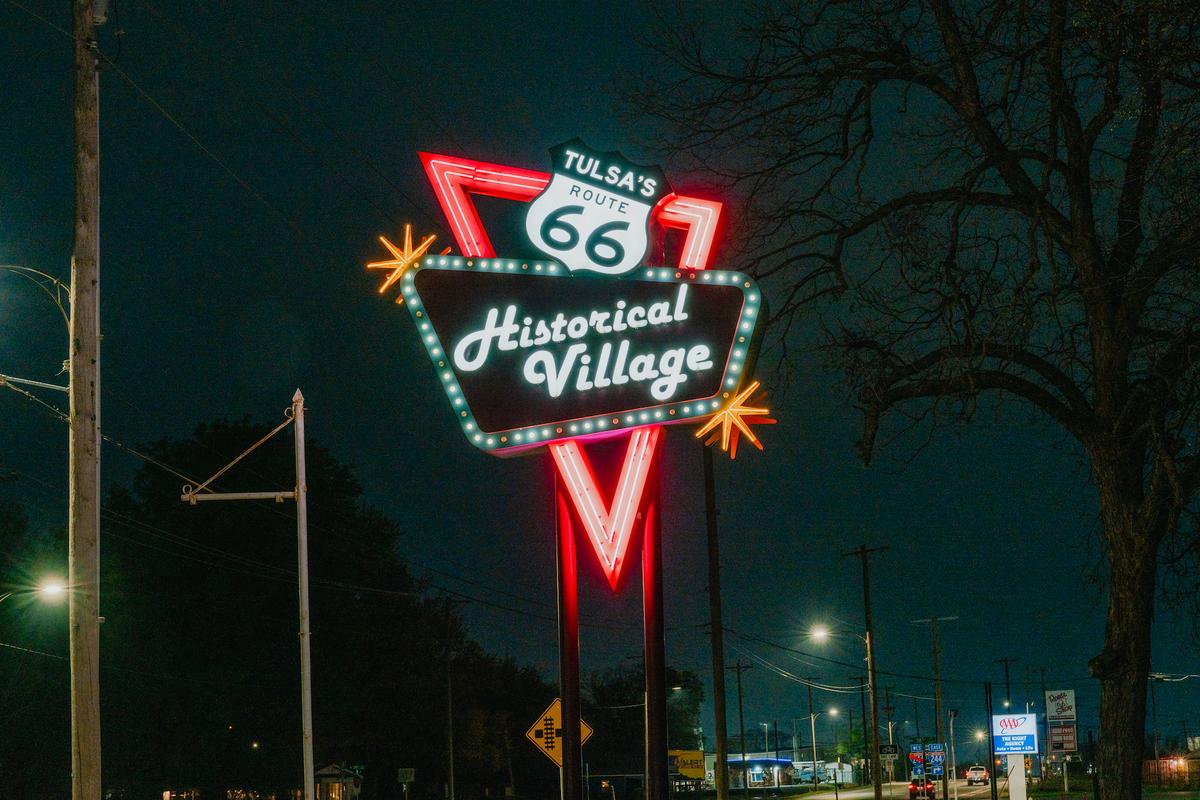
Fans of “The Outsiders” can drive past the bungalow where Francis Ford Coppola shot the film adaptation of the book in 1982. The Curtis Brothers House where the Greasers lived is now a museum. Danny Boy O’Connor, founding member of House of Pain (the song “Jump Around”) is the executive director.