“Man, whoever he may be, has always and everywhere preferred to act as he chooses and not at all as his reason or personal advantage dictate.” So observes the narrator in Fyodor Dostoevsky’s “Notes from Underground.” This intense 1864 novella manifests the unpredictability and inscrutability of human nature, exploring the paradoxes of consciousness that lead us to act in irrational and destructive ways, even when we know better.

Title page of the Russian-language 1866 edition of "Notes From Underground." Public Domain
Dostoevsky, a master of psychological realism, brings us inside the fevered and frenzied brain of a former civil servant who has distanced himself from society, hiding in paranoid seclusion. The unnamed narrator has entered a state of complete isolation—which he calls his “underground”—as a consequence of a frustrated and meaningless life, a painful awareness of his own insignificance, and repeated acts of self-sabotage. From his dark corner, he hurls bitter jibes at his imagined readers as he chokes and spits with spite. He goes on to recount key episodes in his life that led him to his current state of withdrawal.
The psychological “underground” inhabited by the narrator is, of course, symbolic of death (“six feet under”) or, perhaps even more unnervingly, hell—the ultimate underworld. He has withdrawn from human life, human connection, human love. In isolation, the ego devours itself, which is a defining feature of hell and spiritual death.
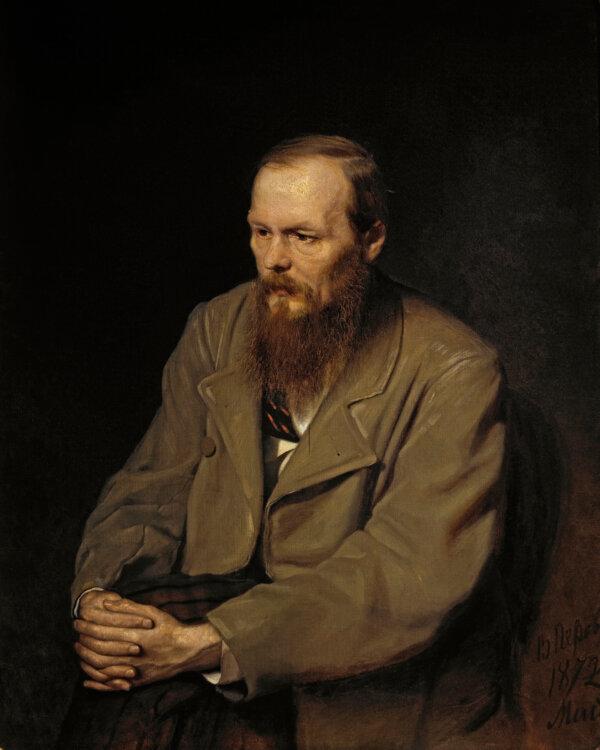
Portrait of Feodor Dostoevsky, 1872, by Vasili Perovby. Tretyakov Gallery. Public Domain
Though he’s filled with spiritual emptiness and a good deal of vitriol, the narrator nevertheless reveals, here and there, his sensitivity and his taste for the good and the noble. As we witness his tragic life story, we sympathize with him—yet we are also repulsed by him; he repeatedly fails to act in accordance with his nobler sentiments. Instead, he sinks deeper into small-mindedness, grasping covetously at his poor, bedraggled, wounded pride. He repeatedly does what he knows will bring him misery.
The delirious account begins with the narrator describing himself as “wildly lonely” and then recalling a minor insult given to him by a certain military officer, and the way he stewed over that offense for months. The officer thinks little of him, even when the narrator gets his “revenge”: bumping into the officer on purpose in the street. The narrator desperately wants to be noticed, yet no one takes any account of him—and it’s this that he considers the greatest offense.
A similar scenario plays out when he forces himself on a gathering of old-school acquaintances. No one wants the narrator there, and he doesn’t want to be there either, except to try to prove his importance to his old schoolmates, who treat him with undisguised disdain when they pay him any attention at all.

The plan fails miserably. The narrator impresses no one. Everyone gets drunk, and the narrator only succeeds in looking weak by lashing out at his companions with childish insults. They soon abandon him for a brothel. He goes there in pursuit, but they’ve already left. In a drunken, passionate state, he impulsively seeks out the services of one of the prostitutes.
Afterwards, the narrator addresses her with an impassioned plea to leave her life of debauchery and degradation. His concern touches her. He invites her to visit him. For the first time, the narrator has an authentic encounter with another human being, where, for a few fleeting moments, the two see one another simply as persons, broken and wounded, but valuable. The insults and the jockeying for social superiority fade into the background. Is the narrator sincere? Is he just playing a game? Is he taking advantage of the girl’s emotions, just as he did her body? It’s not entirely clear, but there’s a hint that the narrator, after all, has a heart.
In his relationship with the prostitute Liza, we see the first glimmer of meaning and altruism in an otherwise chaotic, meaningless, and egocentric existence, a life that resembles a confusing dream. Something like love and hope buds for an instant between them. She comes to see him at his apartment, hoping he might lead her out of the darkness, somehow.

In both "Crime and Punishment" and "Notes From Underground," Dostoevsky probes the irrational depths of conscience and free will. B. Calkins/Shutterstock
And yet—out of spite and pride and willfulness and the unaccountable self-destructive urge within human nature—the narrator intentionally ruins the relationship, ruins his chance to change her life or let her change his. He lets this luminous opportunity pass him by. As he himself puts it, reflecting on his past, “I missed out on life in my corner through moral decay, through lack of human contact, through losing the habit of living and through my narcissistic, underground spite.”
Despite his personal failings and the somewhat unreliable nature of the narrative itself, Dostoevsky’s protagonist articulates many deep verities about human nature. He’s no fool. Indeed, his entire narrative can be seen as an exploration of how foolish human behavior completely defies the predictions of the utopian socialist dreamers of Dostoevsky’s (and our) time.
One of the socialists in Dostoevsky’s novel “Crime and Punishment” says, “environment is everything, and man himself is nothing.” In other words, if you surround human beings with the right social system and structure, they will fall into line and behave well.
In both “Crime and Punishment” and “Notes from Underground,” Dostoevsky reduces such notions to ash with withering realism. He confronts us with the enigmas and paradoxes of consciousness and free will, which defy the logic of social systems that view human nature as something completely malleable. “Man is so partial to systems and abstract conclusions,” the narrator observes, “that he is ready deliberately to distort the truth, ready neither to hear nor see anything, only as long as he can justify his logic.”
But human nature can never be fully systematized, fully comprehended, calculated, or predicted. Nor do human beings always act in their own best interest, as the socialist theorists assume. In an impassioned speech early in the novella—clearly a reflection on his own missed opportunities in life—the narrator declares,
“When did man, in all these thousands of years, ever act solely in his own best interests? What about the millions of cases that bear witness to the fact that people knowingly, that is, while fully comprehending their own best interests, relegating them to the background and following a different, uncertain and risky path, not because they are being forced to do that by anyone or anything, but simply as if reluctant to follow the appointed path, stubbornly and wilfully choose to forge ahead along another difficult and absurd path, seeking it in almost total darkness?”
That’s precisely the point of the narrator’s inglorious life story in “Notes.” In his relationship with his schoolmates and in his relationship with Liza, he knows he was acting in a self-destructive manner, yet he proceeds anyway. This is part of the brokenness of the human condition.
As a result of it, human beings are not completely rational creatures who just need to be taught the right system of government or economics to be happy. Human beings are enigmatic, wounded creatures who cling to their freedom of choice even when that choice will bury them—literally and figuratively. This accounts for much of the personal and societal tragedy that Dostoevsky so clearly perceived.
Because the narrator of this story continually misuses his freedom, acting in erratic ways, he never manages to become a real, fulfilled person. He never lives truly. As he puts it, he “never even managed to become anything … neither a scoundrel nor an honest man, neither a hero nor an insect.” Irrational behavior sabotages happiness and identity—and it certainly defies the predictions of social engineers, who dream a futile dream of a socially constructed paradise on earth that leaves out the variable of human free choice.
To oppose this empty dreaming, there rises from underground the voice of a man far more honest about the propensity for evil in human nature than the utopian idealists are. Where social engineers see numbers and statistics and abstract ideas, Dostoevsky sees flesh and blood and the unfathomable depths of consciousness.
At the end of the novella, from his shadowy place on the outskirts of society, the narrator speaks with the booming voice of a prophet:
“We even find it a burden being human beings—human beings with our own real flesh and blood; we are ashamed of it, consider it a disgrace and are forever striving to become some kind of imaginary generalized human beings. We are stillborn and we have long ceased to be begotten of living fathers—and this we find increasingly pleasing. We are acquiring a taste for it. Soon we'll devise a way of being somehow born from an idea.”
What arts and culture topics would you like us to cover? Please email ideas or feedback to [email protected].