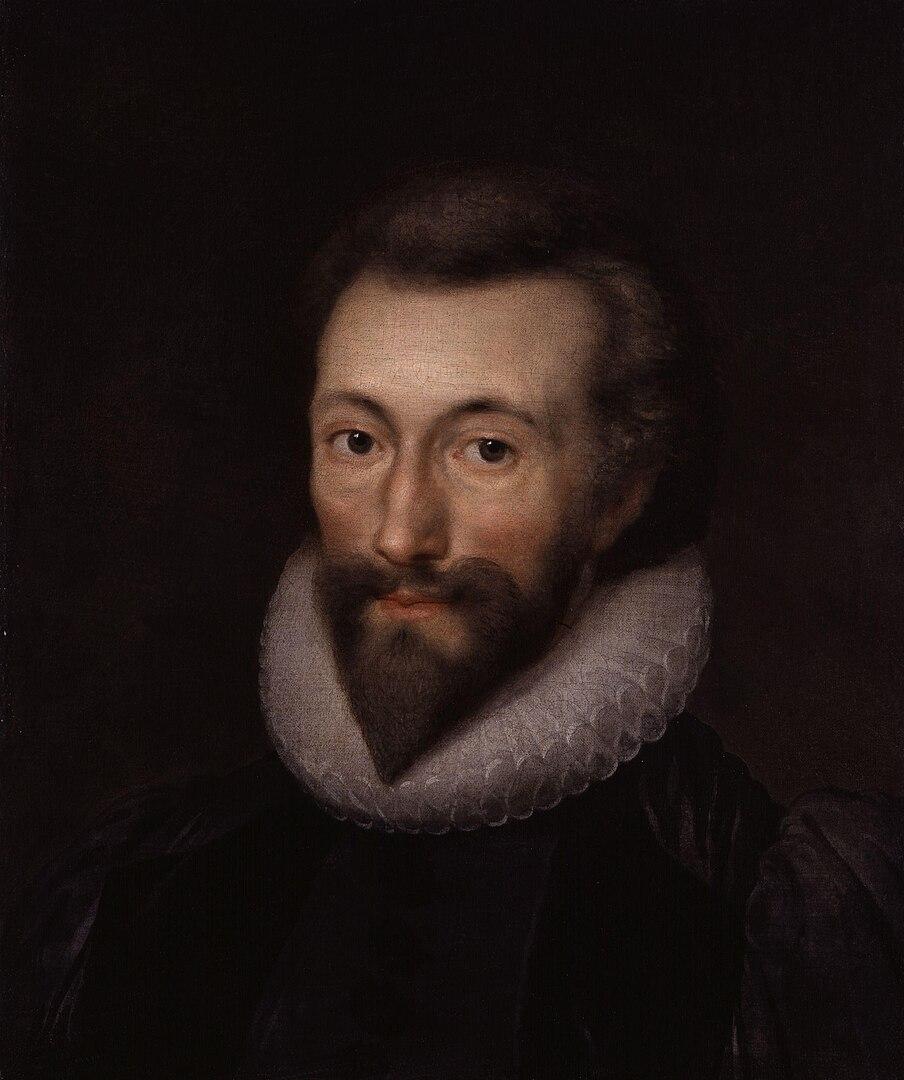
All of us endure painful partings at some time in our lives. The Renaissance poet John Donne sought to comfort his wife on the occasion of one such parting by reminder her that love transcends physical separation.
Donne had to go on a long trip during 1611 to 1612 and wrote these parting words to console his wife. The resulting poem—one of the most anthologized in the English language, according to literature professor William Harmon—demonstrates how marriage offers a stable love that rises above the physical and unites souls even when bodies are no longer together.
The injunction not to grieve arises out of compassion more than it does realistic expectations. Of course, there will be mourning, but the poet will attempt to mitigate it as best he can. This lyric is the poetic equivalent of telling a weeping loved one, “Hush, it’s going to be alright”—even if he’s not sure that it will be alright.
The poem’s form consists of tetrameter quatrains (four-line stanzas with four beats in each line). Its rhyming pattern is ABAB, meaning the first and third lines and the second and fourth lines of each stanza rhyme. This interlocking rhyme scheme gives the poem a strong internal structure, a squareness and solidity that reflects the poem’s theme of permanent and faithful love.
The rhyming lines form couples—like the speaker of the poem and his wife—while the slight distance between rhymes reflects the impending separation. Yet, as the rhyming sound returns after just a little while, so too will the poet return to his love after a little while.

Donne works his way through a series of comparisons to show the strength of his love, the power of his feelings, and the permanence of the couple’s union in spite of physical distance. These elaborate and inventive comparisons are known as “conceits.” “The Oxford Companion to English Literature” explains that a conceit is “an elaborate metaphor comparing two apparently dissimilar objects or emotions, often with an effect of shock or surprise.”
The intricate poetic argumentation—almost like a puzzle box to be solved—forms another distinctive feature of this type of poetry. Renaissance poetry, in general, and John Donne, in particular, are well-known for this poetic device. In fact, the example of a conceit par excellence given by the Oxford Companion is the one Donne offers at the end of this poem (the comparison of two lovers to compasses).
The dominant image that ties together the poet’s diverse comparisons and conceits, however, is the circle. It appears first in the guise of the moon (in stanza 4), then gold (stanzas 5 and 6), then a compass and the circle drawn by a compass (stanzas 7 to 9). Why the emphasis on this particular shape? There are several reasons.
First, as Harmon points out in “The Classic Hundred Poems: All-Time Favorites,” the circle is a symbol of perfection and completeness. It’s also a symbol of gold. Donne uses this symbology to reinforce the ethereal, heavenly, rich, perfect love he envisages between himself and his wife. Further, the circle can be a symbol of eternity—which highlights the undying nature of that love.
Moving stanza by stanza, we can see how gracefully Donne develops his argument against mourning. In the first stanza, Donne appeals to the silence accompanying death as a fitting image for the silence that should accompany the spouses’ parting. “As virtuous men pass mildly away,/ And whisper to their souls to go,”—he begins, indicating the kind of gentle resignation that should characterize the lovers’ separation—“Whilst some of their sad friends do say,/ The breath goes now, and some say, no.” In this last line of the stanza, Donne makes use of the punctuation to create pauses in the line where the reader draws breath, reflecting and evoking the stuttering breath of the dying.
In the next stanza, Donne explains that floods of tears and sighs would reveal too much of the couple’s love to the world, who doesn’t deserve to see it. Indeed, this would be “profanation of our joys/ To tell the laity our love.” The word “profanation” suggests that there is a sacred quality to this married love the speaker shares with his wife. And sacred things are veiled, hidden from the prying eyes of the world.
In the fourth stanza, Donne introduces the moon imagery with the word “sublunary.” He castigates the “dull” love of “sublunary lovers,” contrasting it unfavorably with his own love. Here, we must understand that in medieval and Renaissance cosmology, the region below the moon (earth, essentially) was considered the region of change, instability, and imperfection, while the region above or beyond the moon (the other planets, the sun) was considered a realm of changelessness, stability, and perfection. The planets move in their regular circuits unwaveringly in that realm of perfect order and timelessness.
So when Donne speaks of “sublunary” love, he’s speaking of imperfect, changeable, and earthly love, which he describes as based on “sense” (sensory experience), which is an unstable foundation. As he points out, for those who love on the basis of sight or touch alone, absence or separation is fatal to their love, because it removes the object of the senses.
Donne emphasizes the heavy earthiness of this kind of love with heavy, repetitive “l” sounds: “dull sublunary lovers’ love.” By contrast, the love between himself and his wife is, by implication, of the higher, translunar order—it is perfect, spiritual, unchanging. It does not depend on the sense of sight or touch or smell and can therefore endure the loss of the beloved’s body.
Our two souls therefore, which are one, Though I must go, endure not yet A breach, but an expansion, Like gold to airy thinness beat.
In a striking image, Donne explains that their love will be “stretched” by the distance between them but not broken; instead, it will take on a golden “airy thinness,” something like a golden mist or ether. It will not be broken. Instead, it will expand, becoming more spiritual, more heavenly, more all-encompassing.In the final few stanzas, Donne develops his final comparison at more length, though still shaped by the concept of the circle. He compares his wife and himself to “twin compasses,” (the kind used to draw perfect circles, although the navigational kind has an appropriate resonance here as well). The prongs or feet of the compass remain always united, even when one of the prongs is moving and drawing a line.
Such wilt thou be to me, who must Like th’ other foot, obliquely run; Thy firmness makes my circle just, And makes me end where I begun.
The shape created by the compass is, of course, a perfect circle—with all the connotations mentioned above. And the action of the foot that draws the circular line involves a returning to where it started from, mirroring the poet’s eventual return home. With great dexterity of thought, Donne has found an ingenious and unexpected metaphor for their love, a metaphor that simultaneously captures notions of unity, stable movement, the perfect circle, and a motion of return and completion. Unsurprisingly, Donne chooses to end the poem here, with the idea of return still hanging in the air.Through elaborate imagery and comparisons and strongly structured form and meter, Donne creates a poem with a simple yet profound point: When two people are joined at soul through marriage, it spiritualizes their love, allowing it to transcend physical boundaries and endure separation and hardship. Donne writes of a commitment that is so deep it defies the boundaries of both time and space.
To the modern ear, Renaissance poetry like this can sometimes sound stiff and over-intellectualized. Could all these elaborate comparisons really console a grieving wife? I think the answer is yes, when we realize that for Donne and Shakespeare and their ilk, mind and heart go together, and intense and sublime emotions deserve extravagant and ornate expressions. The complexity is not mere intellectualization; its extremity is a way of revealing extreme emotions that would otherwise defy articulation.
This was Donne’s way of offering his wife something as exquisite as he could make it.