A Lost Manuscript Resurfaces in Rome
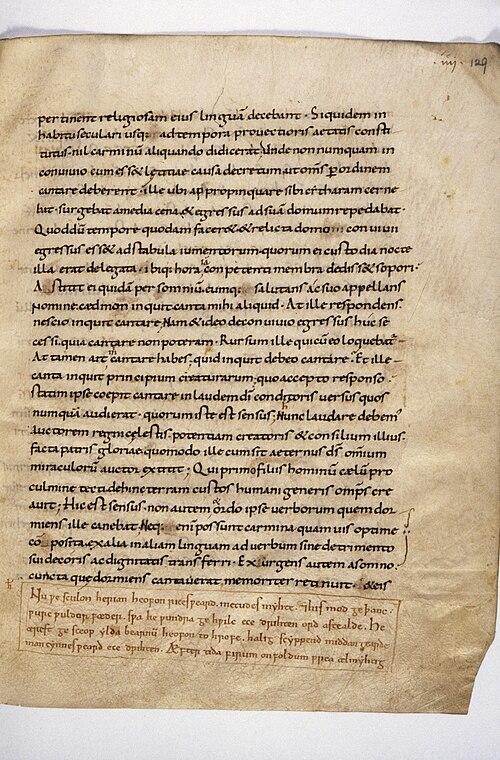
This instance of the poem, dating from A.D. 800 to 830 is the third-oldest known copy. What makes the discovery so significant, then, isn’t primarily the age of the manuscript, but that the poem appears in Old English rather than in Latin. The two older copies of the poem, in Cambridge and St. Petersburg, are both in Latin. The newly revealed Rome copy, which faithfully preserves elements of the early Northumbrian dialect in which Caedmon dictated, will help researchers understand the history of the English language. It also points to the importance of English poetry for readers of the era, who evidently wanted the verses preserved in their own tongue.
In a statement from Trinity College, Faulkner explained why this is a scintillating new clue to English textual and linguistic history.
“Unearthing a new early medieval copy of the poem has significant implications for our understanding of Old English and how it was valued. Bede chose not [to] include the original Old English poem in his [Ecclesiastical] History [of the English People], but to translate it into Latin. This manuscript shows that the original Old English poem was reinserted into the Latin within 100 years of Bede finishing his History. It is a sign of how much early readers valued English poetry.”
According to Faulkner, only about 3 million words of Old English survive, and of this amount, the majority derive from the 10th and 11th centuries. Caedmon’s “Hymn,” on the other hand, is much older, dating from the 7th century, and the brief paean is renowned as the beginning of English literature. The new Roman copy underscores the poem’s unique “Britishness,” even in its early history. It indicates, as Sonja Anderson of Smithsonian Magazine notes, that Old English held its own even against the dominant language of the Roman Empire, which was also the language of most European scholarly, theological, and literary work of the time.
Other distinctive features of this version of the poem include its quirky use of punctuation. It includes full stops after every word, demonstrating that word spacing was a new invention at the time, an important step toward the presentation of the language as we know it today.
Magnanti explained that the process of discovering the manuscript began with some cataloguing inconsistencies. “I came across conflicting references to Bede’s History in Rome, some pointing to its existence and some indicating it was lost.” The two scholars eventually confirmed the manuscript’s existence, and the library digitized it for them. Scanning the pages, they were shocked to find Caedmon’s Hymn rendered in English.

“When we saw it we looked at each other and I said, ‘No one knows about this’,” Magnanti told The Guardian. “To make sure I wasn’t dreaming I double-checked the catalogues and there was no mention of it. It was a huge surprise, a very good one.”
The Birth of English Poetry
The poem itself has an elegant simplicity, its lines as stalwart and beautiful as the beams of a Saxon mead hall. Here is Roy Liuzza’s translation in full:Now let us praise Heaven-Kingdom’s guardian, the Maker’s might and his mind’s thoughts, the work of the glory-father—of every wonder, eternal Lord. He established a beginning. He first shaped for men’s sons Heaven as a roof, the holy Creator; then middle-earth mankind’s guardian, eternal Lord, afterwards prepared the earth for men, the Lord almighty.
Caedmon’s verses include standard features of Old English poetry: two half-lines, separated by a pause or caesura, each with two stressed and two or more unstressed syllables.It is fitting that the genesis of English poetry speaks of the Genesis of the world. This is a poem that revels in the goodness of creation, that celebrates the luminosity of what is, the wonder of being and the author of being.
In the poet’s conception, God’s work of creation was a paternal act, the fashioning of a home for humanity, as vividly suggested by the description of heaven as a “roof.” For Caedmon, God is a craftsman, an artist, and a father. The poem springs from an upwelling of joy in the awareness of God’s power and paternity. In the words of poet Edward Hirsch, “Caedmon connects the energy of language with the power of divine spirit, and his religious poetry of praise inaugurates a tradition.”
Hirsch continues, “'Now we must praise,’ Caedmon instructs us, and thus touches upon one of the primary and permanent impulses in poetry—a calling to more life, a form of blessing, a way of cherishing a world that shines out with radiant particularity.”
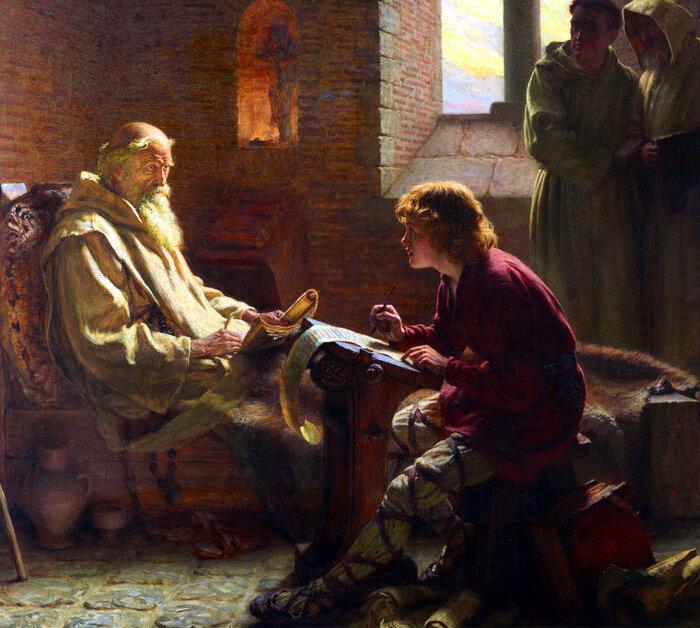
The poem’s alleged origin in the spontaneous poetic inspiration of an otherwise unartistic herdsman fits perfectly with the poem’s own theme and its place in literary history. Bede’s account goes like this: Caedmon, a worker at the monastery of Whitby, always ran away when his turn to sing at a feast or gathering arose because he had no songs to offer. Then, one night, he heard a voice. It asked him to sing. Caedmon objected that he couldn’t sing, but the voice simply told him to sing about the source and spring of all creation. And Caedmon began. He sang verses he himself had never heard before “in praise of God the creator.” According to some accounts, Caedmon eventually joined the monastery and wrote more poetry, though only the “hymn” survives.
It almost doesn’t matter whether the story is historically accurate; it is trans-historically and archetypally true. Just as God “establishes a beginning” and draws a beautiful and bountiful creation out of nothing in the poem, a herdsman with no artistic ability suddenly emerges from nowhere as the fountainhead of English poetry. Where there was nothing, there is suddenly something, and that miracle should fill us with wonder, as Caedmon reminds us.