This copy is for your personal, non-commercial use only. Distribution and use of this material are governed by our Subscriber Agreement and by copyright law. For non-personal use or to order multiple copies, please contact The Epoch Times Reprints.
New York Public Library: Classic Exterior, Artsy Interior
In this installment of ‘Larger Than Life: Architecture Through the Ages,’ we visit one of the largest and most iconic public libraries in the United States.
Dominated by its signature wide staircase, keystone-topped arches, and mammoth fluted Corinthian columns with acanthus-leaf capitals, New York Public Library’s front entrance has a deep-set portico with three pediment-topped brass doors. Lining up symmetrically behind the two lion sculptures, which are located at the base of the steps, are two sculpture fountains embedded in exterior-wall arched niches; they represent allegorical figures of truth and beauty. Prominent bronze and glass chandeliers hang within the portico. Below the pediment roofline and above the entryway are six sculpted figures representing classical disciplines: history, romance, religion, poetry, drama, and philosophy. Mltz/Shutterstock
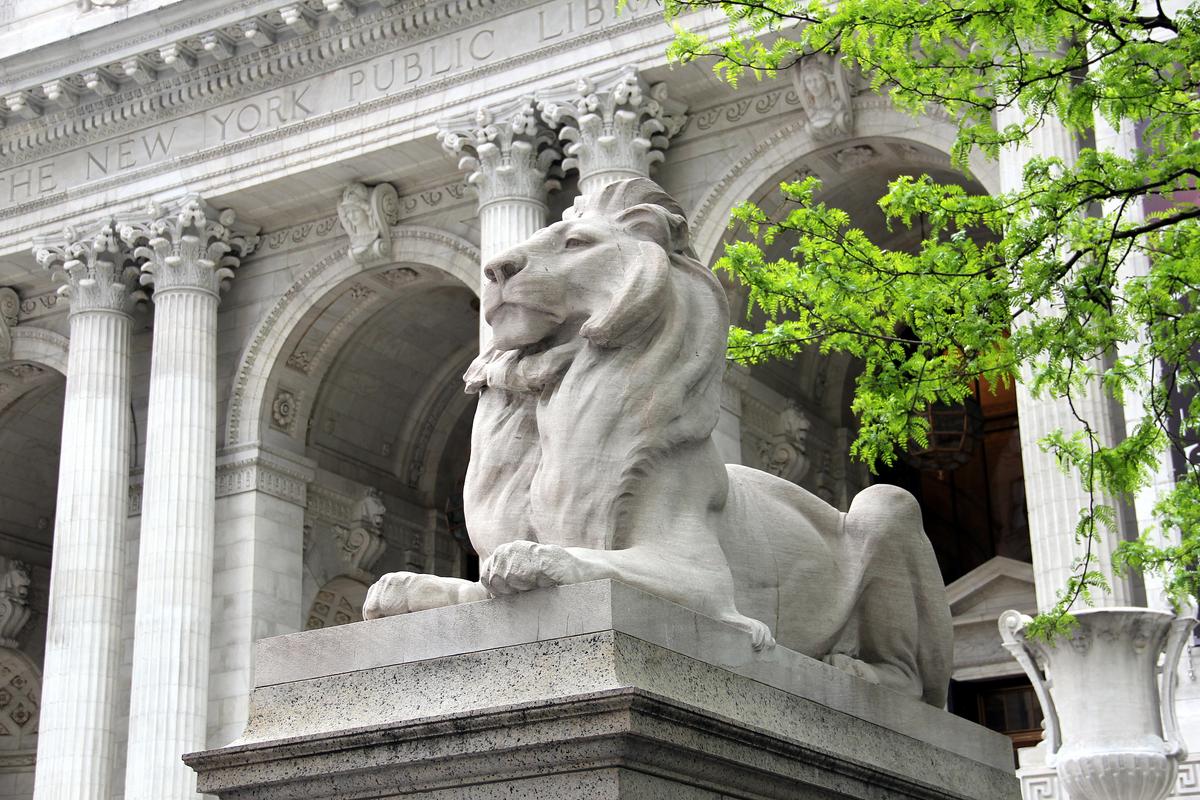
The New York Public Library has been the setting for more than a dozen movies since the 1960s, and the 600-pound lion statues perched at its main-entry stairs are some of the most recognizable landmarks in New York City. The dichotomy of the building’s architectural design—from ground level to its three main floors—is what truly makes this symbolic structure worth visiting.
Today, the city’s main library is also referred to as the Stephen A. Schwarzman building, because of an early-2000s $100 million donation by the businessman toward the building’s renovation. However, the beaux arts-style landmark has been known for more than a century as the New York Public Library’s main branch. For a time, it was the largest marble building in the United States. Due primarily to the amount of marble used (530,000 cubic feet) and its high cost, construction lagged. Sixteen years passed from the launch of the library’s design process to its opening in 1911.
The library’s design was overseen by architects John Merven Carrère (1858–1911) and Thomas Hastings (1860–1929), who specialized in the ancient and Renaissance classical architectural style of beaux arts—prevalent from the 1880s until the 1940s. The firm of Carrère and Hastings incorporated the style’s distinguishing elements in the monumental building’s exterior as well as its vast interior.
The morning following the library’s May 23, 1911, dedication, around 50,000 visitors streamed from Fifth Avenue through the building and marveled at its 12-inch-thick Vermont marble exterior.
Installed just a few days before the library’s 1911 dedication are the two lion sculptures that have become the New York Public Library’s enduring trademark and logo. Sculpted of pink Tennessee marble, these hefty statues are commonly titled Patience and Fortitude due to their calm expressions as they guard the colossal building. Each statue is 11 feet long, not including the tail. Ark Neyman/Shutterstock
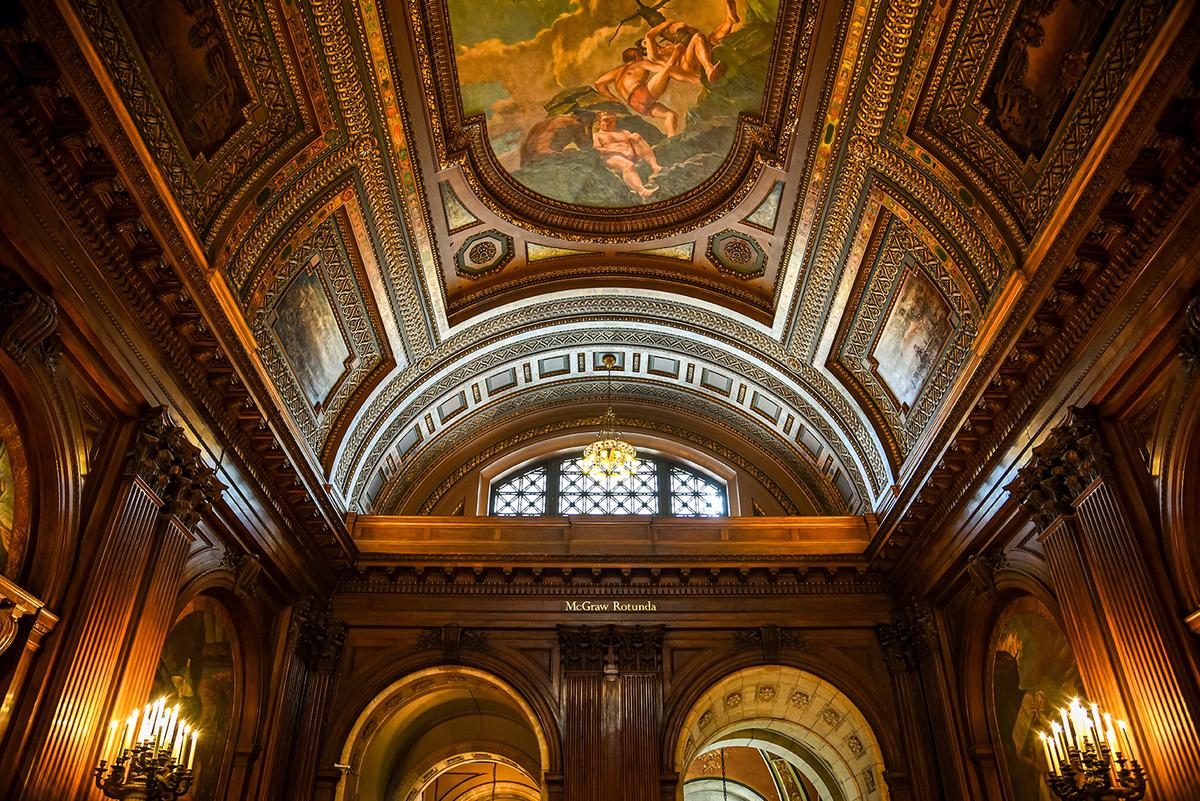
A spectacular scene of carved walnut and elaborate murals greets visitors to the McGraw Rotunda. Several murals are framed by decorative woodworking within the barrel-vaulted ceiling, yet the ceiling's main painting, “Prometheus Bringing the Gift of Fire” is in a gilded frame. Also beautifying the ceiling are carved rosettes inset into hexagons and carved panels in the window arch. Pedro Costa Simeao/Shutterstock
The third-floor McGraw Rotunda, which leads to reading rooms and special collections, features carved walnut walls adorned with 17-foot-tall fluted Corinthian pilasters. The richly hued murals depict the history of the written word. One panel portrays Johannes Gutenberg, inventor of the movable type printing press, offering a page of the Bible to an official. Free-standing bronze candelabras and marble benches border bronze double doors. (Bestbudbrian/CC BY-SA 3.0)
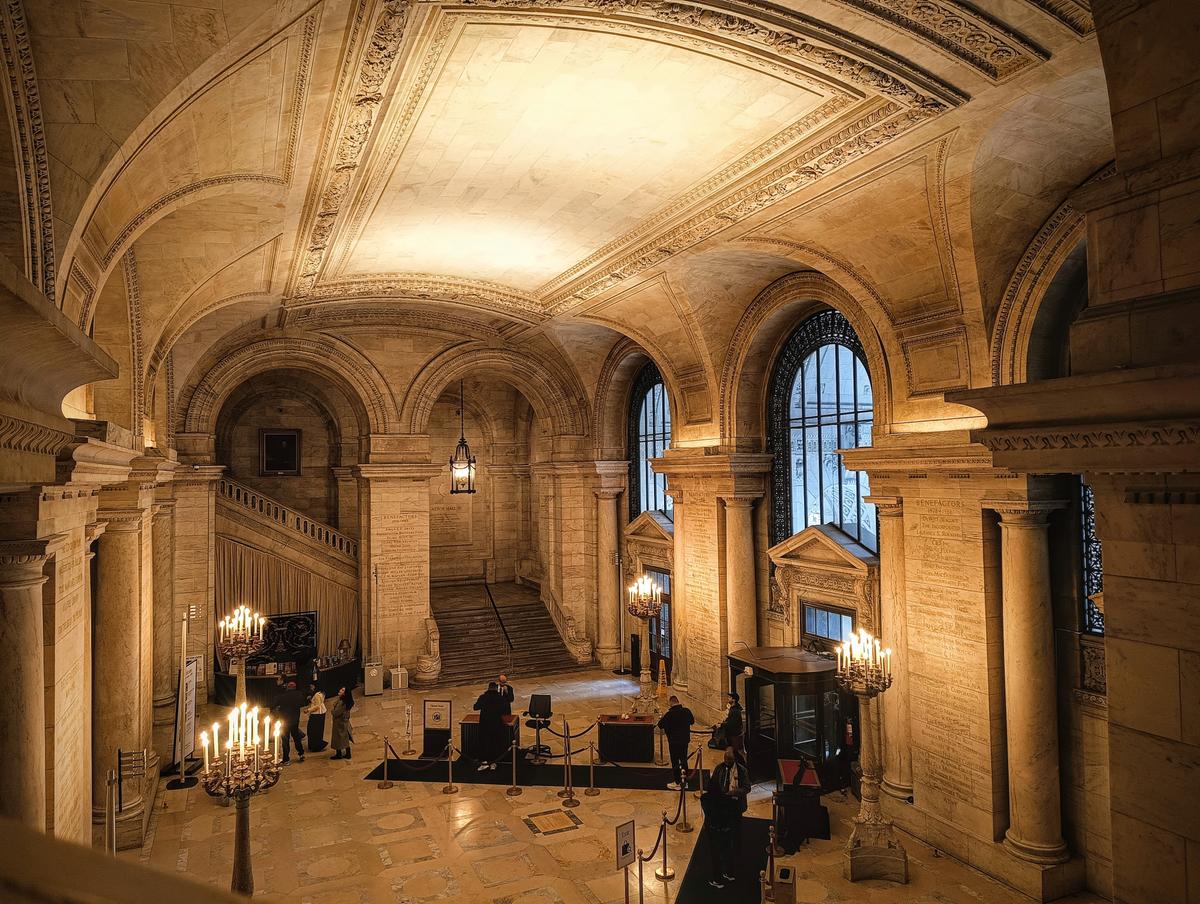
Two grand marble staircases tucked at either end of the stunning Astor Hall foyer lead up to the second floor. The hall is named after John Jacob Astor (1864–1912), who donated his private book and manuscript collection to start one of New York City’s first libraries. The grand, vaulted ceiling entryway of marble features wide, square pillars carved with important historical inscriptions, as well as round columns. The floor is gray marble, and four free-standing marble candelabras provide subdued, medieval-like illumination. Carol Maluf/Shutterstock
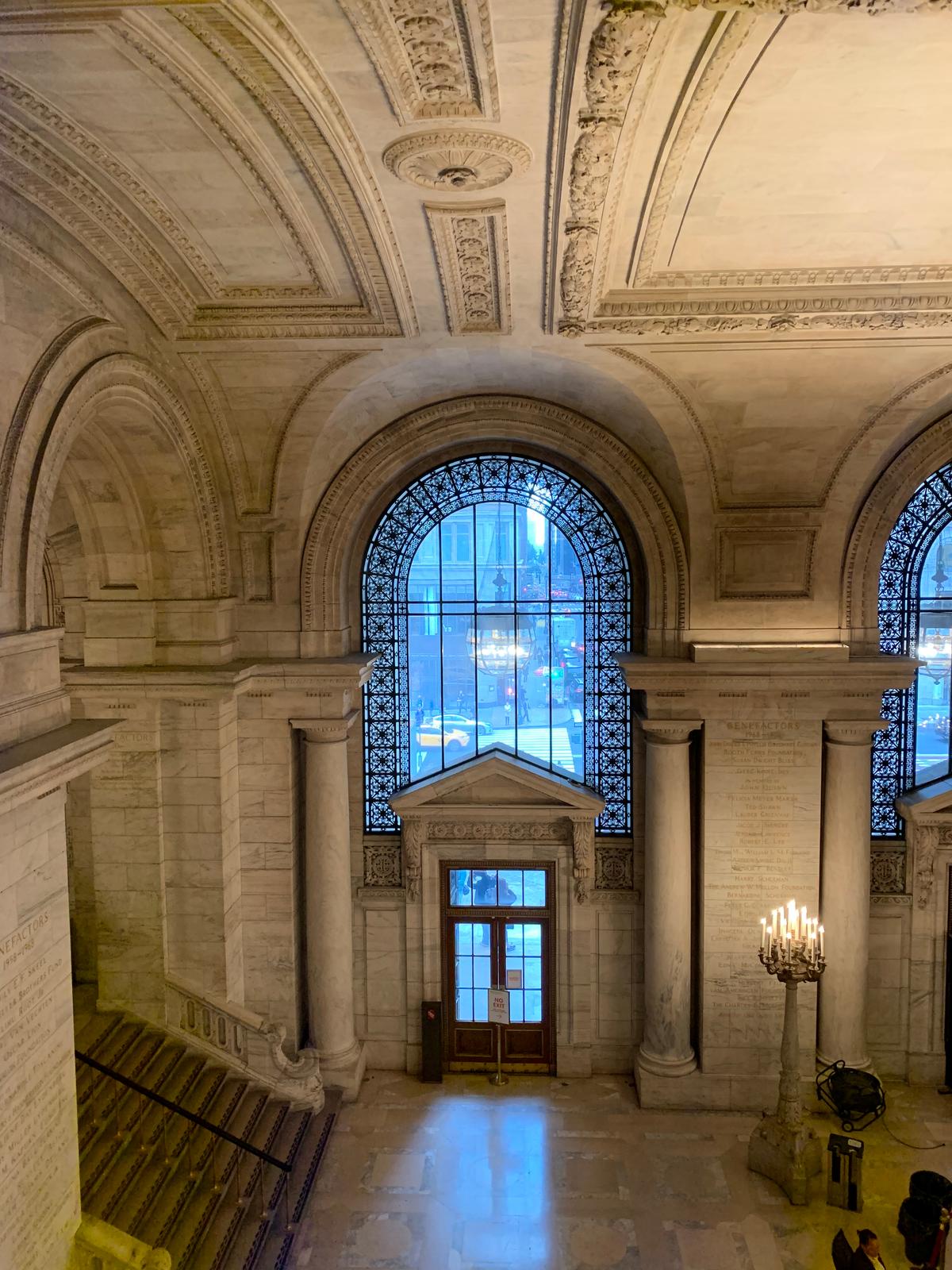
Each of the three tall entryway arches over the doors leading into Astor Hall has windows ornamented with ironwork. Near this door is one of the free-standing candelabras, with a bronze lion’s head holding lamps that resemble candles. Carved into the base is an ox's face and hooves. This marble stairway, one of two in Astor Hall, leads to the third-floor McGraw Rotunda. Heerapix/Shutterstock
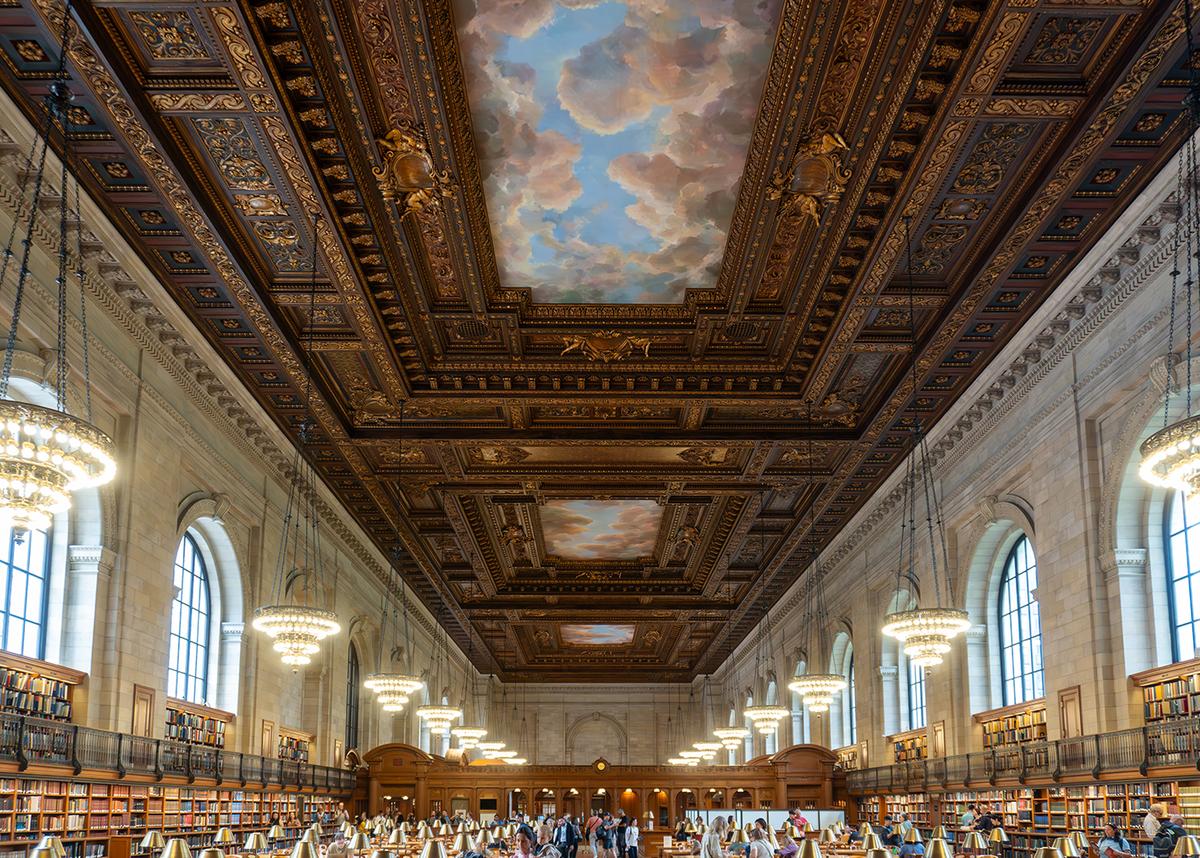
At 78 feet wide by 297 feet long—the length of two city blocks or almost the size of a football field—is the library’s centerpiece Rose Main Reading Room on the third floor. Library patrons have access to the library’s approximately 15 million items, many of which can be perused in this spacious room. Forty-two white oak tables are situated under a nearly 52-foot-tall Renaissance-style plaster ceiling, noteworthy for its decorative moldings, paintings, gold and copper leaf accents, and a mural of blue skies and cotton-like clouds. EWY Media/Shutterstock
Before smartphones and wristwatches, 20th-century New Yorkers kept their schedules by the accurate clocks on and in public buildings throughout the city. The face of this prominent clock in the Rose Main Reading Room is encircled by a bronze ring and topped with a carved wood acanthus-leaf design. It sits in the center of a carved wood classical swag; adorning the clock's lower half is a half-wreath of carved fruit. (Bestbudbrian/CC BY-SA 3.0)
What arts and culture topics would you like us to cover? Please email ideas or feedback to [email protected].
A 30-plus-year writer-journalist, Deena C. Bouknight works from her Western North Carolina mountain cottage and has contributed articles on food culture, travel, people, and more to local, regional, national, and international publications. She has written three novels, including the only historical fiction about the East Coast’s worst earthquake. Her website is DeenaBouknightWriting.com