This copy is for your personal, non-commercial use only. Distribution and use of this material are governed by our Subscriber Agreement and by copyright law. For non-personal use or to order multiple copies, please contact The Epoch Times Reprints.
In this installment of ‘Larger Than Life: Architecture Through the Ages,’ we visit a Georgian-style home built two years before colonial America’s independence.
A hipped roof, keystone-adorned lintels, and louvered shutters are a few elements of Georgian architectural style presented in the two-and-a-half story Corbit-Sharp House. Constructed of nearly 90,000 bricks, the house also is symmetrical in design, especially evident in the placement of the chimneys, dormers, and windows. Flanked by the brick chimneys is a roof balustrade, also called a roof deck, with a lattice railing. Visible on the south end of the main house is a two-story kitchen wing that was added in the late 1700s. Courtesy of Historic Odessa Foundation
With a population of around 350, the small town of Odessa, Delaware, boasts the state’s best-preserved Revolutionary-era home. Situated just a few miles from the Delaware River, the 22-room, Georgian-style mansion known as Corbit-Sharp House is, not surprisingly, a National Historic Landmark. Open to the public, it offers visitors the opportunity to view what life was like for people in the 18th century.
Characteristically Georgian, a style that emerged in England and became popular in the colonies, Corbit-Sharp House has a rectangular footprint and is symmetrical in its exterior presentation. Also true to form, classical details are on display inside and out. Its most distinguishing Georgian features are its two dormers and a roof balustrade.
Inside the home are furnishings crafted by John Janvier (1749–1801), a well-respected Delaware cabinetmaker.
The Corbit family owned the house until the early 20th century, when it was acquired and fully restored by a Delaware preservationist, H. Rodney Sharp.
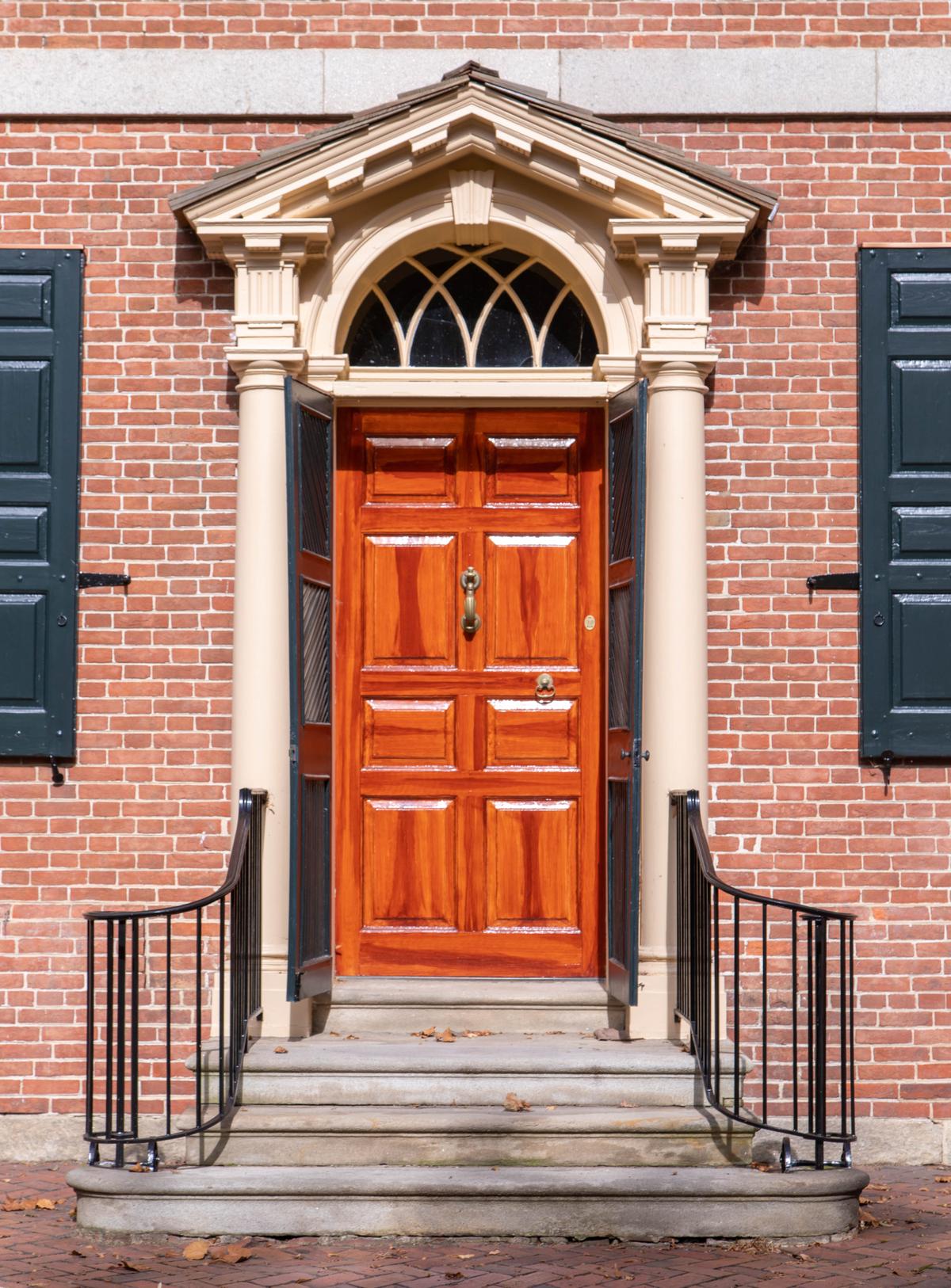
Anchoring Corbit-Sharp House’s exterior symmetry is its front entryway. The paneled, polished-wood door is flanked by round columns with Doric capitals, which are topped with pilasters that appear to support the projecting pediment. Over the door is an arch that frames a transom with a gothic-inspired glass design. Courtesy of Historic Odessa Foundation
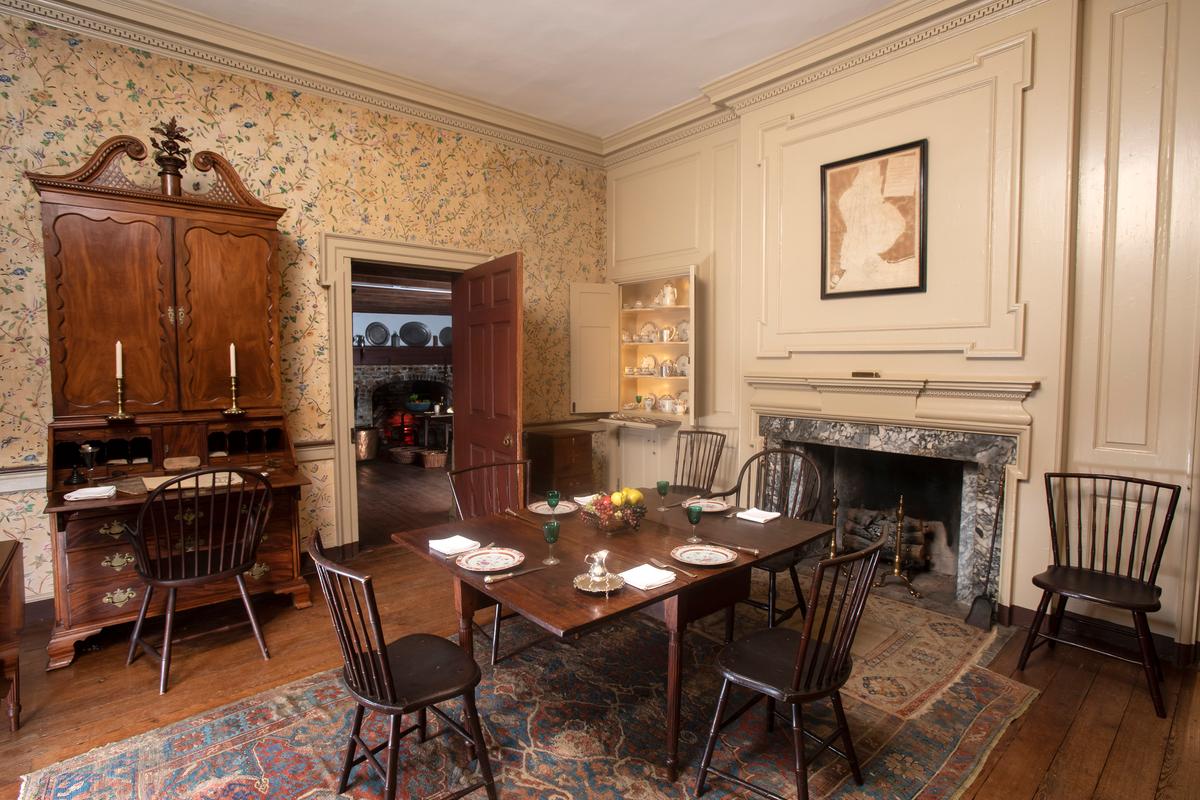
Colonial-era Windsor chairs are situated around the simple dining table; a Windsor chair is also pulled up to the Chippendale-style secretary desk. The ceiling is bordered by crown molding featuring a rope-trim design. A built-in corner hutch holds dishes and china. The walls are paneled, and an overmantel with cross-cut corners frames the marble fireplace. Courtesy of Historic Odessa Foundation
The main ornamentation in the Corbit-Sharp House dining room is an example of hand-painted and hand-blocked (creating a repeating pattern) Chinese wallpaper, popular in the 18th century. The floral-pattern wallpaper serves as a backdrop for the gilded frame mirror that features floral motifs. Courtesy of Historic Odessa Foundation
The Corbit-Sharp House features an upstairs drawing room referred to as the “long room.” Drawing rooms in the 18th and 19th century were less formal spaces where residents—and sometimes their guests —gathered to relax, converse, listen to music, and read. The largest space in the house, the long room showcases 18th-century carpentry skills in its paneled walls, fluted pilasters, and ceiling trim (called modillioned cornice). The room is apportioned with wingback chairs, a Queen Anne sofa, and a pianoforte. A gilded mirror and an oval, pendant-style mirror adorn the walls, while the marble fireplace is equipped with a pole screen that can be moved in front of anyone to minimize the heat from the fire. Courtesy of Historic Odessa Foundation
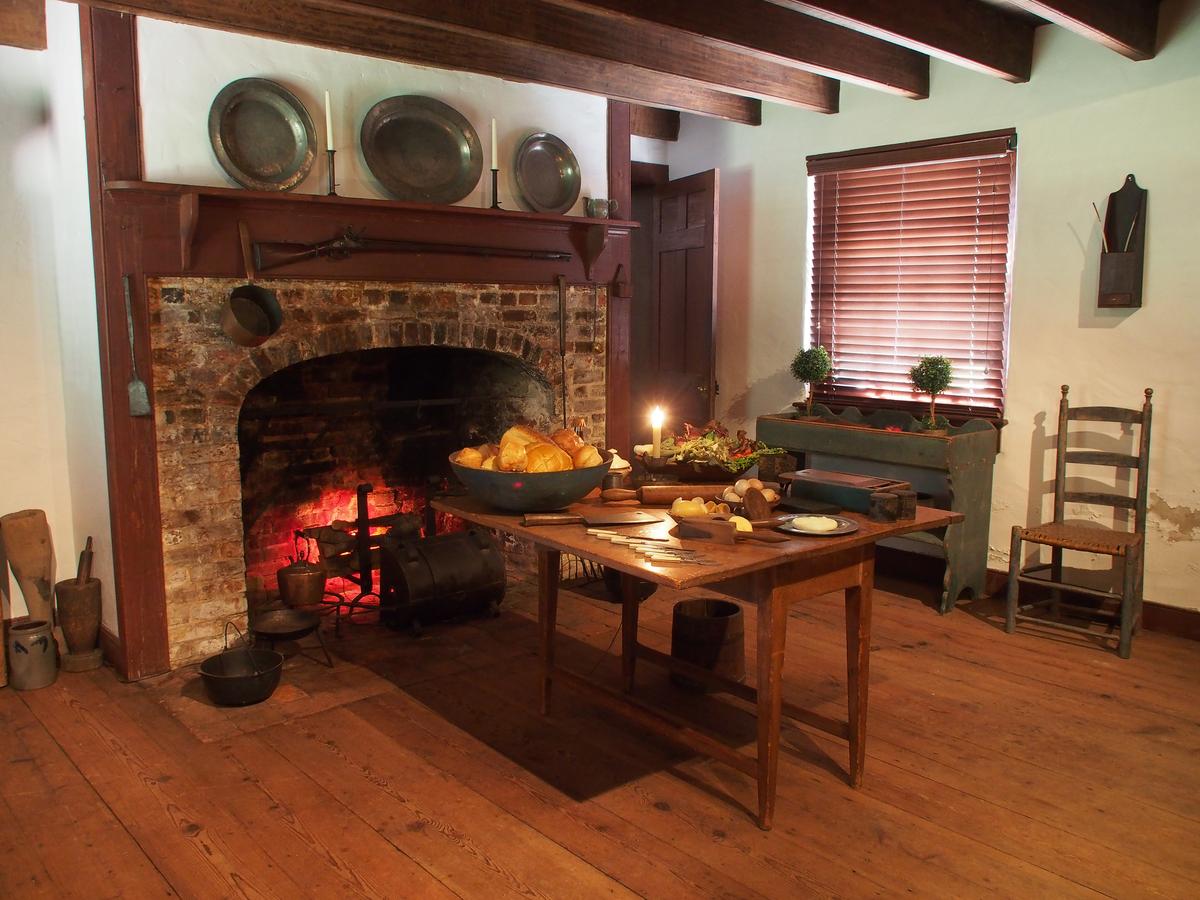
The kitchen features poplar wood beams, heart pine flooring, and a brick fireplace. Displayed on the wood mantel are pewter trays. In the colonial era, pewter was often preferred as a more durable, higher-end material than wood for serving and dishware, yet it was less expensive to make and purchase than silver. Against the wall is a ladder-back chair with a woven rush seat. Courtesy of Historic Odessa Foundation
An overmantel with crossetted corners is featured above the marble fireplace in this downstairs parlor room, also called a reception room. This was the Corbit-Sharp House’s more formal receiving room. Flanking the fireplace are paneled walls, while a decorative trim separates the paneled chair railing from the rest of the wall in this room. Instead of a traditional mantel, a cornice decorates the marble fireplace. Various Chippendale chairs decorate the room. Courtesy of Historic Odessa Foundation
What arts and culture topics would you like us to cover? Please email ideas or feedback to [email protected].
A 30-plus-year writer-journalist, Deena C. Bouknight works from her Western North Carolina mountain cottage and has contributed articles on food culture, travel, people, and more to local, regional, national, and international publications. She has written three novels, including the only historical fiction about the East Coast’s worst earthquake. Her website is DeenaBouknightWriting.com