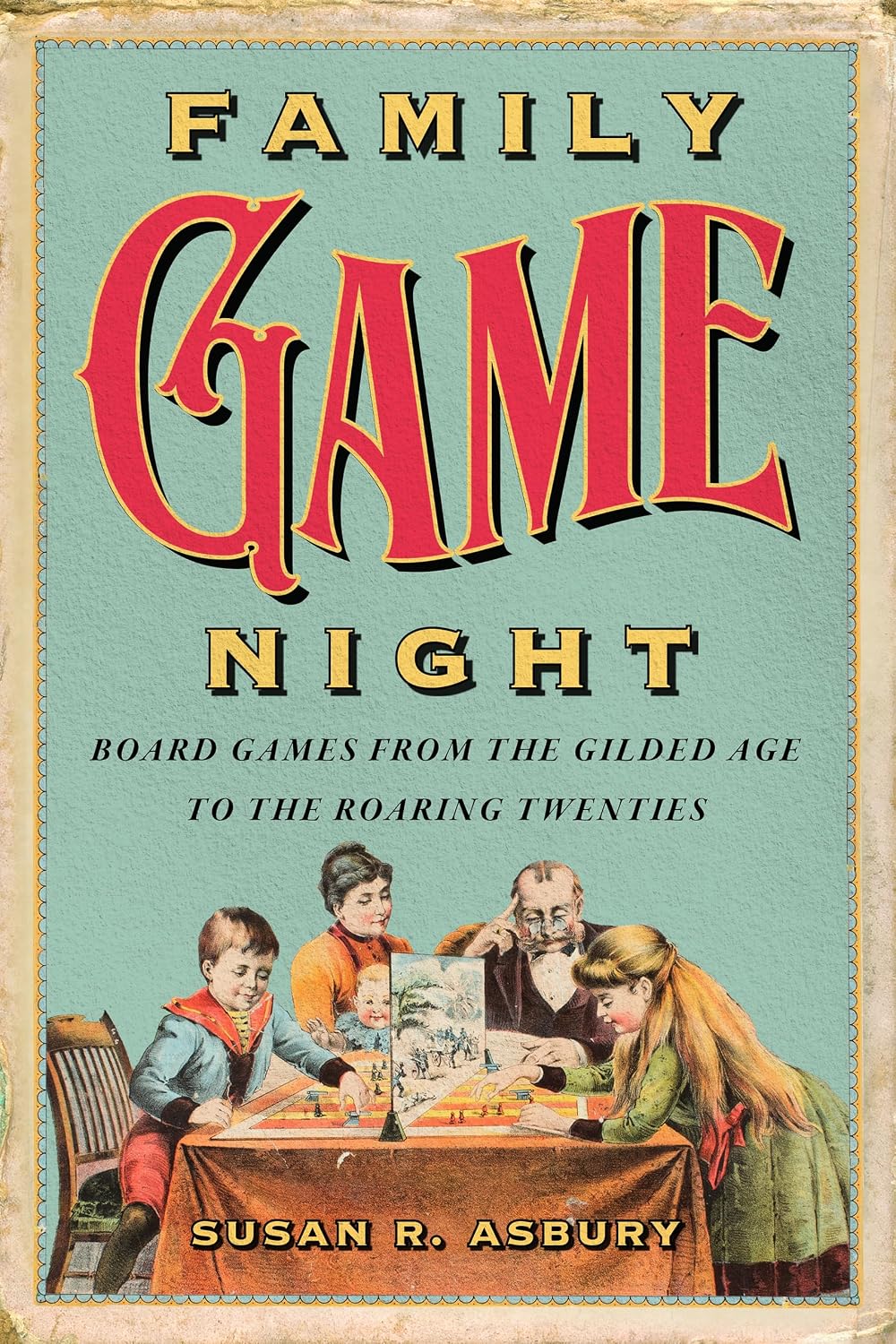
When I received an email from University Press of Kentucky soliciting a review for Susan R. Asbury’s new book “Family Game Night: Board Games From the Gilded Age to the Roaring Twenties,” I found the topic intriguing for several reasons. The Gilded Age is my favorite era of American history, and I had never read about the origins of board games from any era.
I should have read the fine print.
Fine print on the back of the book, states,
“During the second half of the nineteenth century, the rise of industrialization and a gendered division of labor set the stage for tastemakers, architects, and social reformers to elevate the home parlor as a as a space for leisure and family gathering. Board game makers and marketers capitalized on these trends by peddling a certain exclusionary brand of the American dream.”
Omitting the Obvious
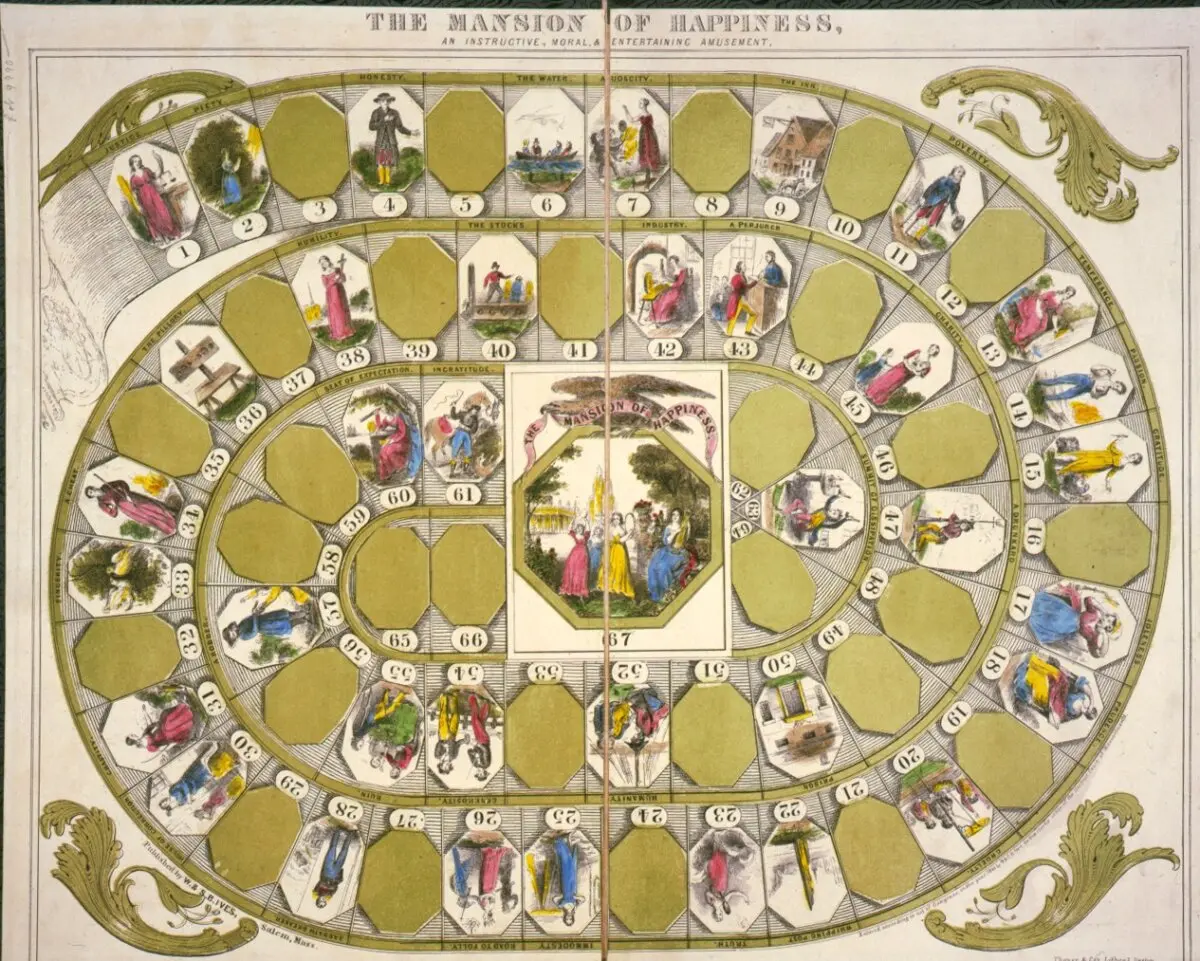
The book starts off well enough with her first two chapters, “Home Amusements” and “Mansions, Happy Old Age, and Fortune.” They discuss how board games and toys encouraged moral ethics and movement toward the middle class, and exemplified gender and social roles. According to Asbury, the games seemed designed to help turn children into productive citizens. This occurred during a time when, as Asbury noted, “nineteenth-century industrialization gave rise to a growing urban middle class that was predominantly white and Protestant.”Of course, identifying the middle class as white and Protestant during the Second Industrial Revolution is like informing the reader that the ocean is blue and wet. During the latter 19th century, whites made up nearly 90 percent of the American population and approximately 60 percent of them were Protestant. This reference to race and religion, among other societal traits, is what Asbury consistently and cynically pursues.

Heavy-Handed Absurdities
Asbury’s light touch in the first two chapters becomes heavy-handed in the final four chapters and conclusion. In the third chapter, the author covers America’s westward expansion through board games. She includes the long conflict between the United States and Native American tribes in games such as “Life in the Wild West,” “The Wild West Game,” and “The Game of Buffalo Bill.” Certainly this period, first among them being the wars, offers ample opportunities for criticism.It is not, however, the fact that Asbury uses board games to critique 19th-century military and geopolitical policies, although that in itself presents its own absurdities. But it is her capacity to read into the motivations of game manufacturers that poses an issue. She compares the weapons shown on the cover of “The Wild West Game”—bow, arrows, shield, and hatchet in one corner, and rifle, revolver, and saber in the other—and claims the imagery “signified a belief that the gun was a superior weapon and therefore better than bows and arrows for fighting and hunting for food.”
In “The Game of Buffalo Bill,” where buffalo heads located intermittently along a path of squares count for points, she claims that to land on the head and collect the point signified “killing the buffalo and eliminating a food source for Indigenous people.” The author indicates this game came out in 1898 but doesn’t mention that, at least for Yellowstone National Park, the U.S. Army had been actively protecting buffalo from poachers since 1886 and that Congress had passed legislation to protect the buffalo and other forms of wildlife in 1894.
Going for Capitalism
Regarding low wages, Asbury ends her book with attacks on capitalism. In her description of “Game of the Monopolist: Or Capital Versus Labor,” she explains the game’s objective was to accumulate enough wealth to “topple the Monopolist.” Asbury then suggests that when the winner defeated the Monopolist and the other players, it “effectively made that player a new Monopolist,” as if the two were one and the same. She notes the game encouraged a suspicion of monopolies, but trust in capitalism, “normalizing that perspective for middle- and upper-class players, comforting them with a sense that the economic system … offered ongoing opportunity … and eschewing the need for the more thoroughgoing reforms demanded by socialists and anarchists.”Games as a Plot Device
To be fair, there is credence to some of her claims. These board games often encouraged certain American values and ethics and attempted to condition players to certain policies, like the belief in Manifest Destiny or the wars against Spain and The Philippines (“Dewey’s Victory” and “The Philippine War: Crushing the Rebellion in Luzon”). There was certainly overt racism in games like “The Jolly Darkie Target Game” or “Jim Crow Ten Pins.” These latter games played into racism of the Jim Crow era, perpetuating an egregious perspective of black Americans. In this particular case, she refrains from speaking from the perspective of presentism.Asbury left clues throughout her book as to the real reason for this book. The board games are simply a plot device for critiquing America’s past. Although in her Conclusion, she indicates that her motivation may have been something far simpler and closer to home: She admits to contacting her son’s teacher about a game he was playing at school. The game was duly removed, but “only recently did that now-adult son remind [her] how upset his classmates had been at the outcome. The game had been popular with the students.”
For a book about games, it is far from a jolly read. If this is how family game night is supposed to go, put me in timeout.