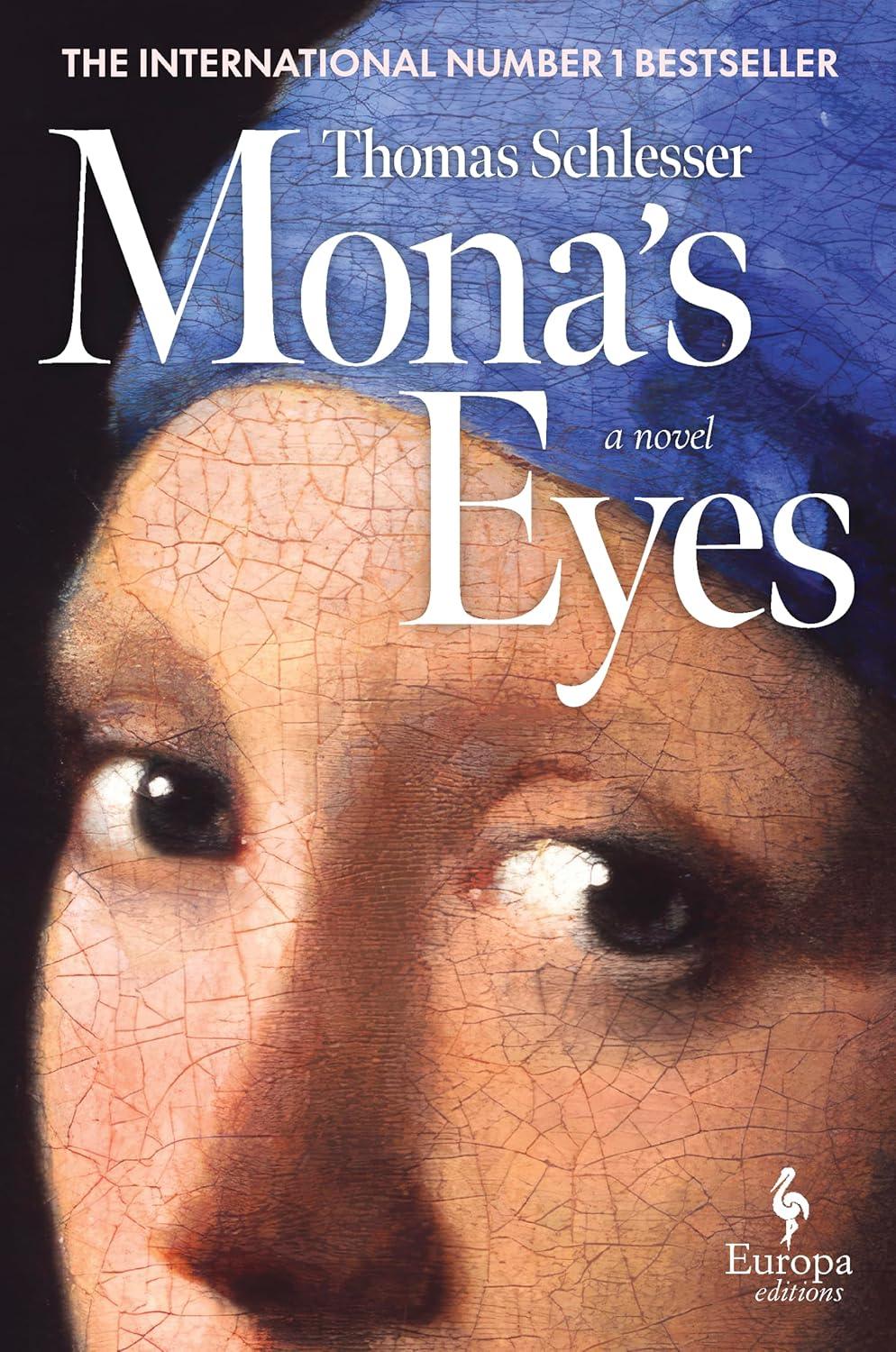
“Mona’s Eyes” by Thomas Schlesser is one of the most disappointing books I’ve reviewed this year. It’s one thing to be a bad book—something poorly written or one with a misguided premise. It’s another matter to promise and have the potential for greatness, then betray that trust for the author’s personal agenda.
The book begins with a pact between 10-year-old Mona and her grandfather, Henry Vuillemin, whom she affectionately calls “Dadé.” Mona has suffered a sudden, unexplained episode of temporary blindness, and doctors can find no physical cause.
Fearing her permanent loss of sight, Henry devises a secret plan. Instead of taking her to the child psychiatrist her parents believe she’s seeing, he escorts her each Wednesday to Parisian museums. They visit the Louvre, then the Musée d’Orsay, and finally Beaubourg (Centre Pompidou).
An Exquisite Premise
While Mona learns about the stories and ideas depicted in each painting or sculpture, she must also navigate the complexities of her 10-year-old life and school relationships simultaneously. But each rendezvous with Dadé is as much of a lesson in life as in aesthetics.Through Henry’s passionate, often deeply personal interpretations, Mona learns about generosity, melancholy, revolt, love, and resilience. The masterworks also mirror aspects of her inner world, serving as catalysts for her emotional and intellectual maturation.
How’s Your French?
One minor hurdle to overcome with “Mona’s Eyes” is the translation by Hildegarde Serle. She chose a more direct translation of the French rather than adjusting the wording to a more familiar American style of language, as most translators do. Perhaps she wanted to maintain the integrity of the natural poeticsm of the language and of Schlesser’s aesthetic aims?

For example, when the doctors can’t find a reason for Mona’s blindness, it’s described as: “The effect seemed to have no cause.” Regardless of the intention, readers unfamiliar with the rhythms of French grammar may find this style somewhat challenging to read.
The Last-Minute Soapbox
“Mona’s Eyes” is presented as a story about a young girl coming to terms with growing older and, ultimately, death itself. “In fact, that’s what we learn from childhood: loss … We think that growing up is about accumulating gains: gains in experience, in knowledge, material gains,” he says But, Schlesser argues, it’s all a delusion. “Living our life means being able to bid it farewell, at every second.” Statements like these make it easy to see why the book became so successful.However, readers learn in the latter half of the book that Mona’s grandmother’s death was due to assisted suicide or, as Schlesser puts it, euthanasia. Having a character die in the story this way is one thing, but proselytizing about the need to make it legal in France is something entirely different.
A story about a grandfather who wants to bestow on Mona the most beautiful memories imaginable is a glorious sentiment and a truly honorable goal. Injecting any political activism at the 11th hour, especially in such a loving and gentle tale, is garishly egotistical and dishonest.
It’s not like the morality of government-sanctioned assisted suicide should be self-evident to anyone; it’s a highly controversial issue, to say the least.
Right Art, Right Thinking
Looking back at Henry’s descriptions of each work of art to Mona, it’s also interesting to note that Henry consistently delivers his explanations with authoritative certainty. He uses definitive language—phrases like “this painting is saying,” “the lesson is,” or “what this work tells us.” He rarely qualifies his interpretations with hedging language such as “some believe,” “one might argue,” or “this could mean.”As an art historian and professor, Schlesser is undoubtedly well-versed in the generally accepted interpretation of these classical works; many of them, no doubt, come from the artists themselves. To be fair, Henry almost always begins the day’s lesson by inquiring about Mona’s thoughts about the art piece first. He checks in with her impressions and what emotions it evokes.
Yet almost every chapter ends with Henry’s didactic and erudite declaration of the unquestionable meaning of the work. Art can be interpreted in many different ways, can’t it? Does Schlesser feel he must instruct the younger generation on “proper thinking” or “the one truth” in both art and morals?
The larger message in “Mona’s Eyes” about seeking the beauty in everyday life and learning to let go is entirely is laudable. However, it shamefully bulldozes over an equally vital principle: Think for yourself, and discover what truth means.