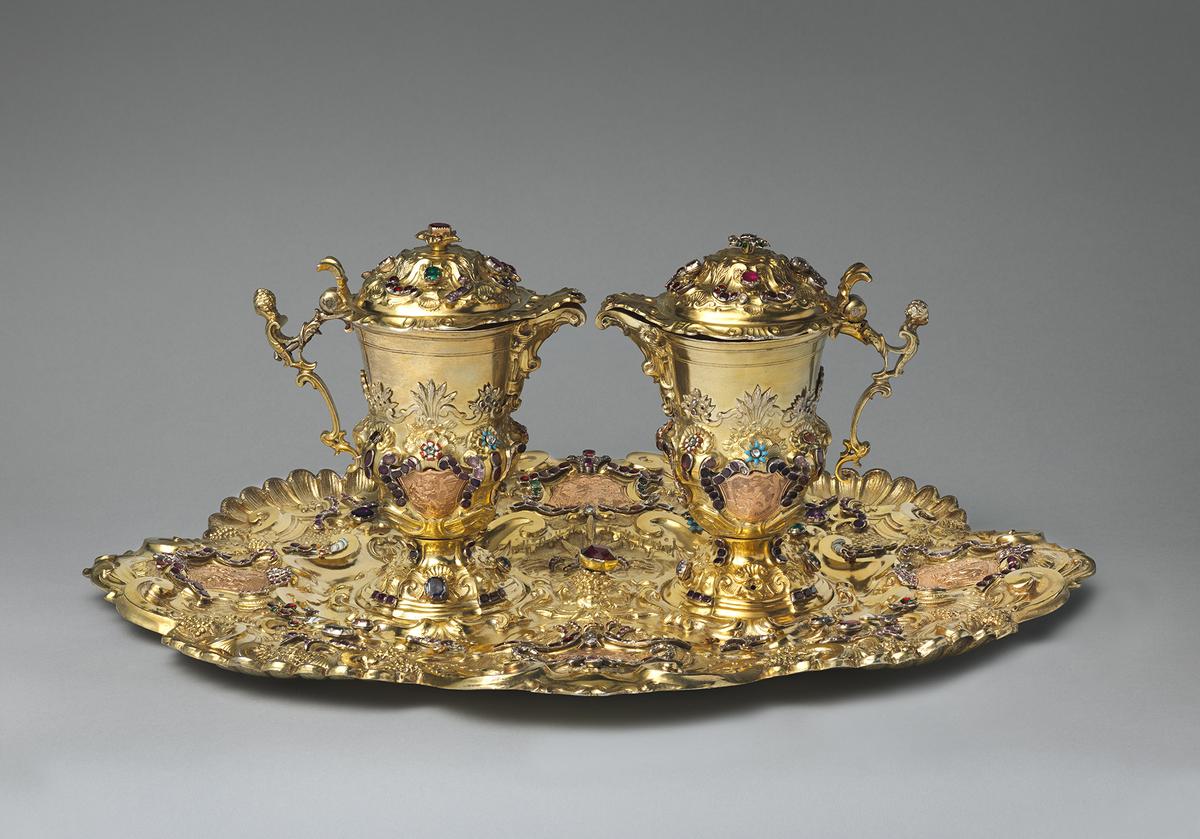
The spectacular exhibit “To the Holy Sepulcher: Treasures from the Terra Sancta Museum” has opened at the Frick Collection in New York City (on view through Jan. 5, 2026). It is the first presentation in North America of more than 40 dazzling objects made specifically for the Church of the Holy Sepulcher in Jerusalem. They were gifted to the church by European Catholic monarchs and Holy Roman emperors during the 17th and 18th centuries.
On view are sumptuously decorated vestments and superb silver and gold liturgical objects, many of which are gem-encrusted. The pieces are decorative art highlights from the Treasure of the Custody of the Holy Land. After the Frick exhibit closes, the artworks will travel to the Kimbell Art Museum in Fort Worth, Texas, from March 15, 2016, to June 28, 2026.
The Church of the Holy Sepulcher
The Church of the Holy Sepulcher is considered the holiest place in Christianity as it is believed to mark the site of Jesus Christ’s crucifixion, burial, and resurrection. It was originally built during the reign of Roman Emperor Constantine (272–337 A.D.) and has since been destroyed and reconstructed multiple times over two millennia. The Christian denominations that worship at and maintain the church today are Latin (Roman Catholic), Greek (Orthodox), Armenian, Syrian Orthodox, Coptic, and Ethiopian.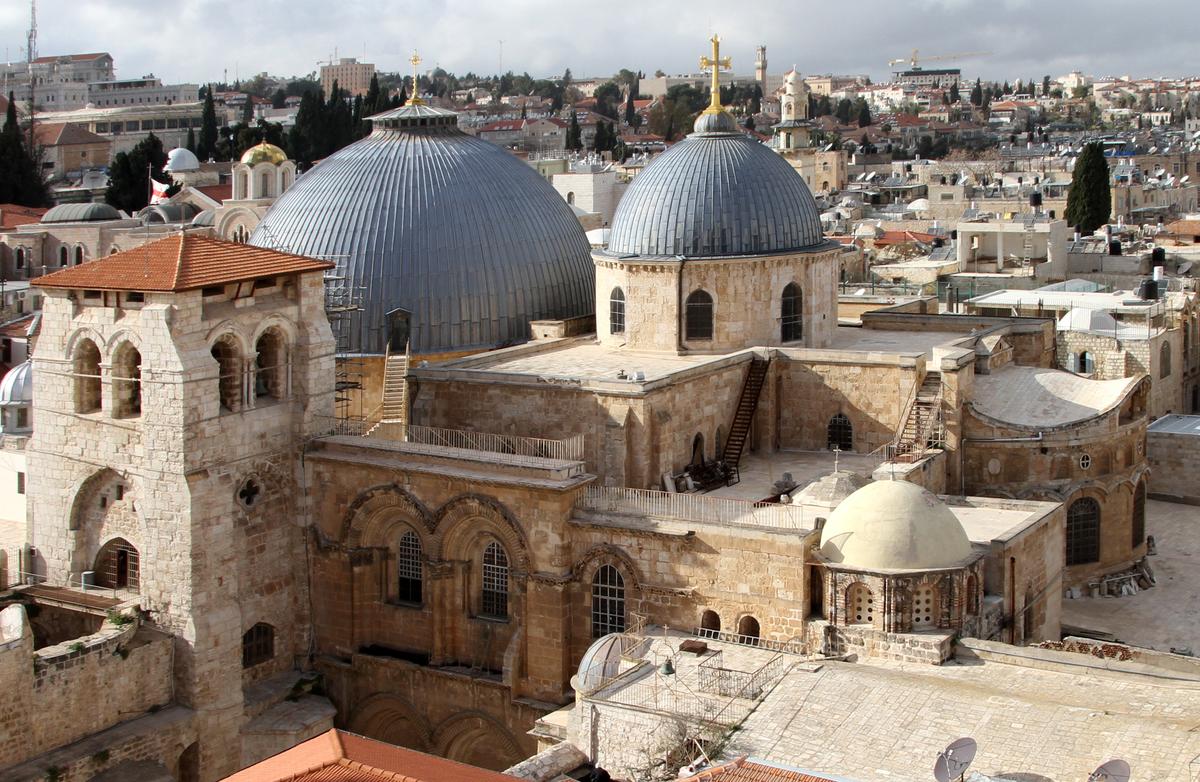
In the early 14th century, the pope placed the Franciscan order in charge of holy sites in the Middle East, including the Church of the Holy Sepulcher. This established the Custody of the Holy Land, which owns the objects, known as the Latin Treasure, that are on loan to the Frick. The Custody has cared for them for hundreds of years. In many cases, the Franciscan friars have used and still use items during liturgical ceremonies at the church. However, the existence of the Latin Treasure was unknown by international scholars until an art historian rediscovered and published information about the collection in the 1980s. Since then, its fame has spread outside of Jerusalem.
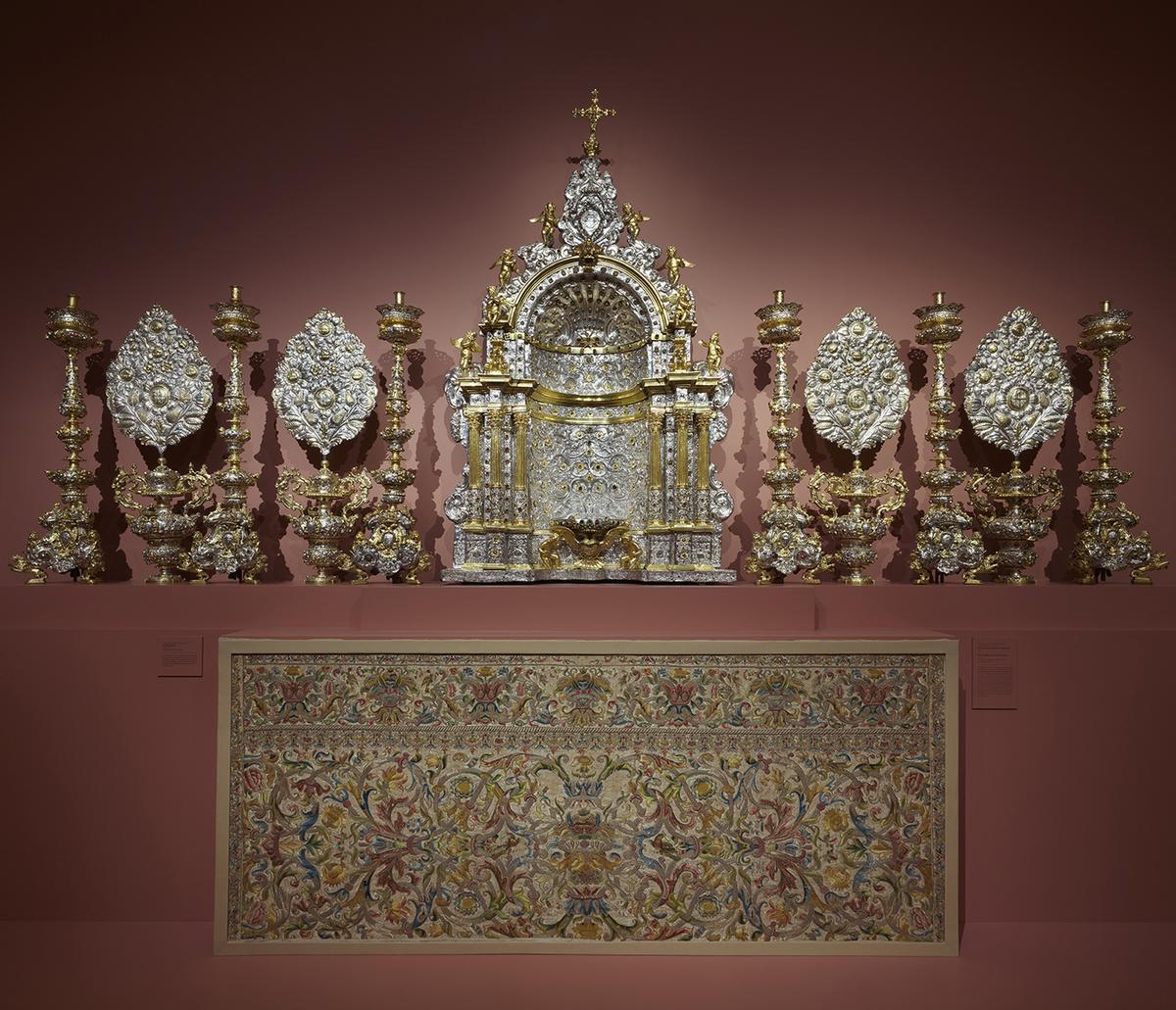
Most of the exhibition is organized geographically by the countries where the objects were made before they were shipped to Jerusalem during the 17th and 18th centuries. Commissariats of the Holy Land, organizations established in most Catholic European countries, were responsible for these arrangements. Represented in the exhibit are Spain, Portugal, the Holy Roman Empire, France, and multiple Italian kingdoms, since Italy only unified in 1861. Many of the exhibited artworks are among the greatest of their type and some are the only known surviving examples.
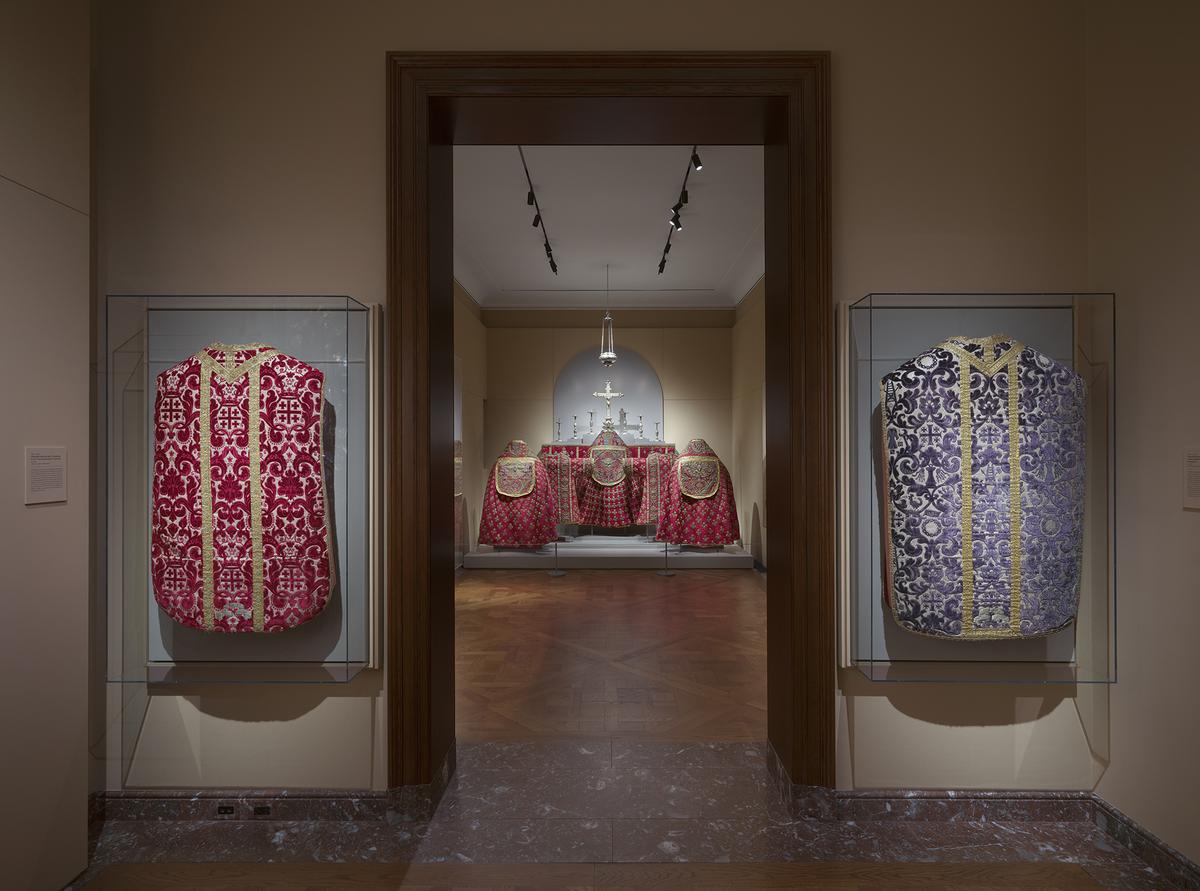
Sacred Vessels and Vestments
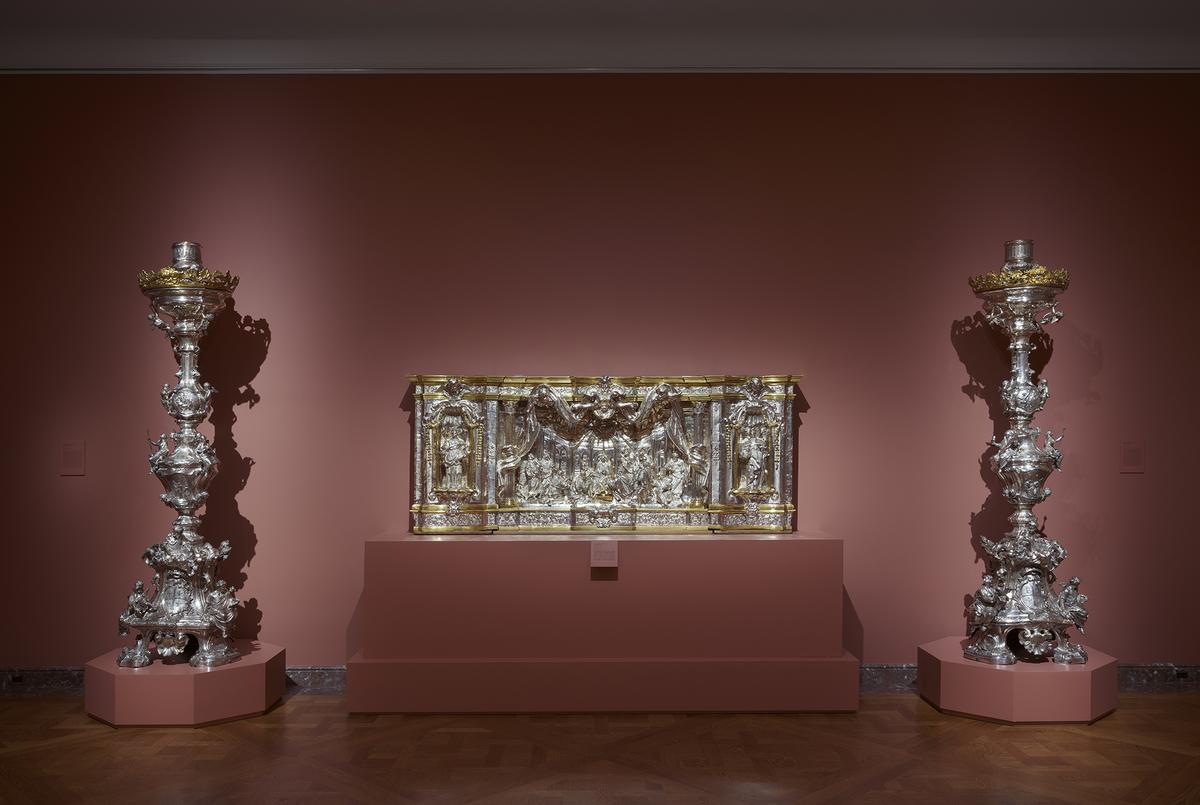
One of the three gallery rooms is devoted to sacred vessels and vestments from France. A group of objects—Large Sanctuary Lamp, Large Processional Cross, Six Altar Candlesticks, and Red Pontifical Vestments: An Antependium, Three Copes, and Two Dalmatics—are dramatically displayed as if during a Mass.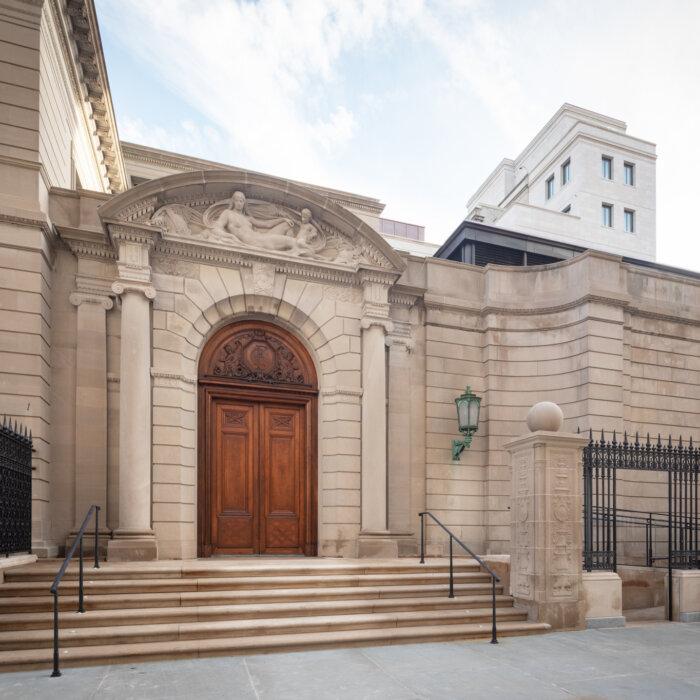
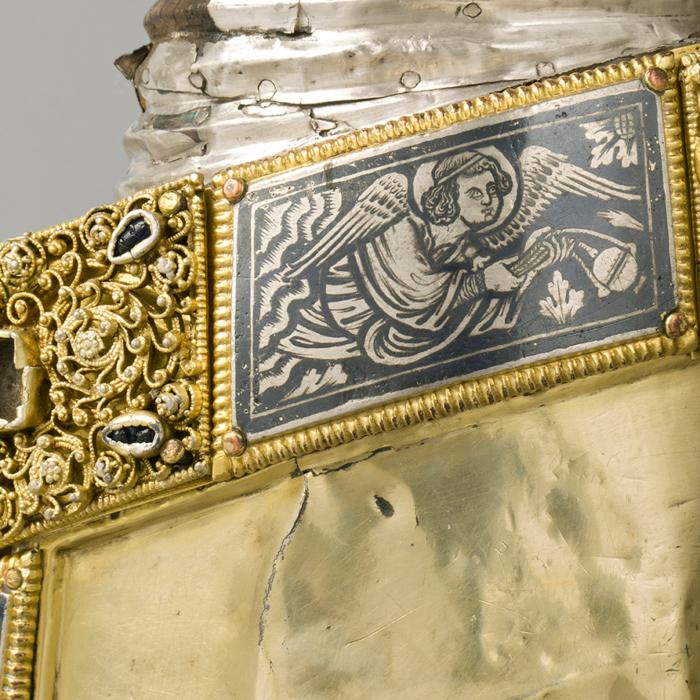
The Frick reads, “No other silver works or liturgical vestments of this importance survive from seventeenth-century France.”
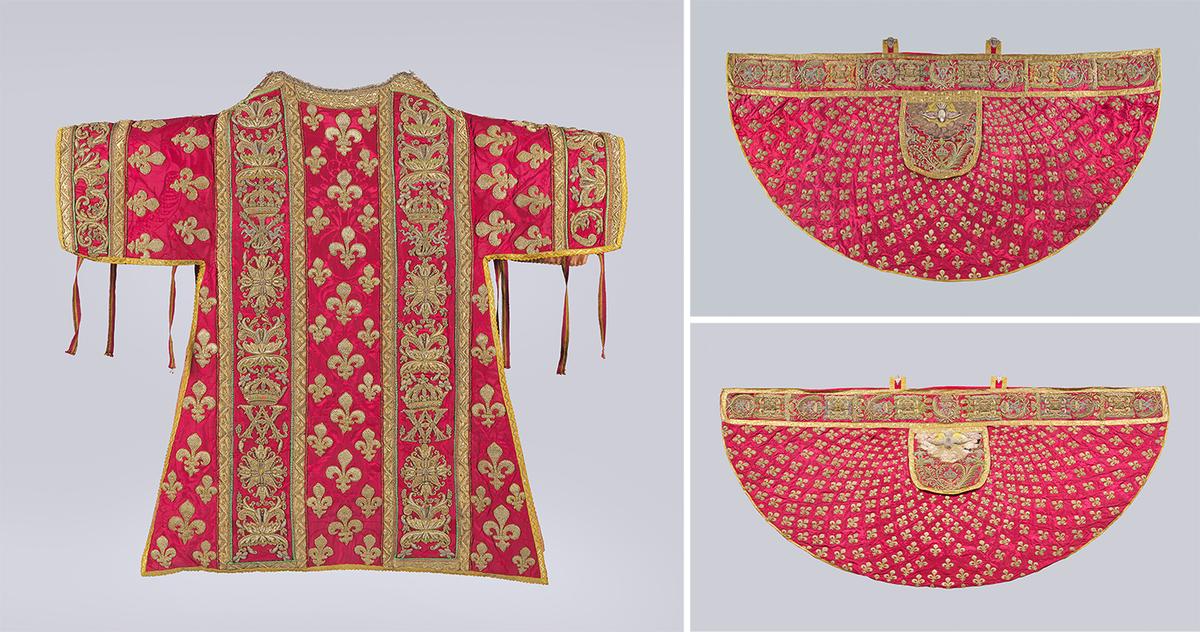
Magnificent needlework in gold and silver is visible on the two copes (worn by priests during solemn celebrations and processions) and one dalmatic (a sleeved garment worn by deacons). The textiles are adorned with the fleur de lis of France and the arms of France and Navarre.
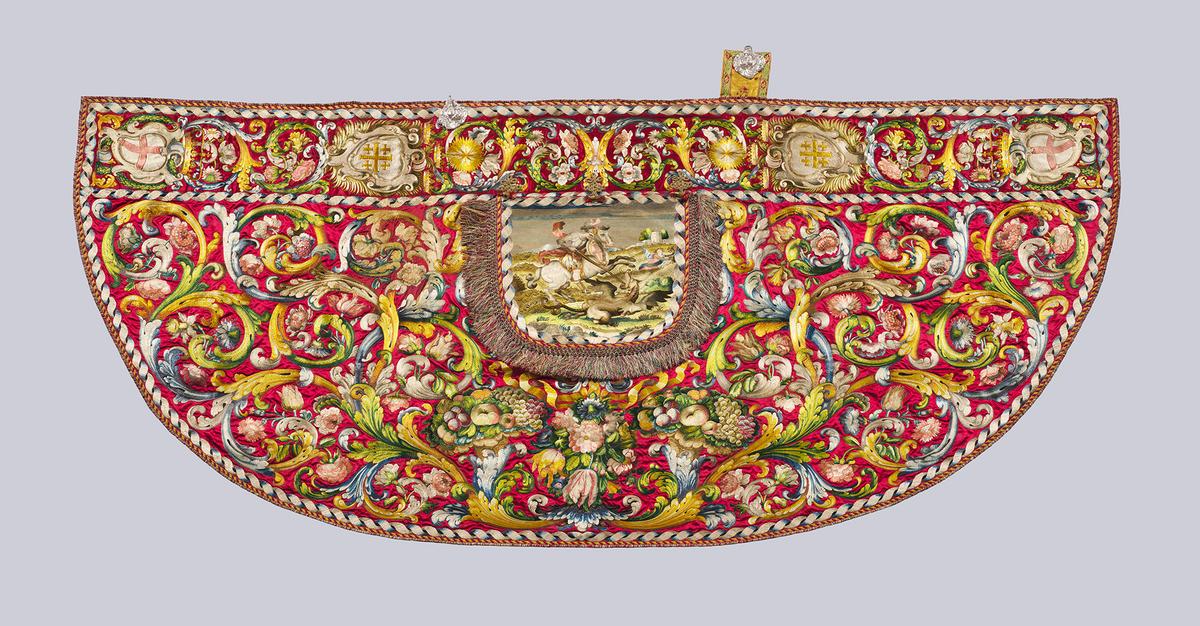
A beautiful gift from the Republic of Genoa in the late 1600s was a set of vestments. They were valuable not for their materials, given that no metallic threads were used, but rather for their great artistry in terms of design and embroidery. This ensemble’s cope is in the exhibit. At its center is a depiction of Genoa’s patron saint, Saint George, defeating the dragon. The rest of the cope features decorative elements: the arms of Genoa and of the Custody as well as interlacing scrolls with flowers and fruits. The scheme has a painterly quality, and it is believed to have been designed by the Genoese painter Domenico Piola and his workshop.
The Throne of Eucharistic Exposition
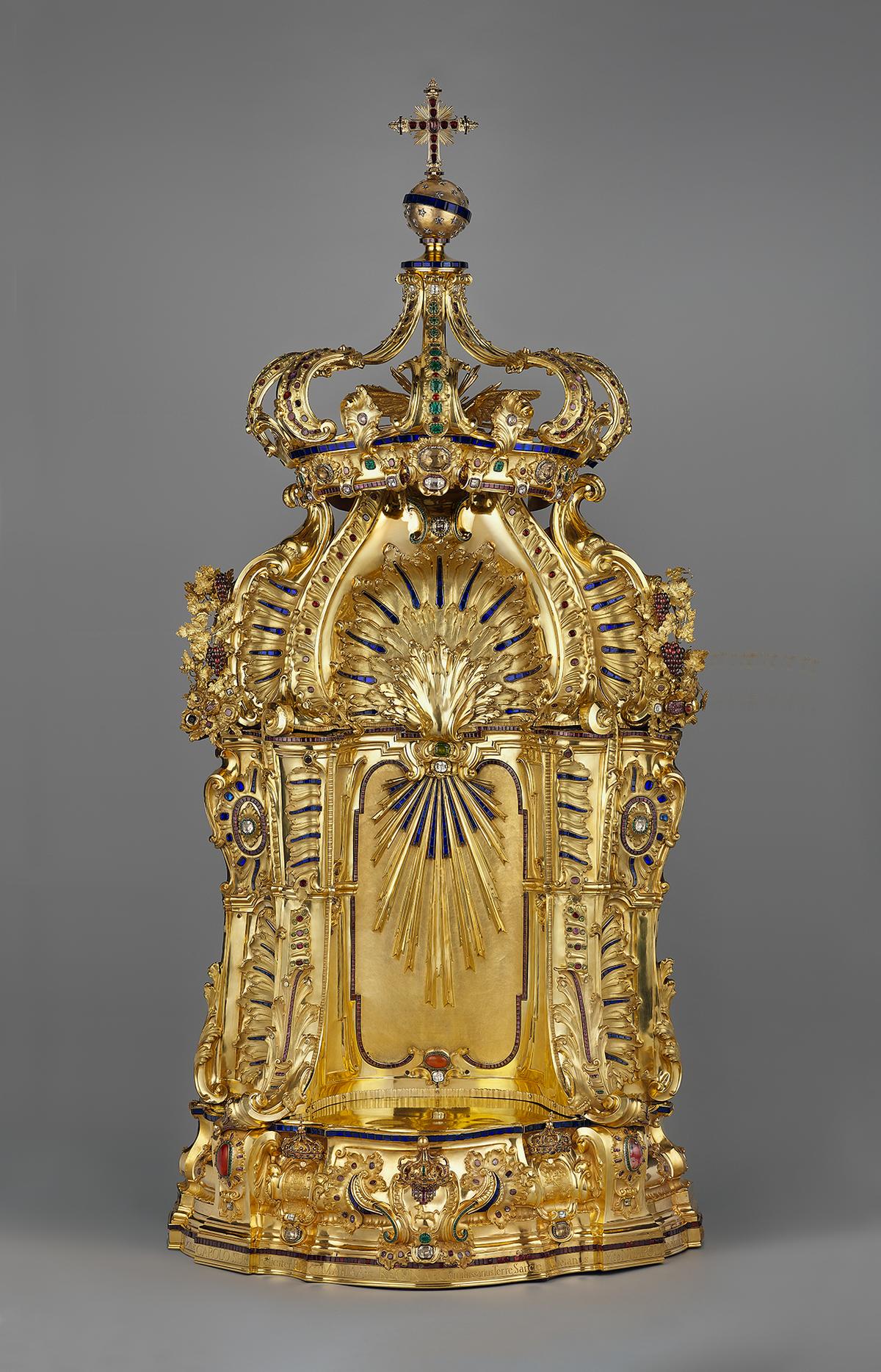
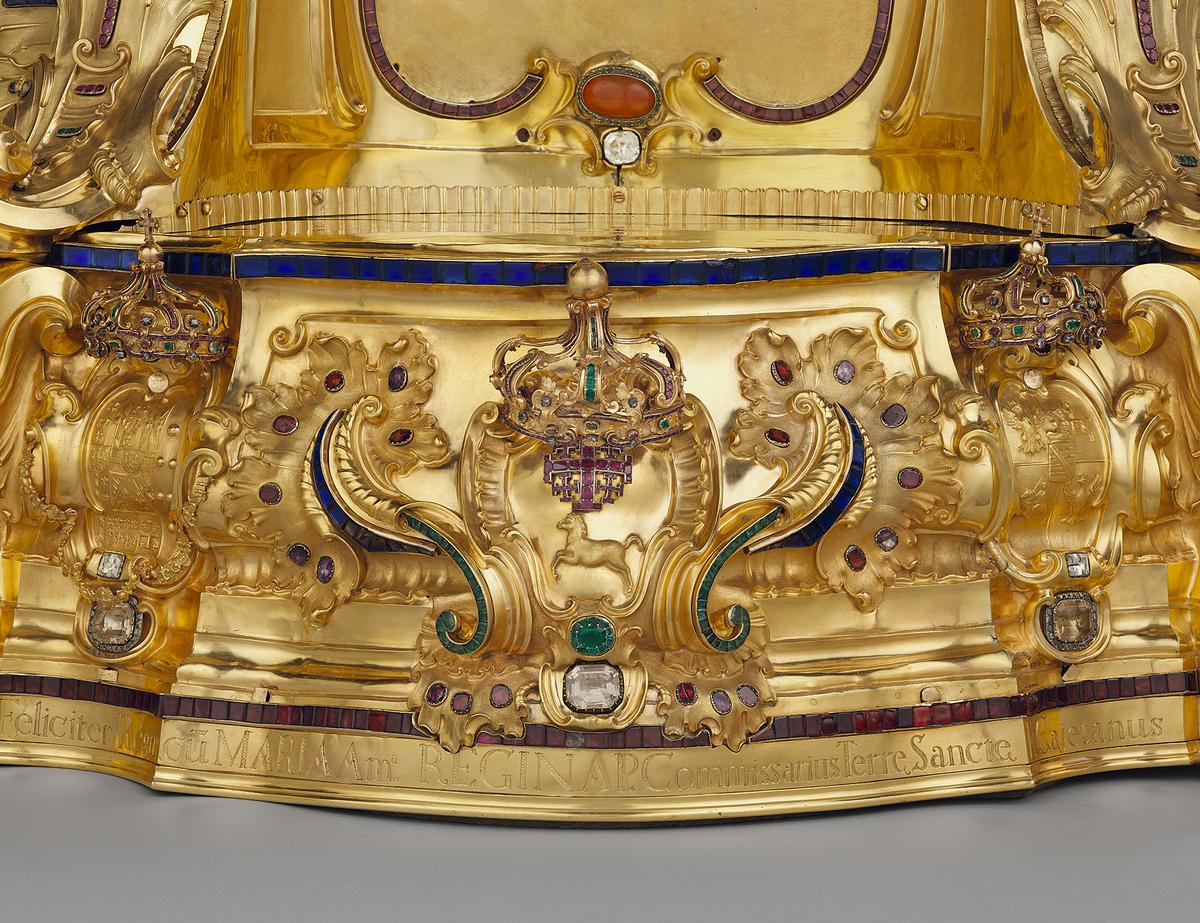
A high point of the exhibit is the gathering of four extravagant objects sent from the Kingdom of Naples in the 1740s and 1750s. The Throne of Eucharistic Exposition is made of gold and bejeweled with diamonds, rubies, rock crystals, emeralds, sapphires, amethysts, carnelians, peridots, and smoky quartzes.
The Frick reads, “Extraordinary for its size and the value of its materials, this is the most impressive object preserved today in the Latin Treasure and one of the most important survivals of eighteenth-century European goldsmith work.”
This structure, as is typical, includes an apse in which a monstrance can be situated to display the Holy Sacrament.
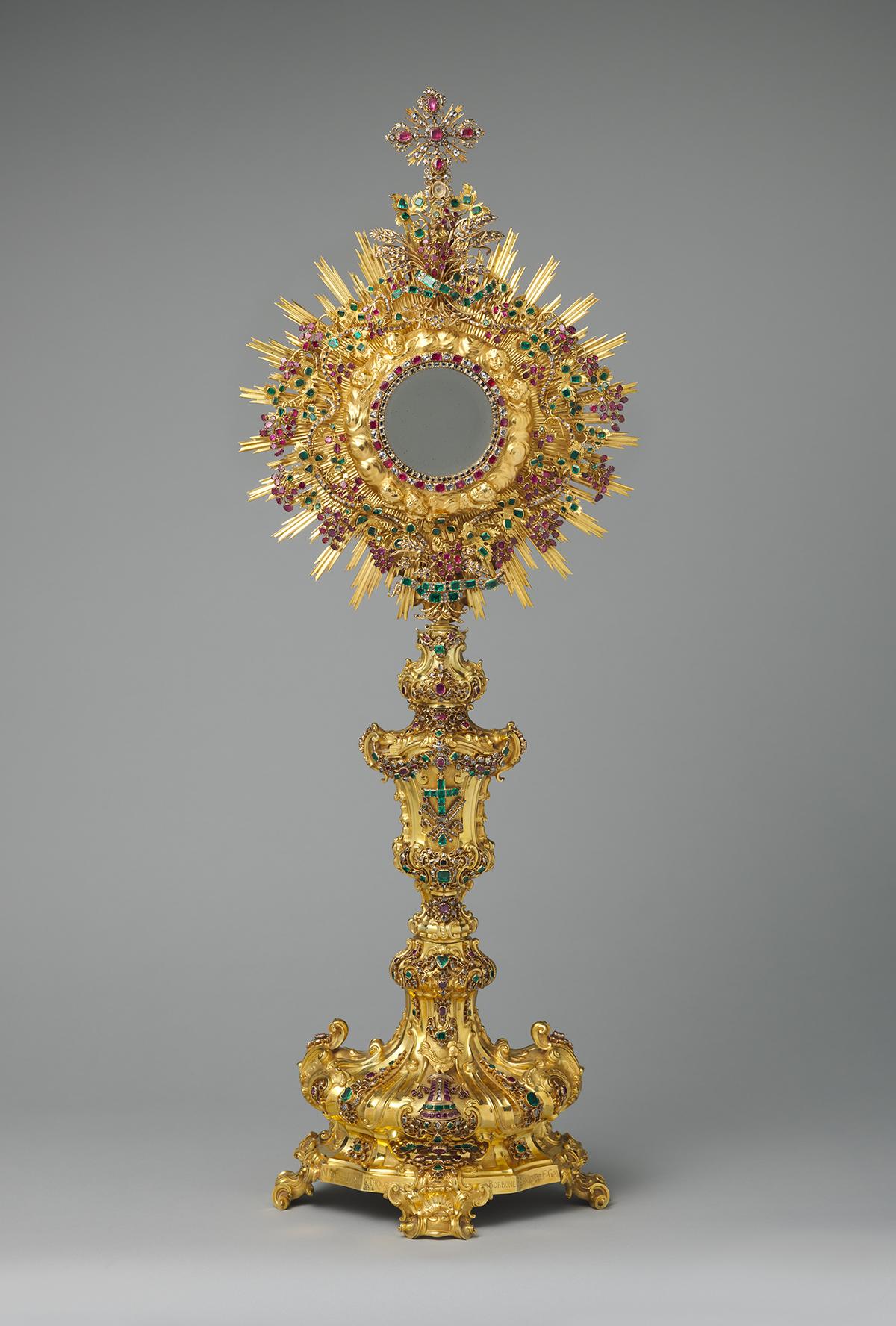
Naples had already sent Jerusalem an exquisite monstrance made of solid gold and studded with precious stones. This astonishing piece is in the exhibit, too.
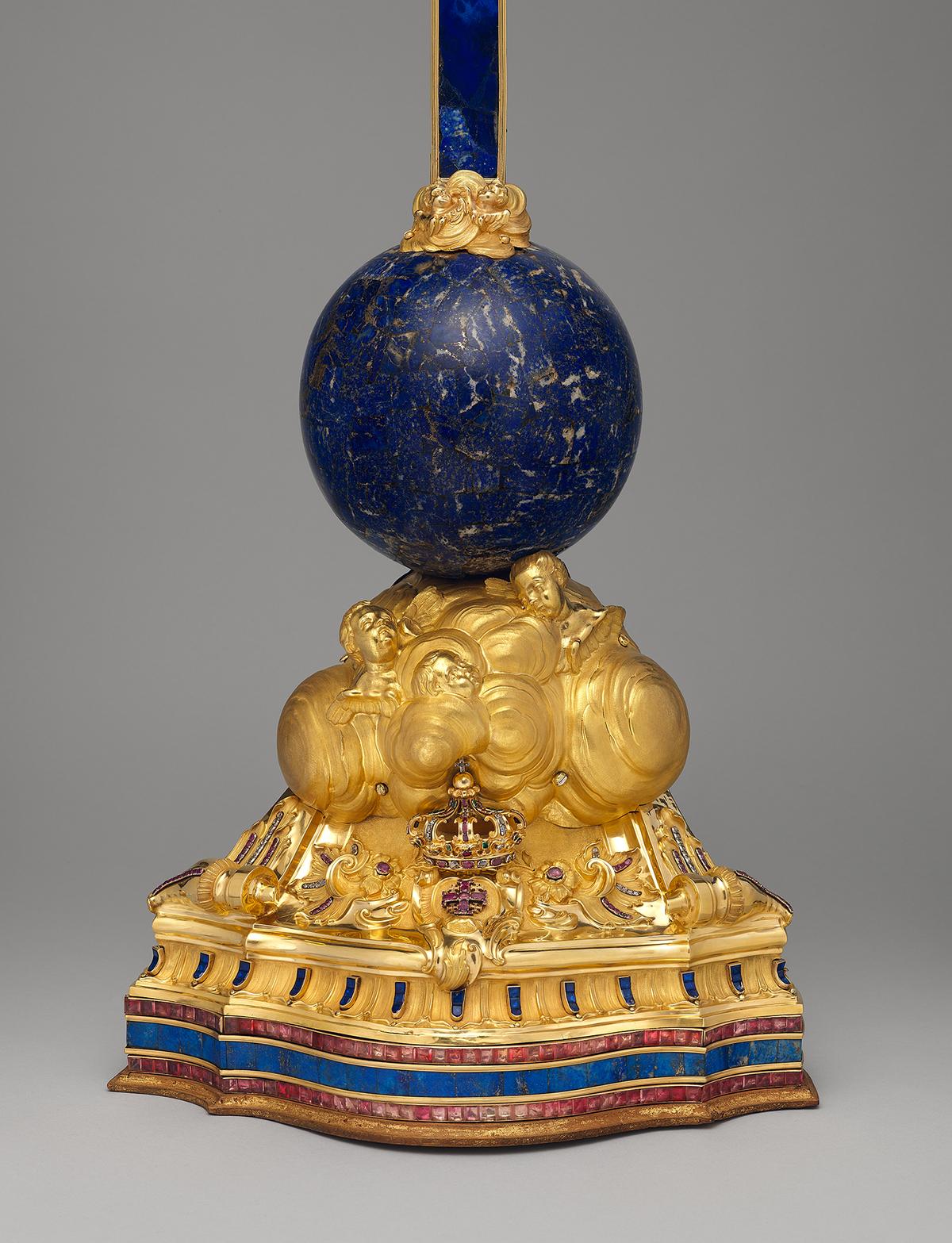
Instead of a monstrance, the Throne of Eucharistic Exposition can also display a crucifix in its niche, subject to the occasion. The Kingdom of Naples gifted Jerusalem a magnificent crucifix, which features gold and precious and semiprecious stones in addition to carved lapis lazuli. The crucifix’s base incorporates a royal crown, the Commissariat of Naples’s arms of a horse, and the Jerusalem Cross. Made of five crosses that symbolize the wounds Christ received during his Passion, the Jerusalem cross is incorporated into many of the exhibition’s pieces.
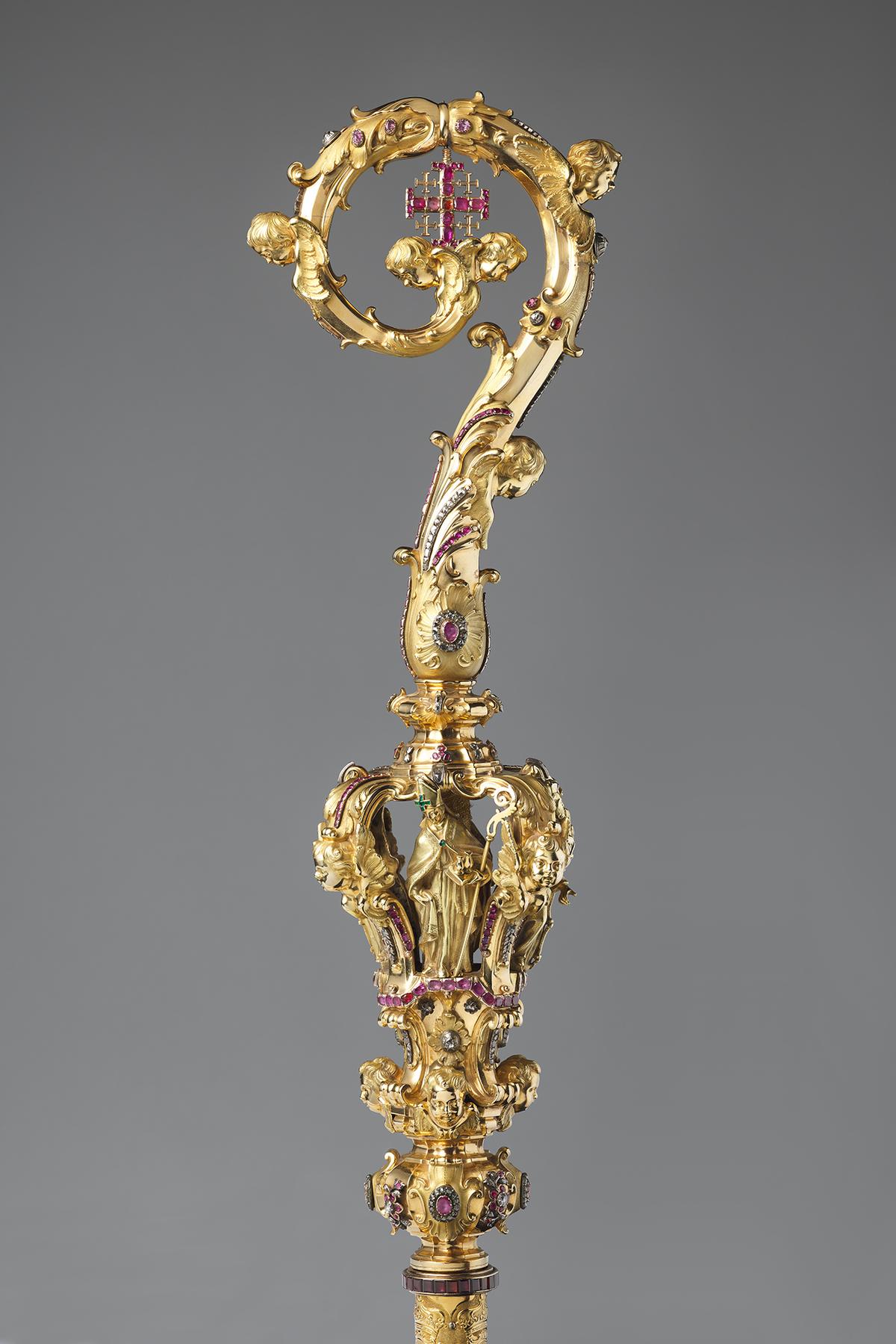
The fourth object is an incredible crozier. A pastoral staff, it was intended for use by the Custos (head of the Custody) during offices. There is no comparable surviving work by a Neapolitan goldsmith. In addition to its jeweled decoration, it showcases four statuettes. Three are of Franciscan saints—Francis of Assisi, Bonaventure, and Louis of Anjou—and the fourth is Naples’s patron saint Januarius.
The exhibit provides visitors with an opportunity to learn about religion, politics, and history through objects that exemplify the zenith of European artistry and craftsmanship during the 17th and 18th centuries.
“To the Holy Sepulcher: Treasures from the Terra Sancta Museum” is titled specifically to evoke the idea of pilgrimage. For much of its existence, the Church of the Holy Sepulcher was difficult for Christians to reach, as it was on land that was part of the Ottoman Empire. Many worshippers sent alms and gifts instead.
Even after the Empire’s fall, the existence of the Latin Treasure was kept discreet. Its survival over the centuries is remarkable, a testament to the Custody. The upcoming opening of the Terra Sancta Museum at the Monastery of St. Savior in Jerusalem will allow for a more permanent public display of these precious artworks.