On July 1, 1850, American artist William Sidney Mount (1807–1868) wrote in his diary: “I must paint such pictures as speak at once to the spectator, scenes that are most popular—that will be understood on the instant.”
Mount’s popular genre paintings capture the camaraderie of hardworking rural folk: jovial Long Island landowners, farmers, and farmhands tending crops, making hay and cider, and dancing, playing music, and merrymaking in bars, barns, and fields.
The Muse
Gifted artist Mount knew the power of music particularly well. He grew up in his Long Island family home filled with the sound of sweet melodies. His uncle Micah Hawkins was a poet, playwright, and composer for musical theater, and he played the flute, piano, and violin. Mount’s brother Robert was a dancing master. Mount played myriad instruments, including the violin, fiddle, piccolo, recorder, wooden flute, and fife. Throughout his life, he acquired over 500 music manuscripts, which doubtless inspired his original music scores.Mount believed he painted best when he played the violin often. On Feb. 16, 1863, he wrote in his diary: “I believe I must have a violin in my studio to practice upon. To stimulate me more to painting. … The violin was the favorite instrument of Wilkie. All the great painters were fond of music.” Here, Mount referred to Sir David Wilkie (1785–1841), the celebrated Scottish genre painter who was King George IV’s painter. Some of Wilkie’s best-loved works feature music makers, including “The Bag-Piper” and “The Blind Fiddler.”
Mount’s words ring true: Italian Renaissance artist Leonardo da Vinci and French neoclassical painter Jean-Auguste-Dominique Ingres were also accomplished musicians who loved playing stringed instruments.
Ingres’s virtuoso violin playing led to the French phrase “violon d'Ingres,” which literally means having a second string to one’s bow. French music critic G. Jean-Aubry explains it as “a secondary gift, or rather a taste which is, so to speak, adventitious; a taste to which the artist gives free reign during the spare moments left him by his own vocation.”
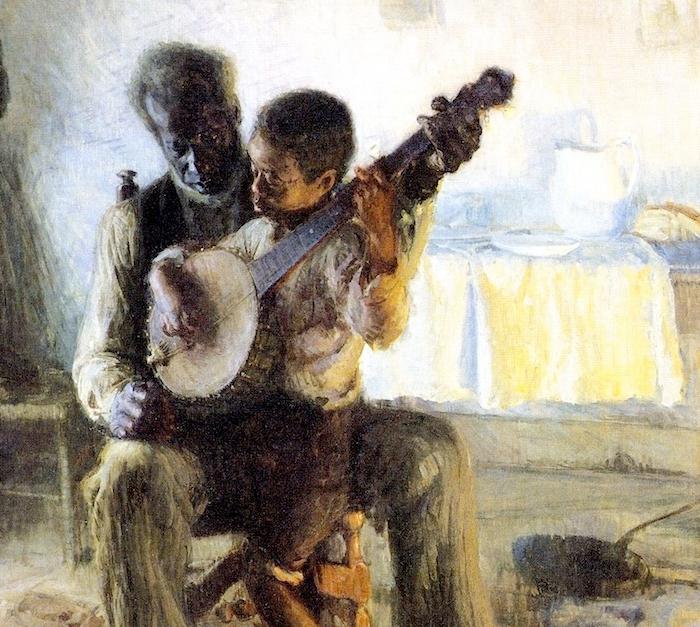

Ingres told his painting students: “If I could make musicians of you all, you would thereby profit as painters. Everything in nature is harmony; a little too much, or else too little, disturbs the scale and makes a false note. One must teach the point of singing true with the pencil or with brush quite as much as with the voice; rightness of forms is like rightness of sounds.”
Artist and art historian Giorgio Vasari wrote of Leonardo playing the lira da braccio, a bowed instrument the size of a viola, for the Duke of Milan: “Leonardo brought with him that instrument which he had made with his own hands, in great part of silver, in order that the harmony might be of greater volume and more sonorous in tone; with which he surpassed all the musicians who had come together there to play.”
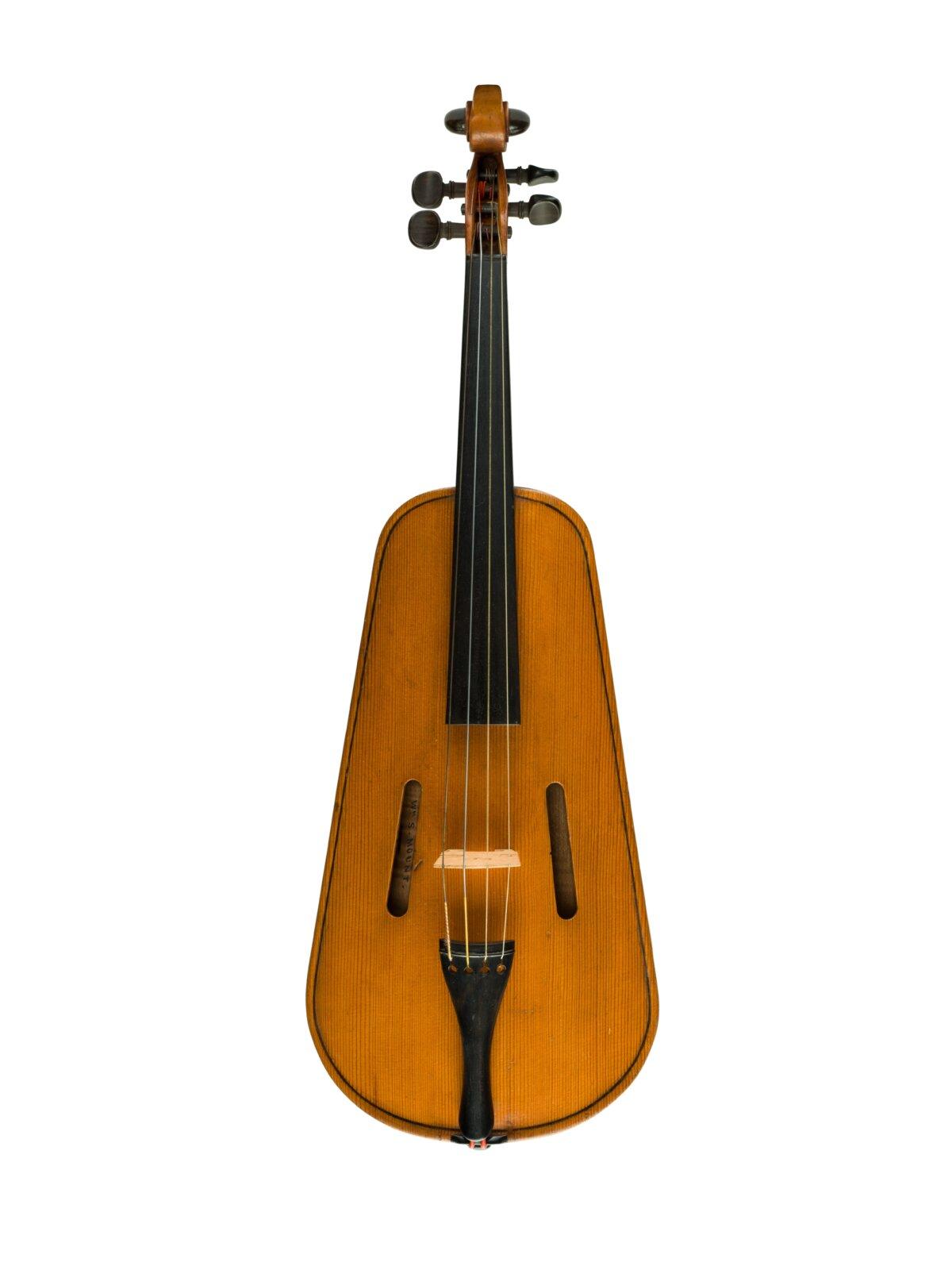
Like Leonardo, Mount created a stringed instrument. He invented and played a hollow-back violin and patented it as “The Cradle of Harmony.” He claimed his creation made a bigger sound, fit for foot-stomping country dances. According to the Smithsonian website, he knew “that a concave shape and a short soundpost [a dowel inside the instrument] would result in a fuller, richer, more powerful tone.”
‘The Power of Music’
Mount’s painting “The Power of Music” visually conveys what American poet Henry Wadsworth Longfellow meant when he wrote: “Music is the universal language of mankind.” In the painting, a farm laborer with his hat in hand has laid down his axe and jug to listen in on impromptu fiddling. Mount could have rendered the farm laborer tapping his toes in time to the tune, but instead he painted him actively listening, lost in the music.The farm laborer’s clothes contrast with the other men’s attire, but his countenance mirrors their musical sensibility.
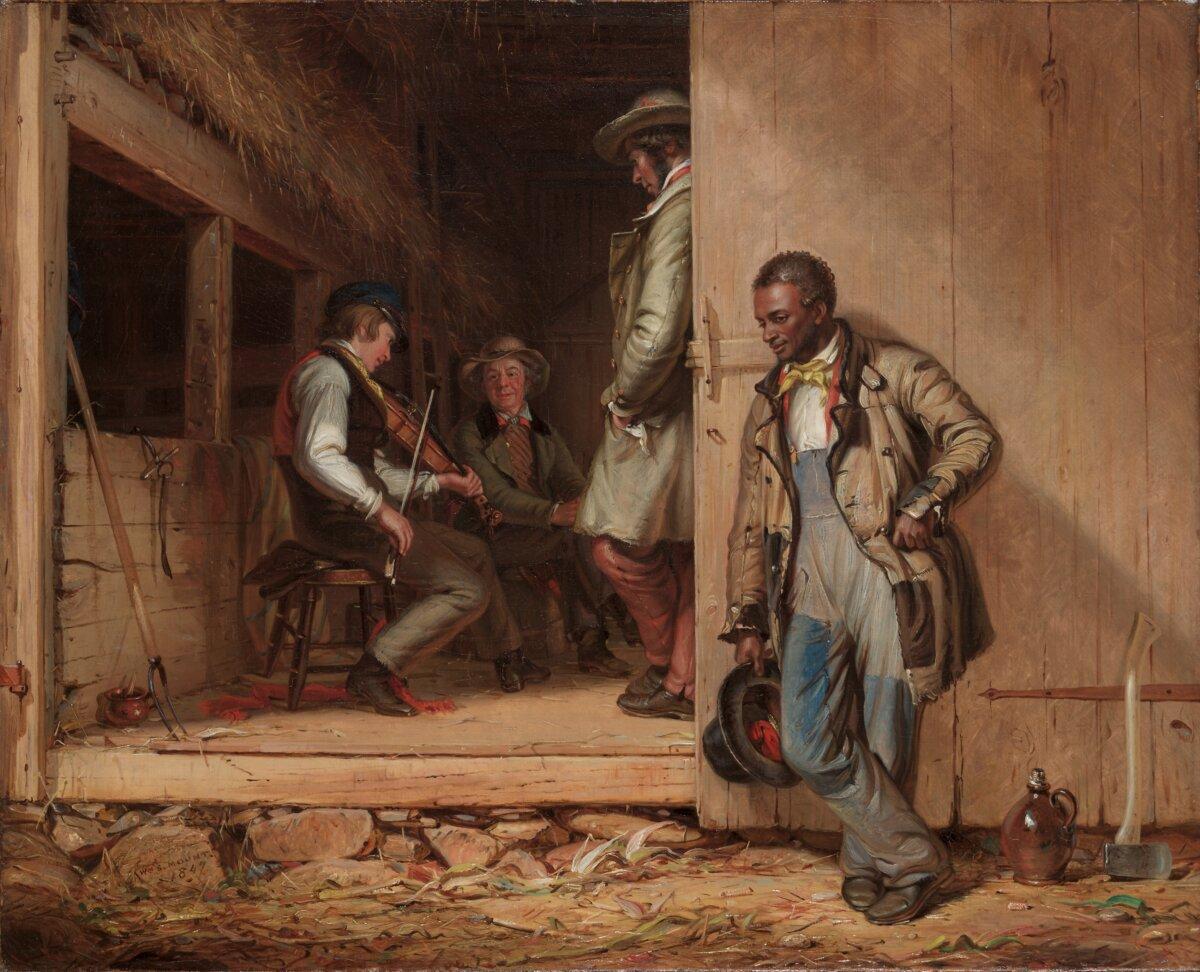
Mount arranged the fiddler, the standing man, and the farm laborer in a triangle. The farm laborer’s arm casts a shadow on the wall, highlighting the bottom of that compositional triangle. His pose echoes the standing figure inside the barn. Renaissance masters such as Leonardo used triangular arrangements in their compositions, especially in Madonna and Child paintings, to create harmony. The composition also echoes the Dutch Golden Age tradition of genre paintings featuring eavesdropping, wherein a maid peeks through a series of doorways or peers around a curtain at her employer.
European Traditions With American Flair
Even though Mount never left the country, he adopted a European style of painting with an American flair starting with his formal training and continuing throughout his life.At 18 years old, he enrolled at New York’s National Academy of Design. There, he learned the foundations of European art traditions, often copying engravings of great artworks via French and British lithographs.
He kept abreast of European techniques in America by connecting with well-traveled New York artists and collecting a sizable reference library of lithographic prints throughout his life. But he stayed in Stony Brook, Long Island.
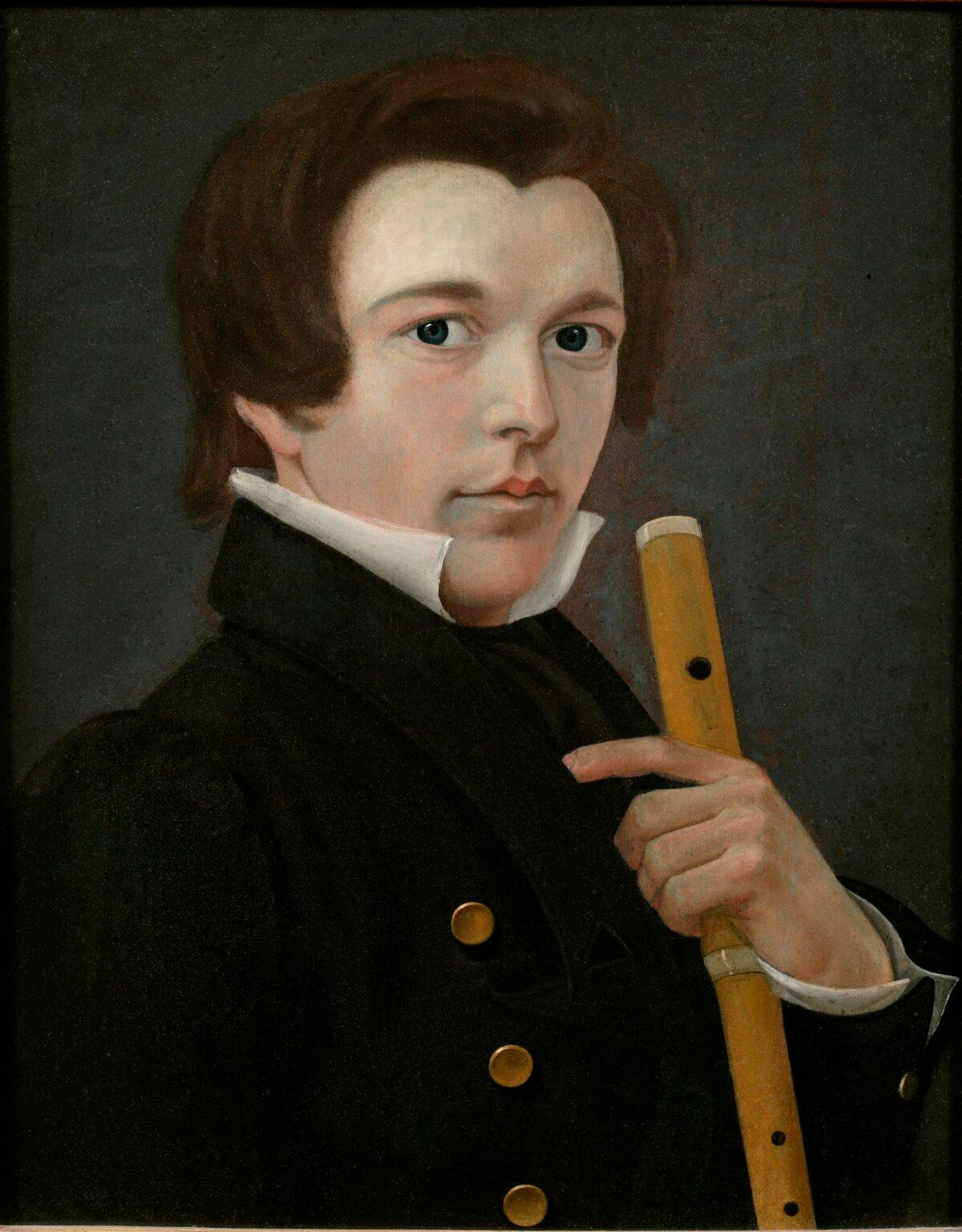
A fresh-faced self-portrait of the 21-year-old artist with his wooden flute follows the Dutch tradition of three-quarter-length portraits.
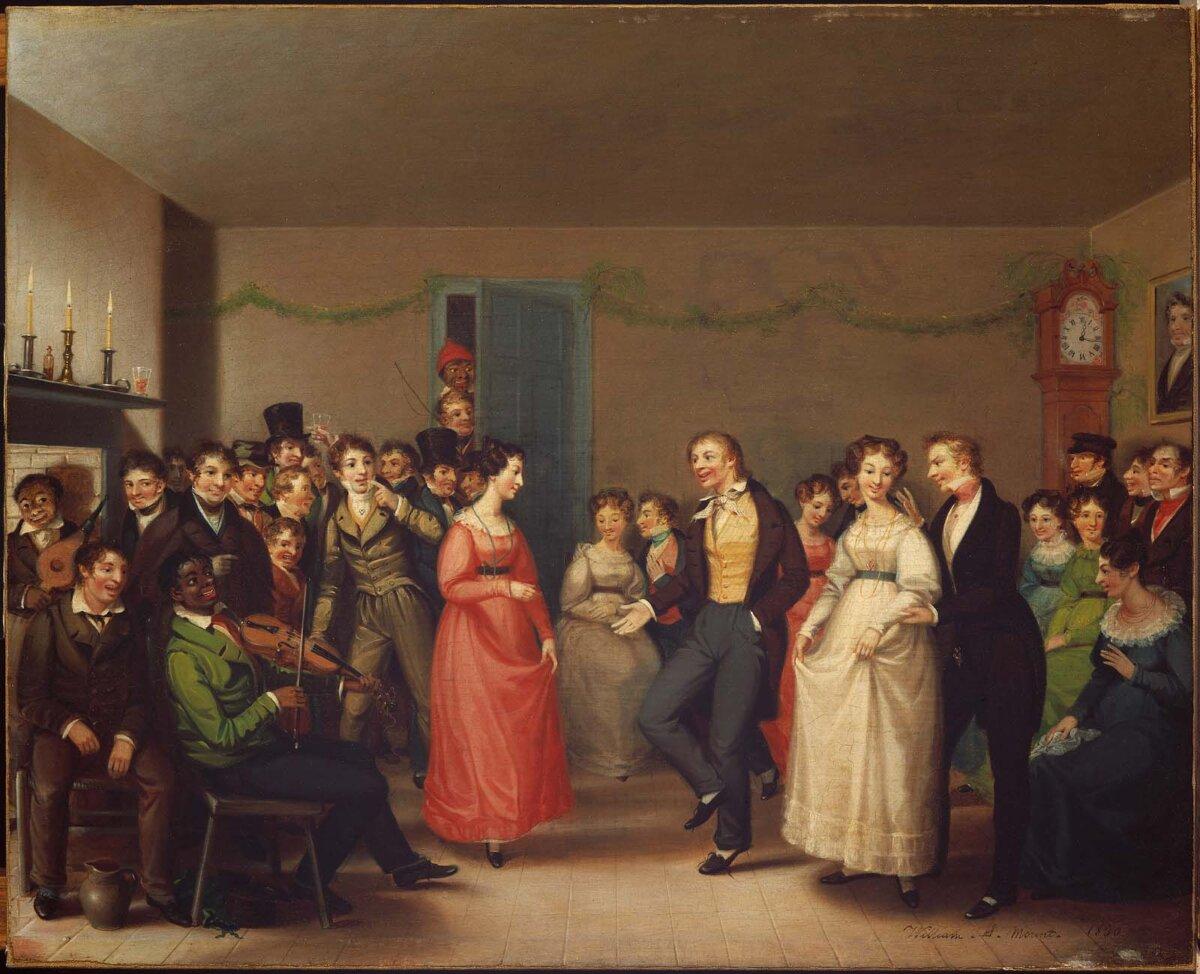
Mount was 23 years old when he won his first award at New York’s National Academy of Design exhibition for a painting titled “Rustic Dance After a Sleigh Ride.” He set the romantic vignette in an inn, in a composition that mirrored the main room of the Stony Brook family home where he lived from 6 years old to his teenage years. The painting demonstrates Mount’s early folk-style figurative painting and is in stark contrast to the sensitive handling and realistic rendering of the portraits that popularized his later works and commissioned lithographs.
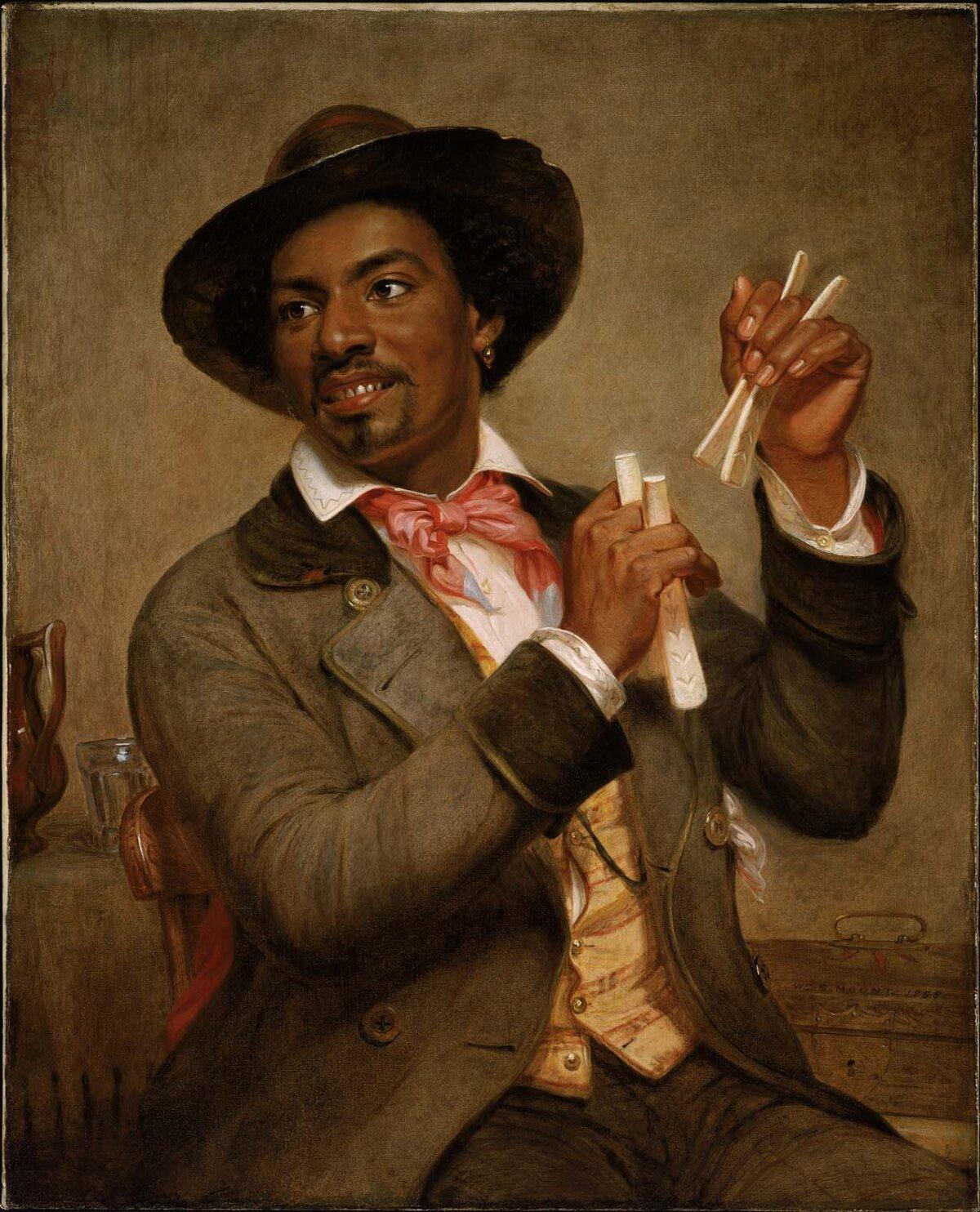
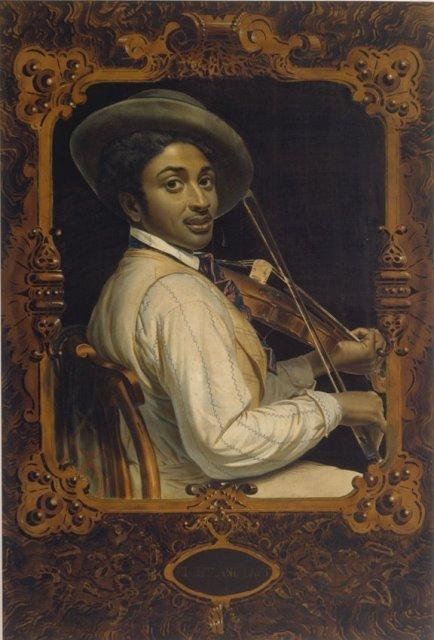
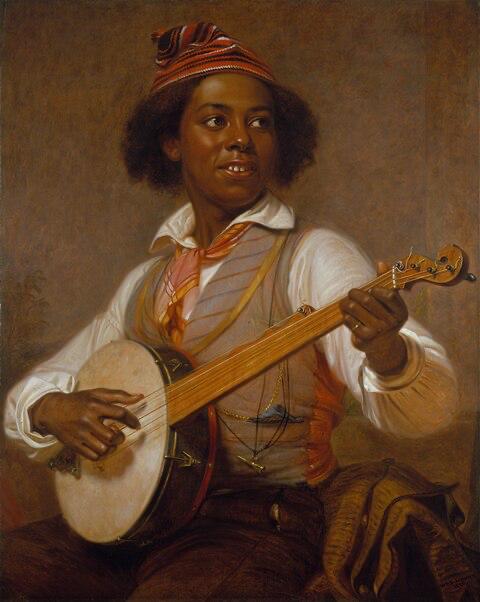
The Paris firm Goupil, Vibert & Co. commissioned several lithographs from Mount, including “The Banjo Player,” “The Bone Player,” “Right and Left,” and “Just in Tune.”
In “Just in Tune,” he painted a man happily tuning his instrument, adjusting the pegs. As a consummate violinist and fiddle player, he could paint the exact hand gestures needed for the fine tuning. He even detailed the flamed wood grain on the instrument.
Mount’s “Right and Left” features a candid portrayal of a left-handed fiddle player, playfully overflowing the picture frame. Sometimes the painting appears in reverse, as a right-handed fiddler, due to a printing error that flipped the image.
Painting True to Nature
The strength of Mount’s painting practice also lies in his insistence on painting true to nature.In an undated diary entry he wrote: “An artist in painting a landscape in the open fields is animated by nature and can do more in the right spirit, in the same length of time, than he can possibly accomplish in his paint room from memory or from his sketches.”
Mount believed that he was the first American artist to paint studies “in the open air with oil colors.”
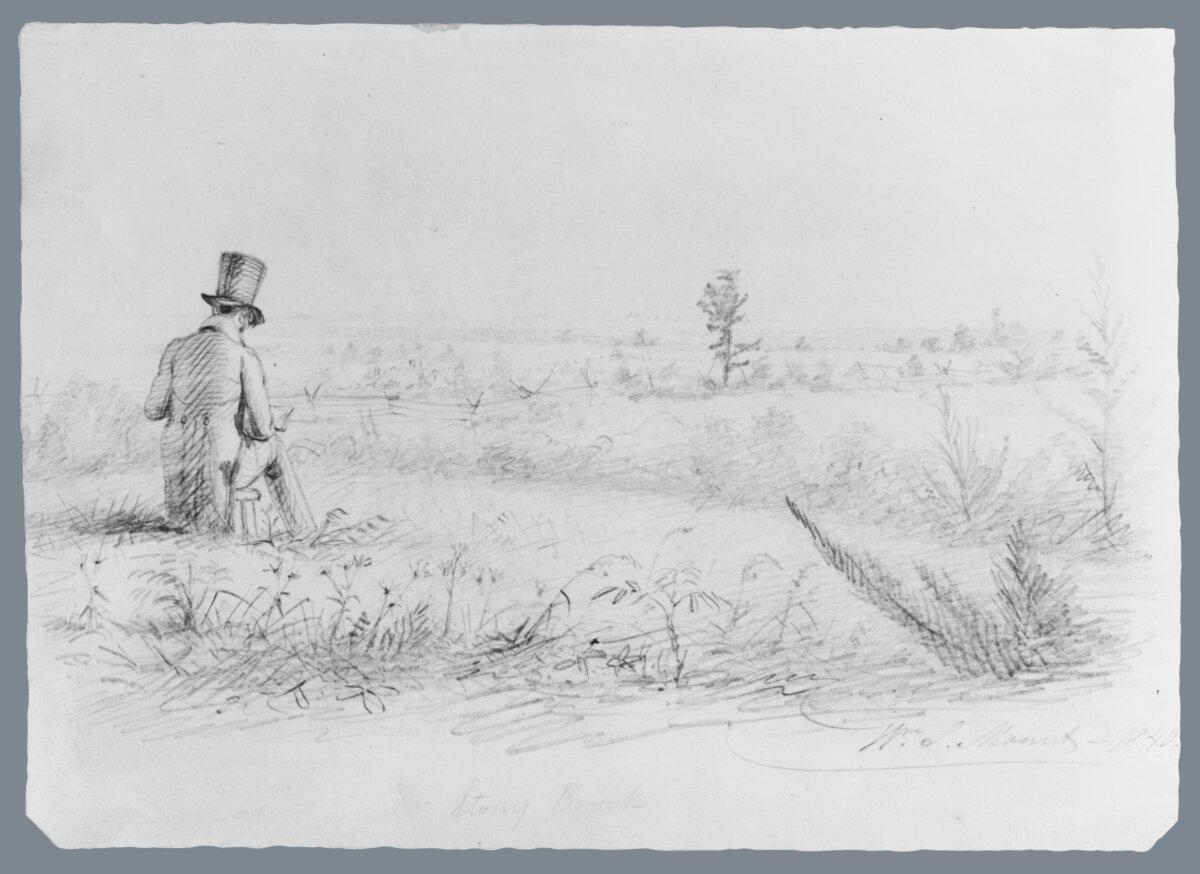
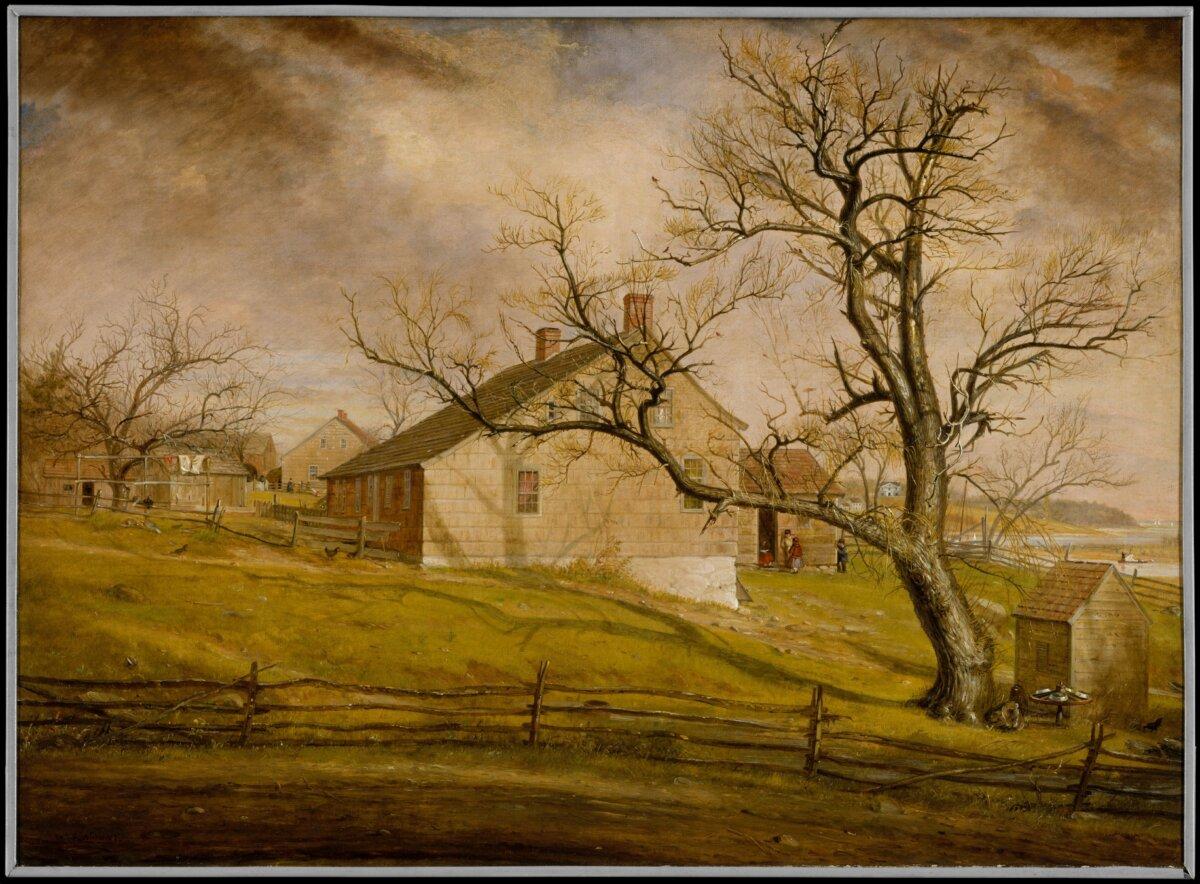
In a rare departure from his portraits and genre paintings, Mount rendered the idyllic Setauket countryside and his brother’s home in “Long Island Farmhouses.” He painted it in a wooden studio on wheels that he had designed so he could concentrate on painting nature without having to swat away the incessant Long Island bugs. According to the Metropolitan Museum of Art, “He chose to commemorate the tranquility of the village in early spring, in contrast to the turmoil of the Civil War, which was raging at the time.”
Music played a major role in Mount’s life and his art imitated it. He made the intangible tangible through his musicality, turning paint on canvas into almost audible rural soundscapes.