Jacqueline Cochran (1906–1980) endured a very difficult start to life. Raised in poverty by Ira and Mary Pittman, she was later informed that the Pittmans were actually her foster parents. The Pittmans moved from state to state—Florida, Alabama, Georgia—settling wherever work could be procured. She found herself working in a cotton mill at the age of 8. It was only then that she was able to purchase her first pair of shoes. Her dresses were made of old flour sacks. Despite such a childhood, which saw her drop out of school at age 9, Cochran (whose name was then Bessie Pittman) possessed beauty, a beaming personality, and a relentless work ethic. The combination of these three, along with a knack for entrepreneurship and adventure, would guide her to one of the most successful and daring lives of the 20th century.
While in Florida as a child, she began working at a beauty shop, and began cutting clients’ hair at 13. By 14, she became one of the few in the country who was skilled at operating the permanent-wave machine. Also, at age 14, she married Robert Cochran, and gave birth to a son three months later.
A New Place, a New Name

It was in New York City that Bessie Cochran changed her name to Jacqueline Cochran. She also maintained that she was an orphan, which was technically true. Although she kept her family life private, she maintained contact with the Pittmans, and even assisted for the Pittmans’ children and grandchildren financially.
With a change of scenery and a change of name, Cochran began working at a high-end beauty salon in 1932. Rubbing shoulders with wealthy patrons, her personality won her favor with many clients, who often hired her to come with them on trips.
Cochran soon began developing her own cosmetic line. During one trip with a client, she met Floyd Odlum, a successful businessman, at a party in Miami. When she discussed her plans for her cosmetic line, he suggested she should learn to fly so that she could deliver her products around the country as a way to get ahead of her competition. She thought the idea was brilliant. She signed up for flying lessons and earned her pilot’s license in three weeks, well ahead of the typical three months. She followed that by earning her instrument rating as well as her licenses as a commercial and transport pilot.
A Competitive Edge
In 1934, she entered her first race—the MacRobertson Air Race, which began in London and ended in Melbourne, Australia. Although mechanical failures forced her to land in Romania, it proved to be the first of many races.In 1935, Cochran established her cosmetic line, Wings to Beauty, in Chicago, Los Angeles, and, eventually, on New York City’s Fifth Avenue. Despite an expanding and successful business, Cochran continued to look for ways to enter the cockpit.
The same year that she founded Wings to Beauty, Cochran entered the prestigious and highly competitive Bendix Race, a transcontinental air race from Los Angeles to Cleveland. When she was informed that women were not allowed to compete, she obtained a signature from each pilot stating they had no issue with her racing. After submitting this impromptu petition, she was permitted to compete. Again, engine trouble forced her to land prematurely, but she was thrilled to have competed and was inspired to continue doing so.
Apparently, she did not simply inspire herself to compete, but other women as well. The next time she competed in the race, in 1937, there was a women’s division. That year, Cochran won the women’s division and placed third overall.
Between the time of the two Bendix races, in May 1936, Cochran and Odlum married. The two enjoyed a happy marriage until his death in 1976.
Flying for the War Effort
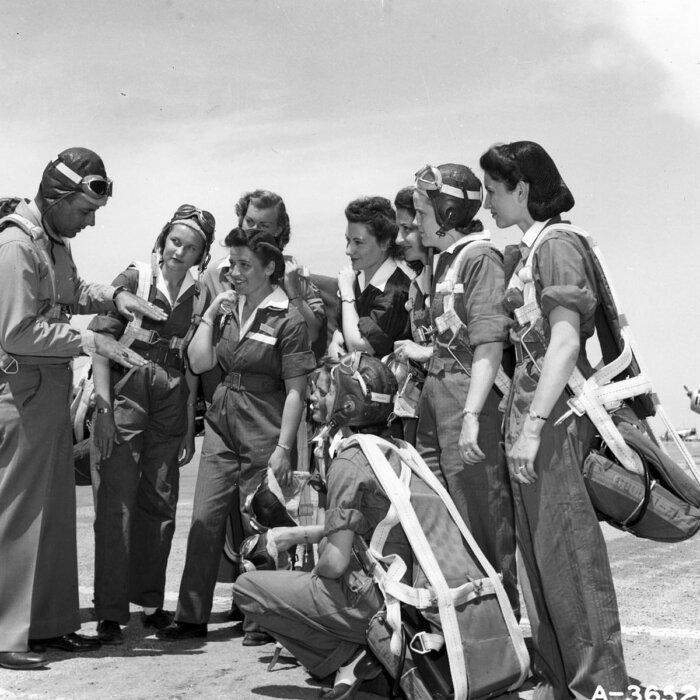
As Cochran’s fame soared due to her success in the air and in business, her collection of friends eventually became equally extravagant and included the likes of Eleanor Roosevelt, Winston Churchill, Dwight D. Eisenhower, and Amelia Earhart. In fact, Earhart spent several days at Cochran’s ranch in 1937 before embarking on her fateful attempt to fly solo around the world. Cochran also was president of Earhart’s organization of international female pilots, the Ninety Nines, from 1941 to 1943.When World War II began in Europe, Cochran suggested that women be used as noncombat pilots. Despite European countries, like France and England, already using women as pilots, her suggestion was refused by the U.S. government. In March 1942, Cochran decided to take approximately two dozen other licensed female pilots with her to England to join the British Air Transport Auxiliary. A few months later, after America had been in the war for nearly nine months, the federal government approved women to become transport pilots. Cochran returned to the United States in 1943, and met with Gen. Henry “Hap” Arnold, who had promised her a position.
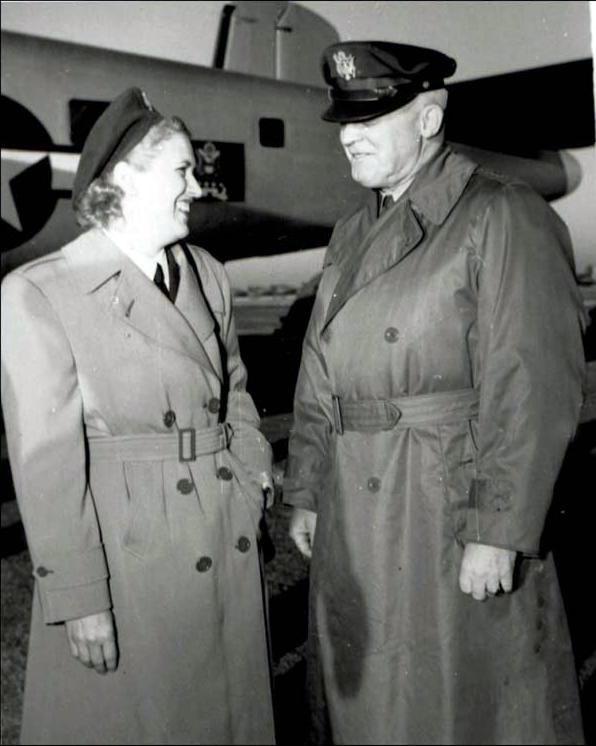
With fellow aviator pioneer, Nancy Love, already directing the Women’s Auxiliary Ferrying Squadron (WAFS), Cochran suggested another organization to Arnold. The WAFS was using already licensed female pilots. Cochran suggested creating a pilot training program to funnel more pilots to the WAFS. Thus Cochran’s Women’s Flying Training Detachment (WFTD) was established. On Aug. 5, 1943, Arnold announced the WAFS and the WFTD would merge to become the Women’s Airforce Service Pilots (WASP).
Breaking Records
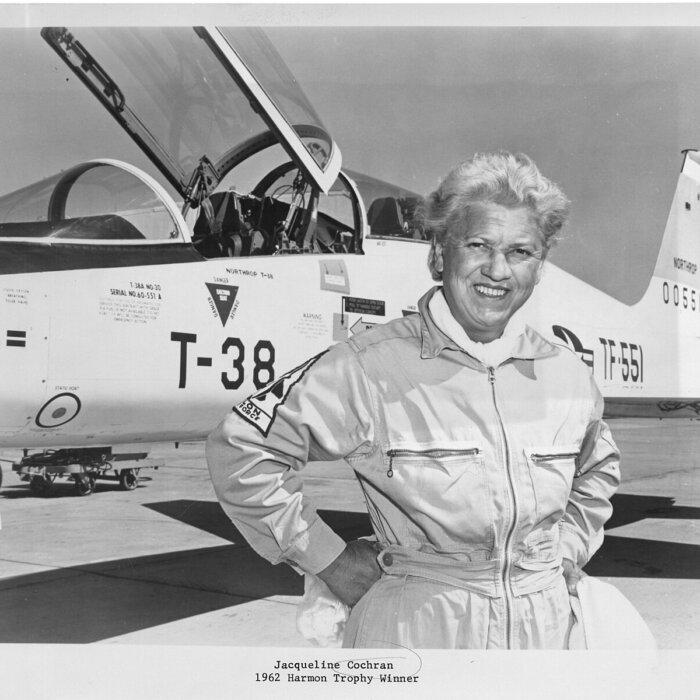
When the war concluded, Cochran’s flying contributions had only just begun. She competed again in the Bendix Race in 1946, coming in second. The following year, Maj. Chuck Yeager broke the sound barrier. Yeager and Cochran became friends, and Yeager trained Cochran to perform the same feat. Cochran broke the sound barrier in 1953 in the F-86 Sabre jet.Before that moment, Cochran remained an active and influential voice in the U.S. military, advocating that the air force become an independent arm of the military, which took place in 1947. The following year on June 12, 1948, President Harry S. Truman signed the Women’s Armed Services Integration Act. Cochran was then commissioned a lieutenant colonel in the Air Force Reserves. By the end of the decade, Cochran was considered the Aviatrix of the Decade and was awarded the Harmon Trophy in 1950.
Leaving Her Mark
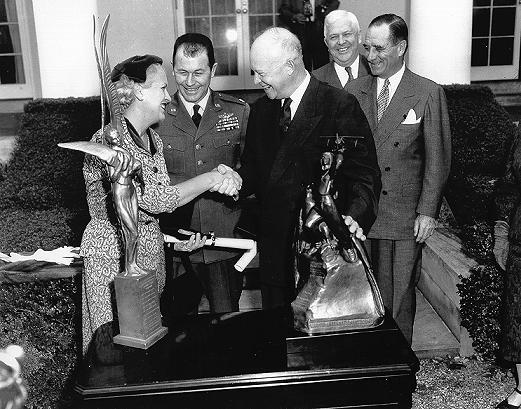
When Cochran broke the sound barrier on May 18, 1953, she had to do it twice. The first time, those who were recording it, did not hear the sonic boom. It was somewhat a providential moment, for when she broke the barrier the second time, she also set a new speed record for a 100-kilometer course at 652 miles per hour. By the end of the week, Cochran held every speed record save one. The following year, Yeager and Cochran were presented the Harmon Trophy by President Eisenhower for Yeager’s fastest flight of 1953 and for Cochran’s sound barrier flight.
Cochran would go on to serve as president of the world’s most prestigious aviation organization, Fédération Aéronautique Internationale, from 1958 to 1960. She set an absolute altitude record of 56,071.80 feet in 1961, surpassed Mach 2 (twice the speed of sound) in 1964, set speed records in the USAF Lockheed F-104G Starfighter, served as an influential Air Force and NASA consultant, landed a jet on an aircraft carrier, flew a jet across the Atlantic, and received more than 200 flight awards.