There’s a great deal of wisdom encapsulated in Zinsser’s words—for both students and teachers. In my experience as a teacher and writing tutor, the best writers are invariably the students who read widely and well. There’s a feel for the language, an intuitive grasp of both sense and structure that can’t be had any other way than by burrowing one’s nose in books. This sense develops organically in the mind of the student who reads regularly.
Conversely, this intuitive sense is almost impossible to replicate in the student who does not read much. No amount of drills, lectures, or templates can make up for this lack. Reading is like protein for the muscle-builder—necessary for growth. Without a rich diet of reading, the teacher (and student) will likely be fighting a losing battle.
Some degree of writing proficiency may be gained purely through lectures, but it will always be a bit clunky and formulaic. The writing muse is a strict one, and she generally only rewards those who have read the great masters of our language. Then, and only then, will the muse make that student’s pen sing.

A Universal Approach to Learning
This is really just common sense. We learn everything through imitation. The violinist watches the instructor hold the instrument and bow at the right angle, then tries it himself. The swimmer watches the teacher demonstrate the butterfly kick, then attempts it herself. Children listen to their parents’ speech and then make bumbling, babbling attempts to repeat it. Little by little, these imitations mirror the model more exactly.So why do some educational approaches treat writing differently, as though it can only be learned through abstract theory or by following arbitrary sets of rules? To be sure, rules and theory help. They certainly have their place in the teaching of writing. But they cannot replace the conscious practice of imitating great writers any more than learning about horse anatomy will teach you how to ride well.

Read, Read, Read
In the first place, teachers must read a lot themselves, for all the reasons already stated. It’s a good idea to read with a pencil and mark particularly beautiful, persuasive, or otherwise effective passages of writing. Notes and underlinings can help the teacher analyze these passages. Most importantly, these passages encountered here and there in the normal course of reading can become the basis for classroom exercises or homework assignments.
Copywork and Dictation
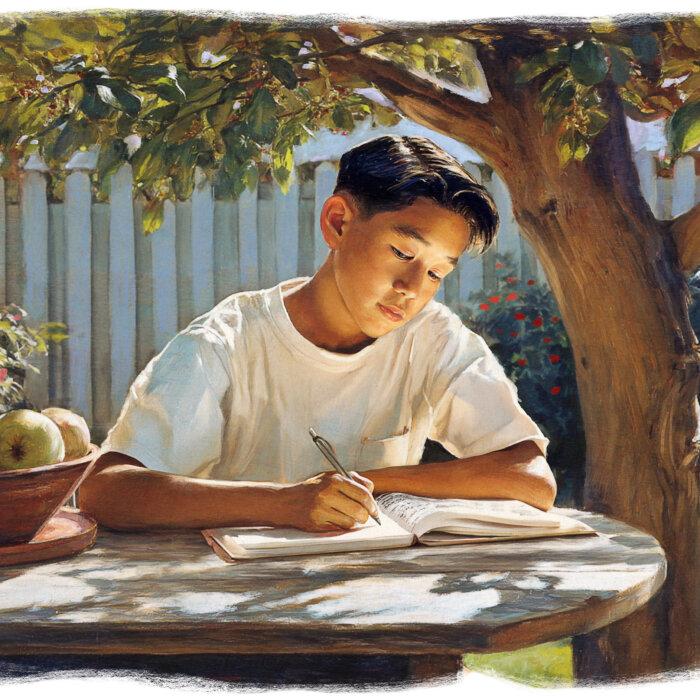
For fine pieces of writing not much longer than a paragraph, teachers can read it aloud in the classroom and ask students to write it down. This dictation exercise forces students to really listen carefully to the sound of the language and then translate those beautiful words in a visceral way into their own body through the act of handwriting. The words become a part of the student, intertwined with the fibers of both brain and muscle.Fill-in-the-Blank
A second and probably more enjoyable exercise begins to introduce the students’ creativity into the process a little bit. For this exercise, teachers can again take a passage from a great book or essay as a starting point. But then the teacher removes certain words or phrases here and there to create a kind of fill-in-the-blank exercise, where the blanks are labeled with the part of speech that corresponded to the writer’s original wording.Now, the students read the passage and rewrite it, but with their own words inserted into the blanks. In this way, they’re still following the structure, tone, sentence length, etc. of the model text, but they’re also beginning to play with word selections of their own.

Style-Based Rewriting
Taking things a step further, a teacher could have students read a model passage and then ask them to rewrite the passage entirely in their own words while maintaining the style of the original author. This really challenges the students to think about what distinctive features make up the author’s style. Does he use long sentences or short? Is the language more formal or informal? Does he use metaphors, similes, alliteration, rhythm?Finding the Balance
In addition to filling students’ heads with an ensemble of great writers and their words, these types of exercises can often be more enjoyable and meaningful than the standard writing exercises often encountered in schools today.The art of imitation combined with lessons on the formal aspects of writing (paragraph and essay structure, grammar, citations, etc.) combine to create an excellent environment for developing literary prowess. In imitation, students get a feel for what works in writing. In lectures, they’re then taught why this or that technique works. I’ve found that this combination of practical, experiential, and theoretical learning creates a beautiful synthesis.