This copy is for your personal, non-commercial use only. Distribution and use of this material are governed by our Subscriber Agreement and by copyright law. For non-personal use or to order multiple copies, please contact The Epoch Times Reprints.
Besides its noticeable mansard roof, what draws the eye to the Hungarian State Opera House is the plethora of sculptures adorning it. From their perches along the top balcony balustrades to tucked inside niches flanking the second-floor portico, the statues represent notable composers and musicians. The main front-facing entryway has an entablature supported by a series of arches and columns. While the main facade presents impressive limestone block construction, the building’s sides and back—which are out of view of this photograph—are plaster over brick. Mitzo/Shutterstock
The 19th-century Hungarian State Opera House in Budapest was considered Hungarian architect Miklos Ybl’s stunning achievement. Although it is not the largest opera house in Europe, it is an architectural standout among the genre of structures. For his design, Ybl drew inspiration from an opera house in Vienna.
Completed in 1884 and considered palace-like in its scale, sophistication, and ostentation, the opera house is distinctly Renaissance Revival—sometimes referred to as neo-Renaissance—in style. Classic Italian design motifs and architectural elements are the pillars of neo-Renaissance. Stone masonry construction, symmetrical facades, grandiose scale, semicircular arches, domes, and centerpiece staircases predominate.
With an emphasis on Baroque design as well, copious artistic presentations and complex embellishments are exhibited both inside and outside the opera house.
The Hungarian State Opera House is equipped to seat close to 1,300 people in its auditorium. For almost 150 years, its prodigious doors have opened to not only visitors interested in viewing awe-inspiring architecture via a guided tour, but also to individuals seeking performances of ballet, musicals, concerts, and—of course—operas.
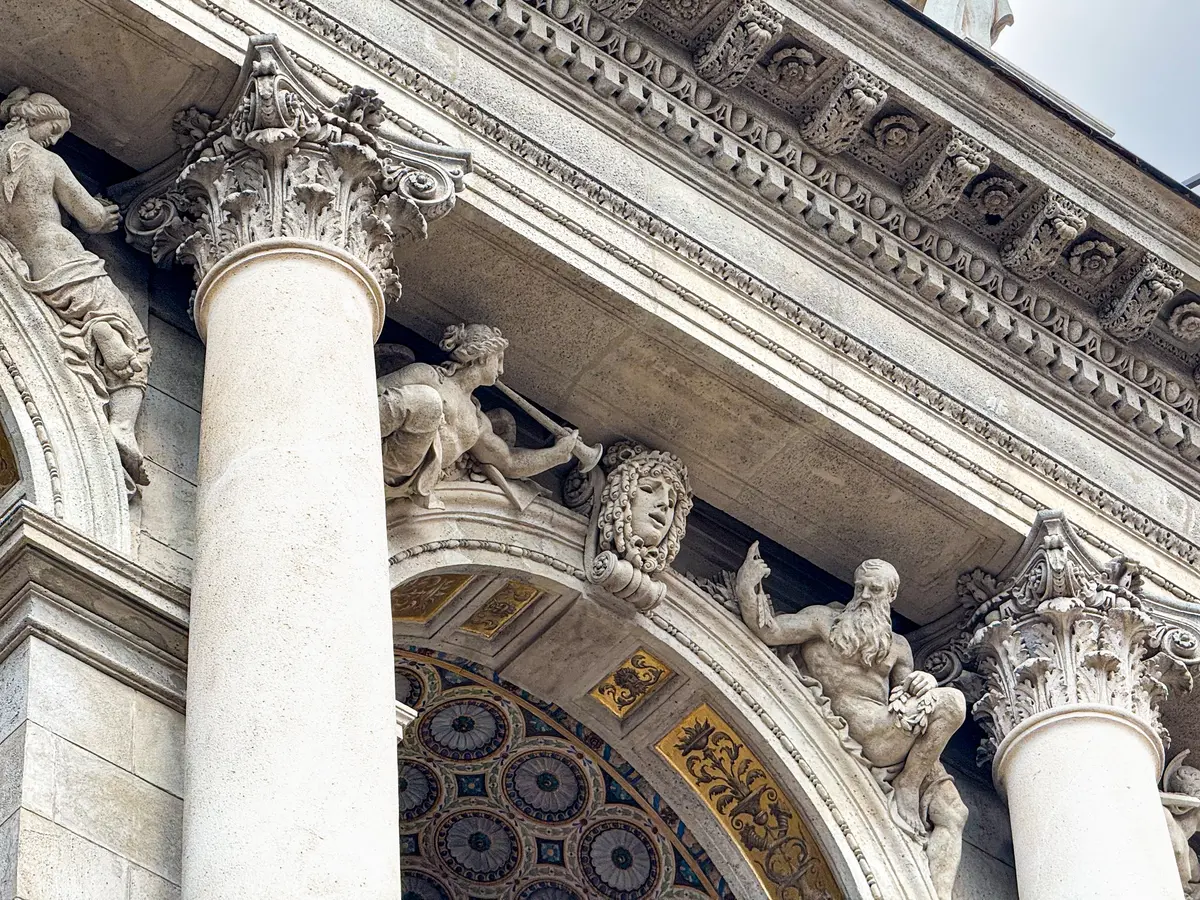
The Hungarian State Opera House showcases many columns in its exterior and interior. Tucked between the main facade’s colossal limestone columns with Corinthian capitals are sculptures, including mascarons: face sculptures showcasing human or animal likenesses or mythological forms. Classic egg-and-dart and dentil trims, as well as acanthus leaf corbels and rosettes, are evident as noticeable adornments above the columns. TheCarPhotographer/Shutterstock
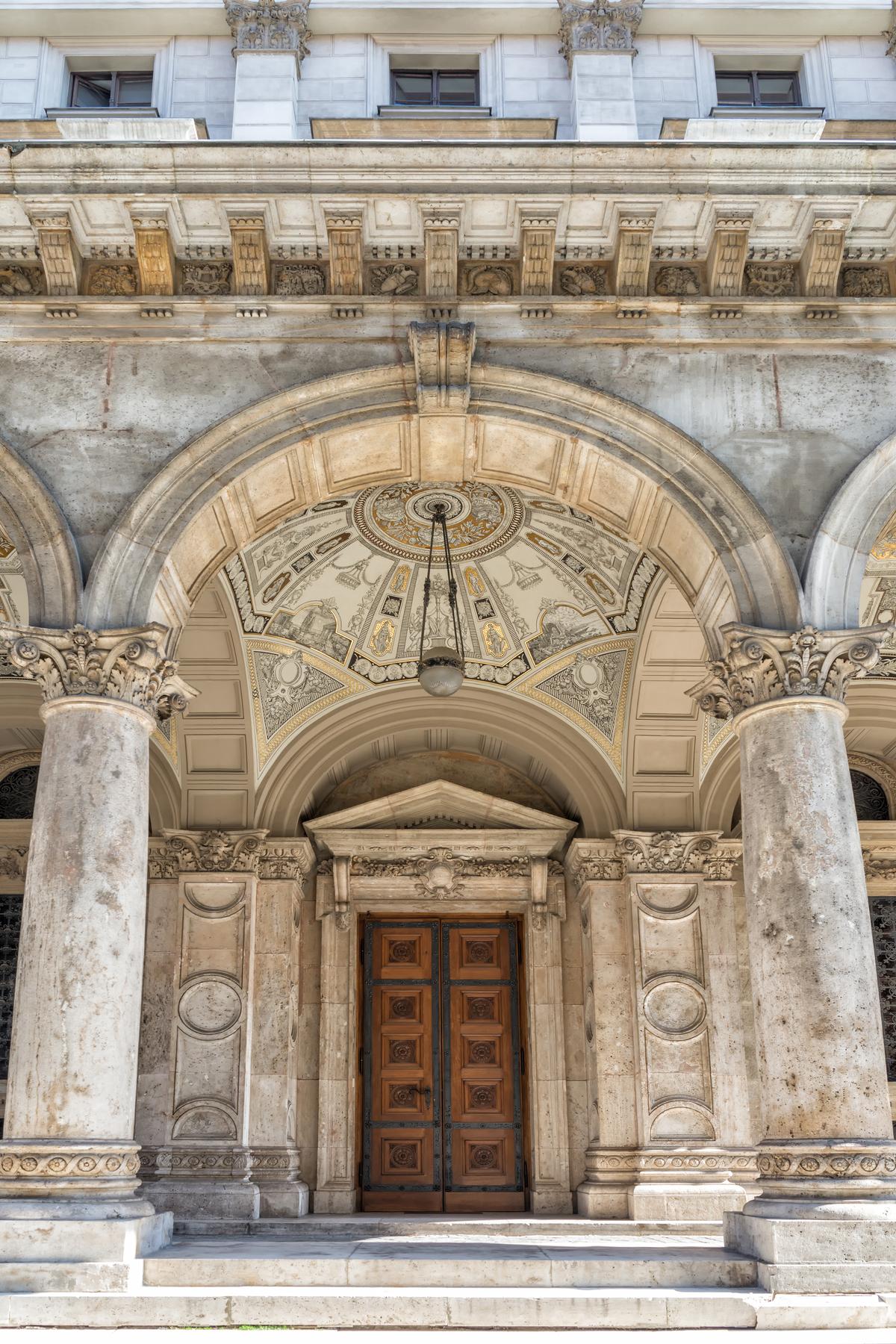
Symmetry is apparent no matter where one looks at the Hungarian State Opera House. This heavily carved, European oak-paneled doorway under a classic pediment and arch is proportionally centered between two capital-topped pilasters with circle and half-circle designs. These elements are positioned exactly between two limestone columns capped with Corinthian capitals and encircled at their bases with a masonry rope and rosette trim. The dome ceiling’s interior is embellished with colorful majolica (Italian earthenware) decoration, which contrasts with the precisely positioned paneled arches. Claude Huot/Shutterstock
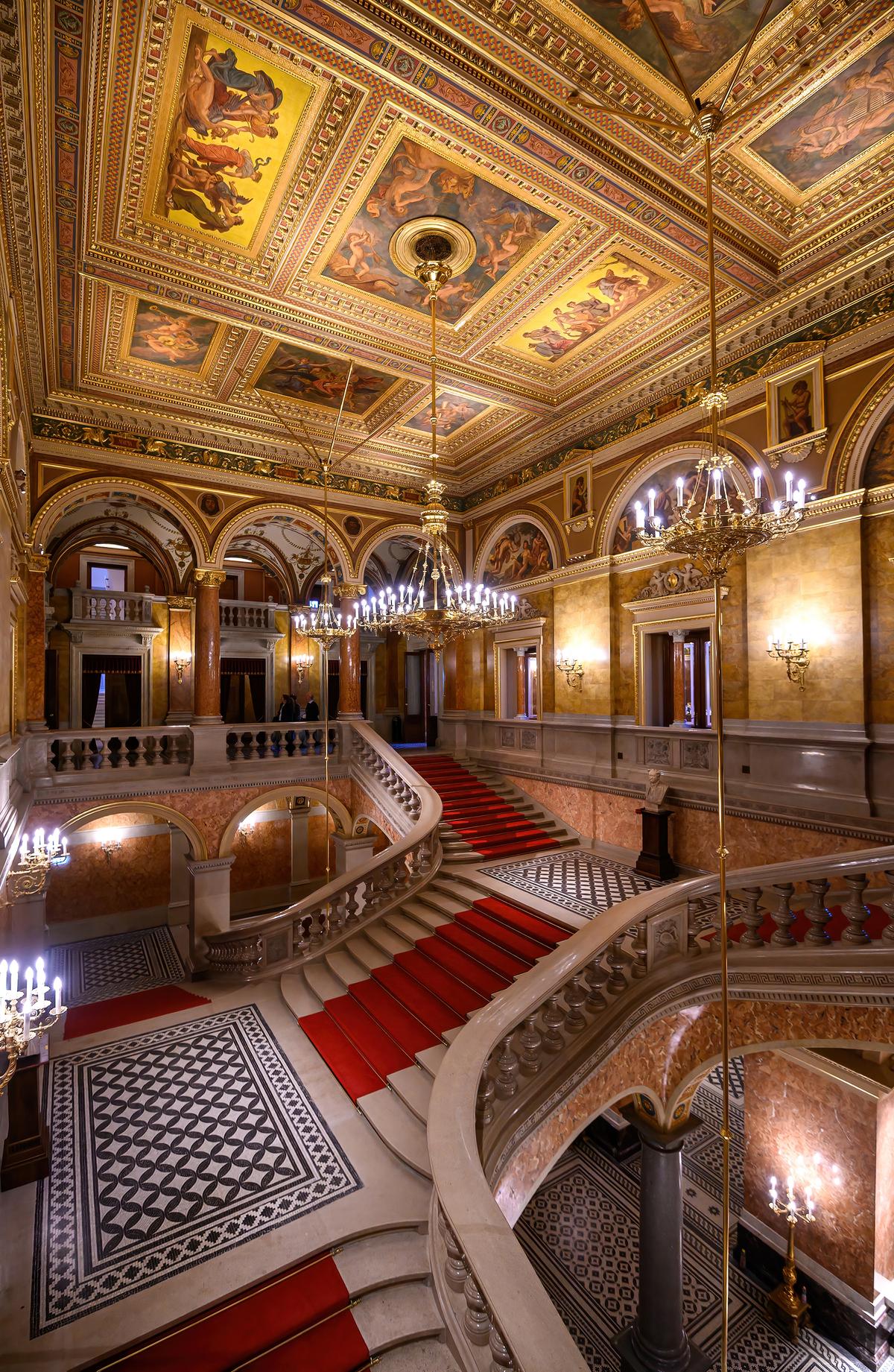
Sweeping in two directions inside the Hungarian State Opera House is the bifurcated foyer staircase leading to what is considered the upper-level Grand Staircase. Crimson-red carpet runners over the marble stairs provide visiting patrons with a truly regal experience as they approach auditorium entrances. The landing is made of patterned tiles. The aesthetics of this space are greatly enhanced by the mythological, music-themed paintings in the nine rectangles composing the gilded, coffered ceiling. Mitzo/Shutterstock
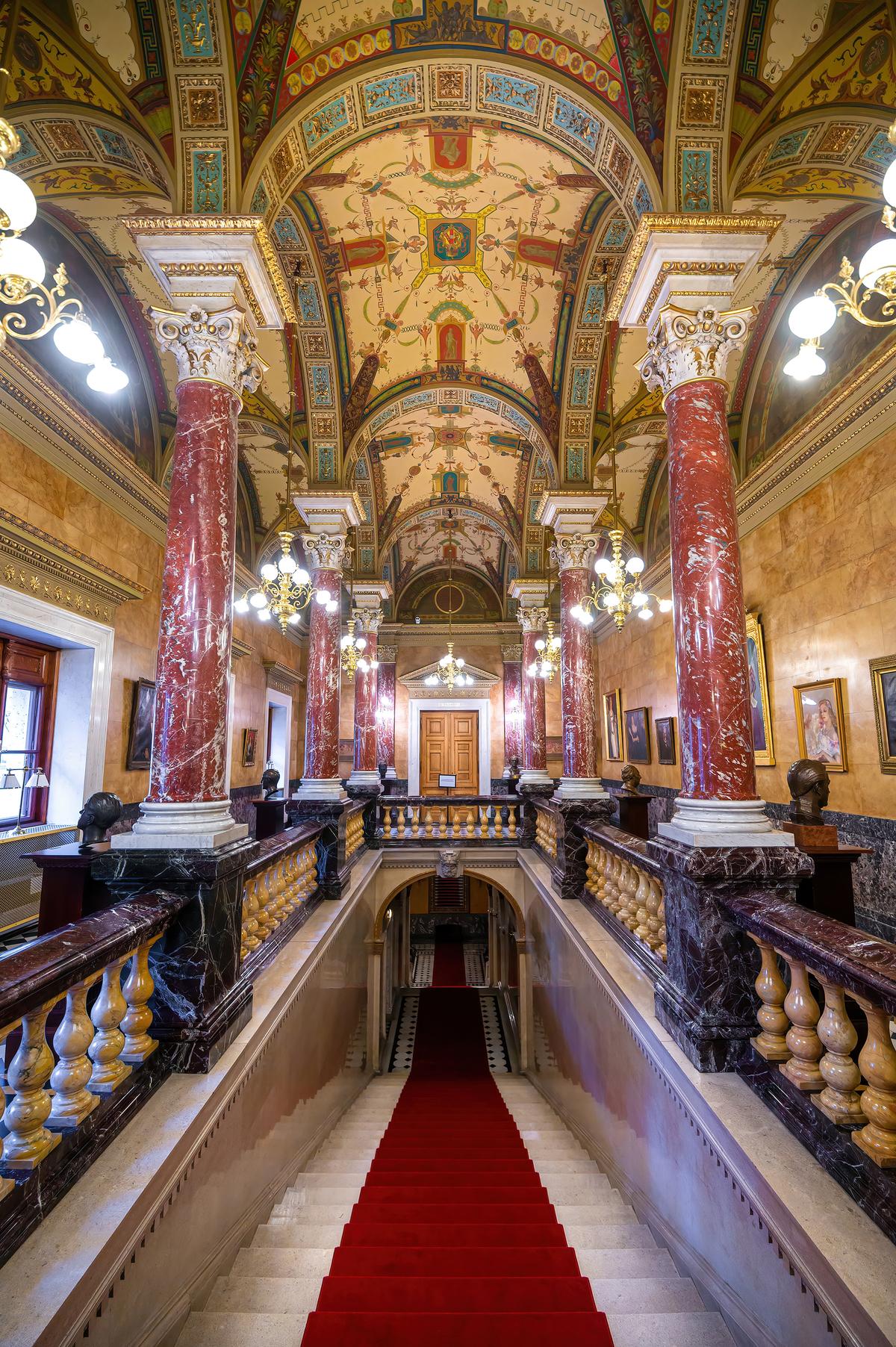
Leading from the outside carriage ramp to the inside of the Hungarian State Opera House is what is deemed the Royal Staircase, because the entryway enables actual royalty to enter the venue discreetly. Eight red marble columns on snow-white, Carrara-marble bases sit atop greenish Florentine-marble pedestals. Florentine marble railings are punctuated with yellow Siena-marble balustrades. Gracing the ceiling are paintings of mythological creatures. Mitzo/Shutterstock
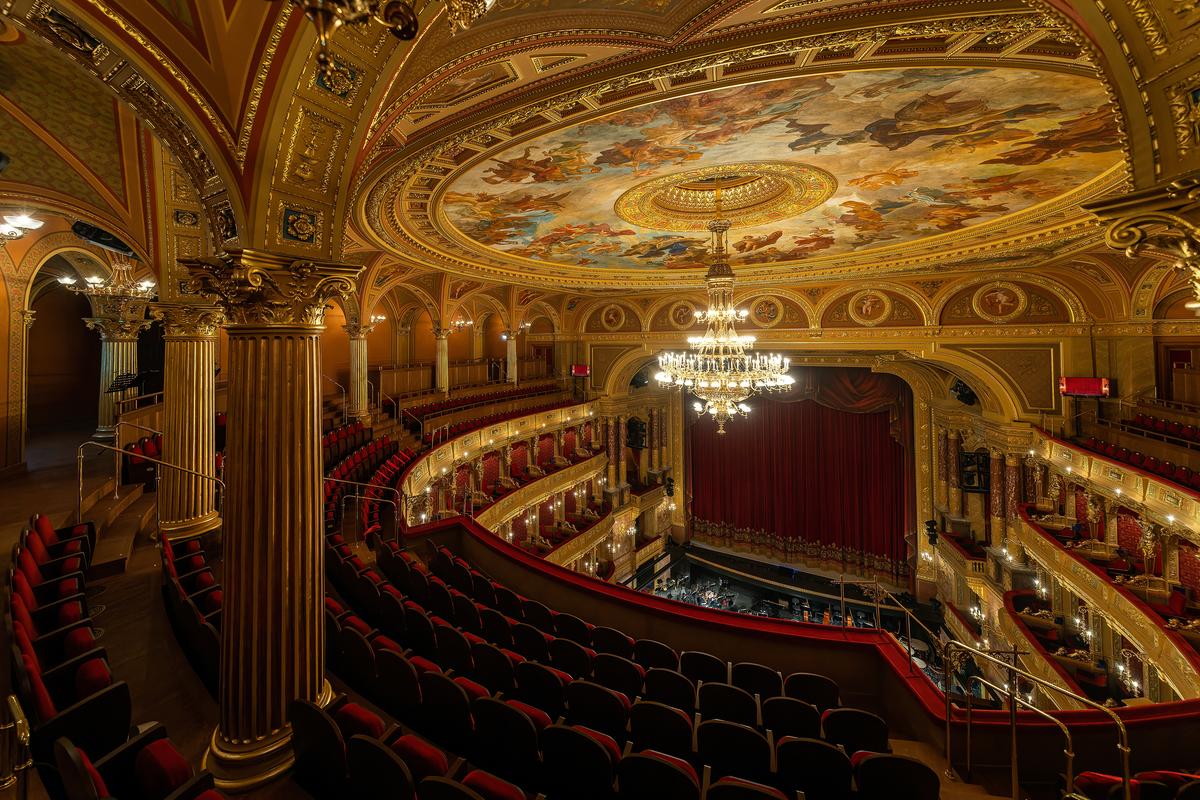
The horseshoe-shaped, three-story auditorium offers visitors a truly theatrical presentation of red and gold hues, a spectacular ceiling fresco, and a focal-point bronze and glass chandelier hanging from inside a cupola. Originally a gas-lit chandelier, the nearly 3-ton fixture is electrically lit with more than 200 bulbs. Resplendent gilded Corinthian columns throughout the auditorium support bedecked arches. posztos/Shutterstock
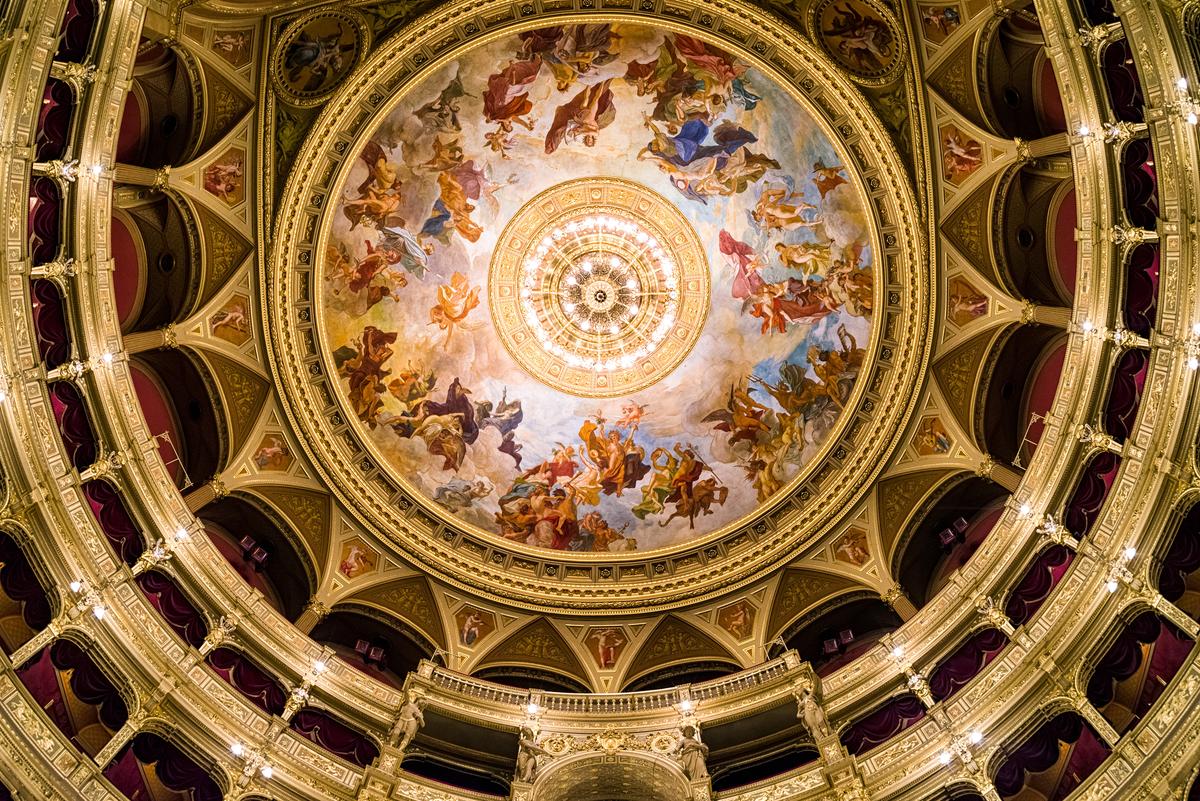
The auditorium’s cupola features the Baroque-style painting “The Apotheosis of Music.” From the view below, symmetrically festooned circles surround the cupola painting and the centerpiece chandelier. Other than the decorative molding around the painting, each of the circular spaces is a level of seating. Adding to the visual presentation are the pointed Gothic arch shapes, which are aspects of the auditorium’s multiple arches. Jaroslav Moravcik/Shutterstock
What arts and culture topics would you like us to cover? Please email ideas or feedback to [email protected].
A 30-plus-year writer-journalist, Deena C. Bouknight works from her Western North Carolina mountain cottage and has contributed articles on food culture, travel, people, and more to local, regional, national, and international publications. She has written three novels, including the only historical fiction about the East Coast’s worst earthquake. Her website is DeenaBouknightWriting.com