This copy is for your personal, non-commercial use only. Distribution and use of this material are governed by our Subscriber Agreement and by copyright law. For non-personal use or to order multiple copies, please contact The Epoch Times Reprints.
In this installment of ‘Larger Than Life: Architecture Through the Ages,’ we tour a 20th-century European-influenced estate in Oklahoma’s ‘Green Country.’
The large steel-framed house has reinforced concrete walls covered in a stucco mix that glitters with ground white marble. The rear of the mansion, which overlooks impressive gardens from a hilltop, features a loggia with five arches supported by Corinthian columns. The roof is covered in terracotta tiles. Accenting the stucco facade on the corners, doors, and windows is Minnesota-quarried limestone. Kit Leong/Shutterstock
Instead of being lost to the ravages of time, many historic homes throughout the world become public museums. Such is the case with Philbrook in Tulsa, Oklahoma. Once referred to as Villa Philbrook, the private home on 25 acres is now a living history site, where visitors can tour the house and grounds, as well as an art museum. The museum exhibits about 16,000 artifacts of American, Native American, and European art.
At first glance, the mansion and its surrounding French, English, and Italian-inspired gardens appear to be situated somewhere in Europe. However, oilman Waite Phillips (1883–1964) had it built from 1926 to 1927 for his wife and their two children. Tulsa was once a Western ranching territory but in the 1920s, it became the “oil capital of the world.”
Designed by Kansas City, Missouri, architect Edward Buehler Delk (1885–1956), Philbrook features primarily Italian Renaissance elements. The 72-room mansion has many features indicative of the architectural style: These include precise symmetry and imposing scale on the exterior and interior, as well as a generous use of classical columns, arches, and balustrades.
The Phillips family owned the estate for only 11 years before they gifted it to the city of Tulsa for use as an art center. In 1939, the museum opened to the public and has been receiving thousands of visitors annually since then.
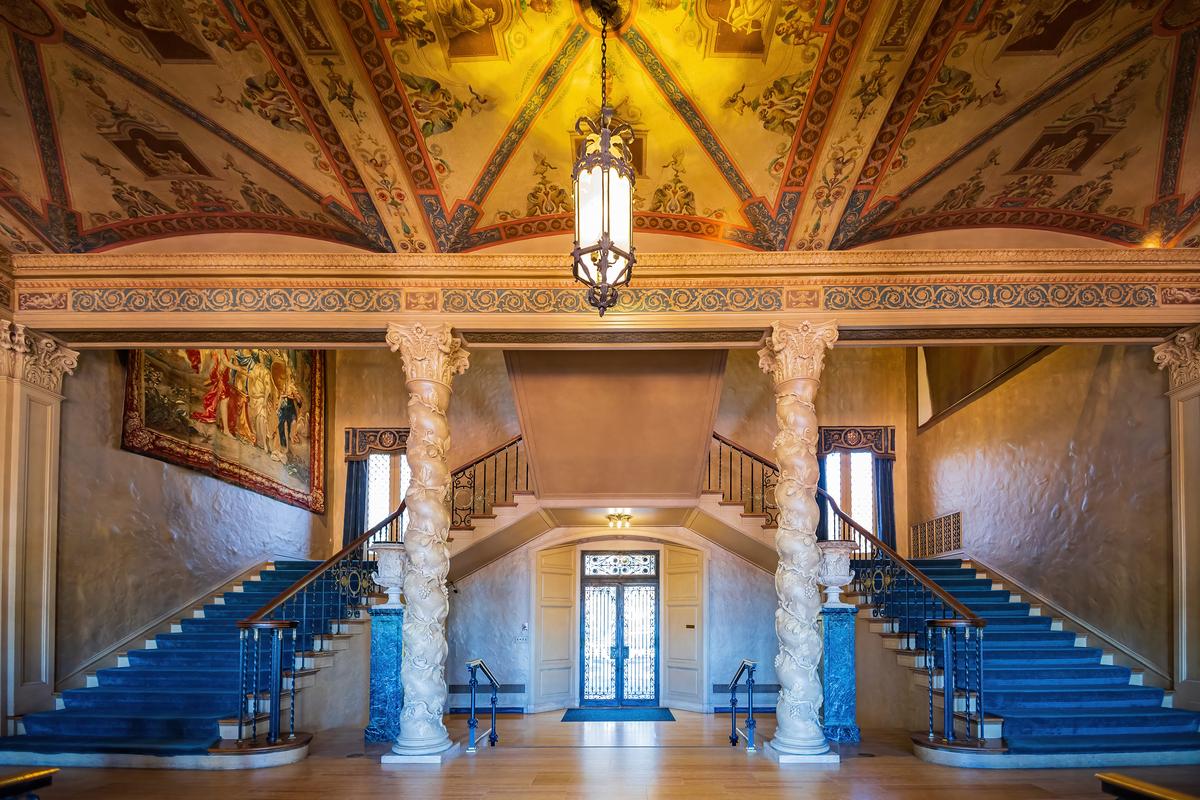
Spiral Solomonic columns adorned with a carved ivy motif and topped with ornamental Corinthian capitals are found in several interior spaces, including at the double staircase, which accesses the grand receiving hall. Floral carvings embellish the beam supported by the columns, and a focal point is the large French-style lantern light fixture hanging from the intricately painted ceiling. A massive tapestry hangs on one of the textured walls. Kit Leong/Shutterstock
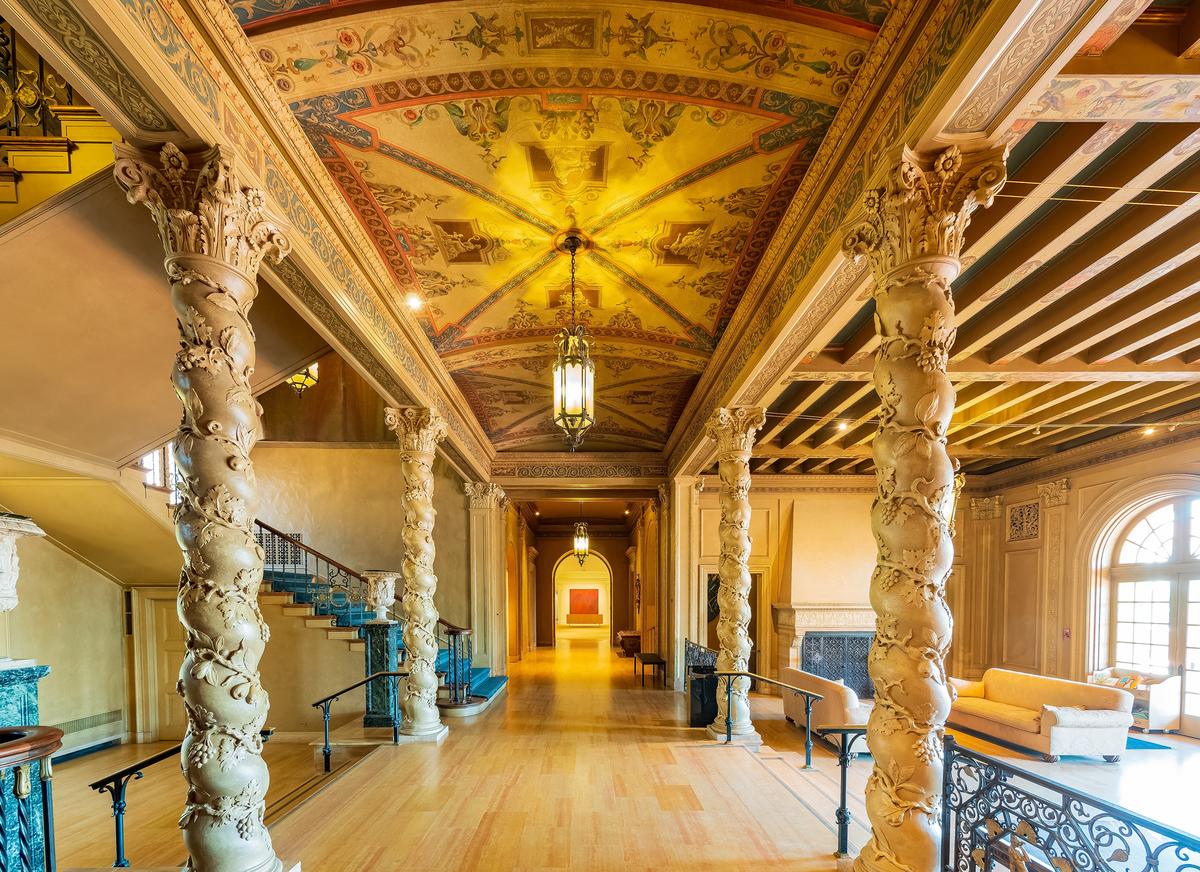
Teak flooring coordinates with the grand receiving hall’s neutral color scheme. Set apart is the frescoed, barrel-vaulted ceiling, which serves as a raised cross-corridor connector between the staircase and a sunlit sitting area. In it, floor-to-ceiling arched windows contrast with a ceiling of painted beams. The Solomonic columns with Corinthian capitals and the mansion’s signature climbing ivy design draw the eye to the room’s artistic ceiling. Kit Leong/Shutterstock
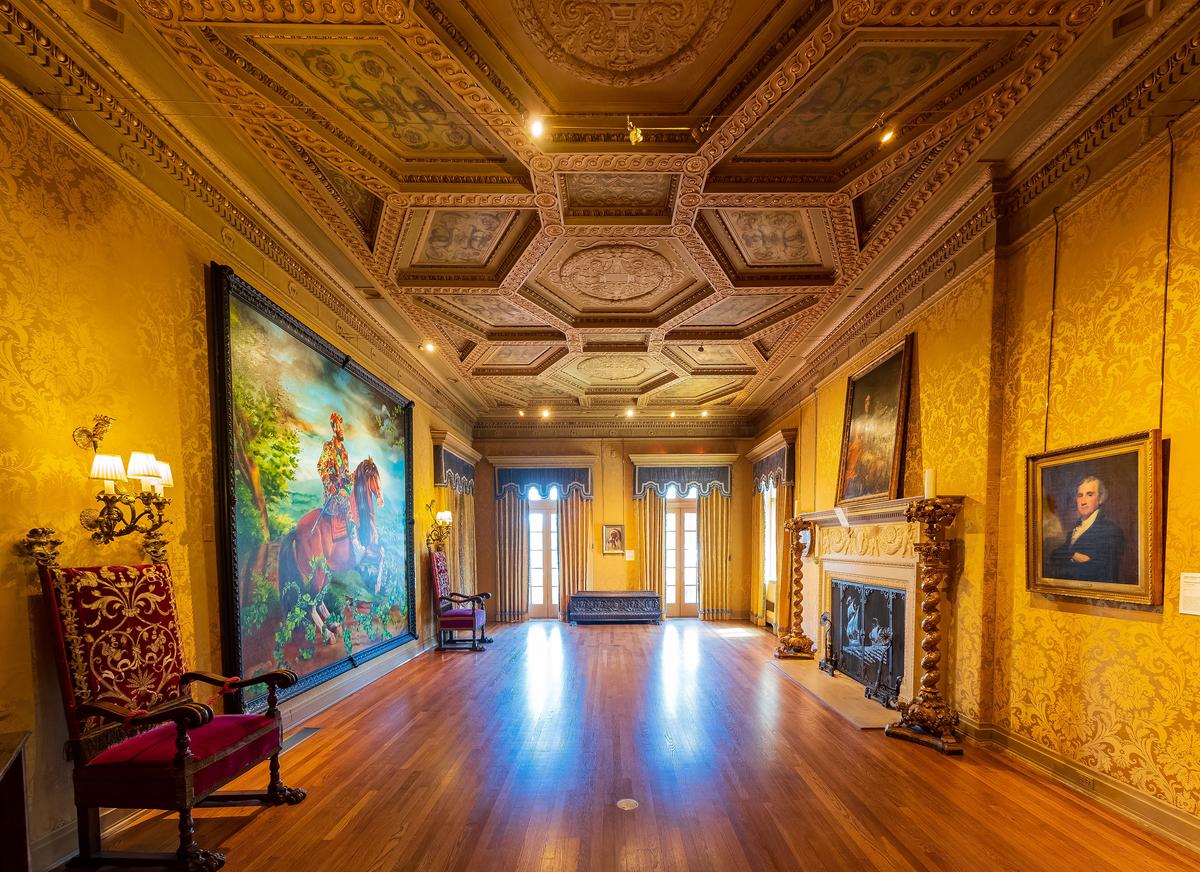
The opulent living room’s most prominent feature is its heavily carved coffered ceiling. Geometric shapes bordered in a carved design are filled with carvings or frescoes. A ship design is showcased in the metal fireplace screen, while the fireplace mantel has a carved classical swag design. The floors are teakwood. Kit Leong/Shutterstock
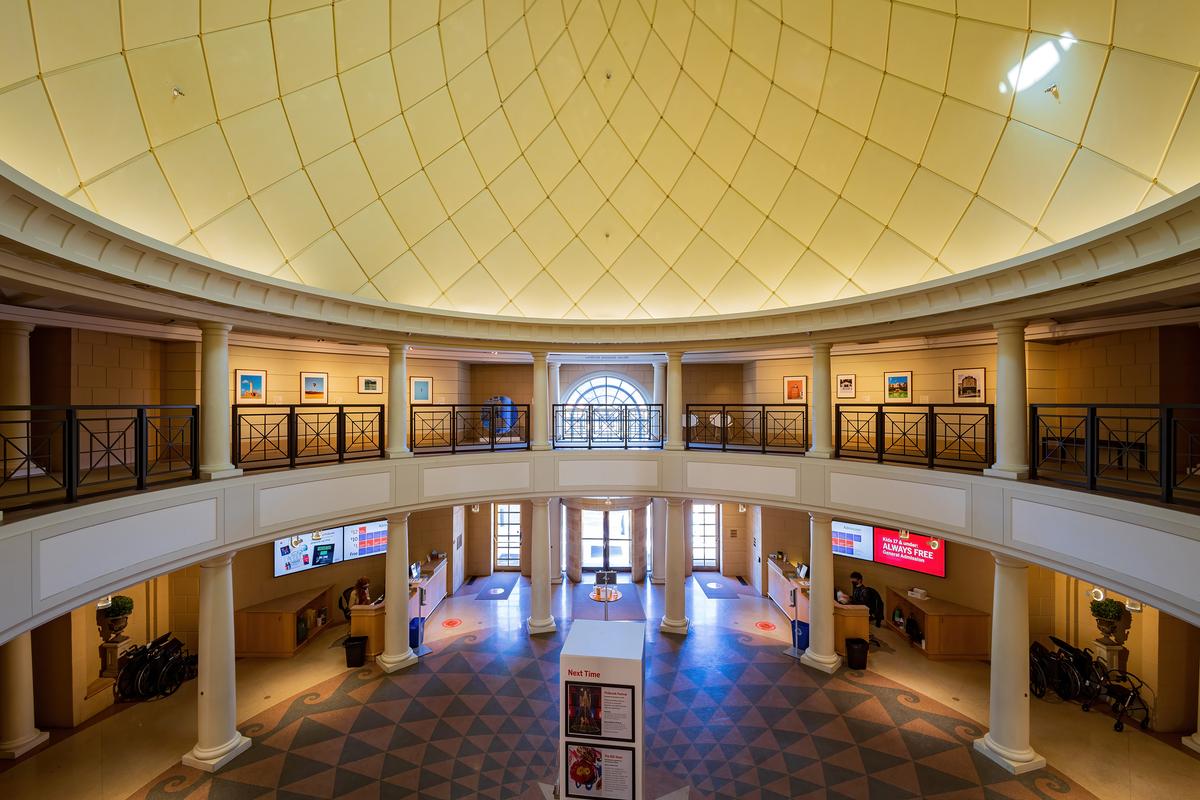
In 1990, a 70,000-square-foot wing was added to the Philbrook’s campus to house more collections and evolve the site into a more comprehensive modern museum complex. Although the rotunda’s design is more simplistic than the mansion, the space features two tiers of rounded Doric columns and three-paneled, square-shaped, metal railings. The diamond- and square-patterned interior of the dome is complemented by the triangle-patterned terrazzo flooring below. Kit Leong/Shutterstock
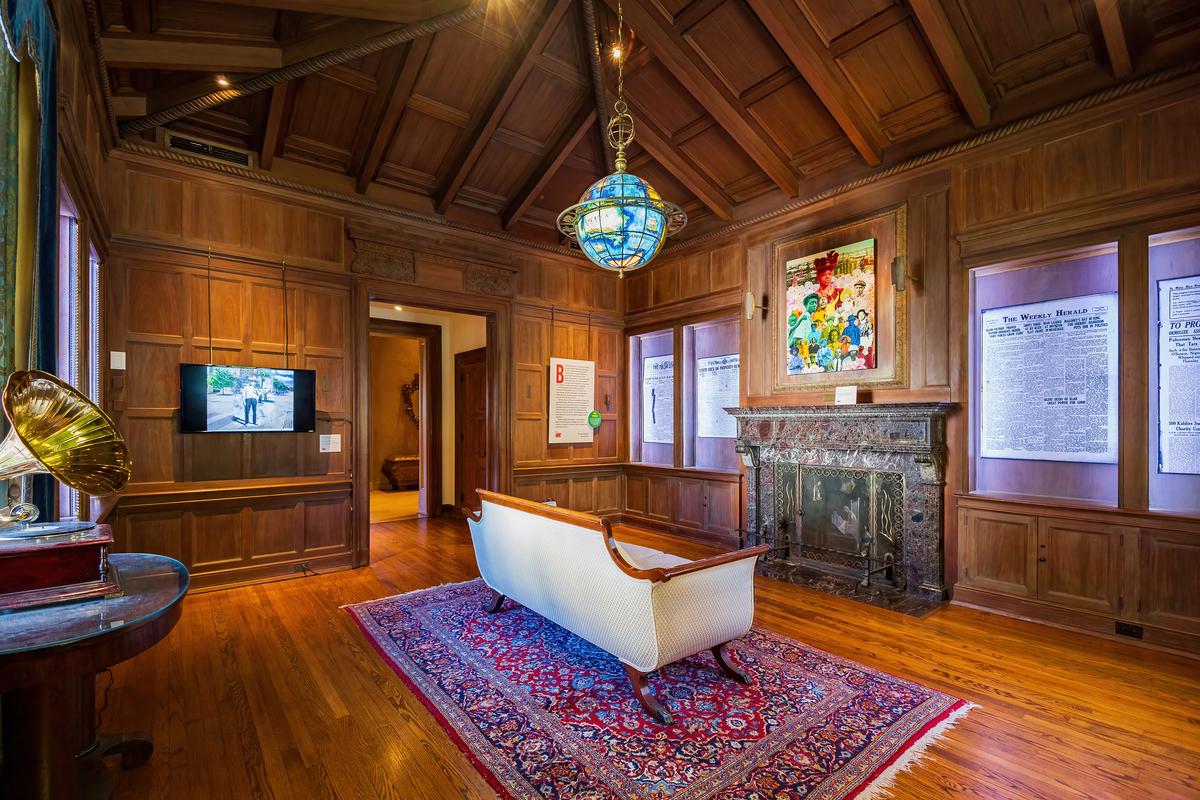
Dark walnut abounds on the library’s paneled walls and vaulted ceilings; polished red oak adorns the floors. Central in this all-wood room is a colorful globe light fixture featuring a reproduction world map from Leonardo da Vinci's time (mid-15th century to early 16th century). An empire-style sofa with wood trim faces the green and black marble fireplace. Kit Leong/Shutterstock
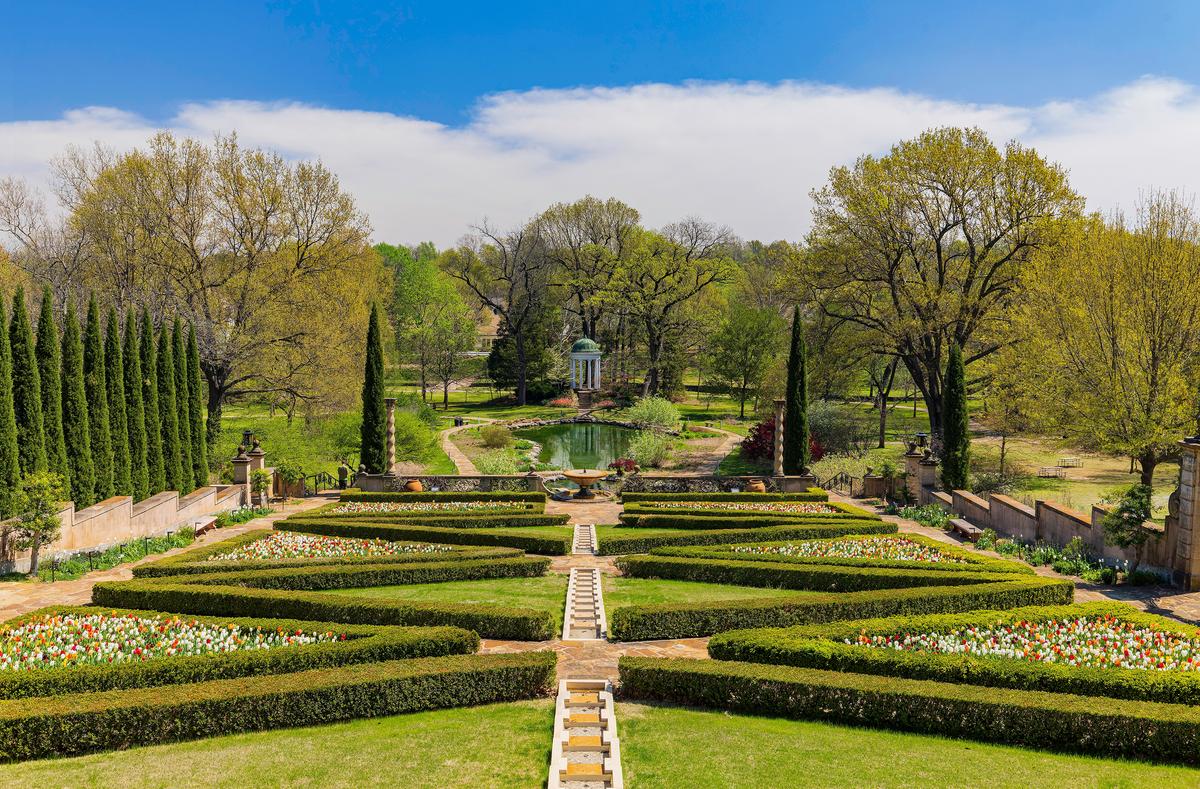
Geometric shapes created by low boxwood hedges play an important role in distinguishing aspects of the formal gardens, which include walls, a pond, and a gazebo-like structure called a tempietto, or little temple. Architect Edward Buehler Delk joined with the landscape architectural firm Hare & Hare to create a formal garden plan inspired by Giacomo Barozzi da Vignola’s 1566 Italian country estate. In true Italian style, the garden’s dominant focus is on the color green, achieved with such plants as English ivy, Chinese privet, and boxwood. Surrounding the garden are many native plants and trees. Kit Leong/Shutterstock
What arts and culture topics would you like us to cover? Please email ideas or feedback to [email protected].
A 30-plus-year writer-journalist, Deena C. Bouknight works from her Western North Carolina mountain cottage and has contributed articles on food culture, travel, people, and more to local, regional, national, and international publications. She has written three novels, including the only historical fiction about the East Coast’s worst earthquake. Her website is DeenaBouknightWriting.com