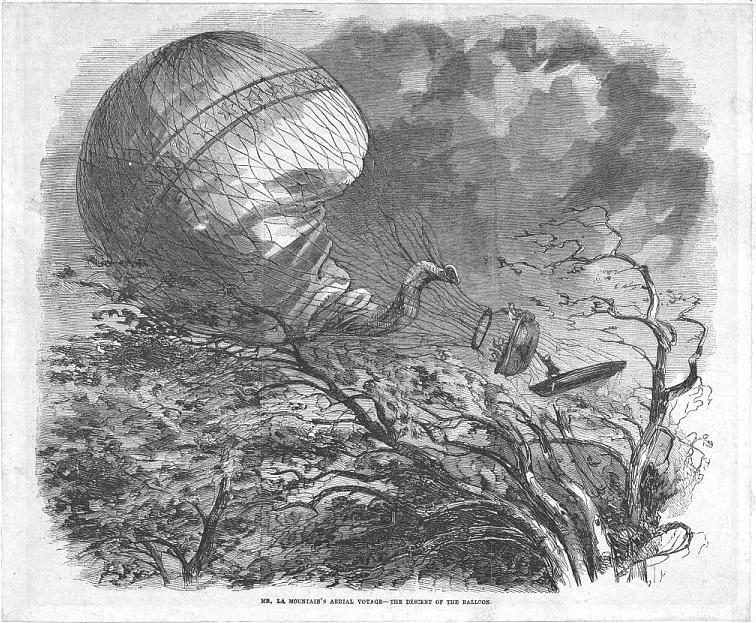
Four men were stuck in a tree. They had just narrowly survived a flight across Lake Erie at a speed of approximately 90 miles per hour. Realizing they were all still alive, John Wise looked at his fellow passengers and proclaimed, “And thus ends the greatest balloon voyage that was ever made.”
Wise was an aeronaut, though most called those of his profession balloonists. It was July 1, 1859, and Wise was not America’s only balloonist. In fact, he was not the only balloonist in his balloon. John LaMountain, a young aeronaut, had joined him for the historic St. Louis-to-Henderson, New York flight.
A Rising Balloonist
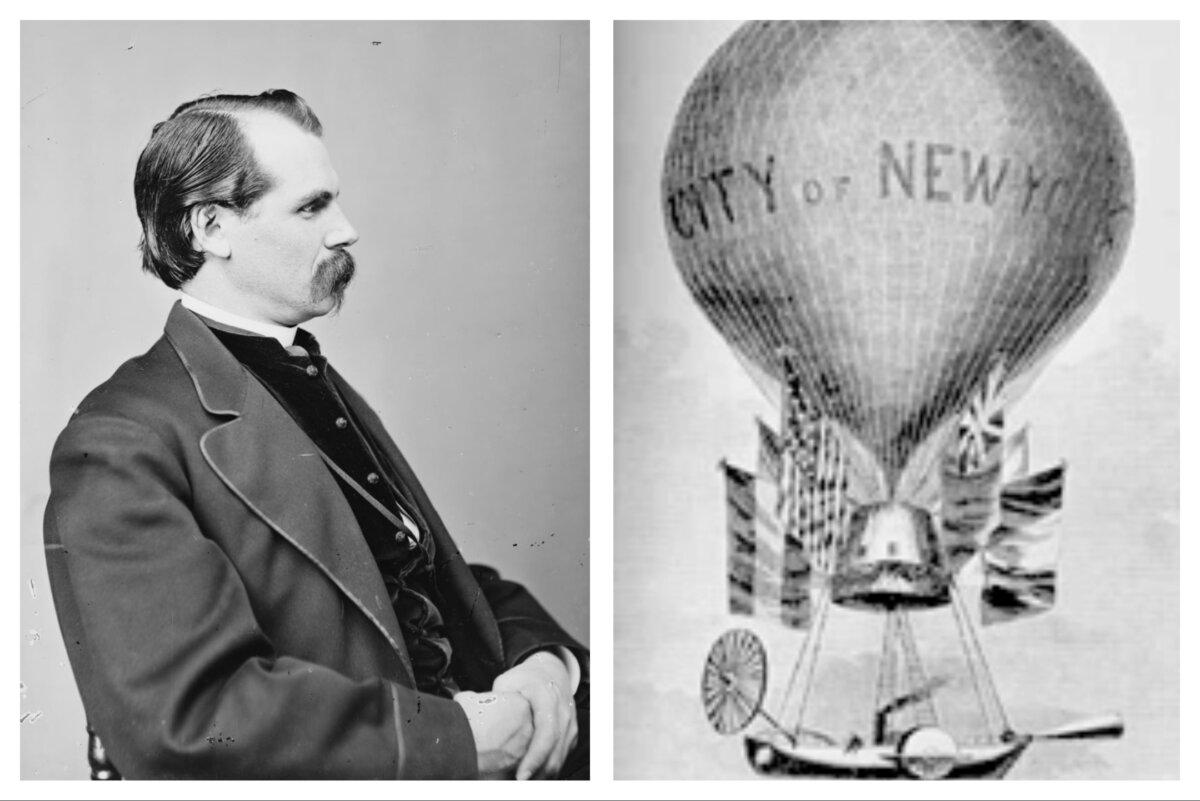
Thaddeus Lowe, a young aeronaut 24 years Wise’s junior, apparently had no issue with being considered all three. Born in New Hampshire in 1832, he only received a fourth grade education, but over time taught himself chemistry and meteorology. His inquisitive mind very much made up for his educational shortcomings. When he was 18, he attended a lecture by Reginald Dinkelhoff on the topic of lighter-than-air gases. Lowe met with Dinkelhoff and the two came to an agreement to let the teenaged Lowe become the professor’s assistant. Lowe was enamored with the subject of gasses and the possibilities they offered.Lowe soon began working with balloons as a showman and a lecturer, conducting demonstrations. In 1855, during one of his demonstrations, he met Leontine Augustine Gaschon, an actress from Paris. A week later, the two were married, and would enjoy a long marriage that resulted in 10 children. In 1856, he acquired his first balloon and began ascensions over the following years, garnering a reputation as a leading aeronaut of the age.
Lowe soon began following in the scientific footsteps of Wise. In 1859, he, like Wise, began to eye building a balloon that could cross the Atlantic Ocean (a feat neither would get the chance to accomplish). He began constructing his first balloon, which would prove to be one of the largest ever built. He called it the City of New York.
A Historic Accidental Trip
The following year, America experienced political upheaval after the 1860 election. With Southern states, specifically South Carolina, threatening secession, the times were uncertain. Abraham Lincoln won the election in November, and South Carolina seceded from the Union the following month. By the time Lincoln was sworn into office on March 4, 1861, six more states had seceded: Mississippi, Florida, Alabama, Georgia, Louisiana, and Texas.

The month following Lincoln’s inauguration, Lowe arrived in Cincinnati. He planned to test out his theory that, after reaching a certain height, wind currents moved from west to east. Of course, this was something Wise had noted in his journal two decades prior.
“This I did, illustrating my lecture with some fine colored diagrams I had made of my large balloon, and explained that the object of my stay in their city was to make it the starting point of a test flight to the Atlantic seaboard, preparatory to my flight across the ocean.”
Lowe waited in Cincinnati for good weather. On April 19, he celebrated at a dinner hosted by Murat Halstead, the editor of the Cincinnati Commercial. During the evening, Lowe was informed that the weather had cleared, the wind was right, and that it would be safe for him to liftoff. The aeronaut didn’t even change his clothes, but left the dinner and headed straight for his balloon called the Enterprise. Several of the dinner guests, including Halstead, joined him.
An Inopportune Landing
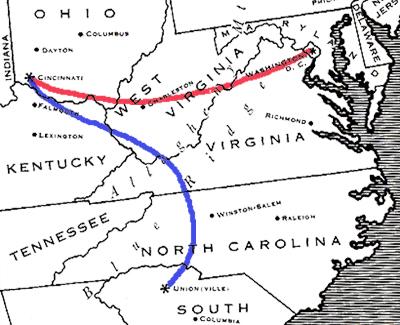
At almost any other time, moving south would not have been an issue, but eight days prior, the Union garrison at Fort Sumter in South Carolina was attacked. The Civil War had begun in earnest.Instead of flying across northern Virginia and into the District of Columbia, the balloon was pushed through northern Kentucky into southern Virginia, and crossed over into North Carolina. If Lowe continued on his path, he would end up in the one state he wished to avoid.
“I continued to discharge weight and let off gas until I attained an elevation of 25,500 feet above the sea. Here the thermometer fell to 10 degrees below zero; the water, fruit, and other things froze, and it required all the clothing and blankets I had to keep me warm. It was now 12 o’clock, and I could distinguish the blue ocean in the Eastern horizon.”
Lowe was running out of ballast and thus his balloon dropped lower and lower to the point where he began surveying a place to land. He dropped low enough for a number of people to grab ahold of his lowered ropes. He had reached Spartanburg in northwest South Carolina. Fear, however, had gripped the town, and the locals begged him to leave, along with his “hellish” flying contraption.
A Suspected Spy
The locals escorted him to Unionville (a rather ironically named location considering the recent events) a few miles away. There, he stayed overnight in a hotel and was visited by curious and friendly citizens. News had spread to Columbia, the state capital, and Lowe was arrested on suspicion of being a Union spy. It took some convincing for Lowe to prove otherwise. Luckily, he had brought with him a copy of the Cincinnati newspaper discussing his scheduled flying adventure.“On examining the [Cincinnati newspaper] I do not approve of the political opinions it contains [but] Professor Lowe says he is no politician [and] only engaged in his profession of an aeronaut in which I hope he will succeed. If you can render him any assistance in getting on his way or any other assistance you can render him will confer a lasting favor on our friend.”
Starting the Balloon Corps
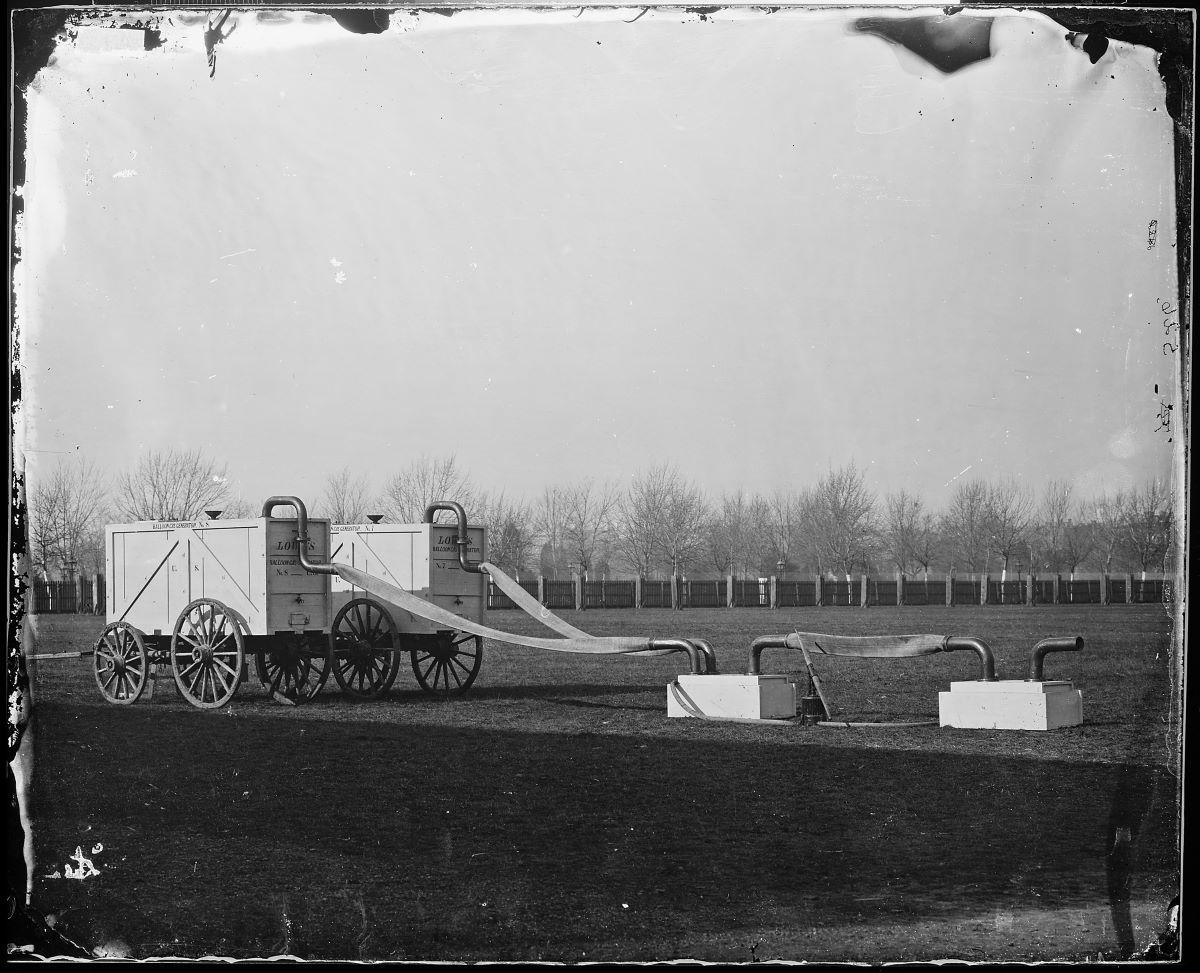
Lowe was certainly not a spy, but he and his balloons would soon become an integral part of intelligence-gathering for the Union Army. Word of his adventure had spread now to the nation’s capital, and he was soon summoned to the White House to meet President Abraham Lincoln and the Smithsonian Institution’s secretary, professor Joseph Henry. Henry had encouraged Lowe’s ballooning efforts and proved a strong advocate for using balloons in the war.On June 16, 1861, Lowe proved the balloon’s effectiveness in gathering intelligence. He stepped inside one of his balloons, powered it to about 500 feet in the air, and surveyed the surroundings. Additionally, he had placed a telegraph inside his balloon car.
The Balloon Corps Legacy
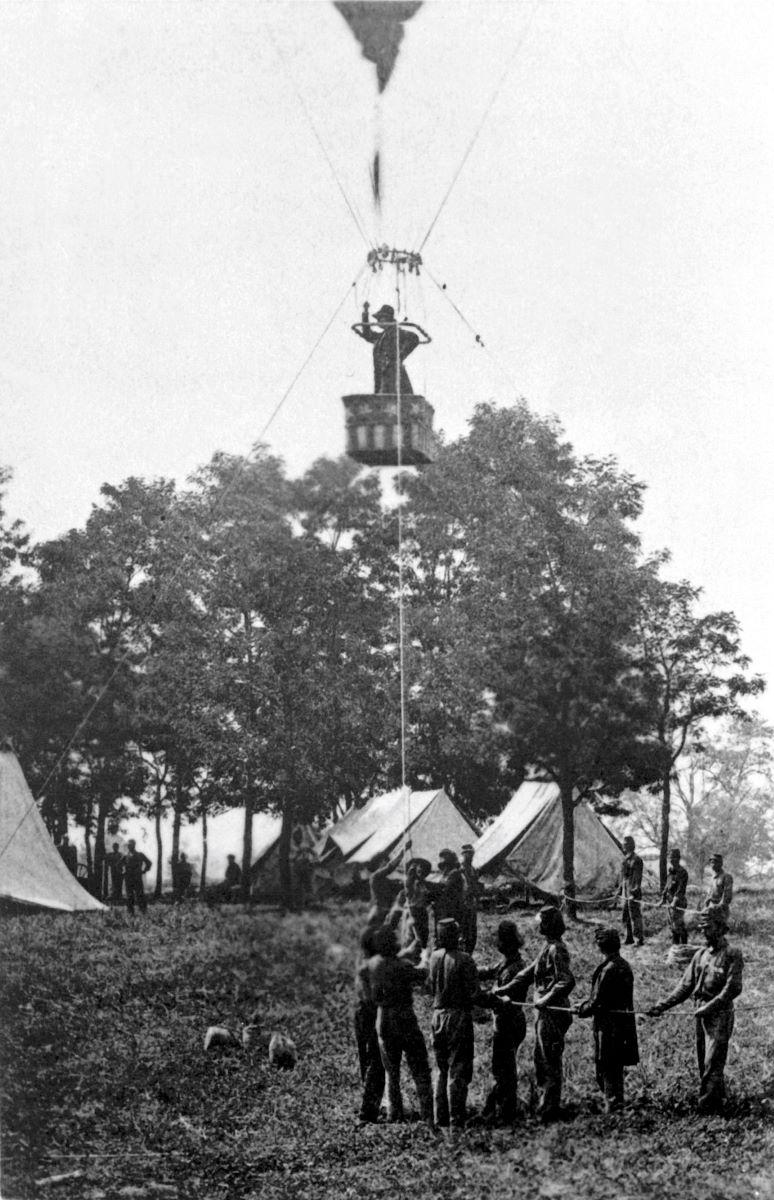
There was some competition among the Union balloonists, including Wise and LaMountain. The latter wished to hold the title of chief aeronaut. However, Wise’s and LaMountain’s balloons were not as successful as those of Lowe’s. Altogether, the Balloon Corps remained in operation into August 1863.
Lowe finally resigned his position primarily due to frustrations with the Army’s bureaucracy. However, his efforts, along with Lincoln’s blessings, formed more than the relatively short-lived Balloon Corps. They gave rise to U.S. aerial reconnaissance.
Lowe was not simply an adventurer, showman, or a man of science. He was also a military visionary. Upon his resignation, he suggested, “I would most respectfully recommend [the aeronautic department] being permanently adopted as an arm of the military service.”
For this reason, Thaddeus Lowe, long called a professor despite having no more than a fourth grade education, is considered the grandfather of the U.S. Air Force.