This copy is for your personal, non-commercial use only. Distribution and use of this material are governed by our Subscriber Agreement and by copyright law. For non-personal use or to order multiple copies, please contact The Epoch Times Reprints.
A plant's leaves evaporate water to help cool the leaf and to move water and nutrients throughout the plant. If the water is leaving the plant faster than it can be resupplied, the plant will wilt. Irma Kakhidze/Shutterstock
Q: We have been offered a large piece of rubber pond liner. It will be free, because it is being used in a display that is being removed. There is a possibility that it leaks, and it could leak more when it is removed from the display. Is there an easy method for determining where the leak is before we install it in a pond in our yard?
A: Yes, I can think of an easy method to check for a leak, and I am including it here because there are people with existing ponds who may be able to do this, too. However, if a pond is already installed with rocks and gravel and a filter system, it will be much harder.
Find a smooth, flat, and level location slightly wider and longer than the liner. This could be a driveway or tennis court, depending on the size of the liner. Check to make sure there are no sharp objects on the surface. Unroll the liner and spread it flat. Use boards, blocks, or whatever it takes to lift the entire edge just a few inches.
Fill the “pond” and let the water sit for 10 minutes to an hour. Drain all the water out, but don’t just knock over one of the edges. Beginning at one end, start rolling the liner up. Look for any water spots on the surface under the liner. As soon as any water is found, begin looking at the liner. The water on the surface will probably be in a circular pattern centered on the leak. Even if it is hard to see any kind of hole, that is a spot that needs a patch. Circle it with a marker, and continue rolling the liner up. When the whole liner has been checked, go back and patch the holes.
Q: The plants in my patio containers are getting plenty of water, and the soil is staying moist, but the plants wilt every afternoon. They perk up each evening and morning, but I am sure this is not good for them. What can I do to prevent this?
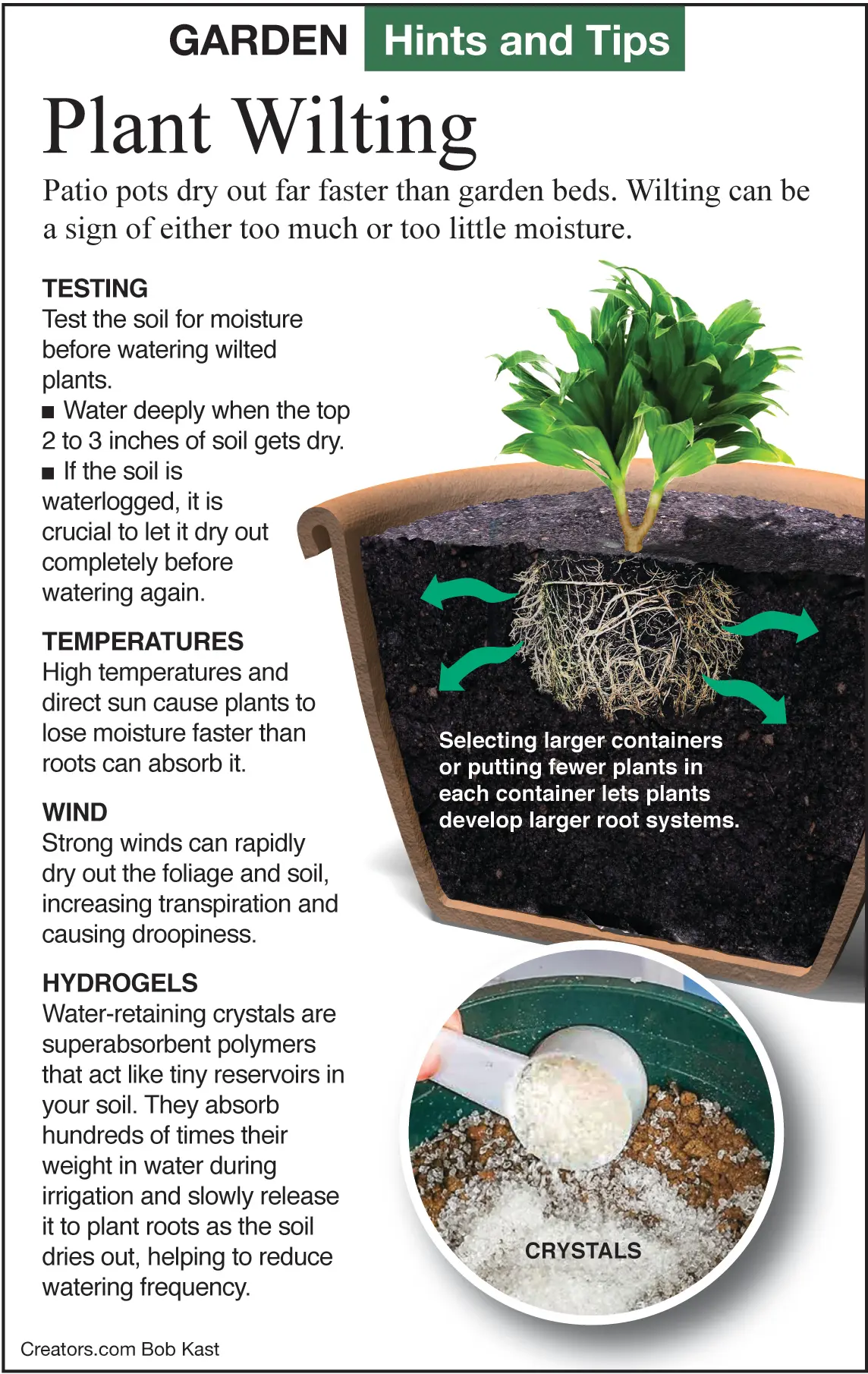
A: Some days are so hot, and the patio area is in such direct sun that plants have a hard time keeping enough water in the leaves. A plant’s leaves evaporate water to help cool the leaf and to move water and nutrients throughout the plant. If the water is leaving the plant faster than it can be resupplied, the plant will wilt. Even though the plant recovers on its own each night, there may still be some tissue that dies. The leaf may develop brown edges, or whole leaves may fall off the plant.
Next year, use larger containers or use fewer plants in each container to allow the plants to develop larger root systems within the pot. Hopefully, the larger root system will be able to keep up with the demand for water.
Using water-retaining crystals in the soil will help the soil hold more water, but if the plant can’t remove enough water, it won’t help.
Try spraying the patio surface with a small amount of water. It will cool the whole patio and may lower the temperature enough to prevent the plants from wilting. This is how many greenhouses are cooled.
Email questions to Jeff Rugg at [email protected]. To find out more about Jeff Rugg and read features by other Creators Syndicate writers and cartoonists, visit the Creators Syndicate website at Creators.com. Copyright 2026 Jeff Rugg. Distributed by Creators Syndicate.