In the closing years of the 19th century, as the United States struggled to reconcile its past and define its future, a Baptist minister named Francis Bellamy (1855–1931) composed a few lines that would outlast him by generations. Spare, deliberate, and softly forceful, the Pledge of Allegiance became one of the nation’s most recognizable civic expressions—recited daily, often from memory, and embedded in American life.
A Minister Shaped by Faith and Duty
Bellamy was born in 1855 in Mount Morris, New York, into a household where faith and patriotism were closely intertwined. His father, Rev. David Bellamy instilled in him a sense of moral order, reverence, and duty—lessons that remained central to his thinking. From an early age, Bellamy absorbed the idea that a nation’s strength depended on shared principles and an engaged citizenry.At the University of Rochester, he proved himself a capable student and a careful observer of a country in transition. He entered the ministry during a period of rapid change—cities expanding, industries rising, and immigration reshaping the population. From the pulpit, he spoke to both spiritual and civic concerns, returning often to the idea that a republic could endure only if its citizens understood not just their rights, but their obligations.

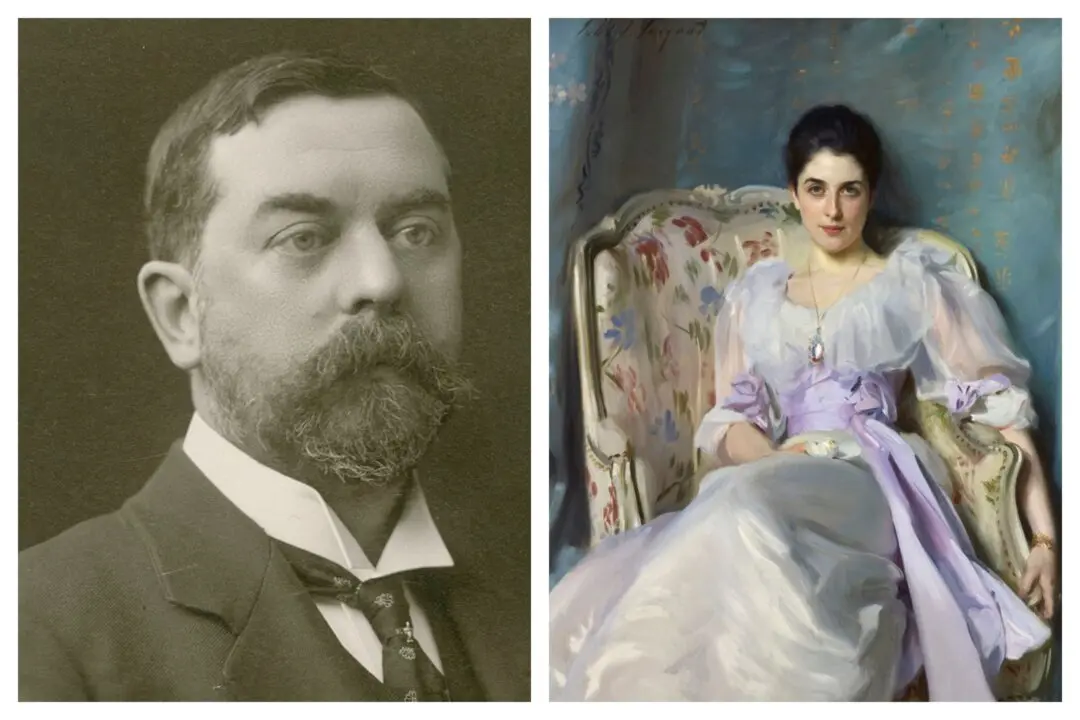
Rev. Francis Bellamy, author of the U.S. Pledge of Allegiance. Public Domain
In 1891, Bellamy joined the staff of The Youth’s Companion, a widely read Boston magazine engaged in a national campaign to place American flags in classrooms. The effort aimed to foster a shared sense of identity among schoolchildren, many of whom were the sons and daughters of recent immigrants. It reflected a broader belief that civic loyalty could be cultivated through education and habit.
The moment was well-timed. Plans were underway to commemorate the 400th anniversary of Christopher Columbus’s 1492 voyage, and Bellamy was tasked with writing a salute that students across the country could recite in unison.
He chose his words carefully. The pledge, he believed, had to be clear, direct, and accessible, while expressing loyalty to the republic rather than to any individual authority. When he finished, the result was striking and simple:
“I pledge allegiance to my Flag and to the Republic for which it stands—one Nation indivisible—with liberty and justice for all.”
Millions Recite a New Civic Ritual
There was no ornamentation. “Allegiance” affirmed loyalty to principle. “One Nation indivisible” recalled the hard-won unity preserved after the Civil War. “Liberty and justice for all” pointed to an ideal still in the making. Its strength lay as much in what it implied as in what it said.

It was an immediate success. On Oct. 12, 1892, millions of schoolchildren, gathered beside newly raised flags, recited the pledge in unison for the first time, marking the beginning of a civic observance that would span more than a century.
In 1923 and 1924, “my Flag” was changed to “the Flag of the United States of America” to remove ambiguity for new citizens. In 1954, during the Cold War, Congress added the phrase “under God,” reflecting the period’s effort to define American identity in moral as well as political terms.

The Pledge of Allegiance memorial in Westfield, Mass. Public Domain
Bellamy understood the role of repetition. Patriotism, in his view, was not merely a sentiment but a practice, reinforced over time. Regular recitation, he believed, would shape citizens aware of their place within the nation and their responsibilities to it.
Over time, the Pledge of Allegiance became a fixture of public life—spoken in schools, at civic gatherings, and during national ceremonies. It has been embraced, questioned, and debated, yet it remains, a rare constant in a country defined by change.
A Lasting Testament
Bellamy did not live to see the full reach of his work. He spent his later years writing and in public service, removed from the daily repetition of the words he had written. When he died in 1931, his name was not widely known, but his words had taken root.What distinguishes Bellamy’s contribution is its precision. At a moment of national uncertainty, he distilled the American idea into a few carefully chosen lines—balancing unity with aspiration, and duty with promise. The pledge does not claim the nation has fulfilled its ideals; it affirms they are worth pursuing.
More than a century later, those words are still spoken. In a country that continues to evolve, the Pledge of Allegiance remains a point of connection—a brief but enduring statement of what the nation seeks to be. Perhaps that is the understated achievement of Bellamy’s work.
In the end, Francis Bellamy gave Americans more than a ritual. He gave them a plain, steady language of civic belief—one built to last.
What arts and culture topics would you like us to cover? Please email ideas or feedback to [email protected]