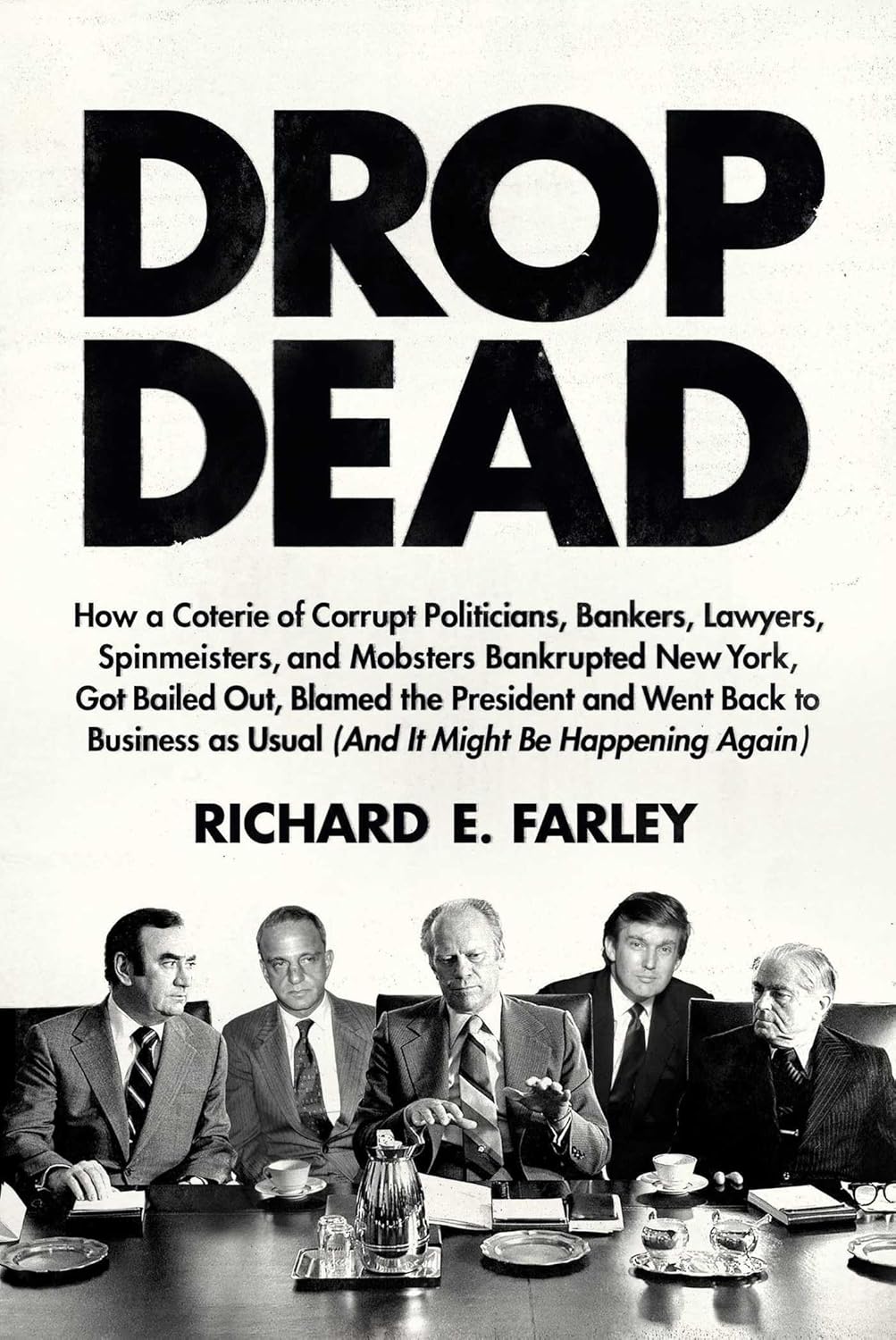
New York City teetered on the brink of financial collapse nearly 50 years ago, thanks to years of deleterious economic policies. Unable to save itself, the city turned to the federal government for help. Republican President Gerald Ford was wary of an unconditional bailout that didn’t address the profligate spending that drove the Democrat-controlled city to near ruin.
But rather than show appreciation of his conditional willingness to help the city, Ford’s political enemies in Washington and the media twisted his position utterly out of context. Most notorious was the New York Daily News’s managing editor, William Brink. Brink published an utterly dishonest page one headline on Oct. 30, 1975 that declared in massive 144-point type: “Ford to City: Drop Dead.”
Financial Decline
Farley traces the roots to Big Apple’s financial deterioration to the loss of well-paying manufacturing jobs starting in the late 1950s. An influx of new blacks and Puerto Ricans (many being low- or no-income) fueled a “white flight” that took away a disproportionate number of middle-income residents.Complicating matters was the city’s excessively generous social services spending. This included a free municipal hospital system with 19 facilities, a city-run university system that offered tuition-free higher education to all local residents, and a rent-control policy.
According to Farley, rent control had “lowered the value of residential buildings, reducing tax revenues and incentives for landlords to improve properties to make them more valuable.” New York City’s municipal unions aggressively muscled City Hall into granting extremely generous perks for their members.
The 1973 to 1974 recession and the elevated inflation that followed hit the city hard. Unemployment rates were far above the national average, and 1.5 million residents were on welfare. The city could no longer spend money it didn’t have. By the time the charismatic but clueless Mayor John Lindsay left office at the end of 1973, the city had a $1.5 billion deficit.

Lindsay’s successor, the former City Comptroller Abraham Beame, attempted to reduce the fiscal chaos by cutting the municipal workforce and trying to reconfigure the city’s budget. But Beame’s efforts were fought by municipal unions and special interest groups that were unwilling to cede power.
Bad Fixes
One scheme that was floated during this period was the creation of the Municipal Assistance Corporation (MAC). MAC was tasked with selling bonds backed by New York State that would fund the city’s operations.MAC was needed because the financial markets were no longer interested in buying New York City debt securities. Farley amusingly describes the odd couple in charge of this initiative: Felix Rohatyn, “the cosmopolitan and refined white-shoe M&A banker from Lazard Frères,” and John P. Scanlon, a “mouthpiece for Anthony Scotto, the Gambino-linked union boss.”
New York City’s troubles also impacted Washington, especially President Ford, who saw the issue as a stumbling block to the 1976 election. Farley recalls that Ford’s advisors warned him that forcing the city into bankruptcy might result in his losing both New York State and other urban industrial states in the upcoming election.
Ford’s Plan
Ford agreed to a plan with the U.S. Treasury providing the city with up to $2.3 billion of seasonal loans for three years; this was accompanied by aid from the New York State government. Ford signed the New York City Seasonal Financing Act into law on Dec. 9, 1975, albeit without a media ceremony.Alas for Ford, the advice he took had the opposite results in the 1976 election. New York State’s 41 electoral votes went to Democratic challenger Jimmy Carter, who won the Electoral College’s results in a 297 to 240 tally. Had Ford carried the state, he would have remained in the White House. Beame also lost his 1977 re-election campaign, even though the city budget recovered into a surplus of $200 million when he stepped down in January 1978.
“Drop Dead” is a lively treat for political junkies. Farley’s book provides a grand insight into the behind-the-scenes dealmaking and bullying that occurred amid the public posturing and grandstanding that shaped public opinion on this crisis.
This is a reminder of the days of old-school roughhouse politics. It also offers a quickie preview of the future of politics with two then-unknowns in blink-and-you-miss-them moments. Donald Trump can be briefly glimpsed working in the real estate business of his father, Fred Trump, a prominent developer, while freshman New York State Assemblyman Chuck Schumer is spotted wrangling an invitation to the birthday party of controversial lawyer Roy Cohn. Who would have guessed that the seeds of the political future were planted in such rocky soil?