America is awash in debt. U.S. national debt has surpassed $35 trillion. This translates to approximately $93,500 per American. National debt today is at levels comparable to those seen during World War II. In the United States, the federal debt has reached or surpassed WWII levels, sitting at around 104 percent of GDP when excluding intragovernmental holdings, and about 128 percent of GDP when including them. This is the highest it has been since shortly after World War II, begging the question: What would become of our currency if we would once again be plunged into world war?

Source: Board of Governors of the Federal Reserve System
Corporate Debt
Corporate debt defaults soared last year and are a problem this year as cash-strapped companies deal with the burden of high interest rates, S&P Global Ratings reported. The number of companies that failed to make required payments on their debt totaled 153 for 2023, up from 85 the year before, an increase of 80 percent. Corporate debt is indeed high today. As of late 2022, corporate debt in the United States had risen to about $19.8 trillion, up from roughly $16.3 trillion just before the pandemic.Low-Income Retirees Leaving the US
A growing number of retirees are moving abroad rather than spending their golden years in the United States. In December 2022, more than 700,000 people were receiving Social Security payments abroad, according to data from the Social Security Administration (in 2000, that figure was less than 400,000).Some move abroad because they can no longer afford to live comfortably on their fixed retirement income in the United States. Costs for housing and health care are becoming more and more unaffordable in much of the United States. Because many retirees rely completely on Social Security payments, which average $1,900 per month, many elderly Americans live in poverty. Moving to some other nations means these Americans won’t have to continuously rely upon increasing debt.
Household Debt
Household debt is defined as all liabilities of households (including nonprofit institutions serving households) that require payments of interest or principal by households to the creditors at a fixed dates in the future. Debt is calculated as the sum of the following liability categories: loans (primarily mortgage loans and consumer credit) and other accounts payable. The indicator is measured as a percentage of net household disposable income.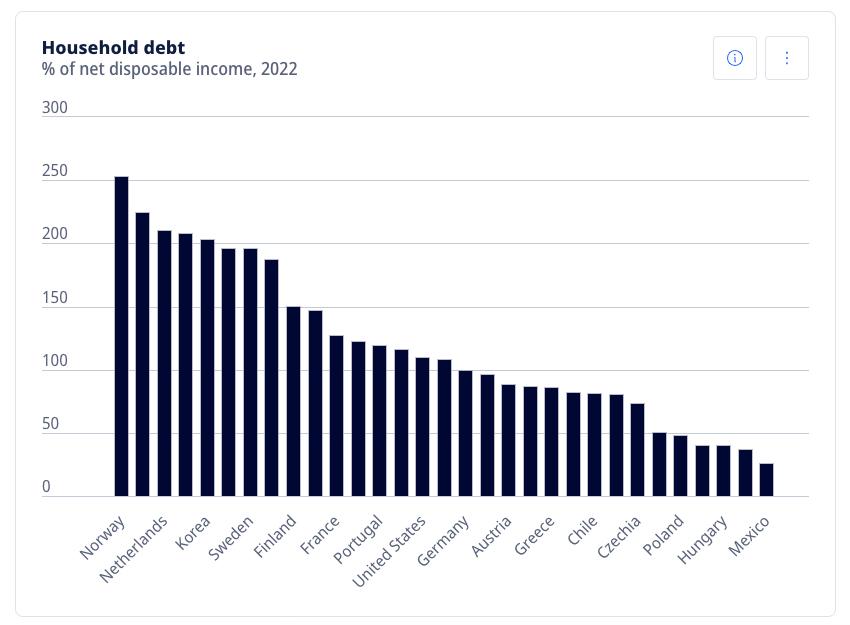
Source: Organisation for Economic Co-operation and Development
Student Debt
Millions of Americans have student loan debt, massing to more than $1.6 trillion as of the end of last year, according to the Federal Reserve Bank of New York. It’s the result of a decades-long explosion in borrowing coupled with soaring education costs. Many students graduate with an average debt of around $28,950. In several waves of student loan forgiveness plans President Joe Biden has been accused of unfairness:Arguments for Fairness
- Supporters argue that the plan provides much-needed financial relief to millions of Americans burdened by student debt, particularly those from low-income backgrounds.
- By reducing debt, individuals may have more disposable income to spend, potentially stimulating the economy.
- The plan aims to address disparities in higher education access and affordability, especially for Pell Grant recipients who typically come from lower-income families.
Arguments Against Fairness
- Critics argue that the plan is unfair to those who have already paid off their loans, chose not to attend college, or served in the military to avoid debt.
- Some believe that the debt forgiveness could contribute to inflation by increasing disposable income without a corresponding increase in goods and services.
- The plan’s cost, estimated to be in the hundreds of billions over a decade, is seen by some as an unfair burden on taxpayers, including those who did not benefit from higher education.
Credit Card Debt
Americans are struggling with their credit card bills at a pace we haven’t seen since the financial crisis of 2008–09.Over 9 percent of credit card balances transitioned into delinquency this past year, according to data from the New York Fed. The level of delinquent debt—card balances that are 30 or more days overdue—hasn’t been this high since 2011, when the United States was still recovering from the Great Recession.
Credit Card Debt Facts
- It carries some of the industry’s highest interest rates.
- It typically accounts for a significant portion of credit utilization on a borrower’s credit profile.
- Paying down substantial portions of outstanding credit card debt is one of the best ways to rapidly improve your credit score.
Address Credit Card Debt
- Evaluate your debt.
- Keep lines of communication open with your credit card provider.
- Check if you qualify for a relief program.
- Ask for a payment plan.
- Be persistent.
Out-of-Control Credit Card Debt
- Stop using your credit cards and stick to your debit card or cash.
- Pay off as much as possible every month.
- Speak to a licensed insolvency trustee to explore options like a consumer proposal or bankruptcy.
- Consider debt repayment strategies such as the debt snowball method or balance transfer credit cards.
- Watch for signs that your debt is unmanageable, such as maxed-out cards, late payments, and using credit cards for necessities.
Mortgage Payments
Average mortgage payments have increased by more than 46 percent over the 12 months ended December 2022. The monthly mortgage payment on the typical U.S. home rose by 31 percent in the last year, driven by record-fast home value appreciation and rising mortgage interest rates. The average homebuyer’s mortgage payment rose recently due to increased sellers’ median asking prices and mortgage rates more than doubling from several years ago.Auto Loans
The average auto loan payment has been on the rise. As of the first quarter of 2024, the average monthly payment for new vehicles is $735 and for used vehicles $523.The double whammy of higher interest rates and increased vehicle prices accounts for the increase. In fact, nearly 15 percent of drivers who financed a new vehicle near the end of 2022 are paying more than $1,000 a month for their vehicle.
Summary
Taken all together, this is a composite picture of a debt-soaked nation now struggling to service this excessive debt. Increasing debt every year has the aggregate effect of allowing us to live a lifestyle beyond what just our earnings would provide, while ultimately and inevitably both servicing and reducing this enormous mountain of debt will mean on average living a lifestyle less than what our earnings would have provided.

The Epoch Times copyright © 2024. The views and opinions expressed are those of the authors. They are meant for general informational purposes only and should not be construed or interpreted as a recommendation or solicitation. The Epoch Times does not provide investment, tax, legal, financial planning, estate planning, or any other personal finance advice. The Epoch Times holds no liability for the accuracy or timeliness of the information provided.