Colorful Travelogues for the Medieval Reader

The Getty Center’s ‘Going Places: Travel in the Middle Ages’ provides an in-depth look at the varied reasons and modes of medieval travel.
Colorful Travelogues for the Medieval Reader
"Villagers on Their Way to Church" from the Book of Hours, circa 1550, by Simon Bening. Getty Center, Los Angeles. Getty Museum
|Updated:
0:00

The Getty Center’s exhibition “Going Places: Travel in the Middle Ages” delves into the fascinating and sometimes fantastical world of medieval travel as depicted in art. On view through Nov. 30, 2025, the show is composed of manuscripts from the museum’s permanent collection.

Many of the exhibited artworks are rarely on public display and some are new acquisitions. Drawing on illuminated manuscripts from diverse genres, including religious texts, world histories, romances, fables, and encyclopedias, the exhibit illustrates how these works became travelogues for the medieval “armchair” reader.

During the Middle Ages most European people did not journey beyond a 20-mile radius of their home in their lifetime. Travel further afield was usually for business duties or religious reasons; the modern concept of tourism did not exist.

A standout in the exhibit is a miniature done with vivid tempera colors, ink, and gold showing Saint Christopher carrying the Christ Child across a turbulent river. Saint Christopher was one of the most popular saints among travelers. The folio comes from a French Book of Hours and is dated to around 1420. The artist’s choice to depict the boats with full sails imbues the scene with liveliness—a characteristic found throughout the works in the Getty’s exhibition.
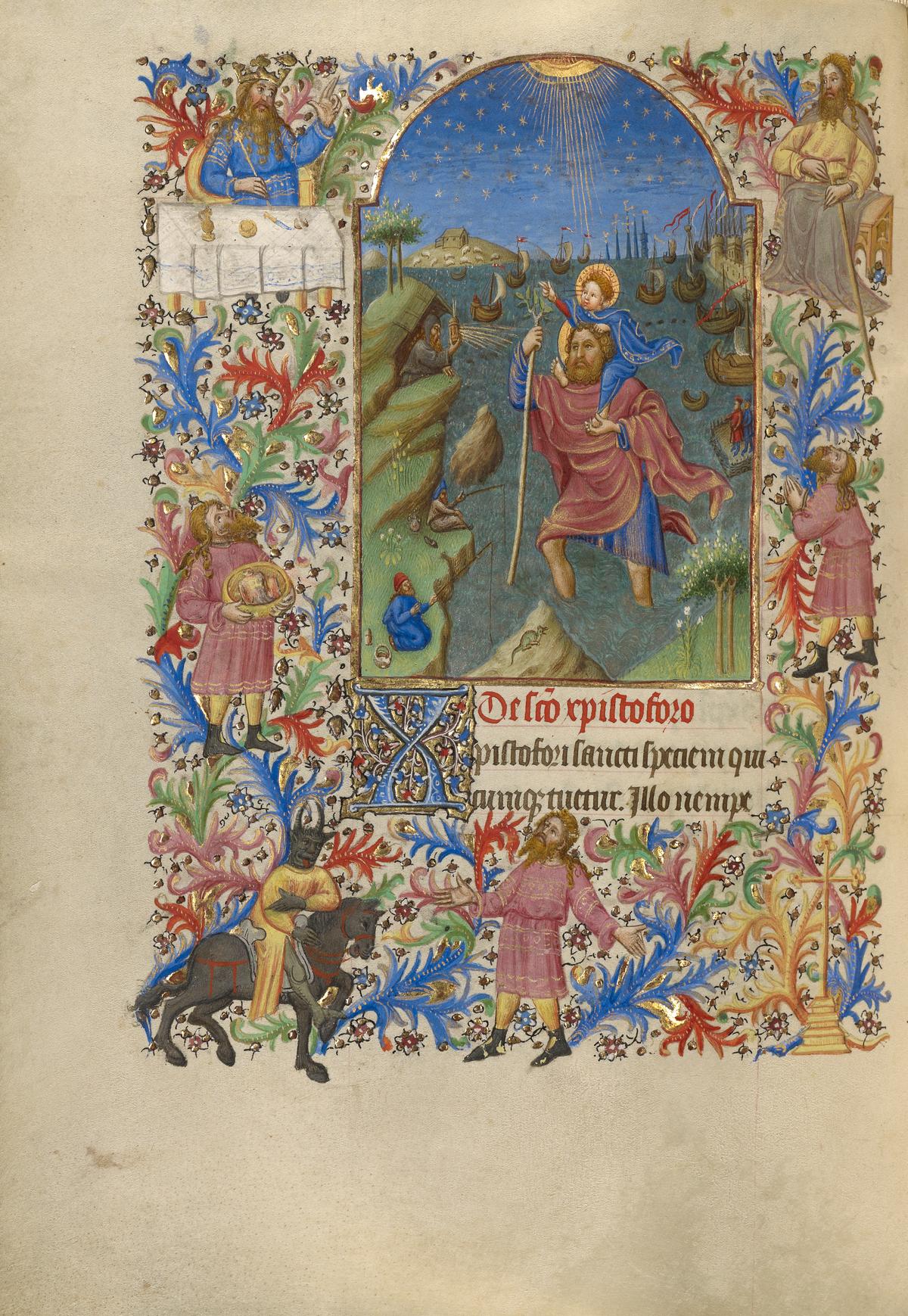
"Saint Christopher Carrying the Christ Child" from the Book of Hours, circa 1420, by Spitz Master.<br/>Tempera colors, gold, and ink; 7 15/16 inches by 5 7/8 inches. Getty Center, Los Angeles (Getty Museum)
"Saint Christopher Carrying the Christ Child" from the Book of Hours, circa 1420, by Spitz Master.
Tempera colors, gold, and ink; 7 15/16 inches by 5 7/8 inches. Getty Center, Los Angeles
Getty Museum
The show is divided into three thematic sections: Following in the Footsteps of Christ: Christianity and Travel; Distant Lands: Diplomacy, Trade, and the Imagination; and Medieval Modes of Travel. Some of the artworks featured show realistic representations of voyages while others are imagined. These manuscripts were made for wealthy Europeans to contemplate spiritually or pleasurably, depending on the genre, the visual and textual accounts of locales.

Christianity and Travel

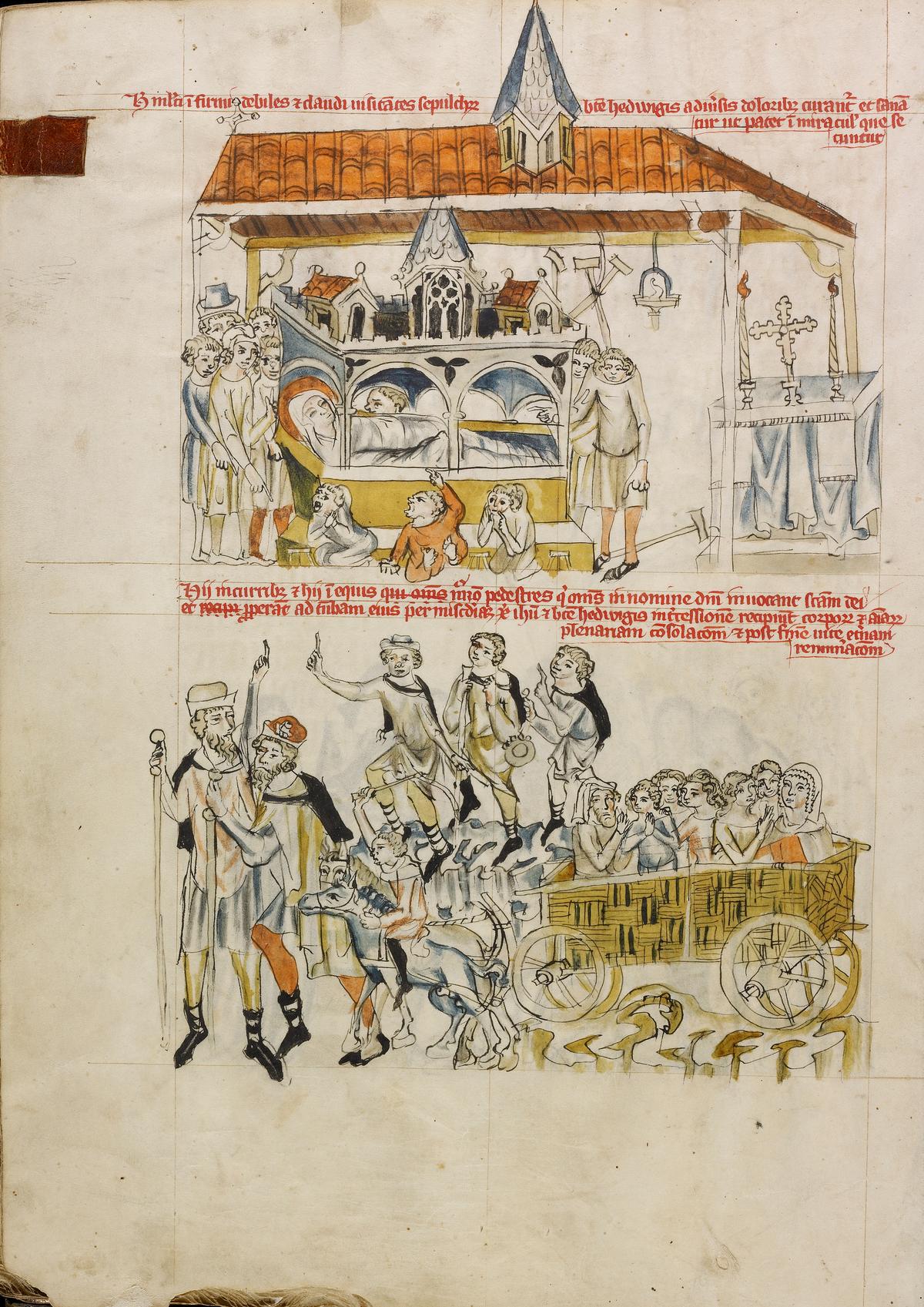
"The Sick, the Leprous, and the Lame Praying at Saint Hedwig's Tomb; People Coming to Visit Saint Hedwig's Tomb," 1353, from Silesia, Poland. Tempera colors, colored washes, and ink; 13 7/16 inches by 9 3/4 inches. Getty Center, Los Angeles (Getty Museum)
"The Sick, the Leprous, and the Lame Praying at Saint Hedwig's Tomb; People Coming to Visit Saint Hedwig's Tomb," 1353, from Silesia, Poland. Tempera colors, colored washes, and ink; 13 7/16 inches by 9 3/4 inches. Getty Center, Los Angeles Getty Museum

The first section, “Following in the Footsteps of Christ,” focuses on journeys central to the narratives of the Christian Bible and medieval pilgrimages. A highlighted work is “The Sick, the Leprous, and the Lame Praying at Saint Hedwig’s Tomb; People Coming to Visit Saint Hedwig’s Tomb.” This 1353 miniature is from Silesia, a historic region located today mostly in Poland along with small parts of the Czech Republic and Germany. Pilgrims traveled to holy sites, such as saint shrines with relics, to pray for miracles. In the lower part of the page, pilgrims come from far and wide, either on foot carrying staffs (medieval symbols of pilgrimage), riding horseback, or using a cart for transport.
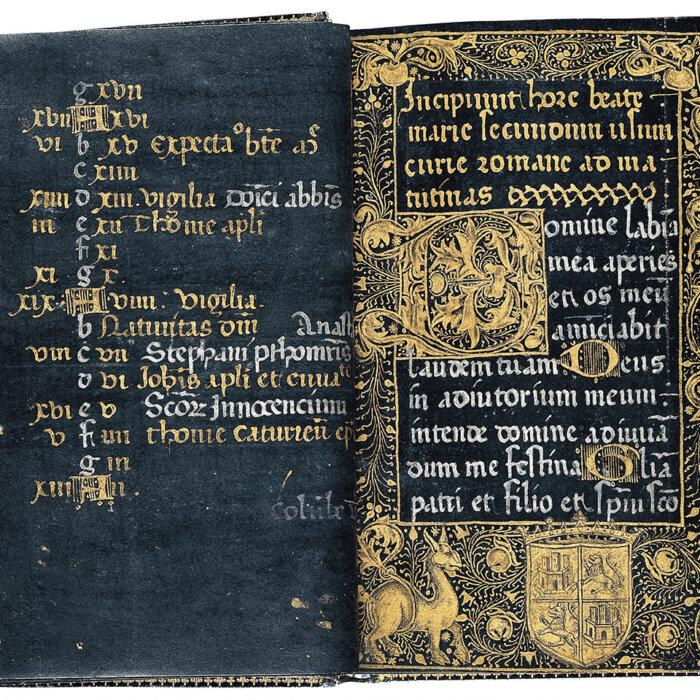
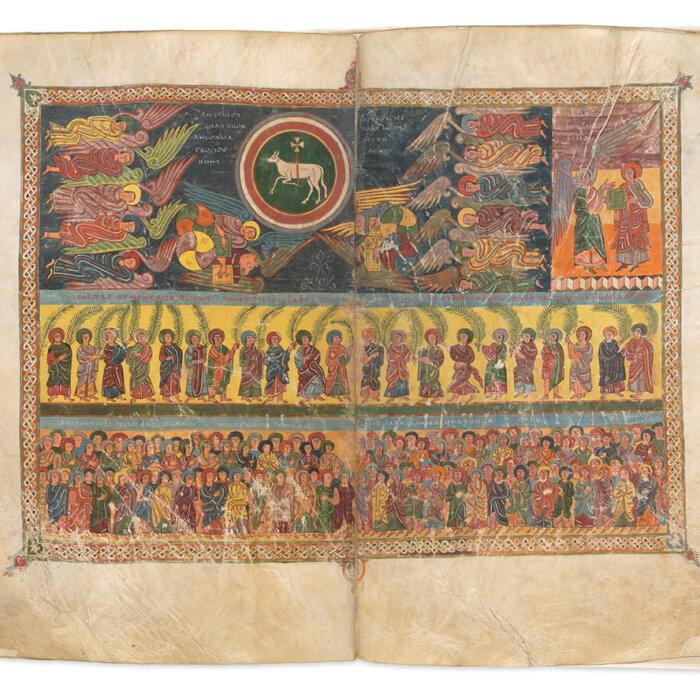
The Getty observes, “The Artist combined the use of colored washes and tempera colors, capturing a quick, spontaneous feel with his lively pen work but including carefully observed naturalistic details such as the texture of the cart’s siding.”

Diplomacy, Trade, and the Imagination
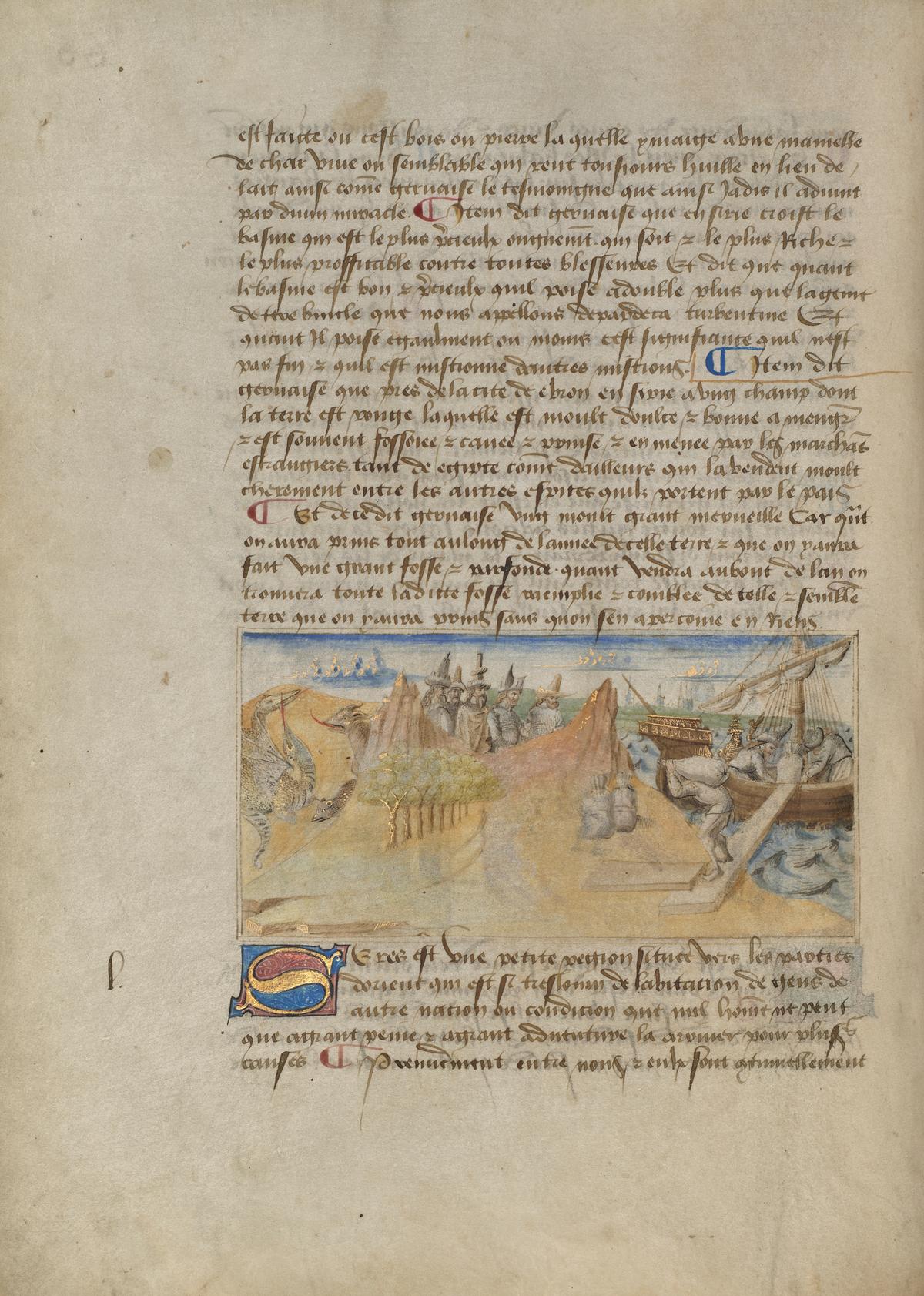
"China (Seres)," circa 1460–1465, by Master of the Geneva Boccaccio from the "Book of the Marvels of the World."<br/>Colored washes, gold, and ink; 5 1/2 inches by 3 1/8 inches. Getty Center, Los Angeles (Getty Museum)
"China (Seres)," circa 1460–1465, by Master of the Geneva Boccaccio from the "Book of the Marvels of the World."
Colored washes, gold, and ink; 5 1/2 inches by 3 1/8 inches. Getty Center, Los Angeles
Getty Museum

Distant Lands, the second section, emphasizes travel undertaken for trade, diplomacy, and warfare, along with fantastical journeys of the imagination. An artwork here is the folio “China (Seres),” dated to about 1460–1465. It shows a Chinese port where merchants are loading goods onto a ship. Trade between China and Europe did take place during the Middle Ages, though the artist has depicted China as a desert landscape with dragons.
The work comes from the Getty’s “The Book of the Marvels of the World,” which was acquired in 2022. It is considered a medieval guide to the globe as it combines information from ancient sources, medieval folklore and alleged eyewitness accounts of places near and far. The text, of which there are four surviving copies, is French and dates to the mid-15th century.
The Getty’s version was illustrated by the Master of the Geneva Boccaccio. His drawing technique in the manuscript “allows for lively, dynamic, and fluid compositions that capture the sense of a traveler moving quickly from place to place across the known globe,” the Getty explains.
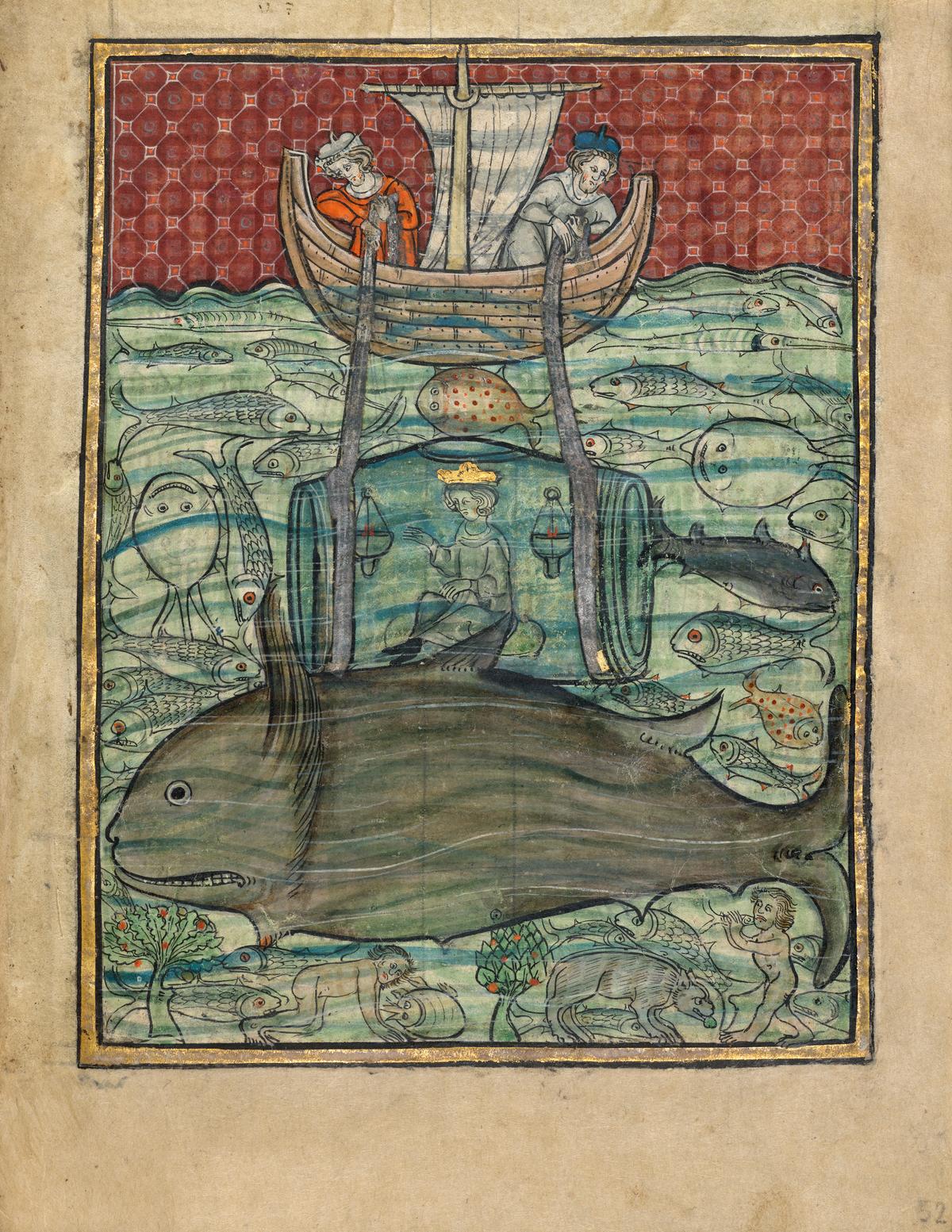
"Alexander the Great Under Water," from "Romance of Alexander," circa 1290–1300, from France or Belgium. Tempera colors, gold and silver, and ink on parchment. Getty Center, Los Angeles (Getty Museum)
"Alexander the Great Under Water," from "Romance of Alexander," circa 1290–1300, from France or Belgium. Tempera colors, gold and silver, and ink on parchment. Getty Center, Los Angeles Getty Museum
Another new exciting Getty acquisition, which contains the folio “Alexander the Great Under Water” included in the exhibition, was purchased in 2025. It is a circa 1290 to 1300 French or Flemish copy of the “Romance of Alexander,” a popular medieval account of the life of Alexander the Great. The text combines a heroic epic, adventure story, and legend, in which Alexander is presented as an ideal medieval knight, rather than a historic conqueror from antiquity. In other folios, he is depicted in 13th-century armor, though he died in 323 B.C. This manuscript’s miniatures are imbued with energy and movement.

Medieval Modes of Travel

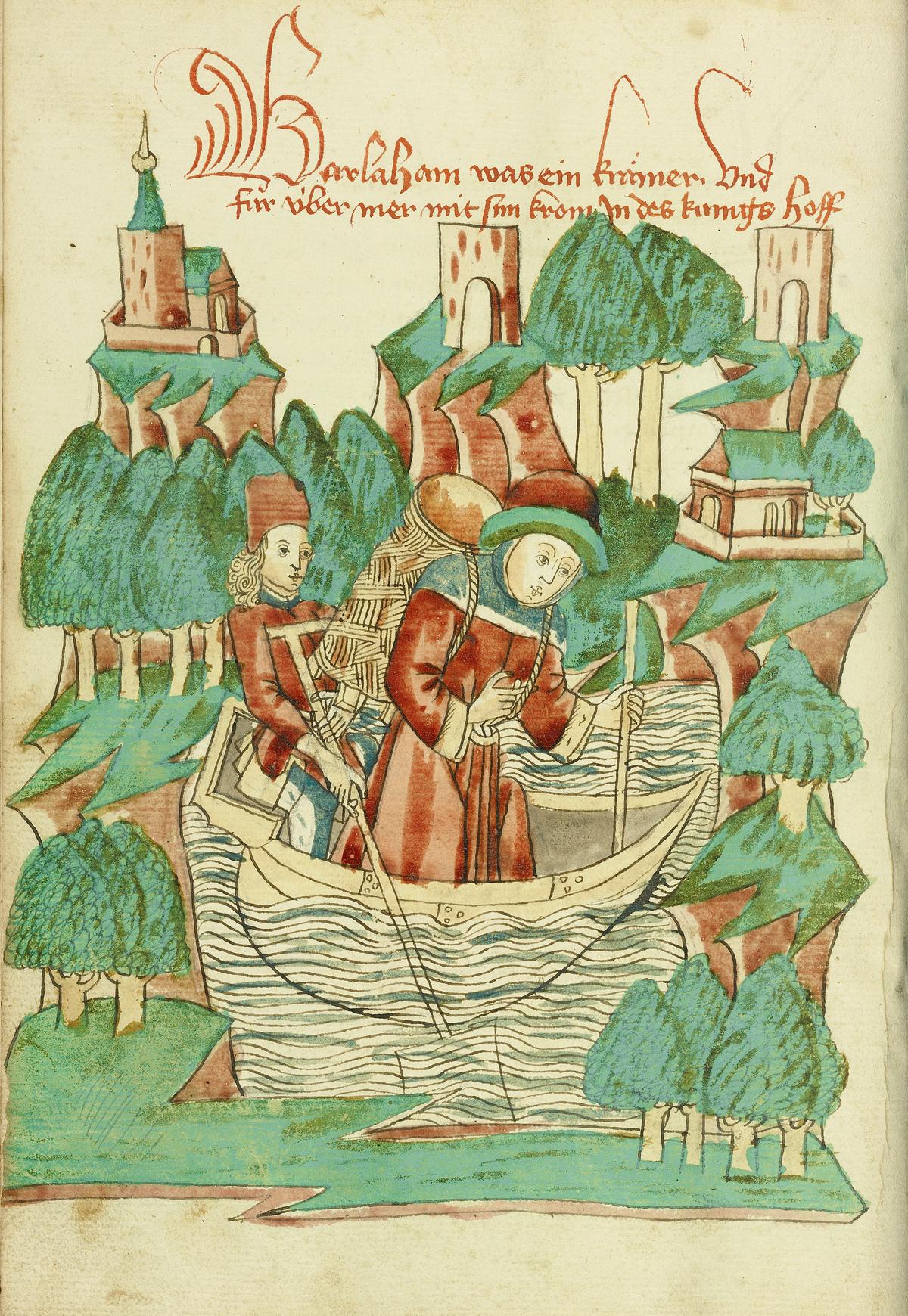
"Barlaam, Carrying a Shoulder Pack, Crosses a River," 1469, by a follower of Hans Schilling. Ink, colored washes, and tempera colors; 11 1/4 inches by 8 inches. Getty Center, Los Angeles (Getty Museum)
"Barlaam, Carrying a Shoulder Pack, Crosses a River," 1469, by a follower of Hans Schilling. Ink, colored washes, and tempera colors; 11 1/4 inches by 8 inches. Getty Center, Los Angeles Getty Museum

The final section, Medieval Modes of Travel, displays real means of travel—walking, riding, and sailing—as well as fictitious types. The folio “Barlaam, Carrying a Shoulder Pack, Crosses a River” portrays the hermit Barlaam on a small boat as he journeys to India to convert Prince Josephat to Christianity. The scene depicts a story in the text “Barlaam and Josaphat,” a Christianized version of the Buddhist story of Siddhartha. The Getty’s copy is Alsatian and dates to 1469.

The artist uses vivid washes of color and bold silhouettes in his illustrations. The manuscript emphasizes visual storytelling, as most of the images take up an entire page. As in the “Romance of Alexander,” the artist updated the figures’ dress, in this case to the 15th century, to help medieval viewers connect with the story.

“Going Places: Travel in the Middle Ages” provides an in-depth look at the varied reasons and ways medieval people visited places. In addition to faraway lands, attention is paid to small journeys undertaken by everyday people. “Villagers on Their Way to Church” is from a circa 1550 Flemish Book of Hours. In shows worshippers making their way to their local parish church.

"Villagers on Their Way to Church" from the Book of Hours, circa 1550, by Simon Bening. Tempera colors and gold paint; 2 3/16 inches by 3 3/4 inches. Getty Center, Los Angeles. (Getty Museum)
"Villagers on Their Way to Church" from the Book of Hours, circa 1550, by Simon Bening. Tempera colors and gold paint; 2 3/16 inches by 3 3/4 inches. Getty Center, Los Angeles. Getty Museum

Despite the artwork’s small size, the artist, Simon Bening, conveyed a landscape’s vastness akin to a large panel painting. Details Bening included—the candlelit procession inside the church and the candles the villagers hold—has led scholars to believe the scene shows a celebration of the holiday of Candlemas. While a mundane event, this folio is no less beautiful than the other works in this adventurous exhibit.
The “Going Places: Travel in the Middle Ages” exhibition at the Getty Center in Los Angeles, Calif., will be on view through Nov. 30, 2025. To learn more, visit Getty.edu.
What arts and culture topics would you like us to cover? Please email ideas or feedback to [email protected]
Google LogoMark Us Preferred on Google
Michelle Plastrik
Michelle Plastrik
Author
Michelle Plastrik is an art adviser living in New York City. She writes on a range of topics, including art history, the art market, museums, art fairs, and special exhibitions.