It’s not easy to create a successful novel these days. Of the approximately 440,000 new fiction works released every year, only 1,000 of these might reach the U.S. bestseller lists. Those odds aren’t great, especially for new authors.
Some might employ gimmicks to boost sales, like new cover editions, discounts, or celebrity endorsements. One option that often surfaces is the “interactive” ploy, offering the audience a novel (pun intended) way to connect to the created world. “Choose Your Own Adventure” books were one such example that emerged in the late 1970s.
Family Secrets
Mia Hayes, 17 years old, is a bookish loner living in Washington, whose childhood was pretty unique. Her father, Hamilton, is a history professor who is obsessed with codes, encryption, and the different ways civilization has used them to keep and pass along its secrets. Her mother, Grace, is a highly regarded journalist.Moving to different countries throughout her life, Mia’s favorite birthday present was always a new and challenging scavenger hunt her parents would craft for her. Every year, she receives a trail of clues and codes she must decrypt to get the big prize at the end. The ultimate gift wasn’t the best part of her experiences, but, rather, the family memories they created.
Three weeks before her 18th birthday, Mia returns home one day and notices her parents are strangely tense. Surprisingly, she receives the first clue of the annual scavenger hunt early—a wooden puzzle box with an alphabet combination lock. A short time later, she comes downstairs from her bedroom to discover three men searching their home and her parents looking very frightened.
An Ally and Another Attack
A few weeks later, Mia is living across the street at a neighbor’s. Police questioned Mia, but the final determination was that she lied about the strange men and that her father was the one who shot Grace. Hamilton hasn’t been seen since the shooting and is wanted for murder.
Numb and devastated, Mia doesn’t know what to think. On the morning of her birthday, she receives a call on her cell from an unknown number. Most likely it’s her father, but she’s furious at him for abandoning his family and won’t even listen to the voicemail.
Walking home from work, she crosses paths with Logan, who kindly returns her dropped wallet to her. Despite herself, she ends up making a dinner date with him that evening. But the date doesn’t go as planned when Powell and his cronies show up at Mia’s home the same night, and Logan ends up getting snared in Mia’s crisis as well.
A Puzzle Box of a Book
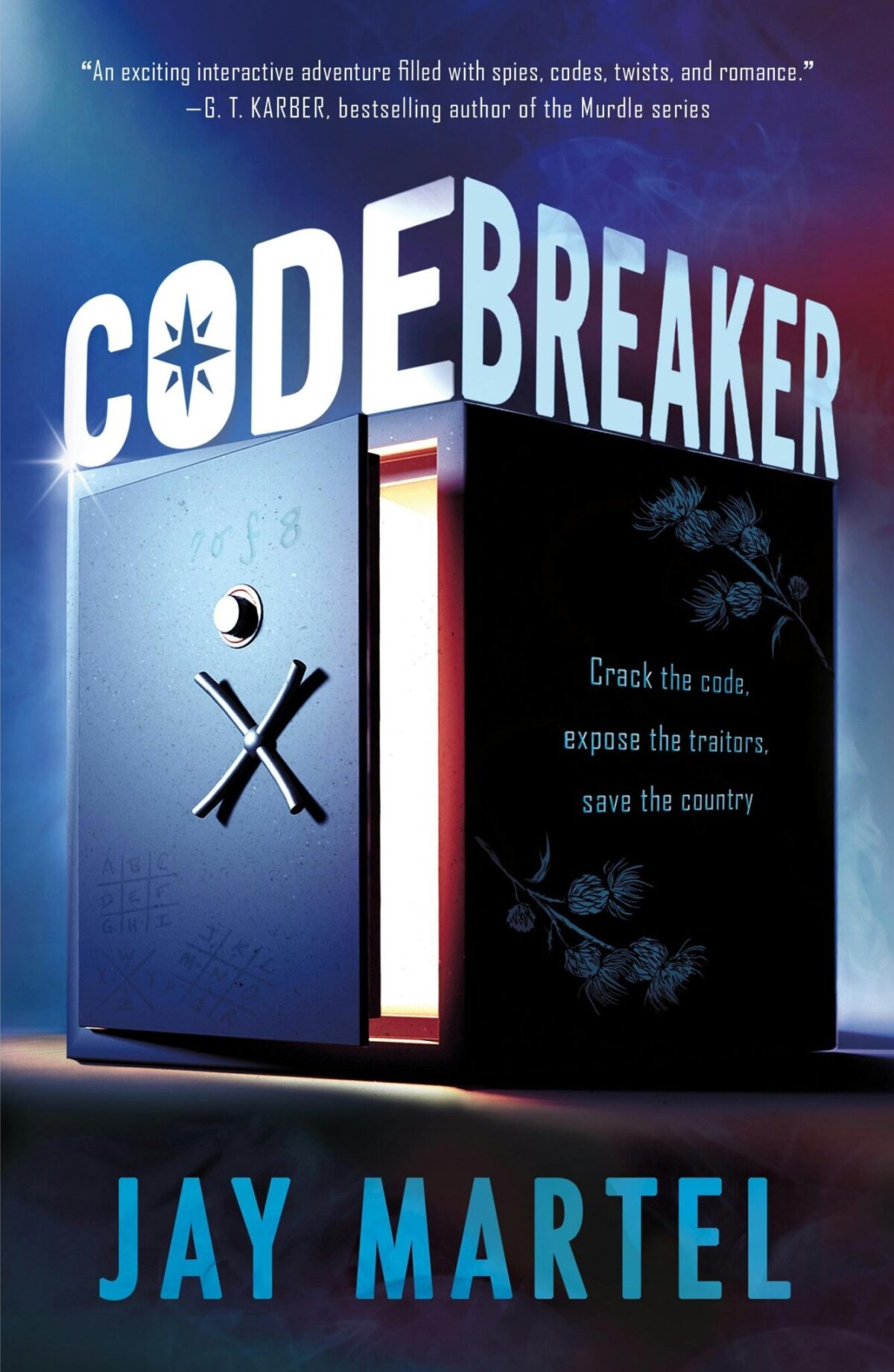
Though the author of “Codebreaker” is listed as Jay Martel, that’s a pseudonym for the writing duo of Andy Bennett and Katy Helbacka. Katy and Andy work in professional theater, cybersecurity, and escape rooms, and they’ve pooled their experiences here to good effect.What’s the “interactive” part? A distinctive symbol appears every so often on the page that lets readers know they have everything they need to solve the puzzle on their own, should they wish to do so. There is also the option of ignoring the symbol and just seeing how Mia and Logan figure it out.
What was most surprising about this “novel with a gimmick” was how solid it is. The concept and the dialogue might be somewhat formulaic and tailor-made for a Netflix audience. But there’s nothing wrong with that, so long as it’s done very well. And that’s precisely what the authors did.
Mia has a believable character arc from a frightened girl out of her depth into a semi-capable hero. Many consequences and harsh realities are not glossed over, and the puzzles are also fun and interesting. Logan has a good mix of white knight and inexperienced kid in him, and the rest of the cast follows suit in a similar, well-balanced way.
Set in the nation’s capital as it is, there is a political angle to the mystery of “Codebreaker” that, early on, seems in danger of becoming heavily partisan. But here again, the book ends up giving a surprisingly balanced approach; this is a very welcome change of pace in the world of YA fiction.