Chasing the History of a Rare Greek Bronze

A rare extant statue of Artemis is on a long-term loan at the Metropolitan Museum of Art in New York City.
Chasing the History of a Rare Greek Bronze
Cropped photograph of the bronze statue of "Artemis and a Deer" at the Metropolitan Museum of Art in New York City. Mike Peel/CC BY-SA 4.0
|Updated:
0:00

Most ancient Greek bronze statues have not survived to the current era. They have been lost or melted down for their precious metal to be reused. Knowledge of these artworks comes mainly from Roman-era marble copies. A rare extant piece is a bronze statue of “Artemis and a Deer,” circa 1st century B.C. to A.D. 1st century.

Prized for its art historical value, the sculpture attracted media attention when it was controversially sold by its owner, the Albright-Knox Art Gallery, now called Buffalo AKG Art Museum. Shattering the then-record for a sculpture at auction, it is now on view at the Metropolitan Museum of Art in New York.

A bronze statue of "Artemis and a Deer," circa 1st century B.C. to A.D. 1st century, in Greece's Late Hellenistic or Early Imperial period. Bronze; 36 1/4 inches tall. The Metropolitan Museum of Art, New York City. (<a href="https://commons.wikimedia.org/wiki/User:Mike_Peel">Mike Peel</a>/<a href="https://creativecommons.org/licenses/by-sa/4.0/deed.en" target="_blank" rel="nofollow noopener">CC BY-SA 4.0</a>)
A bronze statue of "Artemis and a Deer," circa 1st century B.C. to A.D. 1st century, in Greece's Late Hellenistic or Early Imperial period. Bronze; 36 1/4 inches tall. The Metropolitan Museum of Art, New York City. Mike Peel/CC BY-SA 4.0
The bronze depicts the goddess of the hunt, known to the Greeks as Artemis and called Diana by the Romans. She stands 36 1/4 inches tall on the original 12 1/2 inch rectangular base and wears a short chiton, a standard ancient Greek garment. Females wore full-length chitons, but Artemis’s tunic needed to be shorter to facilitate chasing prey. The artist depicted the frontal part in the style of “wet drapery,” as it clings to her lower body. In contrast, the back billows dramatically. A fragmentary himation, a cloak wrapped around the body and over the left shoulder, is visible on her upper body.

Artemis’s feet are shod in intricately laced sandals, and her wavy hair is parted in the middle and crowned by a diadem adorned with silver. This head ornament is crescent-shaped and decorated with engraved palmettes. Her eyes are also silvered. They are surprisingly lifelike with incised irises and recessed pupils. At Artemis’s left is a deer, sometimes referred to as a stag, whose height is 16 3/4 inches. A dog may have once been at her right.
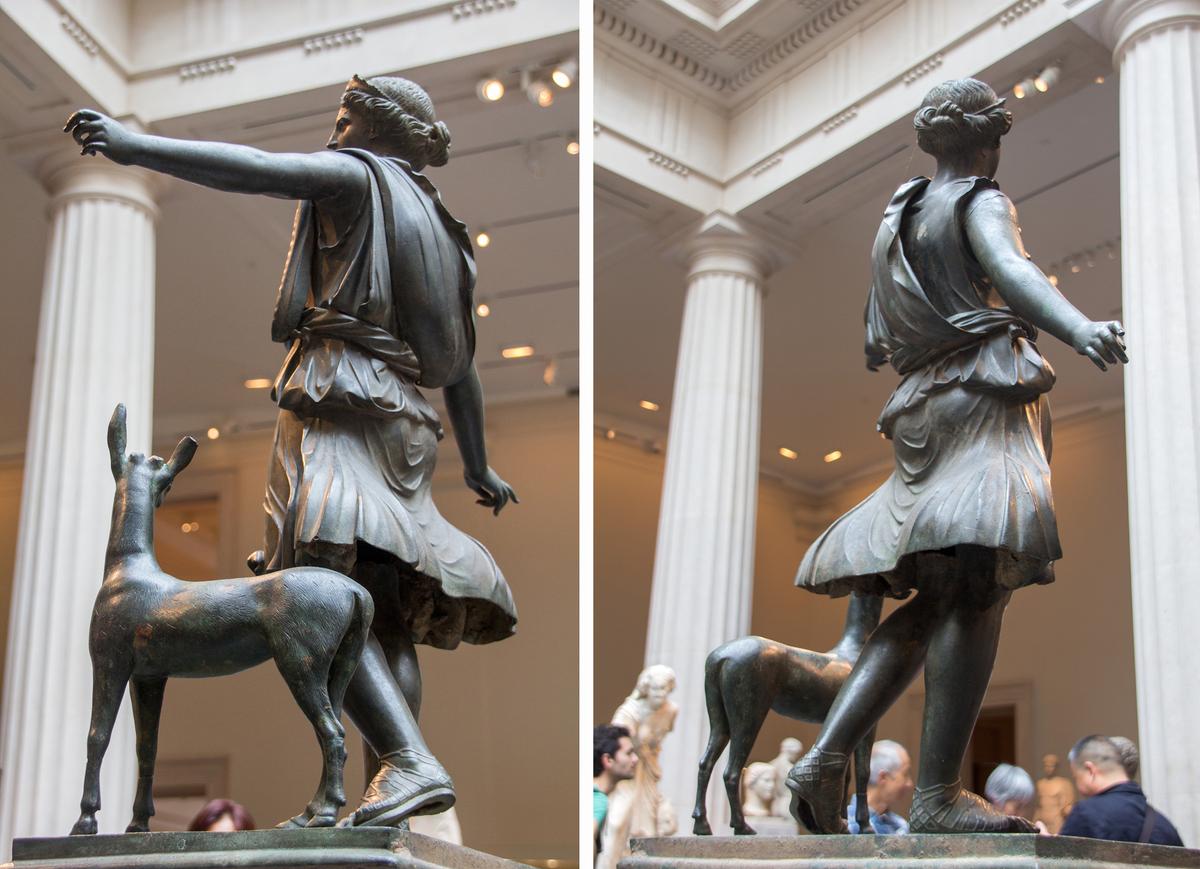
Alternate perspectives of the bronze statue of "Artemis and a Deer" at the Metropolitan Museum of Art in New York City. (<a href="https://commons.wikimedia.org/wiki/User:Mike_Peel">Mike Peel</a>/<a href="https://creativecommons.org/licenses/by-sa/4.0/deed.en" target="_blank" rel="nofollow noopener">CC BY-SA 4.0</a>)
Alternate perspectives of the bronze statue of "Artemis and a Deer" at the Metropolitan Museum of Art in New York City. Mike Peel/CC BY-SA 4.0

She is depicted at the moment just after releasing her arrow; a bow would have originally been in her left hand. Customarily, statues of the goddess show her figure in motion. Here, she stands with her weight on her right leg. The left foot trails behind on pointed toes. The Met terms this portrayal as if she were “in an epiphany.”

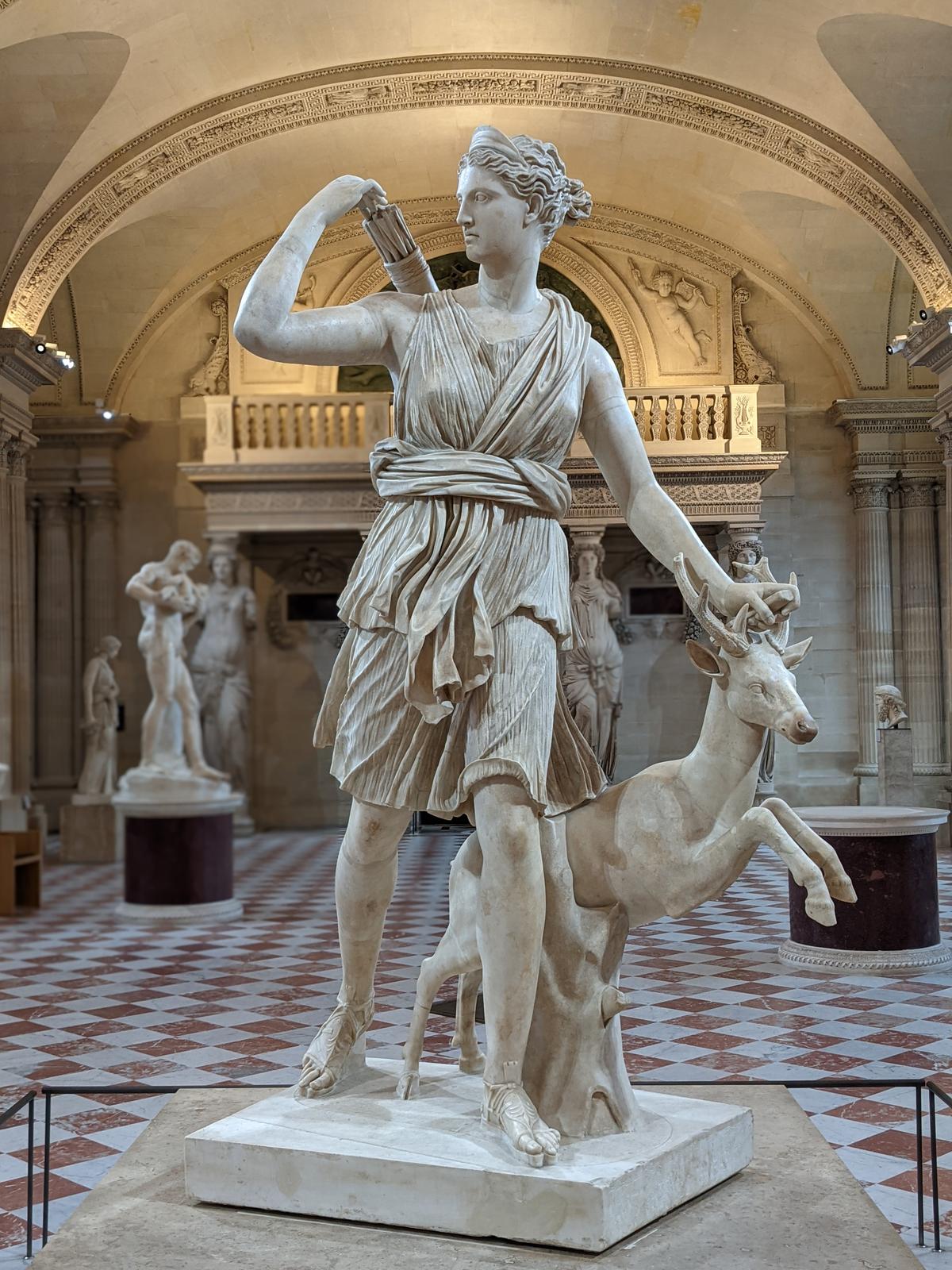
Another departure from historic iconography is Artemis’s physical appearance. She is usually a fully grown young woman, but in this version she is depicted as an adolescent girl. Traditionally, the goddess is shown taking an arrow from her quiver or preparing to shoot, not after the completed action. Furthermore, she lets the deer stand peacefully beside her, instead of grabbing its antlers. A contrasting and quintessential version of the goddess is the Louvre’s “Artemis With a Doe,” known also as “Diana of Versailles.” In this artwork, she is shown in strident action. The Louvre’s version is a Roman marble copy, as the bronze original is now lost.

"Diana of Versailles," circa A.D. 125–A.D. 150, from Italy. Marble; 78 3/4 inches by 54 3/4 inches. Louvre Museum, Paris. (Public Domain)
"Diana of Versailles," circa A.D. 125–A.D. 150, from Italy. Marble; 78 3/4 inches by 54 3/4 inches. Louvre Museum, Paris. Public Domain
Scholars believe “Artemis and a Deer” was made during the Late Hellenistic or Early Imperial era. By repute of the first documented owner of the statue, antiquities dealer Ugo Jandolo, the bronze was discovered before the early 1930s during construction near Rome’s cathedral Church of Saint John the Lateran. Specialists hypothesize that the artwork decorated a peristyle (a columned porch or open colonnade) garden of a private Roman villa or townhouse, rather than a public space.
“Artemis and a Deer” is notable for its fine craftsmanship. The Met explains, “The statue and its base were cast in several sections by means of the lost wax method, as was characteristic in antiquity, and these parts were then joined together with flow welds.” The lost-wax casting technique became the main Greek process for making bronze statuary by the Late Archaic period (circa 500 B.C.–480 B.C.). After casting, artists and their workshops would add decorative details with a chisel and insets.

In 1953, the Albright-Knox Art Gallery acquired the statue. It remained in their collection until 2007, although it had not been shown since 1997. The institution’s core mission is to collect the art of its time, so its ancient holdings were an anomaly. On June 7, 2007, Sotheby’s held an auction of property from the gallery, including “Artemis and a Deer,” with proceeds of these deaccessioned works to go towards the acquisition of contemporary art. This decision was met with heated debate: Many art experts and enthusiasts decried the sale of the historic bronze Artemis, lamenting its removal from a public museum to a private collection.

Estimated to be worth between $5 million and $7 million, it brought $28.6 million and set a record for a sculpture at auction as well as an antiquity at auction. The winner was Giuseppe Eskenazi, a London dealer of Chinese art, who was bidding on behalf of a private European collector. Thankfully, the public can still see this artwork in person: The anonymous owner placed the sculpture on a long-term loan at The Met. It graces the Leon Levy and Shelby White Court, designed as a Roman peristyle—a pitch perfect environment for the beautiful “Artemis and a Deer.”


"Artemis and a Deer" at the Metropolitan Museum of Art in New York City. (<a href="https://commons.wikimedia.org/wiki/User:Mike_Peel">Mike Peel</a>/<a href="https://creativecommons.org/licenses/by-sa/4.0/deed.en" target="_blank" rel="nofollow noopener">CC BY-SA 4.0</a>)
"Artemis and a Deer" at the Metropolitan Museum of Art in New York City. Mike Peel/CC BY-SA 4.0
What arts and culture topics would you like us to cover? Please email ideas or feedback to [email protected]
Google LogoMark Us Preferred on Google
Michelle Plastrik
Michelle Plastrik
Author
Michelle Plastrik is an art adviser living in New York City. She writes on a range of topics, including art history, the art market, museums, art fairs, and special exhibitions.