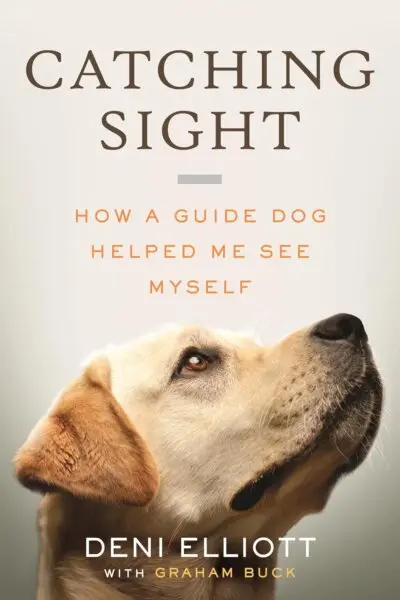
There have been innumerable books about the relationship between people and their dogs, but “Catching Sight” is somewhat different. The canines in question are guide dogs trained to assist a woman who struggled to adapt to needing help.
Deni Elliott recalls her time with four different guide dogs, each offering distinct experiences that required her to relearn the human-canine dynamic. Co-author Graham Buck is a dog trainer who worked with Elliott in adapting to her third and fourth guide dogs.
The Wrong Dogs
Elliott was a professor of ethics at the University of Montana and an independent corporate ethics consultant when she received an ophthalmologist’s conclusion that she was legally blind. Despite going through life with low vision, the diagnosis jolted her. After all, she held a driver’s license despite having vision that could charitably be described as less than crystal clear.It didn’t help her sense of security when she discovered that her husband, who held a professorial job in Los Angeles, was having an affair. She came to terms with her marriage’s failure and ditched her cheating husband. She then opted to have a local dog trainer work with her golden retriever puppy, Oriel, to become her guide dog.
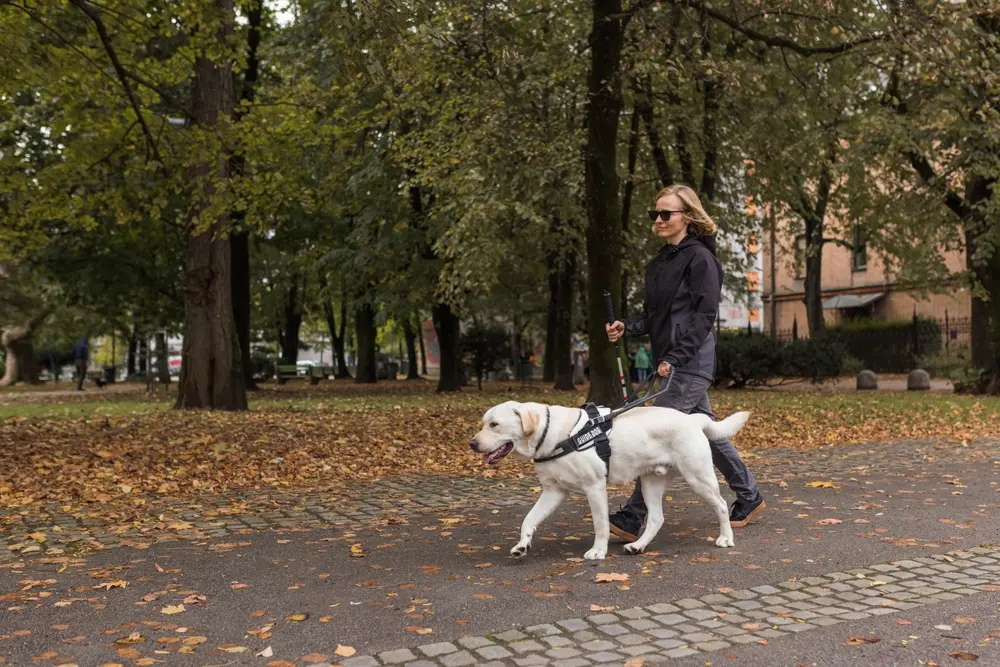
Elliott later relocated to a new academic job in Florida and a second gig as an ethics consultant in Los Angeles. While she had no problems dealing with weekly cross-country flights, poor Oriel quickly became worn out by the excessive travel.
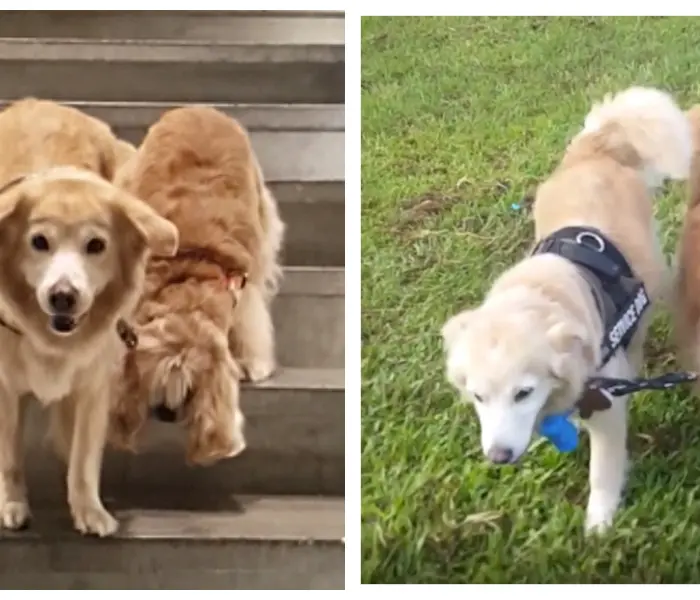
Oriel’s replacement was going to be Wylie, a German shepherd who Oriel’s trainer prepared for the job. But hyper-energetic Wylie required more exercise than Elliott could provide and hated air travel. When Wylie killed a feral cat in an off-leash hiking area, Elliott realized this was the wrong fit. Alas, Oriel’s health failed rapidly during this time, and the dog was euthanized following a ruptured liver.
Better Canine Fits
Elliott’s next companion was Alberta, a Labrador retriever who bonded with the author so quickly that people viewed them as a single unit, even referring to them as “Denberta.”After five years together, Alberta developed an eye condition that was initially diagnosed as conjunctivitis, but was later revealed as a uveal melanoma that required the removal of her right eye.
Alberta could no longer function as a guide dog. Elliott realized she couldn’t keep her as a pet while another guide dog came in. Thus, she made the difficult decision to rehome Alberta.
The author’s fourth dog was Koala, another Labrador retriever, albeit with a different personality from Alberta. As she texted to Buck, “I think that Koala is a German shepherd in Labrador clothing. She doesn’t warm up to strangers.”
The book concludes with Elliott and Koala as a well-functioning duo. In the closing chapter, the author declares, “A guide dog harness no longer represents disability to me. The harness lets me soar.”
An Evolving View
Elliott claims the book was not intended as a memoir, but the story is clearly a self-analysis odyssey. While the author’s vision difficulties are the crux of her story, it is often obvious that some of her problems stem from overlooking the obvious rather than from being unable to see clearly.During her childhood, when her family dog died, the author tearfully confessed to her principal that her big brother had died. The principal’s concern turned to incredulity when he called Elliott’s mother and learned the deceased was not a sibling but a pet.
Likewise, the author’s response as her marriage disintegrates in slow motion, while she futilely grasps at vague hopes for a happy ending, is difficult to fathom, especially since she doesn’t portray her husband as an empathetic character.
Elliott goes into caring and sincere depth about her relationship with the four dogs and how they connect to her professional and personal lives. However, the emotional adjustments in working with Oriel and Wylie come across with greater resonance. She navigates wildly new territory in being dependent on a dog to ferry her about.
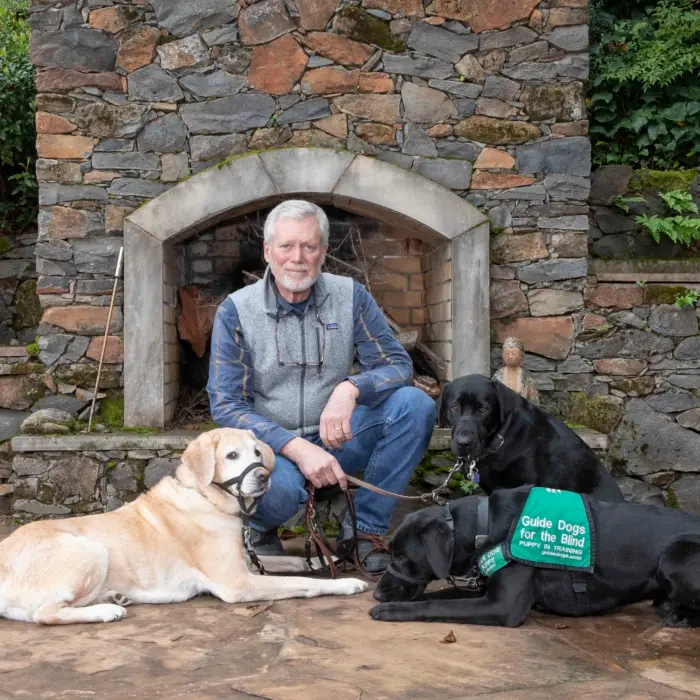
While she describes her training at Guiding Eyes for the Blind with clarity and cogency, it is difficult not to wade through those pages without feeling that the book reads like an advertisement for the organization.
The strength of “Catching Sight” lies in the author’s slow journey towards realizing that disability is not synonymous with inability. While the guide dogs function as an extension of her, she becomes more at ease with the world and herself.
Ultimately, Elliott offers the reader a worthwhile consideration of what it means to see oneself and to be seen by others.