While conducting a recent parenting workshop, Jordan Langdon, CEO of Families of Character, asked moms and dads to share their favorite childhood summer memories. “We rode bikes until the streetlights came on,” “My dad grilled every Sunday evening,” “We caught fireflies,” and “There was always time” were some of the answers.
Few of the parents recalled sports camps, expensive family vacations, or other adult-directed activities, and no one claimed that the best part of summer as a kid was spending hours every day in front of a television. No—the best memories of summer, Langdon found, were centered on family, friends, unsupervised play, outdoor activities, and the bountiful, leisurely days away from a schoolroom.
Some might say that these idyllic versions of childhood are long gone, unattainable in our day, when so many kids and teens are welded to their phones and when working parents look to daycare centers, camps, relatives, and summer nannies as caretakers for their children.
But are these naysayers correct? Are the easygoing summer days of free play for children and their friends now an impossibility for many parents? And if so, does it really matter?
Get Creative With Your Scheduling
Certainly, it’s easier for a stay-at-home parent to provide kids with lots of time for free play and getting together with friends. Yet single-parent households or those in which both parents work can still make room for some old-fashioned summertime fun, preferably spent outdoors, for kids in the evenings and on the weekends. Family walks after supper, gardening together, ice cream shared with the neighbors, having friends and their children over on a Saturday for a meal and some rec time: All are doable options.
Some creativity in scheduling can do wonders as well.
“Something that worked well for me was doing a babysitting trade with my friend who also worked part-time and had three kids,” Langdon told The Epoch Times.
“She watched my kids on the days I worked, and I watched hers when she worked. We didn’t pay each other, and our kids built great friendships. Even if you don’t work outside the home, you could consider swapping this to give you some downtime to recharge your batteries.”
Vanessa Elias, founder of Block Party USA, noted another key component for making free play with other kids work.
“Parents need to do their part by not overscheduling their kids so that they’re available to play,” she told The Epoch Times. “Parents need to build their own connections with neighbors to make it easier for their hesitant kids to get together.”
Host a Block Party to Connect Your Neighborhood
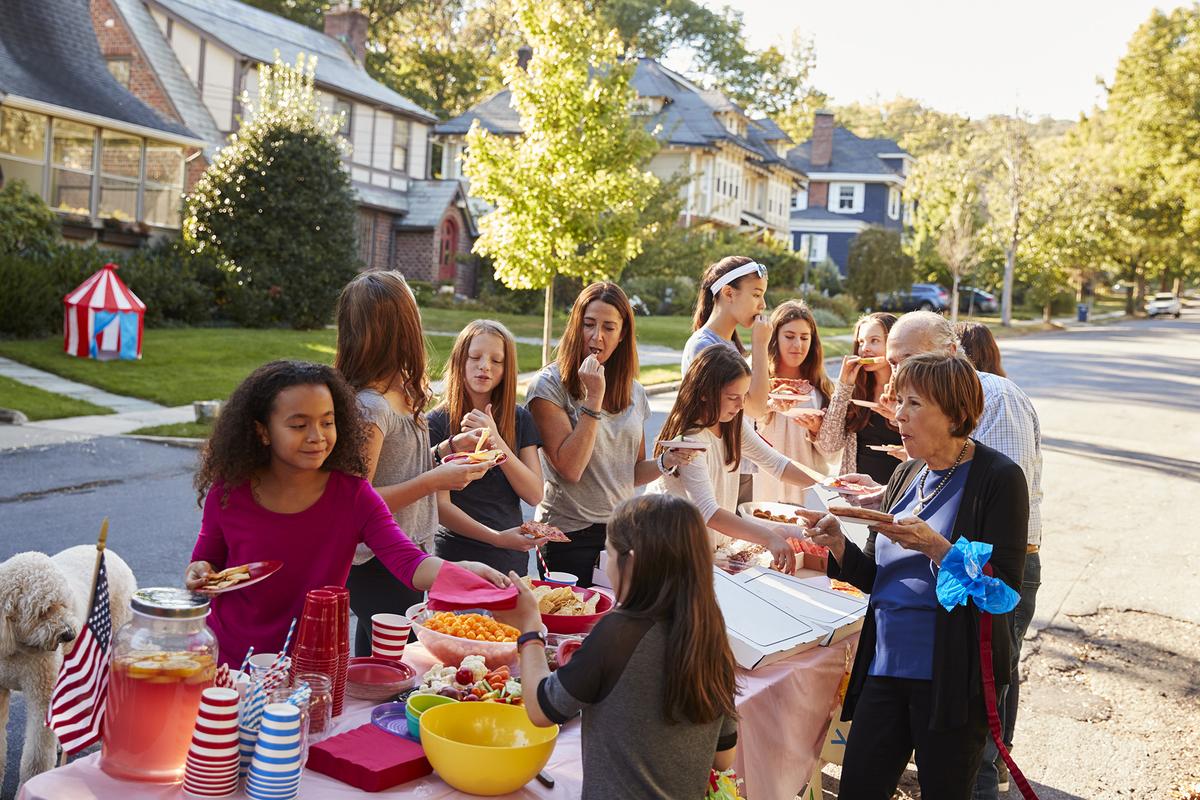
In 2018, Elias started her block party movement in Wilton, Connecticut. That year, 40 neighborhoods participated, each throwing a block party all its own, breaking out lawn chairs, grills, and coolers to have some fun and get to know one another better. Since then, Block Party USA, created to build community, has spread around the nation.
“My block party movement is designed exactly with kids in mind,” Elias said. “Face-to-face connection for all and neighborhood free play for kids were my two primary goals from the get-go.”
These parties are a convenient and natural way for parents of neighborhood children to meet.
“Block parties facilitate parent introductions—this is a key first step in parents allowing their children out the door to play with other kids,“ she said. ”It builds trust and helps parents feel like they’ve been responsible.”
Elias also noted other practical advantages that come from these events. Adults can get to know their neighbors and step in to help in times of need. Teens can find work within a short walk of their homes, such as babysitting, yard work, and pet sitting.
These community get-togethers also make it easier to introduce children and teens to one another. Elias recounted one 4-year-old’s gleeful comment—“She’s my neighbor!”—when two families met for the first time.
“They developed an across-the-street friendship complete with play, carpooling, kid coverage, and sleepovers,” Elias said.
On another occasion, she said, “Kids who went to different schools but recognized each other from gymnastics class learned they were neighbors.”
Elias also mentioned a scenario completely unfamiliar to some younger parents.
“The best story I got was after the block party when parents asked each other if it would be OK to ‘go old-fashioned and have my children just go over and ring your doorbell,’” she said.
Those of us raised in a time and culture when Saturday mornings found us scurrying off to a friend’s house, hoping that they were up for a game of basketball or building a fort in the woods, remember the delight of this drop-in ritual and may smile at its possible revival.
Langdon reminds urban parents to be mindful of other ways their teens and tweens can meet people and find interests outside of the home during the summer.
“Kids who live in the city would do well to get involved in community service projects where they volunteer to serve lunch at soup kitchens or to help around the church,“ she said. ”Many business owners are willing to put on a demonstration or class for kids who are interested in learning more about whatever product they sell or service they offer. Exotic pet shops, bakeries, bike shops, and independent auto body shops are places to consider calling to see about shadowing or a half-day class.”
Watch Your Kids Grow Through Free Play
Both Langdon and Elias are quick to point out the many goods that come from a summer of free play, friends, being outdoors, and feeling less pressured.
Unsupervised play, Langdon noted, “allows kids to make decisions independently, assess and manage reasonable risks, develop their creativity, and practice leadership skills.”
“Psychologist Peter Gray, a leading researcher on play, argues that free play is one of the primary ways children learn self-regulation and responsibility,” she said.
Langdon was referencing Gray’s book “Free to Learn,” in which he wrote: “The drive to play freely is a basic, biological drive. Lack of free play may not kill the physical body, as would lack of food, air, or water, but it kills the spirt and stunts mental growth. Free play is the means by which children learn to make friends, overcome their fears, solve their own problems, and generally take control of their own lives.”
Childhood experts from Fred Rogers to Maria Montessori would agree with this advocacy of unsupervised playtime.
Elias added her thoughts to this call for child-centered play. She stressed benefits such as being “off tech,” the “agency” of child-led play, and the resilience it builds. Practical consequences include more time spent outside, no cost, and “no need for parents to drive them anywhere.” She also said unstructured, child-led play brings parents together and helps them “build the village [they] need to raise [their] children.”
Slow Down and Focus on How Summer Feels
In her article “The Summers Our Children Will Remember,” Langdon wrote that our children grown to adulthood won’t remember so much the specifics of their childhood summers, but rather “how summer felt.”
She concluded her essay: “The beautiful truth is that creating a meaningful summer may have far less to do with doing more—and far more to do with slowing down enough to truly be together.
“Because in the end, the memories that shape a child’s heart are often remarkably simple: freedom, family, laughter, faith and time together.”
Add neighbors and friends to this mix, some backyard parties and fun, and you’ll be giving your children memories they’ll treasure for the rest of their lives.