“The pen is mightier than the sword,” said the Englishman Edward Bulwer-Lytton.
Alas, that may be true. But how many works of literary arts illustrate the wonder and fascination of swords through scenes of wars, duels, or portrayals of swashbucklers and beau sabreurs?
King Arthur’s “Excalibur,” Beowulf’s “Hrunting,” the “Flamberge” of Charlemagne—and even “Glamdring,” the sword of Gandalf the Grey—are names of legendary swords both fictional and real that have captured human imagination for generations.
A sword looks simplistic enough—a long, edged blade of metal with a leather or steel grip and a sharp tip. But since Bronze Age, perhaps more than any other instrument, the sword has helped carve the history of mankind.
In the last 600 years, guns and cannons have largely displaced swords in battle, but throughout history, the sword’s symbolic and authoritative nature is indomitable. Carrying a sword projects power, authority, elegance, and personality, and the sword’s characteristics in turn evoke qualities—both the virtues and foibles—of its bearer.
In Japan, the sword defines courage and strength and often accompanies Shinto religious rituals. Japanese swords—katanas—are highly valued and represent bravery in battle. In the Celtic culture, swords depict a part of family crests or emblems, denoting honor, pride, and wealth. Celtic swords also represent familial ties, hierarchy, and blood lineage. And in medieval Europe, knights carry heavy broadswords that embody righteousness, courage, and justice.
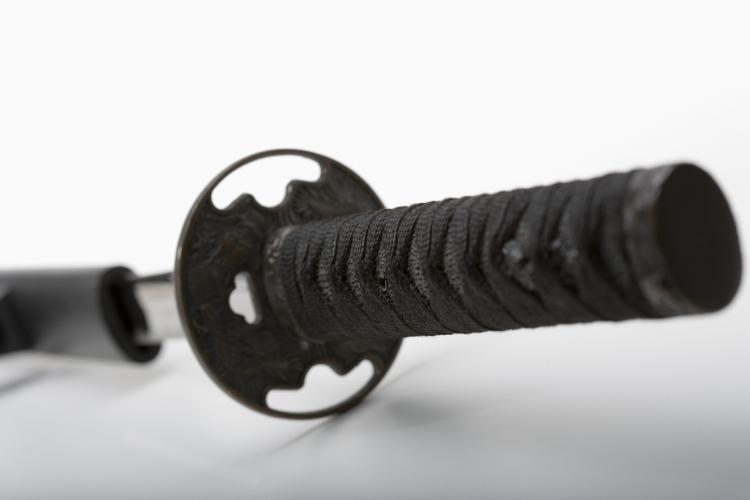
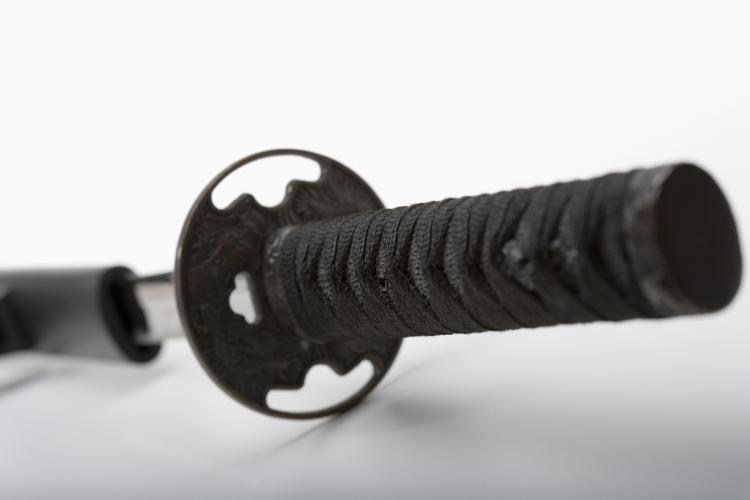
Katanas are constructed from tamahagane, a special Japanese carbon-infused steel. A katana’s edge is more malleable than blades made from traditional hard steel, which could break when struck in combat. The hand guard (tsuba) of the Katana is elaborately designed as a work of art—especially during the Edo period—to depict dragons, Japanese scenery, or a family crest.
Katanas are closely associated with the Japanese samurai, a class of warriors during the feudal period. Japanese nobles employed samurais during the struggle for land among three major Japanese clans during the feudal period—the Minamoto, the Taira, and the Fujiwara. Between the 9th and 12th centuries, the samurai became separately classes—the Samurai (knights-retainers) and the Bushi (warriors). The samurais gave complete loyalty to their daimyo (feudal landowners) and received land, honor, and wealth in return. Daimyo used his samurais to protect his property, family, and sovereignty.
Samurais typically carry two swords—a katana and a wakizashi, a shorter sword of less than 24 inches. Believing that their swords are the “souls” of their warriorship, samurais named each sword they carry.
With such power come supreme discipline and responsibility. Central to samurai thought is “bushido,“ which means the ”Way of the Warrior.” The samurai’s duty and responsibility transcends his fear of death, and in turn, such tranquility affords him an inner peace to serve faithfully and loyally without a hint of selfishness. In a way, the violence and power of the samurai’s katana is tempered by the serenity of his Bushido thought, believed to have derived from the Shinto religion.
The Chinese were experts of technological ingenuity in ancient times, and the Shang Dynasty’s (1700–1100 B.C.) mastery of bronze weaponry created the first recorded Chinese swords—short, stout, leaf-shaped blades of about 14 inches in length.
The jian is a double-edged straight sword closely associated with the Chinese civilization for over 2,500 years. The steel jian from the Han Dynasty (207 B.C.–9 A.D.) onward often boasts wooden carvings, lacquered bamboo scabbards, and ornate inscriptions of family heritage. Later, the Ming Dynasty (1368–1644) introduced silk tassles to Chinese swords as decoration as well as a form of distraction in combat.
Ancient Chinese nobles, officials, and martial artists carry jian on a daily basis. Ornate, gilded jian were passed on from father to son as family heirlooms and signifies a family’s tradition and heritage. Specialized swords, cast of gold or cut directly from a block of jade, are often used in elaborate ceremonies in the Imperial Court.
Chinese swords are portrayed to hold immense power for the wielder in “wuxia” literary arts, a broad genre of Chinese fiction depicting martial artists in ancient times. An prime example is ‘Smiling Proud Wanderer’ by acclaimed wuxia writer Louis Cha. The story writes of a legendary sword manual that would enable whomever that learned from it to be invincible with the “jian.” The question of human nature, morality, and the distinction between righteousness and evil become apparent as pugilists struggle violently for possession of this manual.
Lu Dongbing, one of the “Eight Immortals” in Taoist teachings, is traditionally depicted in artworks carrying a Chinese jian.
King Arthur, the Franco-English monarch from European Middle Ages folklore, carried the “Excalibur,” a legendary sword of great power that came to symbolize the righteous sovereignty of Great Britain.
Lord Alfred Tennyson in his poem “The Passing of Arthur,” wrote:
There drew he forth the brand Excalibur,
And o'er him, drawing it, the winter moon,
Brightening the skirts of a long cloud, ran forth
And sparkled keen with frost against the hilt:
For all the haft twinkled with diamond sparks,
Myriads of topaz-lights, and jacinth-work
Of subtlest jewellery.
The European broadsword—an example of which was the famed “Excalibur”—is the preferred weapon of medieval knights. Its sheer heft and power epitomize knighthood chivalry: the upholding of faith, courage, loyalty, honor, and God.
But the sword is only a portion of a knight’s full ensemble. A knight’s full plated armor can weigh more than 100 pounds in total. Medieval European knights are so well armed that he depends on squires to keep his weapons and armor in working condition.
In times of war, local peasants and nobles flee to the castle, gazing at their lord’s knights from afar as they charge into battle. Under their valorous battle cries, it is on a knight’s glittering broadsword that rests their hope for freedom and sovereignty from invading enemies.
By the sixteenth century, a single-handed, single-bladed sword—the rapier—gained popularity among civilians.
The rapier (rapière in French) has a slender bladeless edge for thrusting, and an ornate and fully protective hilt to guard the hand against foreign thrusts. At first, traditional dueling involved a rapier and another weapon such as a dagger. Later, dueling with a single blade became the norm, and as sword play became less common, the rapier was word as a symbol of nobility as much as a tool for combat. Among noblemen in renaissance period Western Europe (most notably in France, Italy, and Spain), the rapier was worn as a fashion accessory.
A typical rapier weighs between 2 and 4 pounds and measures around four feet long from the pommel to the point, and can be balanced at about 4 inches from the cross-guard.
Such rapier is a tool of fencing, the highest—and most elegant—form of Western martial art, requiring rigorous discipline, agility, and control.
Perhaps the most prominent form of rapier dueling is the Italian School of Swordsmanship, first developed in Italy in the early 1400s, and practiced by European swordsmen for centuries, ultimately serving as a precursor for classical fencing techniques developed in the 19th century.
Italian master Fiore dei Liberi shaped the earliest forms of the Italian School. His “Flos Duellatorum” (Flower of Battle) was the first known Italian martial arts manual, and the most extensive from Medieval Europe. His treatise covers martial arts techniques of dueling, short sword, long sword, and grappling.
The Italian city of Bologna has a rich pedigree of fencing, and one of the most famous Italian School traditions came from the fencing style founded by Lippo Bartolomeo Dardi in 1415. Dardi was an expert swordsman as well as an astronomer and mathematics professor at the University of Bologna. The Dardi School taught a dynamic and flamboyant fencing style with intricate footwork and creative attack forms, often accompanied by the usage of various defensive weapons such as a shield, a dagger, or a cape.
With the invention of gunpowder and pistols, the art of dueling became obsolete. European rapier dueling eventually inspired classical fencing, a sport and pastime practiced by European nobles to this day. Fencing was one of the original competitions in the Olympic Games.
The many titles given to specific swords in art and literature, mythology, and history herald the sword’s significance to human culture.
Indeed, men throughout the ages have placed as much trust in his sword as he does in the hand that wields it. As the English playwright John Webster once wrote, “Lay this unto your breast: Old friends, like old swords, still are trusted best.”
Alas, that may be true. But how many works of literary arts illustrate the wonder and fascination of swords through scenes of wars, duels, or portrayals of swashbucklers and beau sabreurs?
King Arthur’s “Excalibur,” Beowulf’s “Hrunting,” the “Flamberge” of Charlemagne—and even “Glamdring,” the sword of Gandalf the Grey—are names of legendary swords both fictional and real that have captured human imagination for generations.
A sword looks simplistic enough—a long, edged blade of metal with a leather or steel grip and a sharp tip. But since Bronze Age, perhaps more than any other instrument, the sword has helped carve the history of mankind.
In the last 600 years, guns and cannons have largely displaced swords in battle, but throughout history, the sword’s symbolic and authoritative nature is indomitable. Carrying a sword projects power, authority, elegance, and personality, and the sword’s characteristics in turn evoke qualities—both the virtues and foibles—of its bearer.
In Japan, the sword defines courage and strength and often accompanies Shinto religious rituals. Japanese swords—katanas—are highly valued and represent bravery in battle. In the Celtic culture, swords depict a part of family crests or emblems, denoting honor, pride, and wealth. Celtic swords also represent familial ties, hierarchy, and blood lineage. And in medieval Europe, knights carry heavy broadswords that embody righteousness, courage, and justice.
Japanese Nihontō
Nihontō is a traditional single-edged Japanese sword, of which the katana is most common. A katana is slender, slightly curved, and has a circular guard. Known for its superb sharpness and cutting ability, the katana has a long grip to accommodate both hands of the user.Katanas are constructed from tamahagane, a special Japanese carbon-infused steel. A katana’s edge is more malleable than blades made from traditional hard steel, which could break when struck in combat. The hand guard (tsuba) of the Katana is elaborately designed as a work of art—especially during the Edo period—to depict dragons, Japanese scenery, or a family crest.
Katanas are closely associated with the Japanese samurai, a class of warriors during the feudal period. Japanese nobles employed samurais during the struggle for land among three major Japanese clans during the feudal period—the Minamoto, the Taira, and the Fujiwara. Between the 9th and 12th centuries, the samurai became separately classes—the Samurai (knights-retainers) and the Bushi (warriors). The samurais gave complete loyalty to their daimyo (feudal landowners) and received land, honor, and wealth in return. Daimyo used his samurais to protect his property, family, and sovereignty.
Samurais typically carry two swords—a katana and a wakizashi, a shorter sword of less than 24 inches. Believing that their swords are the “souls” of their warriorship, samurais named each sword they carry.
With such power come supreme discipline and responsibility. Central to samurai thought is “bushido,“ which means the ”Way of the Warrior.” The samurai’s duty and responsibility transcends his fear of death, and in turn, such tranquility affords him an inner peace to serve faithfully and loyally without a hint of selfishness. In a way, the violence and power of the samurai’s katana is tempered by the serenity of his Bushido thought, believed to have derived from the Shinto religion.
Chinese Jian
The Chinese were experts of technological ingenuity in ancient times, and the Shang Dynasty’s (1700–1100 B.C.) mastery of bronze weaponry created the first recorded Chinese swords—short, stout, leaf-shaped blades of about 14 inches in length.
The jian is a double-edged straight sword closely associated with the Chinese civilization for over 2,500 years. The steel jian from the Han Dynasty (207 B.C.–9 A.D.) onward often boasts wooden carvings, lacquered bamboo scabbards, and ornate inscriptions of family heritage. Later, the Ming Dynasty (1368–1644) introduced silk tassles to Chinese swords as decoration as well as a form of distraction in combat.
Ancient Chinese nobles, officials, and martial artists carry jian on a daily basis. Ornate, gilded jian were passed on from father to son as family heirlooms and signifies a family’s tradition and heritage. Specialized swords, cast of gold or cut directly from a block of jade, are often used in elaborate ceremonies in the Imperial Court.
Chinese swords are portrayed to hold immense power for the wielder in “wuxia” literary arts, a broad genre of Chinese fiction depicting martial artists in ancient times. An prime example is ‘Smiling Proud Wanderer’ by acclaimed wuxia writer Louis Cha. The story writes of a legendary sword manual that would enable whomever that learned from it to be invincible with the “jian.” The question of human nature, morality, and the distinction between righteousness and evil become apparent as pugilists struggle violently for possession of this manual.
Lu Dongbing, one of the “Eight Immortals” in Taoist teachings, is traditionally depicted in artworks carrying a Chinese jian.
European Broadsword
King Arthur, the Franco-English monarch from European Middle Ages folklore, carried the “Excalibur,” a legendary sword of great power that came to symbolize the righteous sovereignty of Great Britain.
Lord Alfred Tennyson in his poem “The Passing of Arthur,” wrote:
There drew he forth the brand Excalibur,
And o'er him, drawing it, the winter moon,
Brightening the skirts of a long cloud, ran forth
And sparkled keen with frost against the hilt:
For all the haft twinkled with diamond sparks,
Myriads of topaz-lights, and jacinth-work
Of subtlest jewellery.
The European broadsword—an example of which was the famed “Excalibur”—is the preferred weapon of medieval knights. Its sheer heft and power epitomize knighthood chivalry: the upholding of faith, courage, loyalty, honor, and God.
But the sword is only a portion of a knight’s full ensemble. A knight’s full plated armor can weigh more than 100 pounds in total. Medieval European knights are so well armed that he depends on squires to keep his weapons and armor in working condition.
In times of war, local peasants and nobles flee to the castle, gazing at their lord’s knights from afar as they charge into battle. Under their valorous battle cries, it is on a knight’s glittering broadsword that rests their hope for freedom and sovereignty from invading enemies.
Rapier Forms and Fencing
By the sixteenth century, a single-handed, single-bladed sword—the rapier—gained popularity among civilians.
The rapier (rapière in French) has a slender bladeless edge for thrusting, and an ornate and fully protective hilt to guard the hand against foreign thrusts. At first, traditional dueling involved a rapier and another weapon such as a dagger. Later, dueling with a single blade became the norm, and as sword play became less common, the rapier was word as a symbol of nobility as much as a tool for combat. Among noblemen in renaissance period Western Europe (most notably in France, Italy, and Spain), the rapier was worn as a fashion accessory.
A typical rapier weighs between 2 and 4 pounds and measures around four feet long from the pommel to the point, and can be balanced at about 4 inches from the cross-guard.
Such rapier is a tool of fencing, the highest—and most elegant—form of Western martial art, requiring rigorous discipline, agility, and control.
Perhaps the most prominent form of rapier dueling is the Italian School of Swordsmanship, first developed in Italy in the early 1400s, and practiced by European swordsmen for centuries, ultimately serving as a precursor for classical fencing techniques developed in the 19th century.
Italian master Fiore dei Liberi shaped the earliest forms of the Italian School. His “Flos Duellatorum” (Flower of Battle) was the first known Italian martial arts manual, and the most extensive from Medieval Europe. His treatise covers martial arts techniques of dueling, short sword, long sword, and grappling.
The Italian city of Bologna has a rich pedigree of fencing, and one of the most famous Italian School traditions came from the fencing style founded by Lippo Bartolomeo Dardi in 1415. Dardi was an expert swordsman as well as an astronomer and mathematics professor at the University of Bologna. The Dardi School taught a dynamic and flamboyant fencing style with intricate footwork and creative attack forms, often accompanied by the usage of various defensive weapons such as a shield, a dagger, or a cape.
With the invention of gunpowder and pistols, the art of dueling became obsolete. European rapier dueling eventually inspired classical fencing, a sport and pastime practiced by European nobles to this day. Fencing was one of the original competitions in the Olympic Games.
The many titles given to specific swords in art and literature, mythology, and history herald the sword’s significance to human culture.
Indeed, men throughout the ages have placed as much trust in his sword as he does in the hand that wields it. As the English playwright John Webster once wrote, “Lay this unto your breast: Old friends, like old swords, still are trusted best.”