Beyond the Grand Gesture: 4 Painters Who Capture Fatherhood

Spanning four countries and five centuries, these timeless paintings capture a father’s steadfast love.
Beyond the Grand Gesture: 4 Painters Who Capture Fatherhood
A detail of "Rudolf von Arthaber and His Children Rudolf, Emilie, and Gustav," 1837, by Friedrich von Amerling. Amerling trained under one of Europe's great portraitists and went on to paint emperors, yet his most revealing work may be this tender, unguarded scene of a powerful man, perfectly content by the weight of his children on his lap. Public Domain
|Updated:
0:00

Fatherhood has always been difficult to paint. It resists the grand gesture, the obvious symbol, the easy sentiment. The most honest images tend toward the understated: A man with his children in his lap, a family waiting for a father’s return, a father welcoming his son home.

The four paintings gathered here find their power in exactly those moments. They span four countries and five centuries, but they share a common subject: what it looks like when a father’s love is the steadiest thing in the frame.

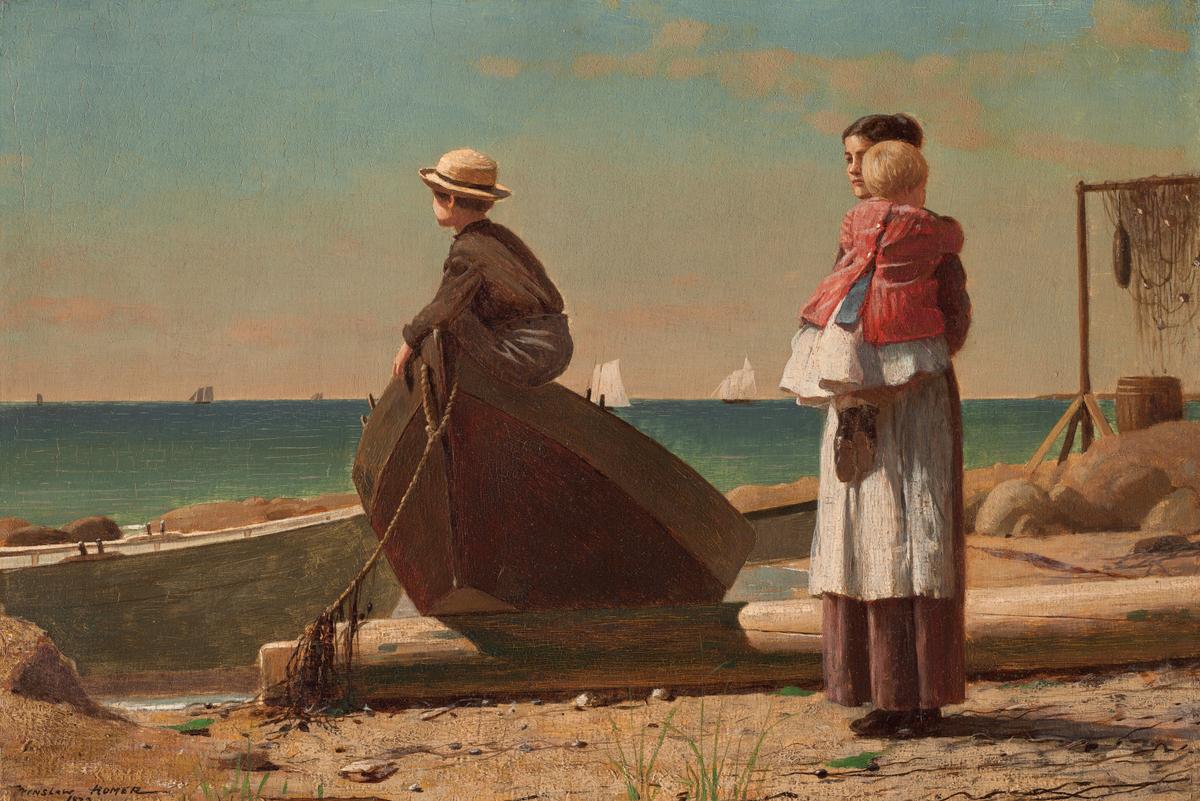
‘Dad’s Coming!’

"Dad's Coming!," 1873, by Winslow Homer. Oil on wood; 9 inches by 13 3/4 inches. Homer turns waiting into a physical sensation: a woman, a baby, and a boy frozen in the same breathless moment of expectation. National Gallery of Art, Washington. (Public Domain)
"Dad's Coming!," 1873, by Winslow Homer. Oil on wood; 9 inches by 13 3/4 inches. Homer turns waiting into a physical sensation: a woman, a baby, and a boy frozen in the same breathless moment of expectation. National Gallery of Art, Washington. Public Domain

“Dad’s Coming!” is a small but charged work by Winslow Homer (1836–1910) that captures the feeling of a family looking forward to a father’s return. On a sandy beach strewn with rowboats, nets, and barrels, a young woman stands holding an infant, scanning the horizon. A boy perches eagerly in the tipped-up bow of a beached dory, his attention fixed on the same distant point. A cluster of white sails sits low against the pale horizon line.

Homer was deeply interested in the emotional lives of those left onshore during this period, and here he condenses that interest into a single moment of waiting. The composition is deceptively simple. The woman and boy are spatially separated but united by the invisible thread of their shared gaze, and the painting’s horizontal format—the ocean filling the upper half and the shore the lower—reinforces the sense of a world poised on the edge of a happy reunion. Homer keeps the palette cool and restrained: aquamarine water, ice-blue sky, pale peach clouds, the baby’s red jacket the only bright note, a small beacon of color that feels like excitement made visible.

In the 1870s, sail still dominated U.S. coastal trade and fishing, and the sight of vessels on the horizon was an ordinary part of life for New England families. Homer knew this world well, and he trusted his audience to know it, too. When the painting was reproduced as an engraving in “Harper’s Weekly” in November 1873, it reached a national readership for whom a sailor’s homecoming needed no explanation.

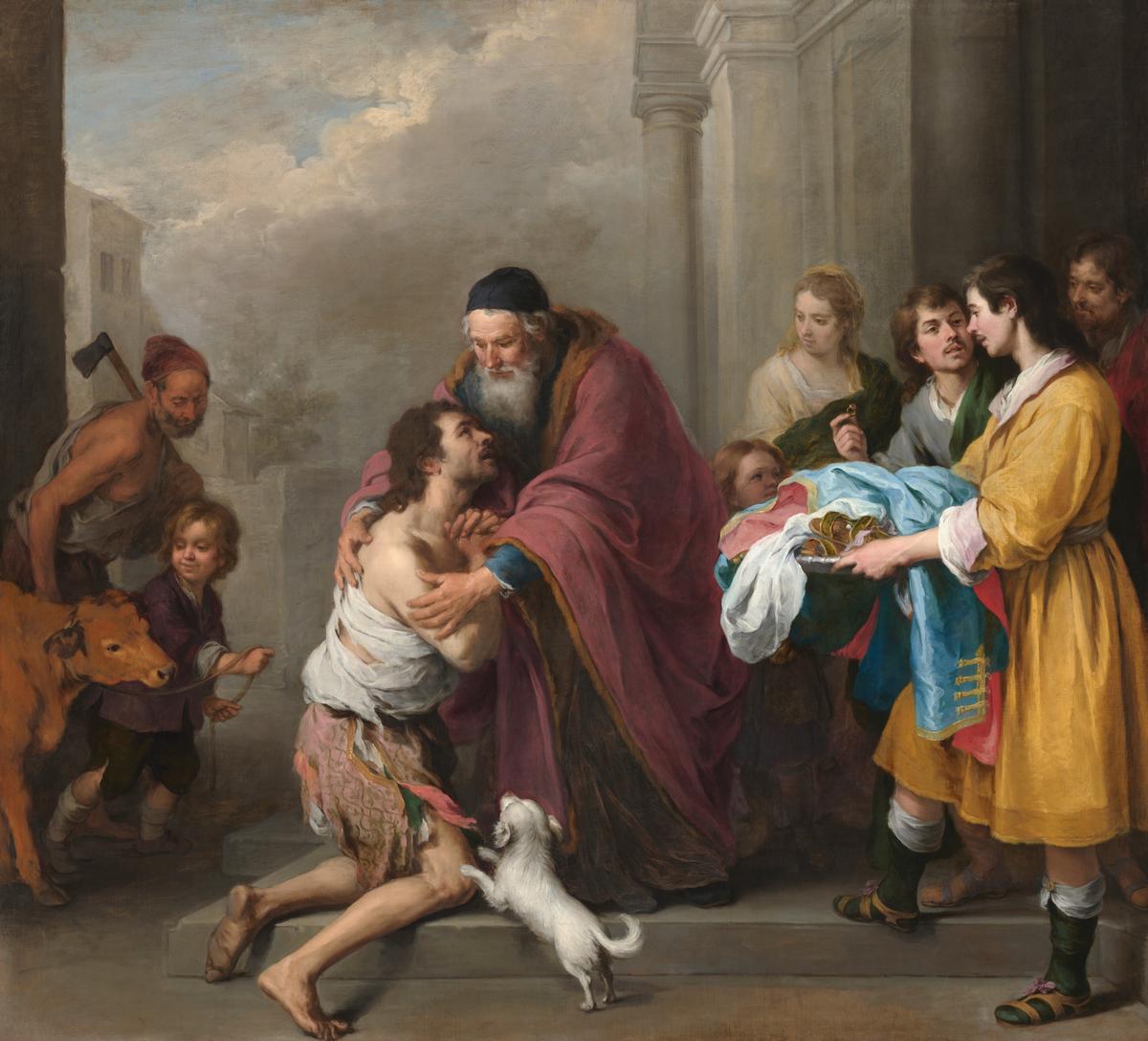
‘The Return of the Prodigal Son’

"The Return of the Prodigal Son," circa 1667–1670, by Bartolomé Esteban Murillo. Oil on canvas; 93 1/16 inches by 102 3/4 inches. Murillo had his choice of every moment in the parable, and he chose this one: the instant a father's unconditional love proves stronger than anything a son could do to test it. National Gallery of Art, Washington. (Public Domain)
"The Return of the Prodigal Son," circa 1667–1670, by Bartolomé Esteban Murillo. Oil on canvas; 93 1/16 inches by 102 3/4 inches. Murillo had his choice of every moment in the parable, and he chose this one: the instant a father's unconditional love proves stronger than anything a son could do to test it. National Gallery of Art, Washington. Public Domain

This allegorical canvas is one part of a series that Bartolomé Esteban Murillo (1617–1682) painted for the Church of Saint George Hospital in Spain, a hospice founded for the homeless and destitute. The commission shaped the painting’s theological emphasis; each image was painted to represent one of the seven corporal acts of mercy. Four of these works are still in Seville: “The Miracle of the Loaves and Fishes,” “Moses at the Rock of Horeb,” “Saint Elizabeth of Hungary,” and “Saint John of God Carrying a Sick Man.”

The father and son occupy the center of the canvas, drawing the viewer’s eye to what matters most: the relationship between them. Murillo places forgiveness and love at the apex, as the father welcomes his son in a warm embrace. The son’s unkempt appearance is rendered with the same frank realism Murillo brought to his street scenes, details that make the father’s unconditional welcome all the more moving.

Murillo’s eye for small details, such as the leaping puppy, gives the scene a warmth that lifts it beyond the merely illustrative. To the right, two servants prepare to welcome the son: One holds fine clothing, the other a ring, tangible signs that his place in the family has been fully restored. Together, these touches deepen the scene into a living story that pulls the viewer in.

‘Rudolf von Arthaber and His Children Rudolf, Emilie, and Gustav’
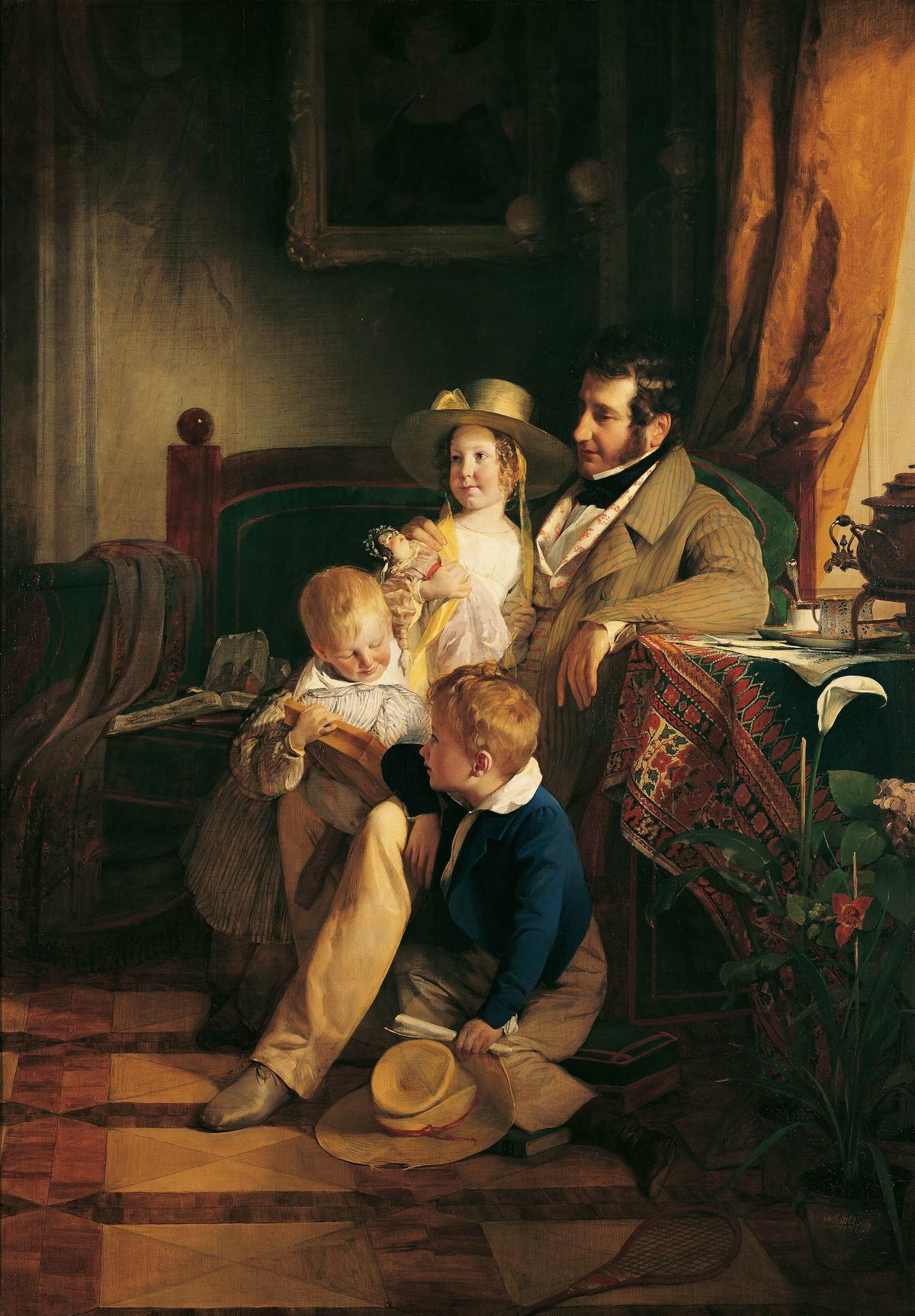
"Rudolf von Arthaber and His Children Rudolf, Emilie, and Gustav," 1837, by Friedrich von Amerling. Oil on canvas; 87 inches by 61 inches. Belvedere, Vienna. (Public Domain)
"Rudolf von Arthaber and His Children Rudolf, Emilie, and Gustav," 1837, by Friedrich von Amerling. Oil on canvas; 87 inches by 61 inches. Belvedere, Vienna. Public Domain

Perhaps nothing captures the essence of fatherhood so completely as the man who draws his children close, steadily and tenderly. Friedrich von Amerling (1803–1887) was one of the most sought-after portrait painters of his era, producing more than a thousand works, nearly all of them portraits.

This group portrait shows Rudolf von Arthaber, a Viennese textile manufacturer and passionate art collector, with his three children, Rudolf, Emilie, and Gustav. Amerling had trained under Thomas Lawrence in London and would go on to serve as court painter to the Austro-Hungarian emperor, and his influence is apparent here.

Arthaber is seated with his three children clambering in his lap, his face showing a mix of weariness and affection. The children tumble and reach with the unselfconscious energy of the very young, perfectly at ease in their father’s presence.

The Romantic period’s deep interest in childhood as a state of innocence and vitality inflects Amerling’s tenderness toward the young figures, whose faces are individualized and full of life. Light falls softly on the group against a loosely rendered landscape background, a style Amerling absorbed from Lawrence. The result is a portrait of a family at ease with itself, devoted in feeling and generous in spirit.

‘Francesco Sassetti and His Son Teodoro’
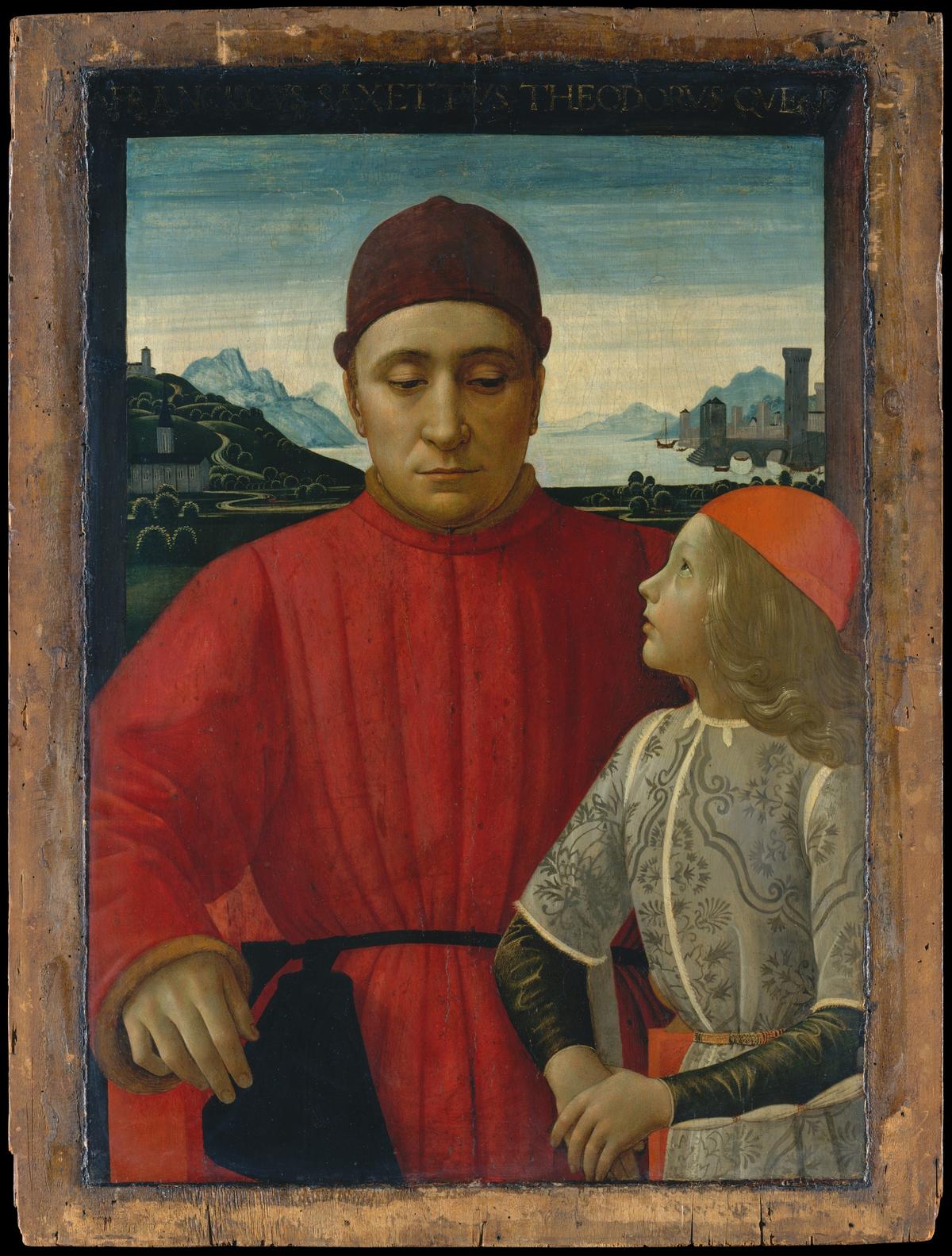
"Francesco Sassetti and His Son Teodoro," circa 1488, by Domenico Ghirlandaio. Tempera on wood; 33 1/4 inches by 25 1/8 inches. Ghirlandaio was the portraitist Florence's merchant class trusted to record their place in the world, and here he delivers: Sassetti is prosperous, composed, and permanent, with his young son beside him as proof that what he has built will outlast him. Metropolitan Museum of Art, New York City. (Public Domain)
"Francesco Sassetti and His Son Teodoro," circa 1488, by Domenico Ghirlandaio. Tempera on wood; 33 1/4 inches by 25 1/8 inches. Ghirlandaio was the portraitist Florence's merchant class trusted to record their place in the world, and here he delivers: Sassetti is prosperous, composed, and permanent, with his young son beside him as proof that what he has built will outlast him. Metropolitan Museum of Art, New York City. Public Domain

In the late 15th century, Domenico Ghirlandaio (1448–1494) was celebrated for his narrative frescoes, which frequently incorporated portraits of prominent Florentine citizens. One of his most recurring subjects was Francesco Sassetti, general manager of the Medici banking network across France and Switzerland.

Ghirlandaio’s preferred medium was fresco, suited to the large wall surfaces he decorated, but the altarpieces for those same chapels called for smaller works on wood panels. This portrait is one such work. Ghirlandaio pairs Sassetti with his young son Teodoro on a small panel, the composition formal and deliberate.

Sassetti wears the lucco, the long red cloak that served as the standard civic dress of prosperous Florentine men and was legally required of office-holders. The deep red color was itself a signal of prosperity, as the dyes needed to achieve it were costly, and its use was effectively reserved for the elite.

Sassetti faces forward, his downcast eyes suggesting thoughtfulness, while Teodoro appears in profile, a convention that conveyed innocence and purity. Visible in the background, as if glimpsed through a window, is an oratory that Sassetti built in Geneva, placing his faith, wealth, and influence within a specific geography rather than a generic landscape.

These works span genres and centuries, from devotional narrative to dynastic portraiture, yet each one places a father and child at its center. Together, they trace how artists have returned to this relationship again and again as a subject worthy of careful attention. In doing so, they remind us that the most resonant art has always drawn from the most universal human experiences.

What arts and culture topics would you like us to cover? Please email ideas or feedback to [email protected]
Google LogoMark Us Preferred on Google
Sarah Isak-Goode
Sarah Isak-Goode
Author
Sarah Isak-Goode is a writer and art historian rooted in the Pacific Northwest. Her name—pronounced EYE-zik-good and meaning "good laugh"—hints at the warmth she brings to everything she does. Equal parts scholar and storyteller, Sarah brings the past to life through a distinctly human lens, exploring what connects us across the centuries. Away from her desk, she feeds her curiosity through traveling, painting, reading, and hiking with her dog, Thor.