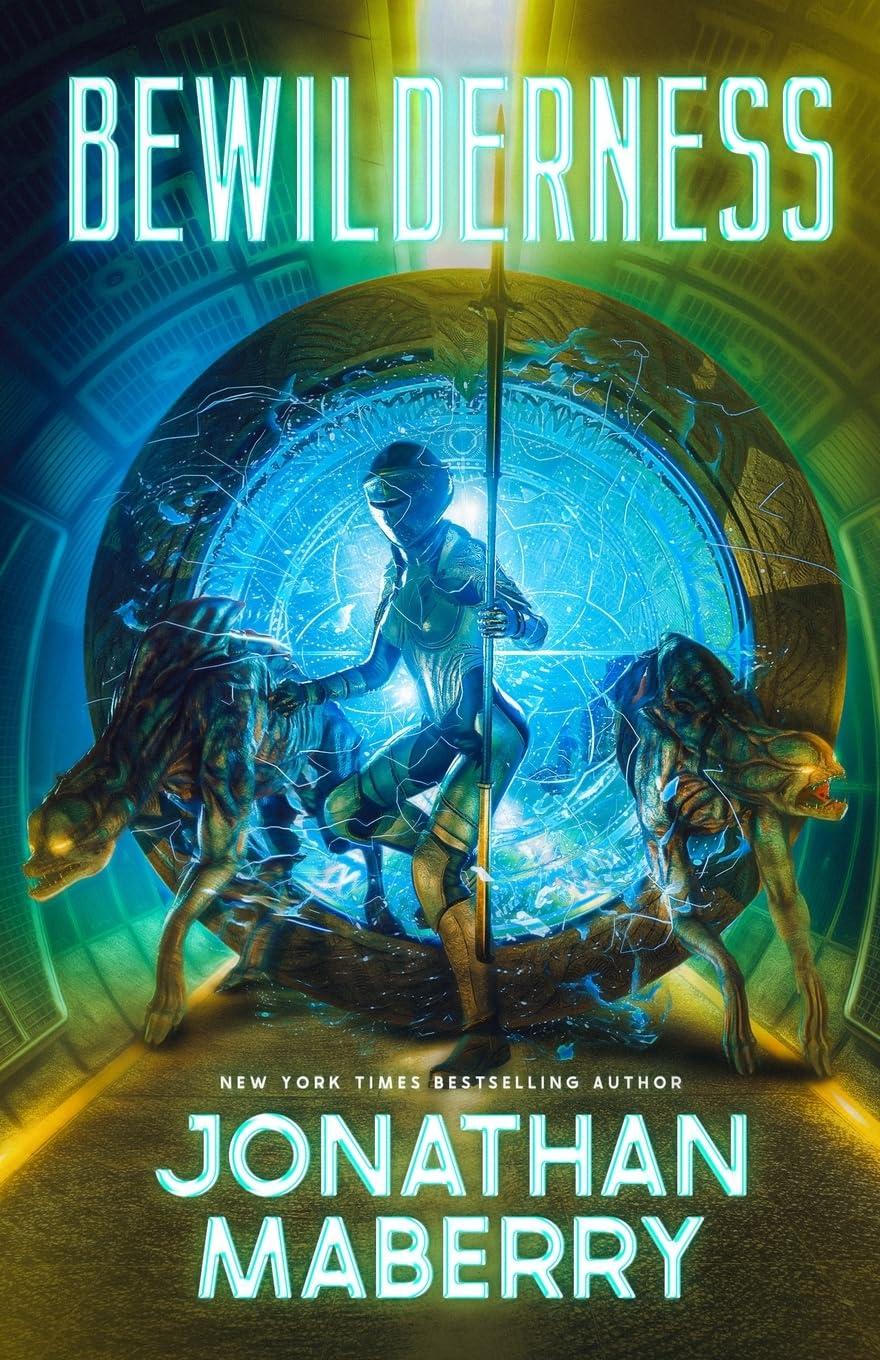
Dr. Abby Corman has developed the Gateway, a machine that allows access to parallel Earths. Award-winning author Jonathan Maberry’s new thriller “Bewilderness” follows her project to create a stable connection with at least one uninhabited parallel Earth and the catastrophe that follows.
Corman believes in wonderful possibilities. On this virgin Earth, crops can be grown and resources can be extracted, providing plenty for the population of this Earth. Heavy industries can be placed on uninhabited parallel Earths, allowing our own Earth to become a giant park. It’s a noble dream.
She plans a step-by-step test that stresses safety and minimizes risk. Then, she discovers that the laws of unintended consequences are more powerful than the laws of science.
The machine is in a New York skyscraper, a building strong enough to withstand anything short of an atomic blast. Once in lockdown, it becomes an unbreakable vault.

Change of Plans
He throws Abby’s step-by-step test plan out the window. On the first run, he plans to make a full-power run for a stable connection with an alternate Earth. When Corman objects, he fires her and escorts her out of the building. After all, what could go wrong?Plenty. This technology has been tried before, leading to near-disaster each time. Abby’s plan was designed to mitigate risk. When the run is made, things go very wrong.


Gateway connects with other alternate realities, but the link is unstable. It skips from one alternate reality to another, dragging things from those Earths into this Earth. It becomes a bewildering wilderness—a “bewilderness.”
The effects, contrary to predictions, aren’t confined to the Gateway building. They spill into downtown Manhattan, creating chaos.
Gateway has to be shut down, but only Corman can do it. The building is in lockdown, but Abby was smuggled back in by sympathetic co-workers before the test started and the building was isolated from the world. Corman and her allies among the Gateway staff must get to the backup control center and shut things down.
Parallel Earths
Travel between parallel Earths is a standard science fiction trope. H. Beam Piper perfected the concept with his “Paratime” stories, a series written in the 1950s and 1960s. Harry Turtledove created a six-book homage to Piper’s concepts in the 2000s with his “Crosstime Traffic” series.With previous science fiction involving travel between parallel Earths, the cross-time conveyance is mature. It serves the same role as horses in a Western or faster-than-light starships in a space opera. It’s the mechanism which delivers the characters to the story.
Maberry’s contribution to the genre is making the transporter the story itself. Piper’s stories assume cross-time conveyers have been used for centuries, possibly millennia. In this book, Maberry shows the conveyer under development.
Piper hints at potential development issues in his series’s distant past. Mayberry brings them front and center. He makes the development problems the theme of the book, creating a catastrophic situation which the story’s heroine must put right.
Once readers accept the premise that travel between alternate Earths is possible, the behavior of the book’s primary villain, Benjamin, is most realistic. There are many senior managers of federally funded science projects who are as narcissistic and arrogant as this project’s director.
One only need look at the revelations emerging about the leadership of the COVID-19 response. The actions of feckless federal technology managers have created disaster in the past. The pollution of the Animas River by EPA employees who failed to consider the potential consequences of their actions is one example.
Real federal managers are adverse to risk. They rarely take direct action when potential negative consequences could splash back on them. Masters at deflecting blame, they lead others to make the actual decisions. They make their preferences for those actions known but let others take responsibility for the adverse consequences that follow.
Without Benjamin ordering and actually participating in the Gateway activation, there would almost certainly not be a story. Rationality would prevail.
In real life, that’s preferable. In “Bewilderment,” it would’ve deprived readers of a first-rate thriller, with non-stop action (but a good deal of profanity) as a handful of good guys strive against the odds to save the world.