Behold the Beauty: Teeny-Tiny Mosaic Masterpieces

Grand tourists treasured these Italian mementoes.
Behold the Beauty: Teeny-Tiny Mosaic Masterpieces
“The Roman Forum,” circa 1850, by Domenico Moglia. Micromosaic; 18 1/8 inches by 25 5/8 inches. Rosalinde & Arthur Gilbert Collection; Victoria and Albert Museum, London. Public Domain
|Updated:
0:00

Made from minute pieces of colored glass, micromosaics make the most amazing, often painterly pictures. Some of the best micromosaics contain an astounding 3,000 to 5,000 tiles per square inch.

From the 17th to the 19th century, wealthy Europeans on their Grand Tour of Italy bought these micromosaics as jewelry and souvenirs. The micromosaics depicted all manner of things, especially quintessential scenes of Rome: the people, landscapes, and, of course, famous architecture such as the Colosseum, St. Peter’s Square, and the Roman Forum.

Sometimes the micromosaics would be inlaid into furniture, snuffboxes, or decorative boxes. Many micromosaics were sent straight to jewelers in Paris and London to be set into jewelry. However, micromosaic jewelry fell out of fashion in the 1870s.
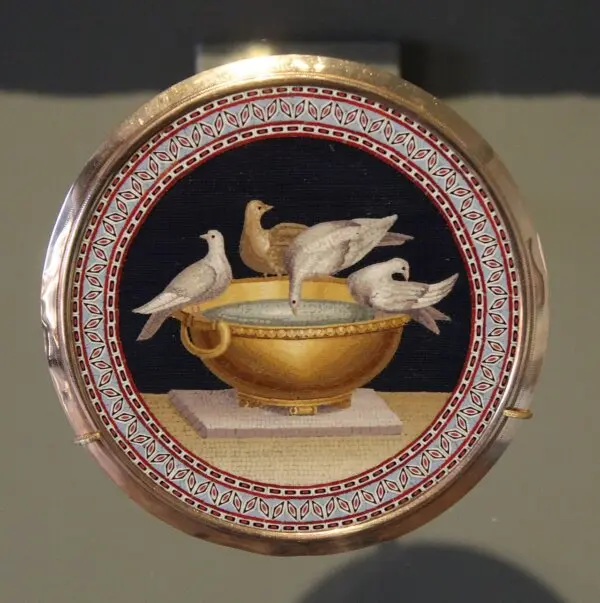
“Doves of Pliny,” 1801, by Giacomo Raffaelli. Micromosaic in a gold frame; 3 3/8 inches. Rosalinde & Arthur Gilbert Collection; Victoria and Albert Museum, London. (Public Domain)
“Doves of Pliny,” 1801, by Giacomo Raffaelli. Micromosaic in a gold frame; 3 3/8 inches. Rosalinde & Arthur Gilbert Collection; Victoria and Albert Museum, London. Public Domain

Making Micromosaics

According to the Victoria and Albert Museum, a micromosaic artist fuses different colored glass mosaic tiles to create an assortment of colors, each unique in size and shape. Then the artist melts a selection of these tiles in a metal crucible and pulls the molten glass into long canes (filati) that solidify upon cooling. The artist scores the canes and carefully snaps them into tiny, oblong pieces (tesserae).

The artist then prepares a metal base with paste, into which he or she then marks the design. Using tweezers, the artist then painstakingly places each teeny-tiny mosaic piece onto the paste.

Once the picture is complete, the artist coats the composition with a few layers of wax, then sands it down to a smooth polish.
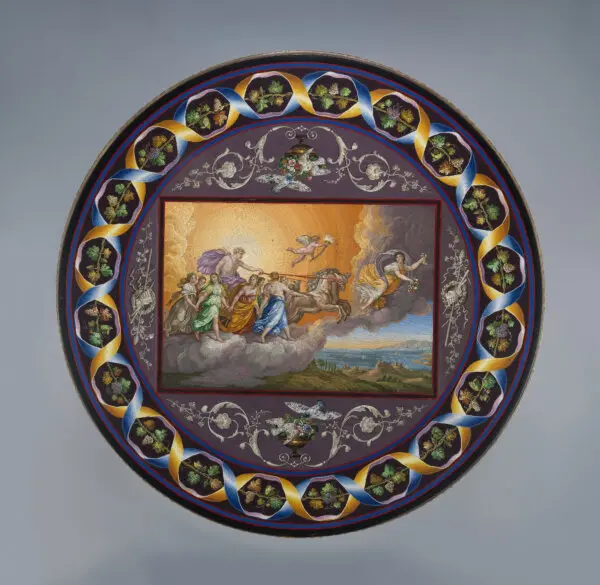
“Aurora and the Chariot of Apollo,” 1822, by Gioacchino Barberi, after a painting by Guido Reni. Micromosaic tabletop; 37 inches in diameter. Bequest of Barbara Bodne Anspach, 2014; Metropolitan Museum of Art, New York. (Public Domain)
“Aurora and the Chariot of Apollo,” 1822, by Gioacchino Barberi, after a painting by Guido Reni. Micromosaic tabletop; 37 inches in diameter. Bequest of Barbara Bodne Anspach, 2014; Metropolitan Museum of Art, New York. Public Domain

In early micromosaics, the tiles were visible, but later artists developed ways to seamlessly set the designs so that the tiles disappeared and exquisite, painterly micromosaics emerged.
What arts and culture topics would you like us to cover? Please email ideas or feedback to [email protected].
Google LogoMark Us Preferred on Google
Lorraine Ferrier
Lorraine Ferrier
Author
Lorraine Ferrier writes about fine arts and craftsmanship for The Epoch Times. She focuses on artists and artisans, primarily in North America and Europe, who imbue their works with beauty and traditional values. She's especially interested in giving a voice to the rare and lesser-known arts and crafts, in the hope that we can preserve our traditional art heritage. She lives and writes in a London suburb, in England.