The costumes for George Washington’s soldiers had to be perfect. All the reenactors were in their 20s and 30s because servicemen in the Revolutionary War days were typically young men. They were all clean-shaven, no beards, because that was the fashion back in the 1770s.
“They’re very, very knowledgeable,” McDonald, from Allentown in eastern Pennsylvania, told The Epoch Times, speaking of the reenactors, of whom he sometimes is one. “They‘ll tell me stuff, and then I’ll get an idea.”
One such reenactment was the seed for McDonald’s painting depicting Washington’s army at Valley Forge. He doesn’t paint big battle scenes, he said, but prefers a “little story that happened before or after the battle.” This scene was after the British had beaten Washington’s army in New York, after their escape across New Jersey, over the Delaware, and upon their reaching safe-haven in Pennsylvania for the winter. But not quite.
“Congress was supposed to have all of these cabins put up by the time they got there. Nothing was there. They didn’t even have tools,” McDonald said. “Imagine thousands of people showing up in this area and there’s no shelter, living out in the elements.”
“It was just miserable.”
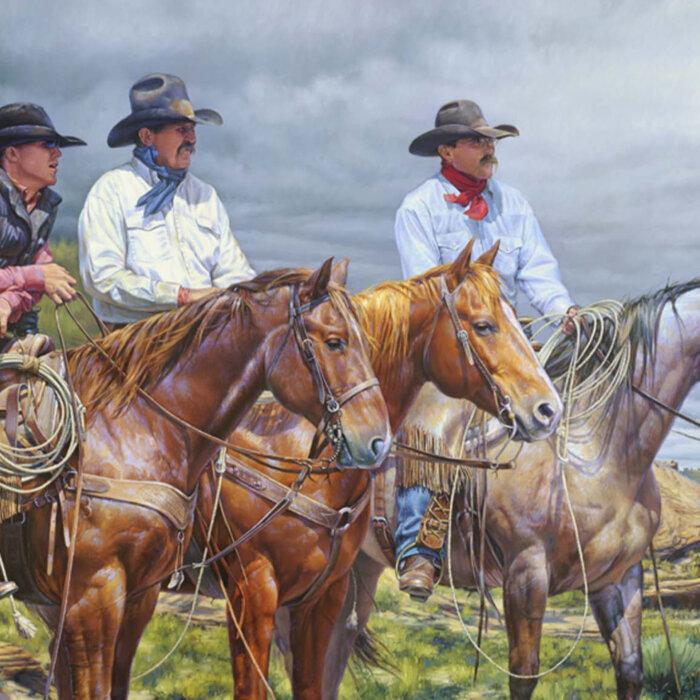
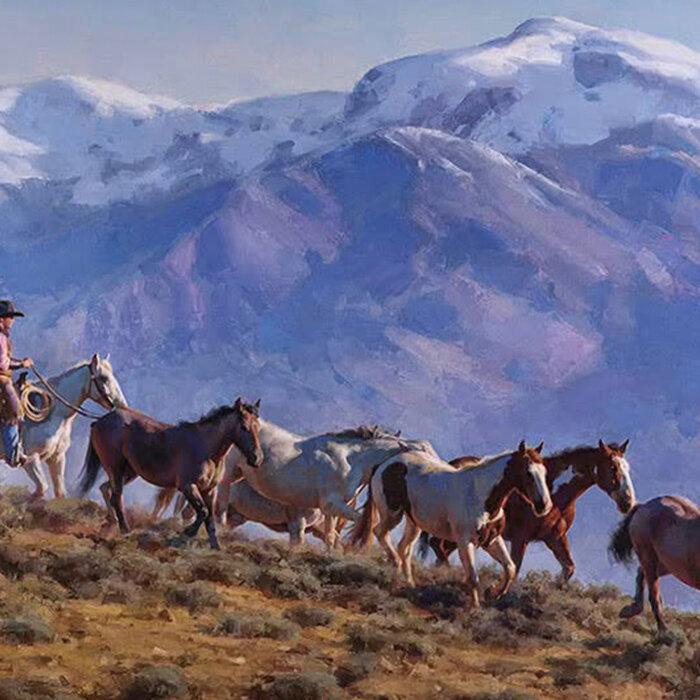
Lodges were eventually built at Valley Forge, and for his photo McDonald chose a few of Washington’s young soldiers warming their hands by a small campfire. Some were the sons of reenactors McDonald is friends with, who themselves were too old for the scene. The few mounted men in the background would have guarded their horses dearly, McDonald said, or they might have been taken and eaten by starving soldiers.


McDonald uncovers these little details from firsthand accounts in books. “Oh, that could be in a painting,” he said. He highlights a paragraph that could be in his next artwork, painted on his small gessoed panels. Then he gathers together friends who are just as into it as he is. Sometimes his paintings even end up on the covers of period-themed magazines like Muzzleloader, as did one titled “Encounter,” and the guys get a kick out of it.
Similar excerpts inspired a painting of the Commander-in-Chief himself.

“You could also see New Brunswick, and that’s where the British had a big group of soldiers and they actually camped,” he said, noting that he grew up near that escarpment, called First Watchung Mountain. “The art school I went to was in the shadow of the mountain.”
Not overshadowed by the Revolutionary War in historical stature, the Civil War era also found its way into McDonald’s scenes. An idiosyncratic, white-bearded figure is central in “Tactics by Major Twiss” where, in a paradoxical encounter, a hermit-like man dressed like a Native American gives an unlikely lecture to several uniformed Union soldiers. Drawing in the dirt with a stick, he compares Gen. Grant’s Vicksburg campaign to one by Napoleon.
In a plot twist, it’s revealed that the man is Major Thomas Twiss, who attended West Point and served in the Army before becoming deeply involved with the Oglala Lakota (Sioux) people. He married a Sioux woman, who watches warily from a wall behind the men.

Sometimes McDonald leaves his stories open to interpretation, allowing the inherent tension in the work to spark the viewer’s imagination. Since frontier life was filled with danger, he loves painting the colonists’ often dicey run-ins with Indian tribes.
“Encounter” portrays two frontier men, who could be trappers or fur traders, who have stumbled across Native warriors in the wild.
“They’re in an area that they’re probably not welcome there by Indians,” McDonald said. “They’re all armed.”
“I really learned how to paint in his class,” McDonald said.


“[Caras] was pushing me to go into the freelance world with illustration,” the artist added. “I took my portfolio, I went to New York City, met his agent. He had an agent in New York, and his agent said they liked my work.”
The teacher really wanted young McDonald to go “be a hero” by becoming a freelance illustrator, he says. But he just laughed and played the corporate game instead, working in graphic design for 40 years before just recently deciding to paint full time.
More Paintings By Kevin McDonald