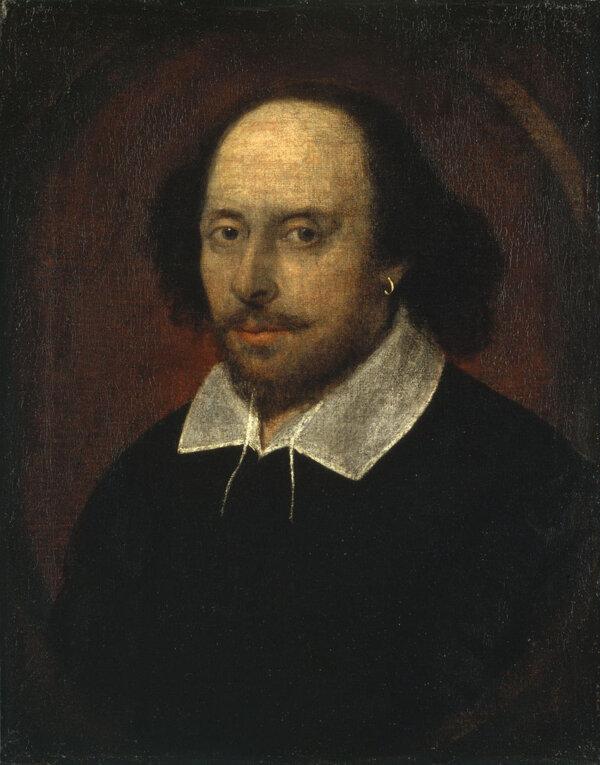
There is no debate that the 16th-century playwright is one of history’s greatest writers, possibly its greatest. Shakespeare’s literary influence is practically on par with the Bible’s King James Version. But what of his moral and philosophic influence? Womersley, in his new book “Thinking Through Shakespeare,” makes it clear that Shakespeare’s plays plumb the depths of humanity much further than one would expect.
Along with being a professor at Oxford, Womersley is a Fellow of the British Academy and of the Royal Historical Society. As if those titles didn’t suggest he belongs to an elite group of literary thinkers, his new work certainly substantiates the suggestion. In “Thinking Through Shakespeare,” the English professor becomes the scientist, using his pen as a scalpel to peel back the many layers that encompass Shakespearean thought.
‘Just Representations’
For Womersley, what can be learned about the world philosophically can be found in Shakespeare’s plays. The reason for this is that, as Womersley notes, the Bard, or at least his plays, was not shackled by traditional moral or intellectual constraints. “Shakespeare … seems to have had no settled opinions, despite overflowing with ideas,” the book notes.Womersley indicated early in his book that the purpose of his work is to “reconnect Shakespeare’s plays to the abiding concerns of thoughtful people—concerns which … seem to have formed part of our ‘general nature’ since the earliest antiquity.” The author’s “general nature” quote is a reference to Samuel Johnson’s summary view of Shakespeare’s writings, which he viewed as “just representations of general nature.”
History’s Philosophies in Action
Although these four plays are foundational, they are not the only ones referenced in his chapters. Probably half of Shakespeare’s 37 (or 39) plays are referenced in the book to demonstrate various points. But it is not simply Shakespeare’s works that are examined or compared. Womersley presents an entire library of philosophical works from antiquity to the 20th century to exemplify Shakespeare’s intellectual depth.

The author makes the case that practically every political, moral, intellectual, and relational question can be studied in Shakespeare. The answers in the dramas, of course, are not always ideal. This is obvious if one has read the four aforementioned plays. But the solutions chosen by the characters, even the morally dubious or categorically evil, force the reader or audience member to wrestle with these important questions.
Individuality and Morality
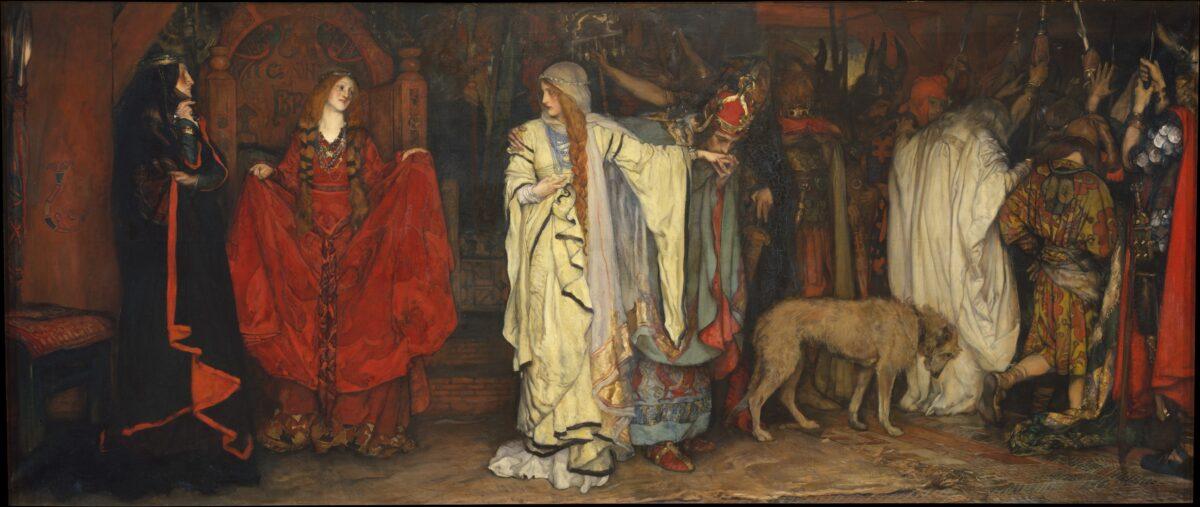
Womersley’s first chapter entitled “Selves and Others: Othello” is a study of individuality—who we once were, who we want to be, and who we become. The chapter presents the philosophical reflections of Aristotle, Locke, Hume, and T.S. Eliot, along with the fictional moral dilemmas in the works of Goethe (“Elective Affinities”), Conrad (“Lord Jim”), and several Greek tragedies. The consequences of these dilemmas, whether self-inflicted or otherwise, tend to lead either to the character’s demise or some form of degradation. Womersley notes that Shakespeare’s works “take a complicated stance on the matter of identity” by presenting characters from various social backgrounds—from servants and soldiers to kings and princesses. It is through this plethora of characters that “these plays affirm a common humanity that is camouflaged, but not destroyed, by accidents of birth or wealth ... [and] affirm the reality and stability of individual identity.”Shakespeare ‘For All Time’
“Thinking Through Shakespeare” is a brilliant study of the Bard’s work at a level one rarely, if ever, sees. Not only is the book a statement on Shakespeare’s importance concerning human thought, it is also a defense of the great English writer in an era when academics, specifically in the West, have attempted to belittle him and his works for rather arbitrary reasons.Womersley addresses these “politically-minded theorists” straightaway in his introduction, stating:
“The migration of high theory from the social sciences to the literary humanities which occurred in the second half of the twentieth century temporarily drove from the field of literary criticism that well-established way of thinking about how and why great literature holds and rewards our attention.”
By David Womersley Princeton University Press: March 10, 2026 Hardcover, 432 pages