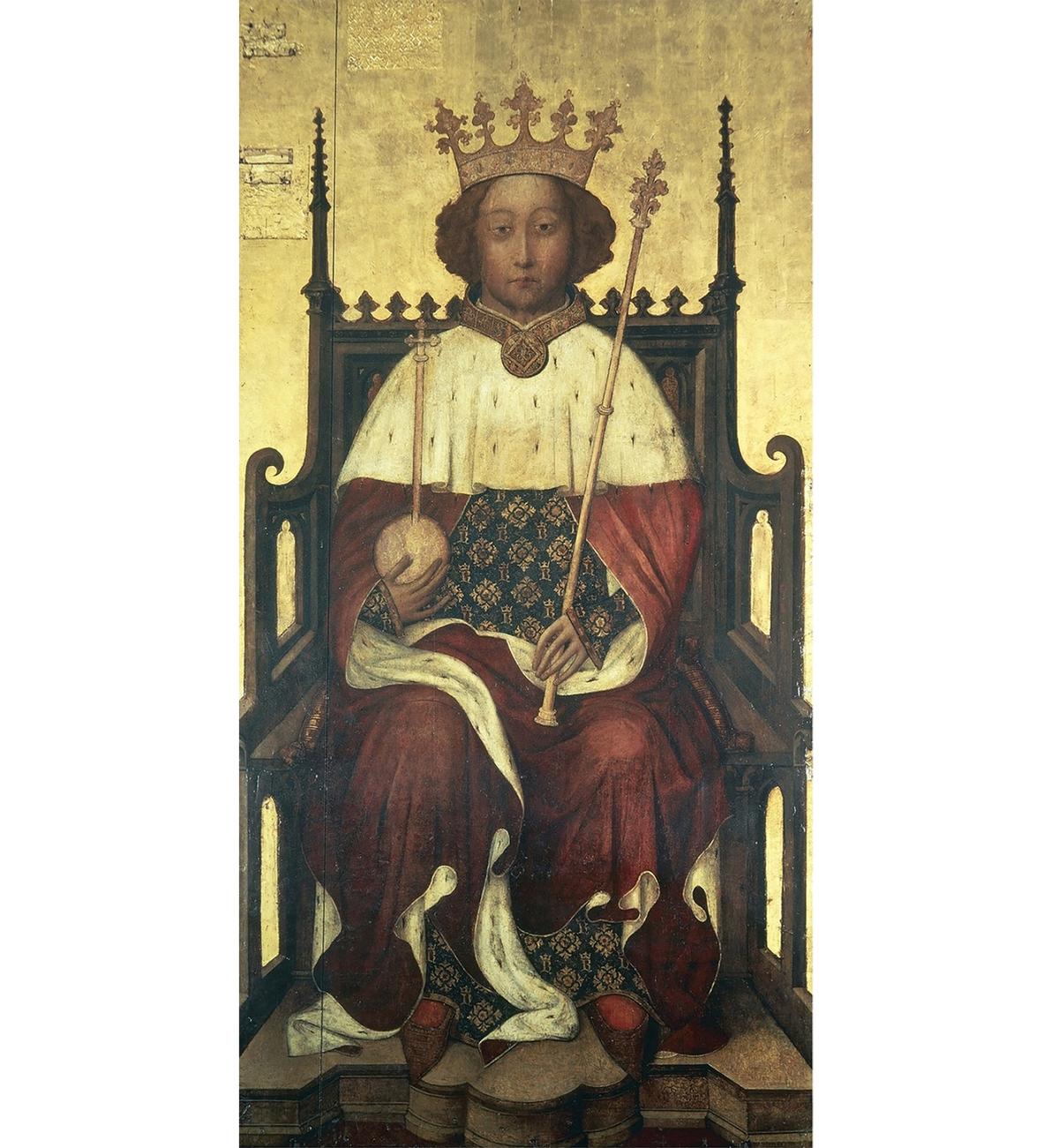
“Not all the water in the rough rude sea/ Can wash the balm off from an anointed king,” says Richard II in William Shakespeare’s eponymous 16th-century history play.
The real King Richard II of England (1367–1400) believed in the absolute power of the monarch and that he was answerable only to God. This proved to be Richard’s undoing, as his rule was eventually perceived by many of his subjects to have descended into tyranny. In the fall of 1399, Richard was deposed and imprisoned by his cousin Henry Bolingbroke, who became Henry IV. Richard died a few months later, just after his 33rd birthday. The cause of death was likely starvation, although there have long been rumors that he was murdered.
‘The Wilton Diptych’
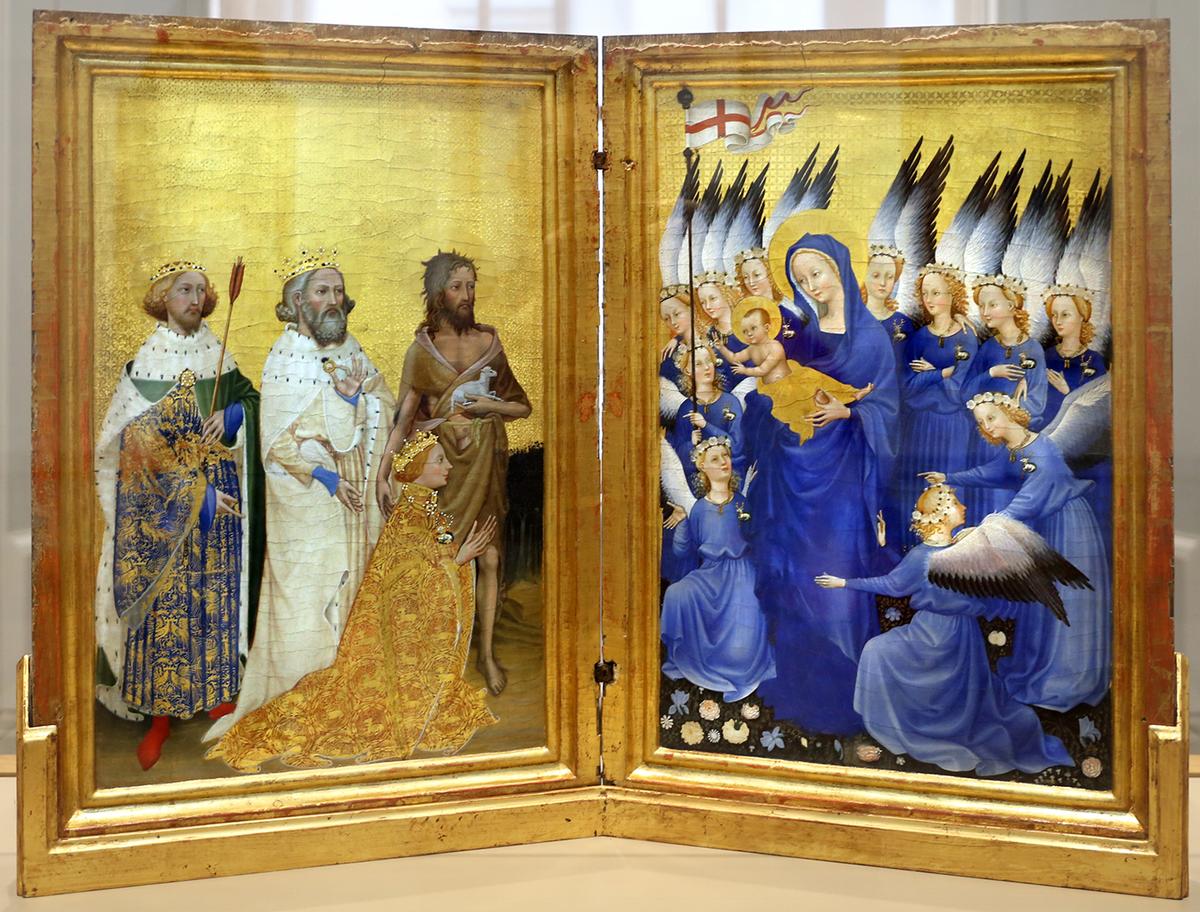
Its full title is “Richard II presented to the Virgin and Child by his Patron Saint John the Baptist and Saints Edward and Edmund.” It is a small diptych, a painting made of two panels joined by hinges that was traditionally used for private devotion.
The hinges allow the artwork to be closed, akin to a book, with the interiors protected. Typically, one side of a diptych depicts a portrait of the patron praying. In this example, Richard II kneels in the interior left panel and the inside right panel shows the Virgin and Child.
This diptych’s medium is egg tempera, in which colored pigments were mixed with water and egg yolk as a binder. The colors and metal leaf in “The Wilton Diptych” are resplendent. They include gold and silver leaf, ultramarine—the era’s most expensive pigment—vermilion, indigo, azurite, and orpiment, which contains arsenic.
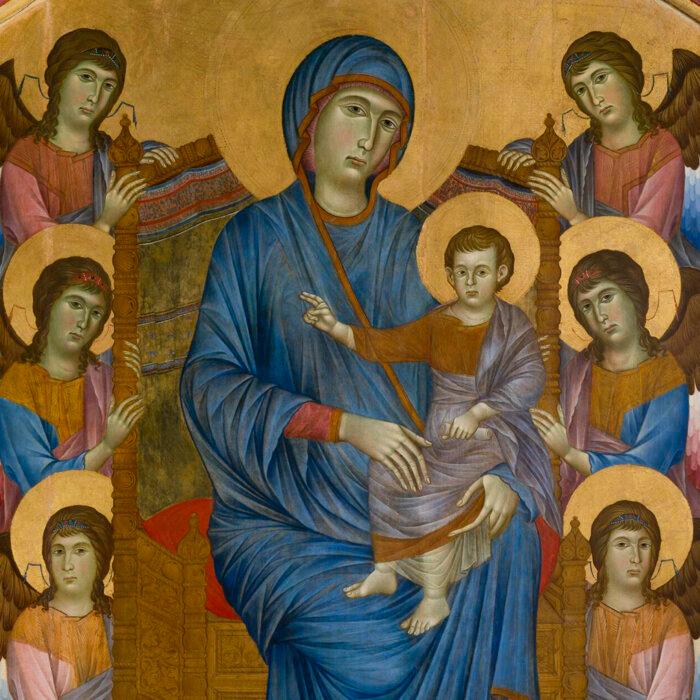

The artwork’s genre is classified as International Gothic, a late 14th-century courtly style that features elegant figures, textiles, architecture, adornment, and images of the natural world all rendered in meticulous detail. The picture is a mixture of religious and secular themes related to monarchy.
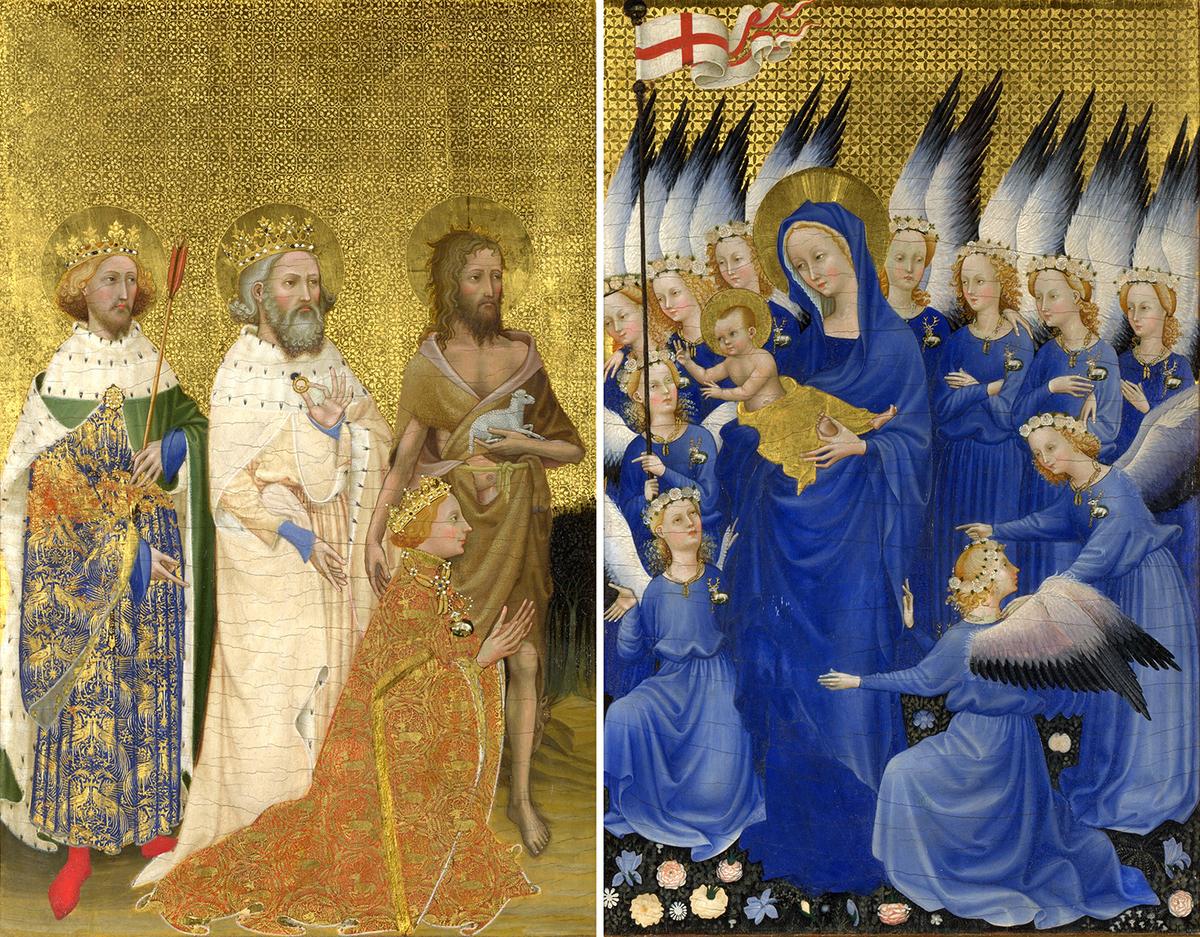
Richard was a grown man when the diptych was created, yet he is shown as a fresh-faced youth with reddish-golden hair. The king is believed to have had a beard since at least 1388 to 1389, years before the painting was created in around 1395. The purpose of this idealized discrepancy, which illustrates Richard as he would have looked at the time of his coronation, may have been to emphasize his kingship. It caused confusion for a period among scholars, with some erroneously dating the artwork to the start of Richard’s reign.
The Madonna and Christ Child
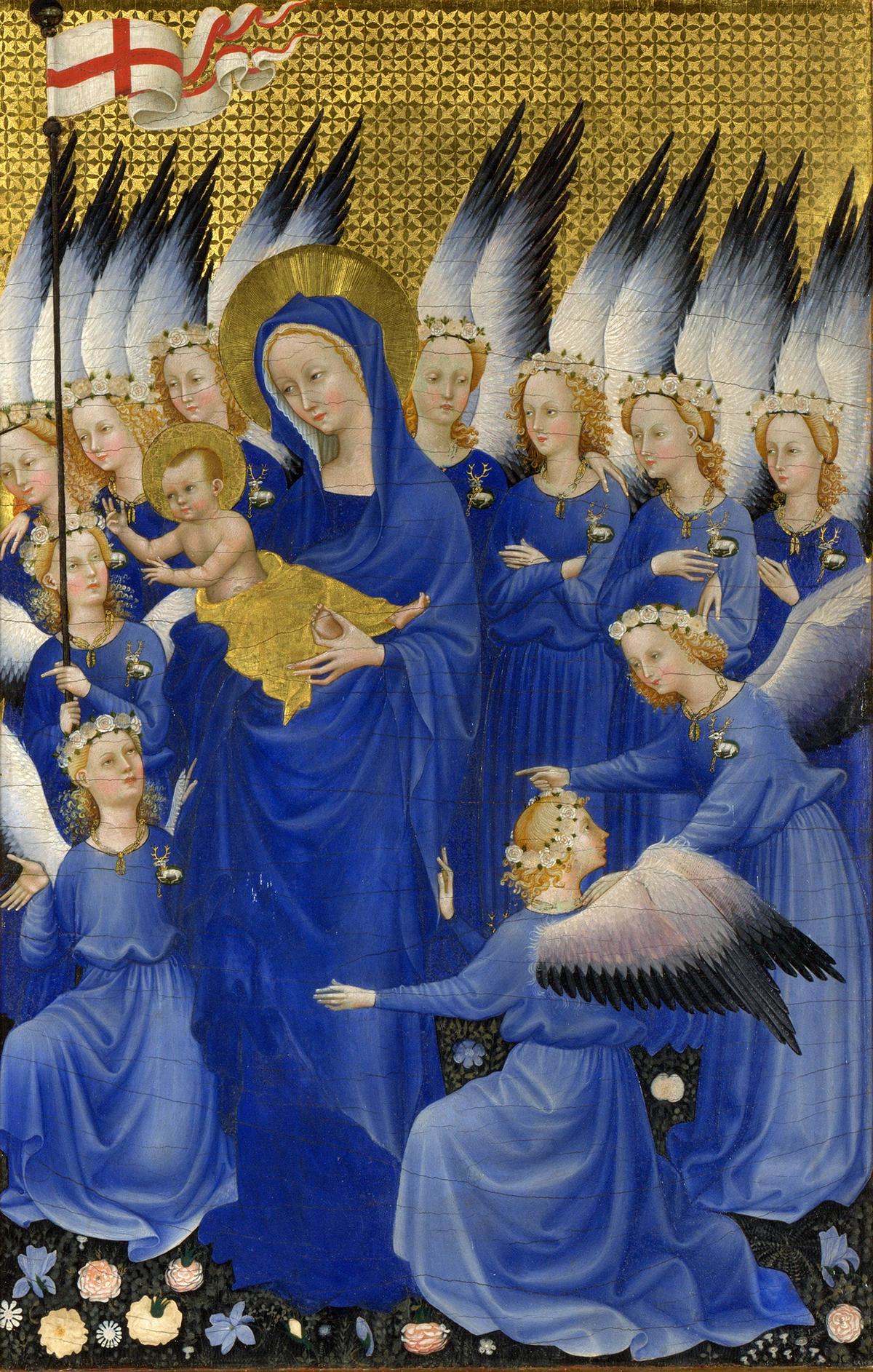
The saints present the king to the figures on the interior right panel: the Madonna and Jesus encircled by angels. The bare earthly landscape of the kingly panel is countered by a blooming meadow that represents heaven on the other panel. Under the feet of the divine figures, all swathed in blue except for Jesus, are roses and violets, which are symbols of the Virgin.
The Christ Child is highlighted by his garb of gold, and his halo contains stippled symbols of the Passion. An interpretation of his hand gesture is that he is blessing Richard. In turn, the king’s opened hands appear ready to receive the pennon, which Christ may be blessing, too. This banner is held by one of the angels. At the time, viewers would have associated it with Saint George, patron saint of England. An implication of Christ presenting this flag to Richard is another sign of his divine sovereignty.
Earthly Left Panel
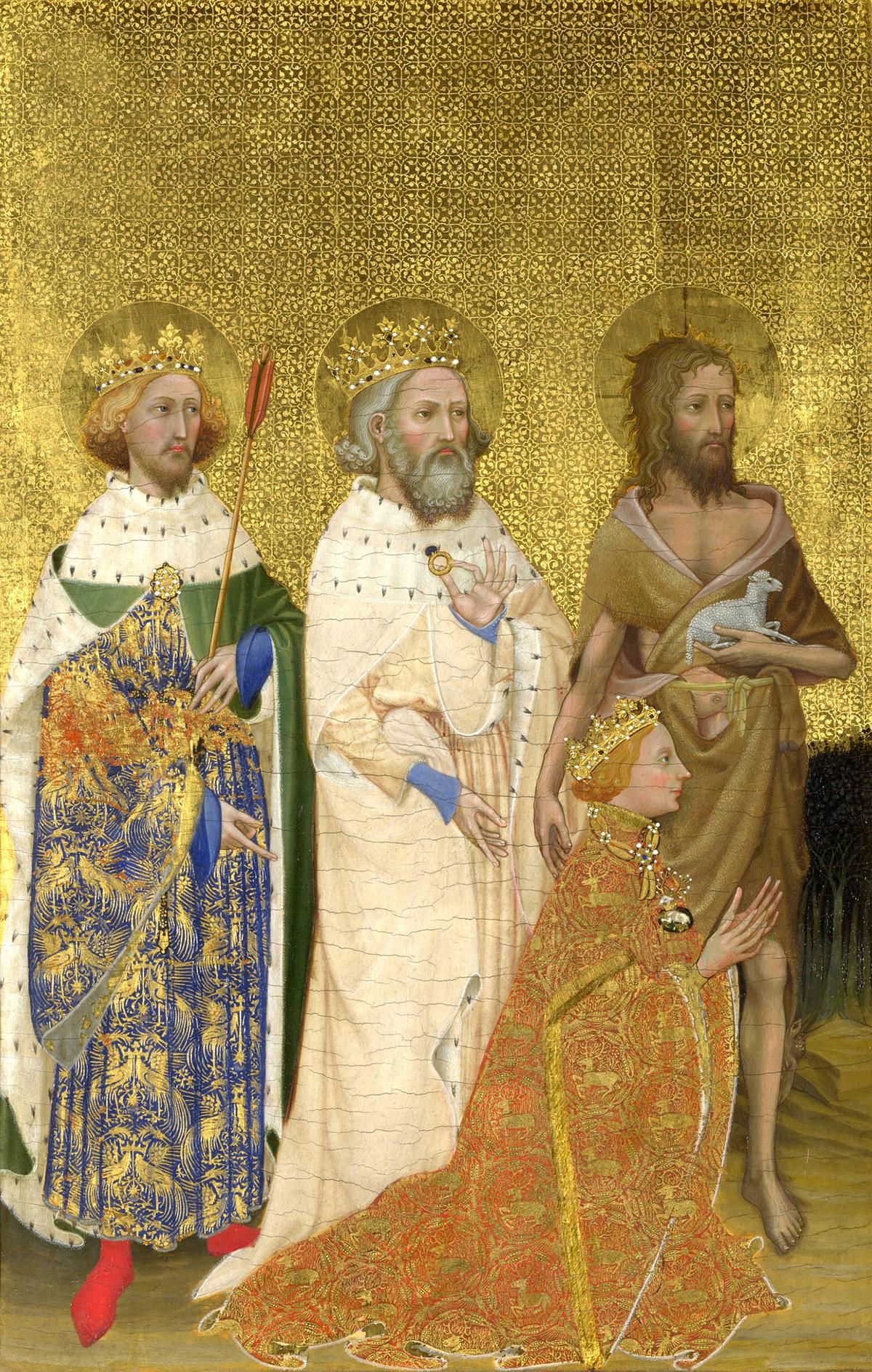
The textiles worn by the figures on the interior left emphasize the scene’s symbolism. Saint Edmund’s houppelande, a loose belted robe with wide sleeves, full skirt, and fur trim, has a pattern of birds called demoiselle cranes (Anthropoides virgo/Grus virgo), which allude to the Virgin. The cranes are linked by crowns. Crown motifs are found throughout the diptych; they represent kingship and Richard’s coronation.
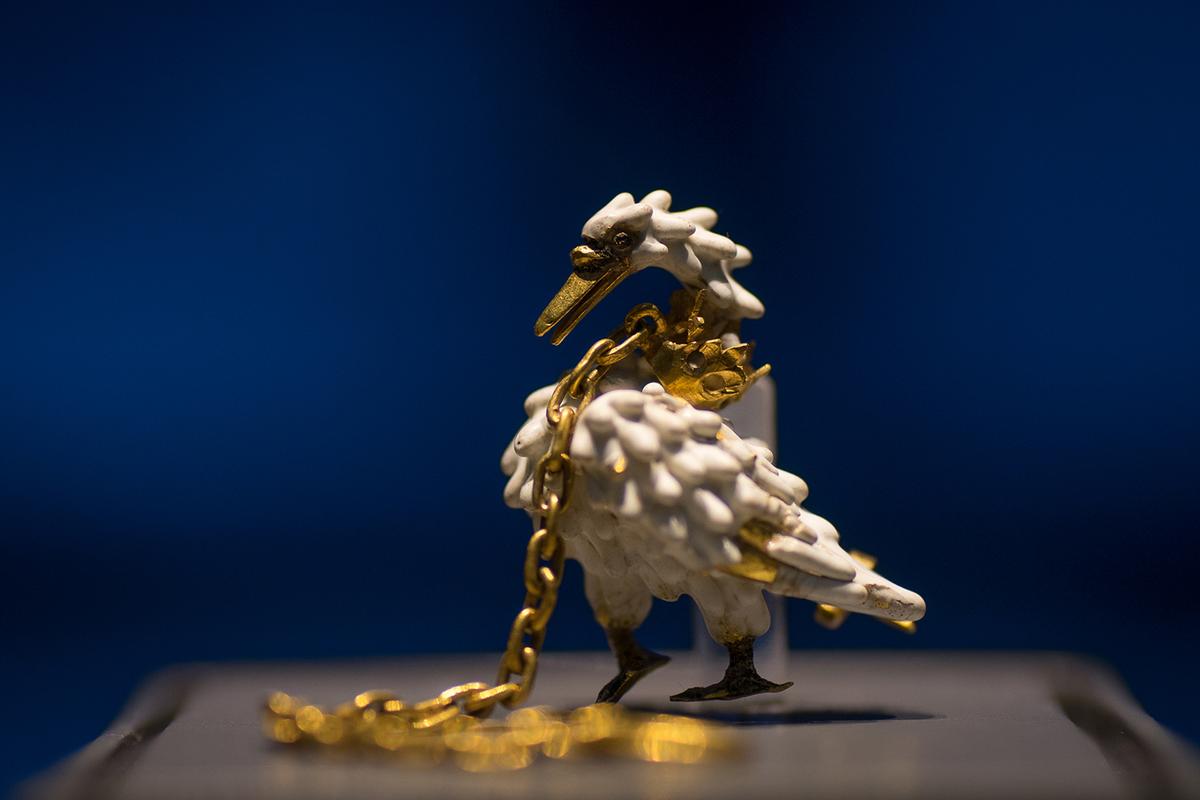
The lavish fabric of Richard’s houppelande is decorated with several elements, including harts, also known as stags. Richard’s heraldic badge was a white hart; in this work, he wears a jewel in the shape of the animal. The hart is depicted collared and chained.
The Diptych’s Outer Panels
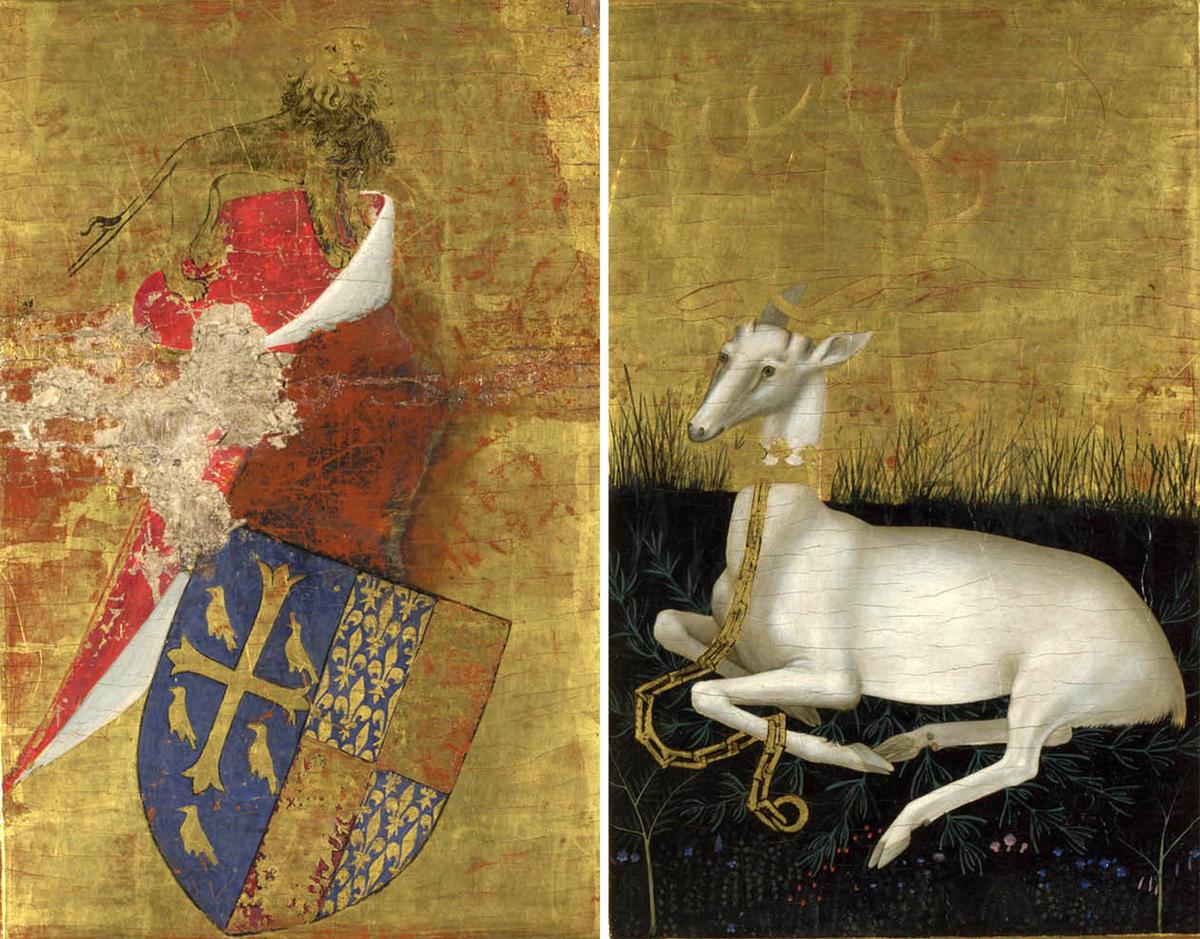
The high-quality preservation of the interior panels of “The Wilton Diptych” suggest that it was often closed and protected by the exterior wings, which were also painted.
The outside left wing shows a white hart with a crown around its neck posed on blooming ground. The flowers are emblematic of Richard’s first and second wives. The rosemary and ferns symbolize Anne of Bohemia, who died of the plague in 1394, while the irises and pimpernels represent Isabelle of France.
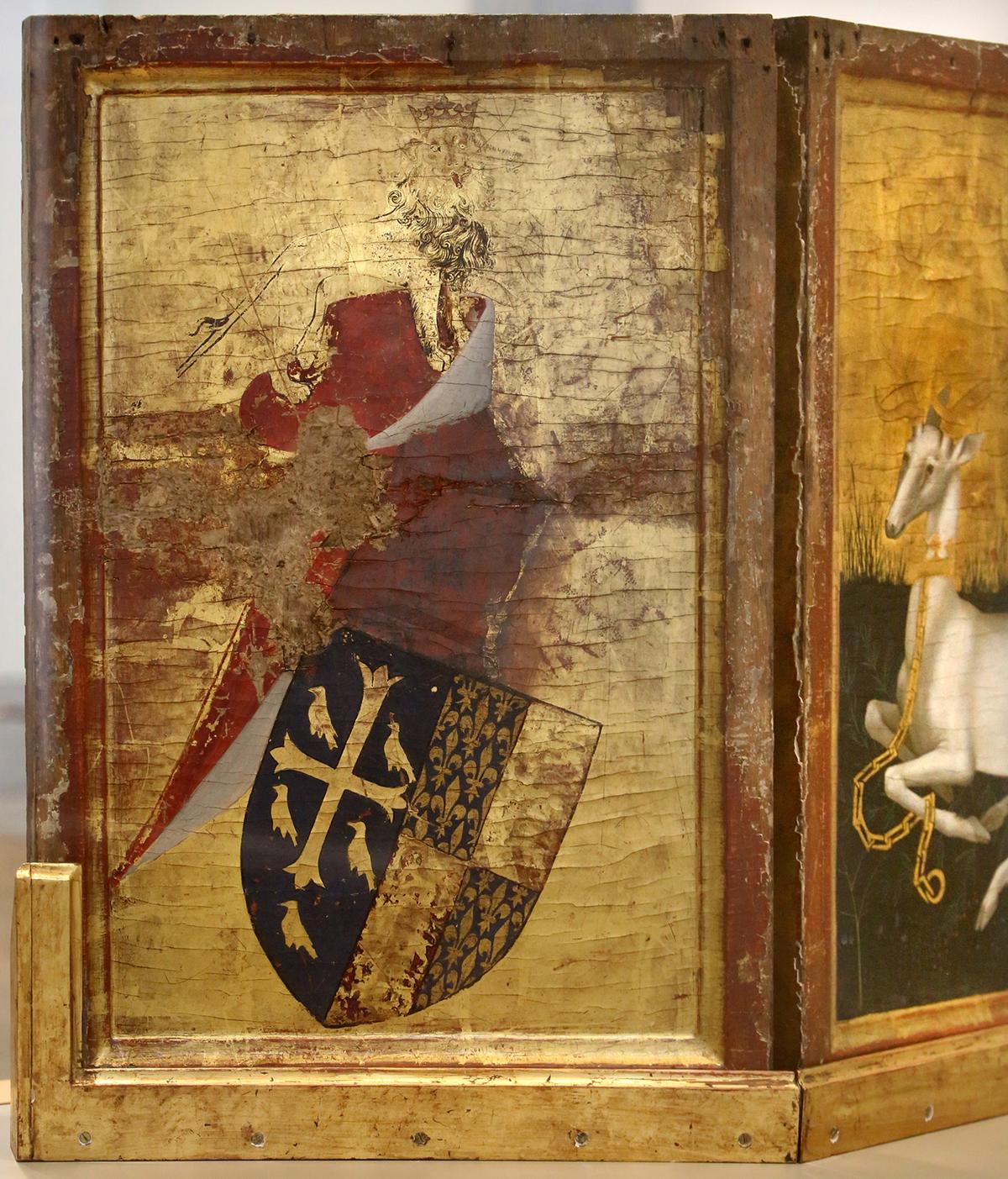
The exterior right wing contains a shield with the English royal arms used by Richard—three lions—placed side-by-side with Edward the Confessor’s fictive ones—an arrangement of five footless martlets (mythical birds) inset with a cross patonce (a cross with three prongs). This panel has sustained damage that makes some of the painted areas difficult to discern.
Mysterious Origins
The identity of the artist who painted “The Wilton Diptych” is unknown. Even their country of origin is subject to vigorous scholarly debate. A range of influences from the courts of northern Europe, France, Italy and Bohemia can be perceived in the artwork.The diptych’s oak support, preparatory chalk ground, and depiction of Christ’s outward-turned sole of his foot were popular in northern European panels of the period. The painting technique of green underpaint for flesh tones and use of tempera align with Italian artistic practices.
In contrast, oil paint was already the preferred medium in the north of Europe. Furthermore, aspects of the diptych can be linked with manuscript illuminations made in France. French connections can also be perceived in John the Baptist’s attire (a camel-skin robe, replete with the camel’s head), Passion symbols in Jesus’s halo, and the composition of saints presenting an artwork’s patron. The Virgin and Child in the diptych may be based on a French statue that Richard owned, but other analyses link it to Bohemian statues. The presentation pose, which is the depiction of a king being presented by a saint to the Virgin and Child, also came from a Bohemian panel painting.
Ultimately, the consensus is that the artist must have been part of the English court because the overall iconography is so personal to Richard. Art historians have pondered how an English artist would have been able to see Italian, especially Sienese, panel painting and diverse genres in French, particularly Parisian, art.
There is no work directly comparable to “The Wilton Diptych” by an artist of any origin. The only consensus is that its creator made a masterpiece and was highly adept at precision, refined detail, three-dimensional effects, and manipulation of paint layers.
Amid the overall cryptic nature of this devotional object’s sophisticated design and production, the NG gleaned recently concrete information. In 2022, the museum had dendrochronological testing (tree-ring dating), done on the diptych’s panels. It revealed that the wood comes from the eastern Baltic, with the latest ring from the year 1375.
There are no medieval records related to “The Wilton Diptych.” Its earliest historical mention is in 1649, when it was catalogued as part of King Charles I’s collection. Later, it appears that his son, King James II, gave it to Lord Castlemaine. In turn, the man’s heirs sold it to Thomas Herbert, 8th Earl of Pembroke, in 1705. It was kept at the earl’s Wilton House, hence the diptych’s sobriquet, in Wiltshire. It remained there until the NG acquired it from the family in 1929.
At the end of Shakespeare’s “Richard II,” the king laments “the hollow crown” as death awaits him. Although his reign was inglorious, Richard was the conduit for one of the greatest artworks of the Middle Ages.