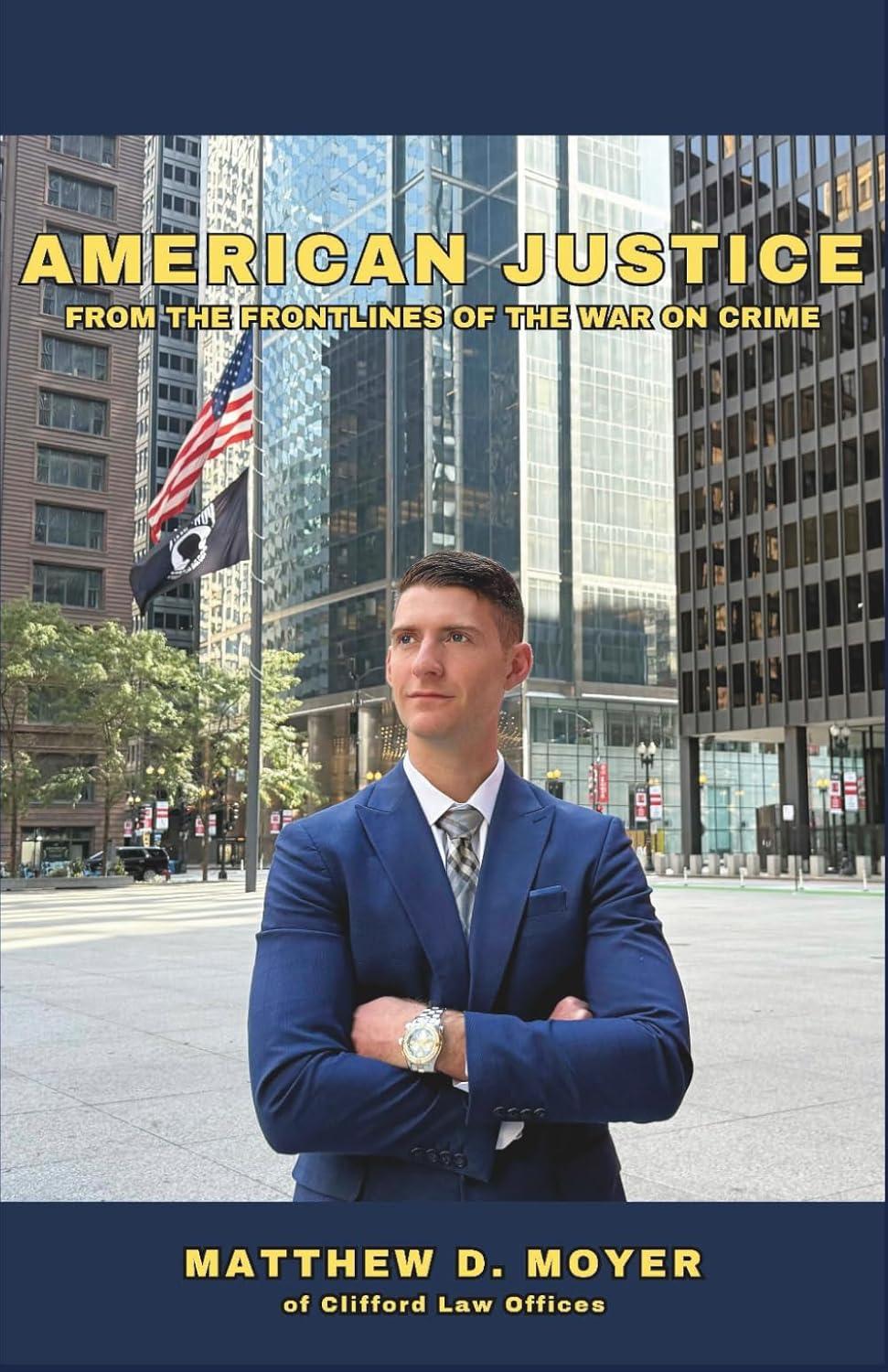
The new book “American Justice: From the Frontlines of the War on Crime” by Matthew D. Moyer, a former Chicago-based state and federal prosecutor, offers an astonishing insider’s view to a judicial environment where dysfunction is commonplace and public safety is often treated like an afterthought.
Some sections of the book are so intense in the description of violent crimes that sensitive readers could easily be disturbed long after absorbing the passages. Other sections on miscarriages of justice are so illogical that Moyer’s sentences need to be reread to confirm the bizarre actions that prevail.
For a prosecutor with the tenacity to pursue multiple emotionally complex cases, Chicago was an ideal location for Moyer. As he explained in the introduction, “Between the carjackings, cold-blooded homicides, daring bank robberies, and white-collar fraud schemes, the crime here is as varied as it is enduring.”

Children and Danger
One of the most riveting chapters in “American Justice” involves a boy dubbed “Kevin” by Moyer. Kevin began his criminal career at the age of 10 and was in and out of the juvenile detention center every few weeks. By the time he reached 11, Kevin gained “legend status” with the police for the staggering number of times he was arrested, with crimes including carjacking, weapons possession, and robbery.Incredibly, Kevin’s reign of terror wasn’t stopped because of the tumult he inflicted on Chicago. Instead, a report came out that an unidentified juvenile his age was shot during an attempted carjacking by a concealed carry holder.
Kevin wasn’t the shooting victim, but a judge who dealt with him previously felt it would be safer for him to be sent to a locked youth facility. Thus, the judge’s sympathy was stronger for the safety of a habitual juvenile delinquent than the people impacted by his crimes.


The most painful section of Moyer’s book involves cases of domestic violence and child abuse. “I recall far too many cases where mothers were beaten until bleeding by their abusive boyfriends, their horrified children watching with wide, teary eyes,” Moyer wrote.
Challenges to Reality
An even more astonishing story follows, with Moyer highlighting the impact of a physician he named “Dr. Richardson” who found a lucrative niche as a “hired gun” to provide medical input for defendants charged with child abuse. Dr. Richardson had a talent for deflating prosecutors’ medical experts to prove the accused abusers weren’t responsible for the injuries suffered by their children.Moyer came up against this physician, who was brought in to defend a father whose infant had suffered multiple broken bones; it seemed like an obvious abuse case. The prosecutor had a hunch about the nature of Dr. Richardson’s upcoming testimony. He researched an article where the physician made comments on pediatric bone fractures that mirrored the case he was trying to refute.
Moyer effectively discredited Dr. Richardson’s expertise on pediatric bone fractures in that case. Incredibly, the judge ruled it was impossible to know if the injuries to the baby were accidental or intentional and there was no conviction on child abuse charges. Moyer added he wasn’t upset at the judge for the ruling, but that he remained “skeptical” of the parents.
For pure drama, Moyer’s chapter on the investigation into a robbery crew that was targeting Mexican bodegas and cantinas across Chicago unfurls like an Agatha Christie mystery. The crew’s modus operandi seemed baffling, with assaults that always occurred between 6:00 p.m. and 8:00 p.m. and behavior that seemed strangely oversized. It seemed as if they were playing for the security surveillance cameras that captured their shenanigans.
Through a combination of lucky breaks and deductive reasoning, Moyer and his colleagues uncovered a wildly ingenious plot that showed the unlikeliest connection between the predators and their prey. Giving more information would be an epic spoiler, because this amazing story needs to be read to be believed.
Moyer has since moved out of prosecuting and into private practice where he specializes in personal injury cases. He could certainly switch careers again into full-time writing. “American Justice” is a brilliantly effective overview of a wildly imperfect judicial system. Fans of true crime stories will be richly rewarded with this fine book.