This copy is for your personal, non-commercial use only. Distribution and use of this material are governed by our Subscriber Agreement and by copyright law. For non-personal use or to order multiple copies, please contact The Epoch Times Reprints.
Americans in the early 1770s toasted the New Year in a variety of fashions. In some locales, for instance, young ladies banded together on New Year’s Eve, heated up bowls or pots of cider, ale, or wine flavored with spices like ginger and cinnamon, and shared this wassail with friends and neighbors. Chocolate drinks were also popular, so much so that Thomas Jefferson once predicted they would replace coffee and tea as favorites.
In Philadelphia, troupes of costumed men and women, called mummers, celebrated New Year’s Day by going door-to-door, singing, dancing, and clowning around in hopes of receiving refreshment or money. Exchanging small gifts on New Year’s and simply visiting with friends and neighbors were also common.
Many people also attached certain superstitions to the holiday. Throw something away from your house on New Year’s Day, for instance, even fireplace ashes or dirty water, and someone who lived there would die that year. If the sky was red on the first day of the year, it portended not only immediate bad weather but also a year of strife and trouble.
Given that last belief, in our mind’s eye we should see the early morning skies on Monday, Jan. 1, 1776, as glowing scarlet red with a few patches of blue over all 13 colonies. On that day in history, troubles, fear, and hope were the condiments in their wassail.
New Year’s in Quebec
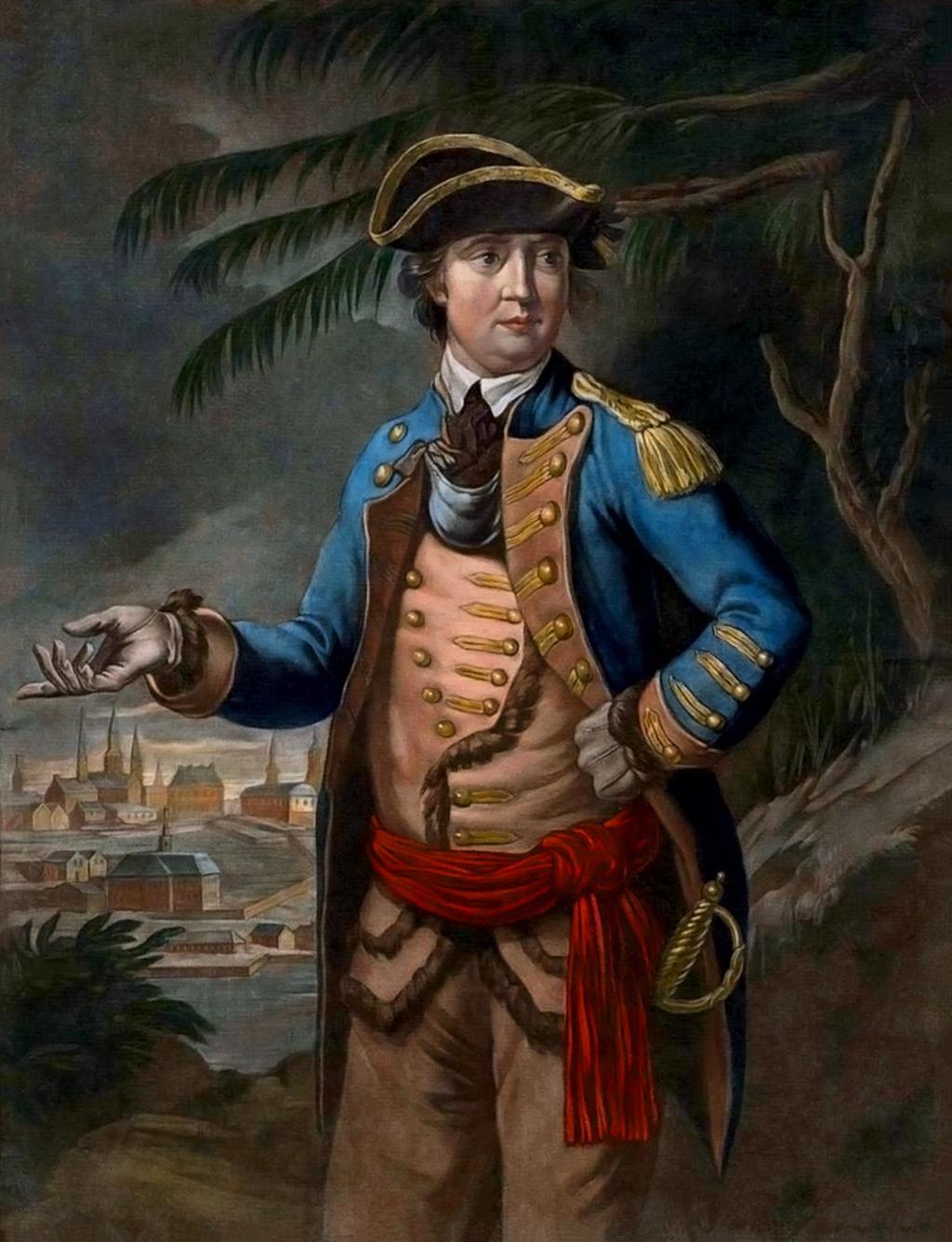
On New Year’s Eve, 1775, American forces under the command of Gen. Richard Montgomery and Gen. Benedict Arnold attacked Quebec and its defenders, British troops led by Gen. Guy Carleton. Hoping to take the war into Canada and encourage the people to rebel against the crown, the Americans had occupied Montreal, but their ambitions stalled outside the defenses of Quebec. Brutally cold weather, a smallpox epidemic, and lack of adequate foodstuffs acted as British allies to reduce the already inferior numbers of American militia.
A color mezzotint of American Revolutionary War Gen. Benedict Arnold, 1776, by Thomas Hart. Brown University, Providence, R.I. Public Domain
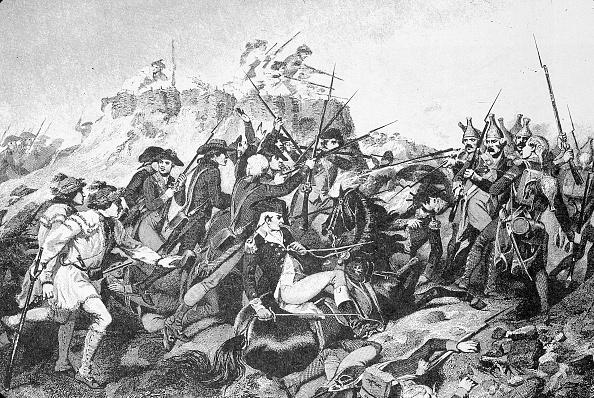
A blizzard on the night of the attack only added to their troubles. Though some Americans managed to get inside the city, their attack was readily repulsed. Montgomery died on the field of battle, Arnold escaped with a leg wound, and Gen. Daniel Morgan, who had assumed command after Arnold was shot, was taken prisoner along with some 400 of his troops.
"The Death of General Montgomery in the Attack on Quebec, December 31, 1775," 1786, by John Trumbull. Oil on canvas. Yale University Art Gallery, New Haven, Conn. Public Domain
The Americans suffered 51 dead, compared to 5 of the British, and 387 men captured. Though Arnold continued the siege, Carleton had laid in ample supplies. His troops handily survived while the Americans suffered a long winter and spring of privation. Finally in May, they retreated from Canada. The effort to rouse the Canadians to join their rebellion was an abject failure.
Benedict Arnold is shot in the leg while leading American troops in Canada. Arnold later turned traitor and fought for the British. (MPI/Getty Images)
The Great Conflagration
Some 700 miles to the south, New Year’s Day 1776 brought catastrophe to the port city of Norfolk, Virginia.
Dawn on that bright winter’s day revealed four British warships and dozens of other craft in the harbor. Fugitives from the city, many of them British Loyalists fearing for their lives, had rushed onto the ships when patriotic forces led by Col. Robert Howe and Col. William Woodford had seized the town. Other civilians had fled into the countryside.
Known as “shirtmen” for the long hunting shirts many of them wore, the eagle-eyed American militia had sniped at the British ships for the past two weeks. Finally, Lord Dunmore, the royal governor of Virginia who had fled first from Williamsburg to Norfolk and then to the ships after the patriots had defeated his ragtag force at Great Bridge, commanded the British captains to commence firing to drive away these marksmen. At 3 p.m. that first day in January, the four ships unleashed a cannonade that destroyed several warehouses and docks from which the snipers had fired. The artillery thumped away even after darkness fell, though the only civilian injury of this bombardment was a nursing mother who was hurt when a cannonball rolled through her home and broke her leg.
The barrage then ceased, but a few hours later flames erupted all over the city. Within three days, most of Norfolk had burned to the ground. By early February, nearly every building in the city was either leveled or a smoking ruin, burned by order of the new patriot government.
News of these British atrocities lit another fire—outrage, leading colonists who had wavered in their allegiance to the cause of liberty to declare their support. Lord Dunmore became a devil incarnate. And later that summer, in the Declaration of Independence, Thomas Jefferson in part referenced this destruction when he wrote that George III’s forces had “burnt our towns, and destroyed the lives of our people.”
The burning of Norfolk made for great propaganda, but like so much war propaganda, the reports were false. We know now that it was the shirtmen who looted homes and businesses and put them to the torch, with some of them telling residents they were acting under orders.
The burning of Norfolk fired up patriotic spirits except, of course, for those whose homes and occupations were destroyed.
Liberty Sounds the Bell
Meanwhile, in Philadelphia on New Year’s Day, a time bomb made of words was ticking away.
Though no exact date exists, newly arrived Thomas Paine finished writing “Common Sense” in late 1775. As the calendar began a new year, that explosive pamphlet document likely lay in the hands of printer and bookshop owner Robert Bell. Harvard professor and Pulitzer Prize winner Bernard Bailyn described it as “the most brilliant pamphlet written during the American Revolution, and one of the most brilliant pamphlets ever written in the English language.”
Frontispiece of "Common Sense: Addressed to the Inhabitants of America," 1776, by Thomas Paine. Internet Archive. Public Domain
On Jan. 10, this manifesto of liberty appeared in public and immediately became a bestseller throughout the colonies, selling 120,000 copies in three months and 500,000 by the war’s end. It’s with good reason that the National Constitution Center dubbed it “the original publishing viral superstar.”
From American leaders like Ben Franklin, who had encouraged Paine to pen this call for American liberty, to soldiers, farmers, and shopkeepers, men and women took “Common Sense” to heart. It was read aloud in taverns, and its words and phrases were shouted in the streets.
The General and the Flag
Finally, New Year’s Day brought more than defeats and words. It brought out the best in the man who would lead the Army to victory.
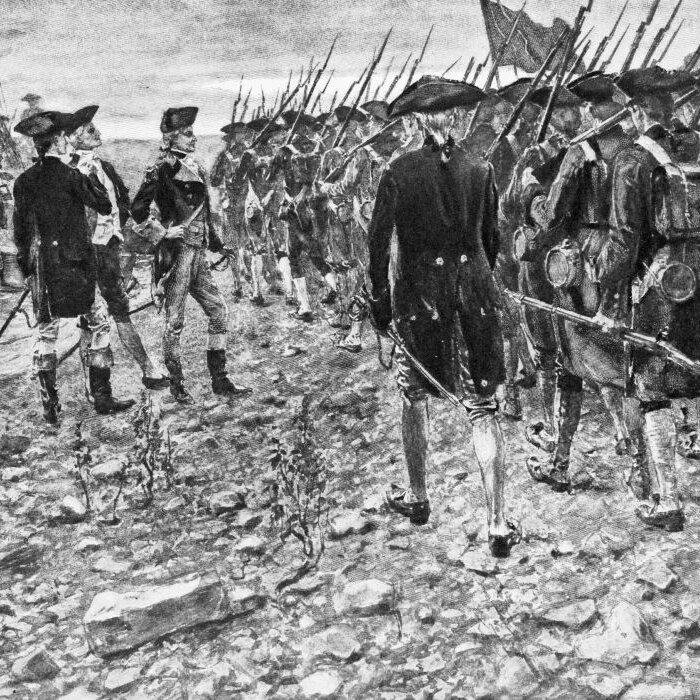
In his “General Orders, 1 January 1776,” George Washington declared the “commencement to the new-army, which in every point of View is entirely Continental.” He recognized that the men under his command were “brave and good,” but urged everyone, from brigadiers to the lowest private, to give way to subordination and discipline.
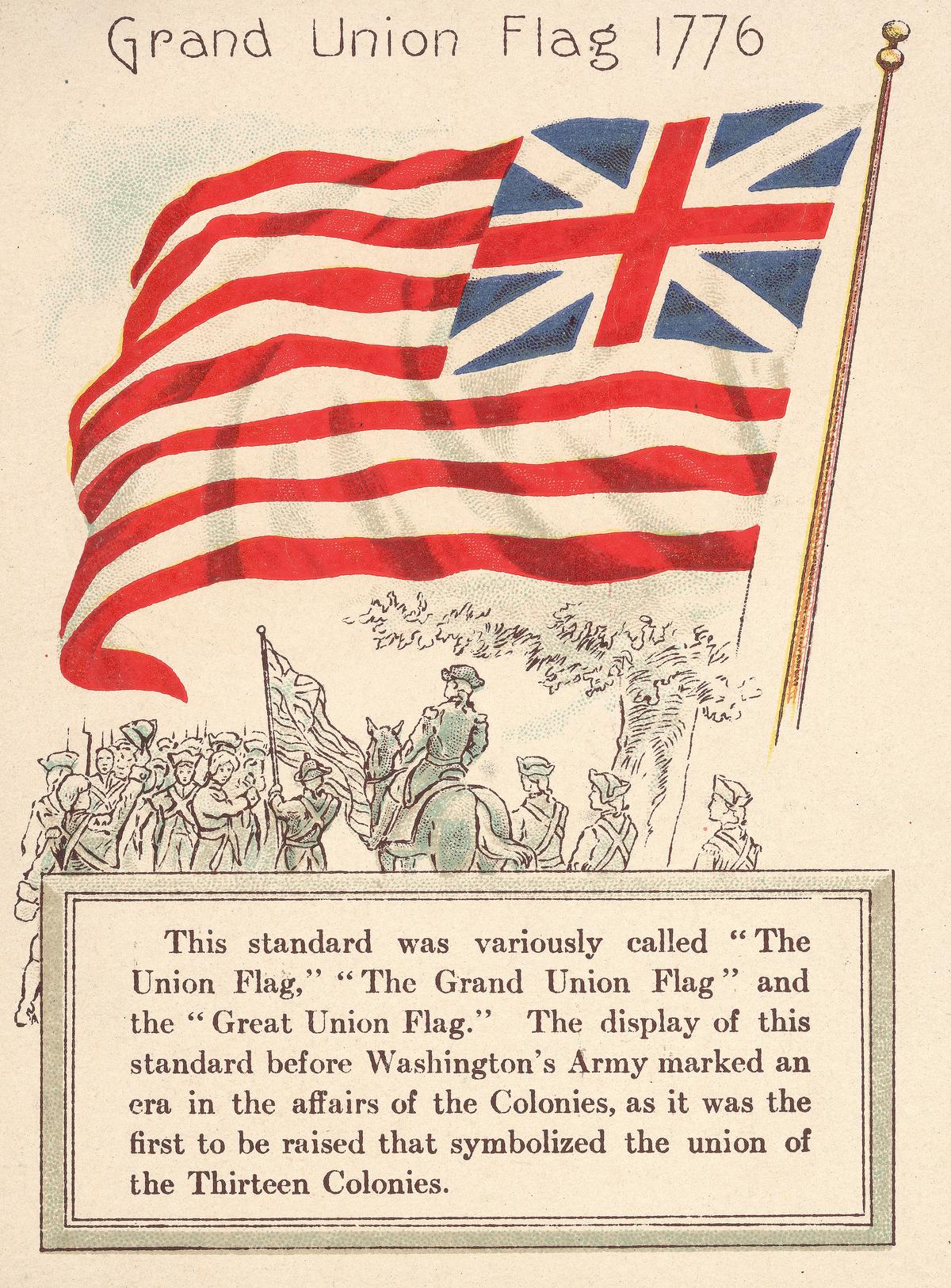
Nor did Washington stop there that day. When British officers under a flag of truce delivered copies of an October speech made by George III, in which the monarch insulted and threatened the colonists, the Americans mocked the king and burned the speech. At some point on this same day, in another effort to boost the morale of his men, Washington ordered the raising and first display of the Grand Union Flag with its 13 white and red stripes and the crosses of St. George and St. Andrew in its upper corner. Though some historians today contend that the flag was instead the British Union Jack, Washington’s men nevertheless saluted it with cannon fire and cheers.
Illustration of the Grand Union Flag of 1776 from a 1912 promotional pamphlet. Kean Collection/Getty Images
With these words and deeds, Washington showed himself on this New Year’s Day as a man who meant to create and govern an army.
A New Year’s Lesson for Our New Year
The Apotheosis of Washington fresco in the eye of the Rotunda of the U.S. Capitol in Washington on Oct. 31, 2025. Madalina Kilroy/The Epoch Times
Looking back at the past can be tricky. Regarding the American Revolution, for instance, the results, in this case independence, may seem inevitable today. We forget that those people living on that first day of 1776 were likely experiencing a spectrum of emotions regarding the future, running from trepidation to courageous hope.
Asked to wager whether the colonials would free themselves from the mother country, a gambler on that day would likely have bet against that possibility. The American forces were failing militarily, as at Quebec; they were at one another’s throats, as witnessed in Norfolk; and they were taking as their battle cry words written by a man who had lived among them less than 14 months. Even Washington, who would prove to be a key player in the long struggle, had to remind his subordinates “that an Army without Order, Regularity & Discipline, is no better than a Commission'd Mob.” Gaining their liberty was a game of dice, and no one could predict the winner.
As we embark on our celebration of the 250th birthday of the Declaration of Independence, we will likely encounter derogatory criticism of our country or news of American decline. When that occurs, it behooves us to remember the men and women who, under much greater duress, fought doubt and fear and founded a nation. With them as our examples, surely we can fight to keep that nation true to its principles of liberty and justice for all.
What arts and culture topics would you like us to cover? Please email ideas or feedback to [email protected]
Jeff Minick has four children and a passel of grandkids. He has written two novels, “Amanda Bell” and “Dust on Their Wings,” as well as “Learning as I Go” and “Movies Make the Man.” You’ll find more of his writing at JeffMinick.substack.com.