The Frick Collection’s upcoming “Vermeer’s Love Letters” exhibition centers around the last painting Henry Clay Frick acquired before his death: Johannes Vermeer’s “Mistress and Maid.”
The Frick’s painting forms a trio in the exhibition, with two special Vermeer loans: “The Love Letter” from the Rijksmuseum in Amsterdam, and “Lady Writing a Letter, With Her Maid” from the National Gallery of Ireland, in Dublin.
Dutch Letter Writing
In the essay “Disciplining the Hand, Disciplining the Heart: Letter-Writing Paintings and Practices in Seventeenth-Century Holland,” art scholar Ann Jensen Adams explained that private love letters often weren’t private. They were often read secretly in transit, read aloud on receipt, shared with others, and sometimes even published.Epistolary Painting
In addition to painting, Vermeer was also an innkeeper and respected art dealer known for his fine collectorship and art expertise. He and his peers often painted compositions similar to one another, varying small details. “Any vision we may have had of Vermeer working in single-minded isolation in his hometown of Delft is a myth. He appears to have been a highly engaged and collegial painter,” exhibition curator Robert Fucci notes in the exhibition catalog. Fucci is a 17th-century Dutch art scholar at the University of Amsterdam.Dutch genre paintings featuring love letters peaked between the late 1650s and the early 1670s.
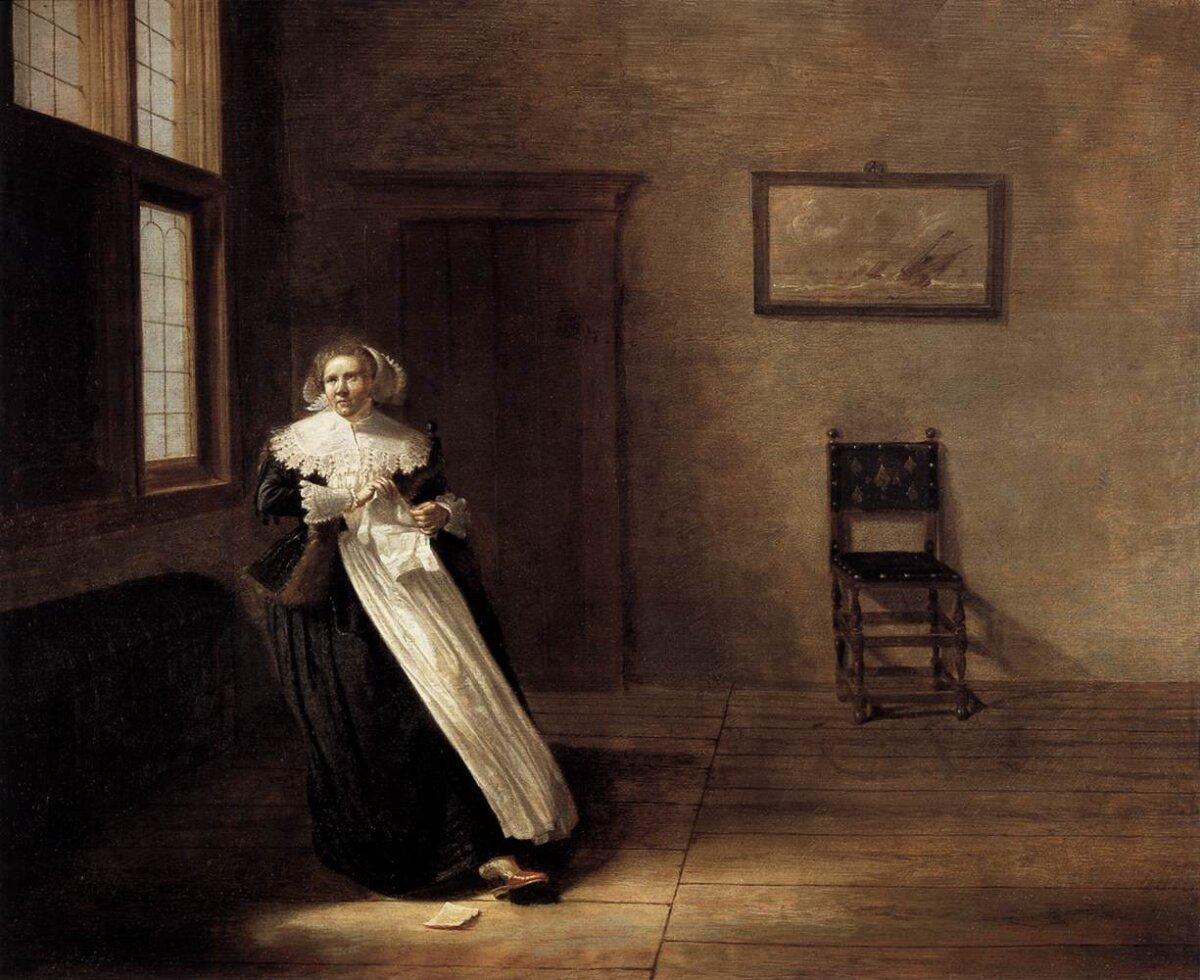
Early examples of love letter paintings include “Woman Tearing a Letter,” painted by Dirck Hals (1591–1656) in 1631. Hals painted a woman wearing a black dress and white apron standing in a sparsely decorated room, with an empty chair that often symbolized the missing suitor. She’s frozen in shock.
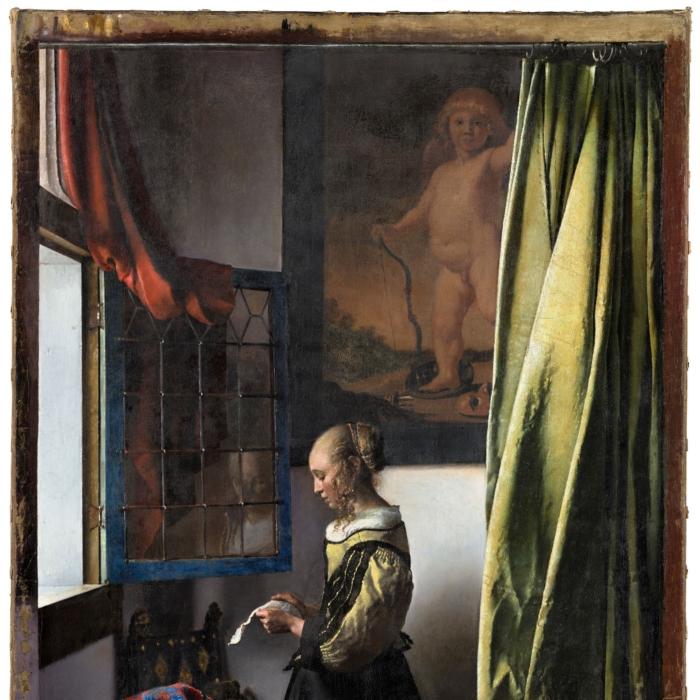
Hals’s dynamic treatment of the skirt of her dress suggests that she’s just leaped up from her chair to the window in a moment of despair, after she’s read the letter.
A Trio of Vermeer’s Love Letter Paintings
Of the 37 Vermeer paintings known to survive, six include letters. “The Oxford Companion to Art” gives a general overview of Vermeer’s genre paintings, which fittingly describes the three exhibition paintings: “The predominant colours are yellow, blue, and grey, and the compositions have an abstract simplicity which confers on them a power of impact out of relation to their small size.”In The Frick’s “Mistress and Maid,” Vermeer created a palpable tension as the mistress gazes at the unopened letter. The maid has just interrupted her mistress’s writing. The maid’s flushed cheeks indicate that she holds an urgent or long-awaited message, requiring immediate attention. Her mistress listens attentively as the maid relays a verbal message.
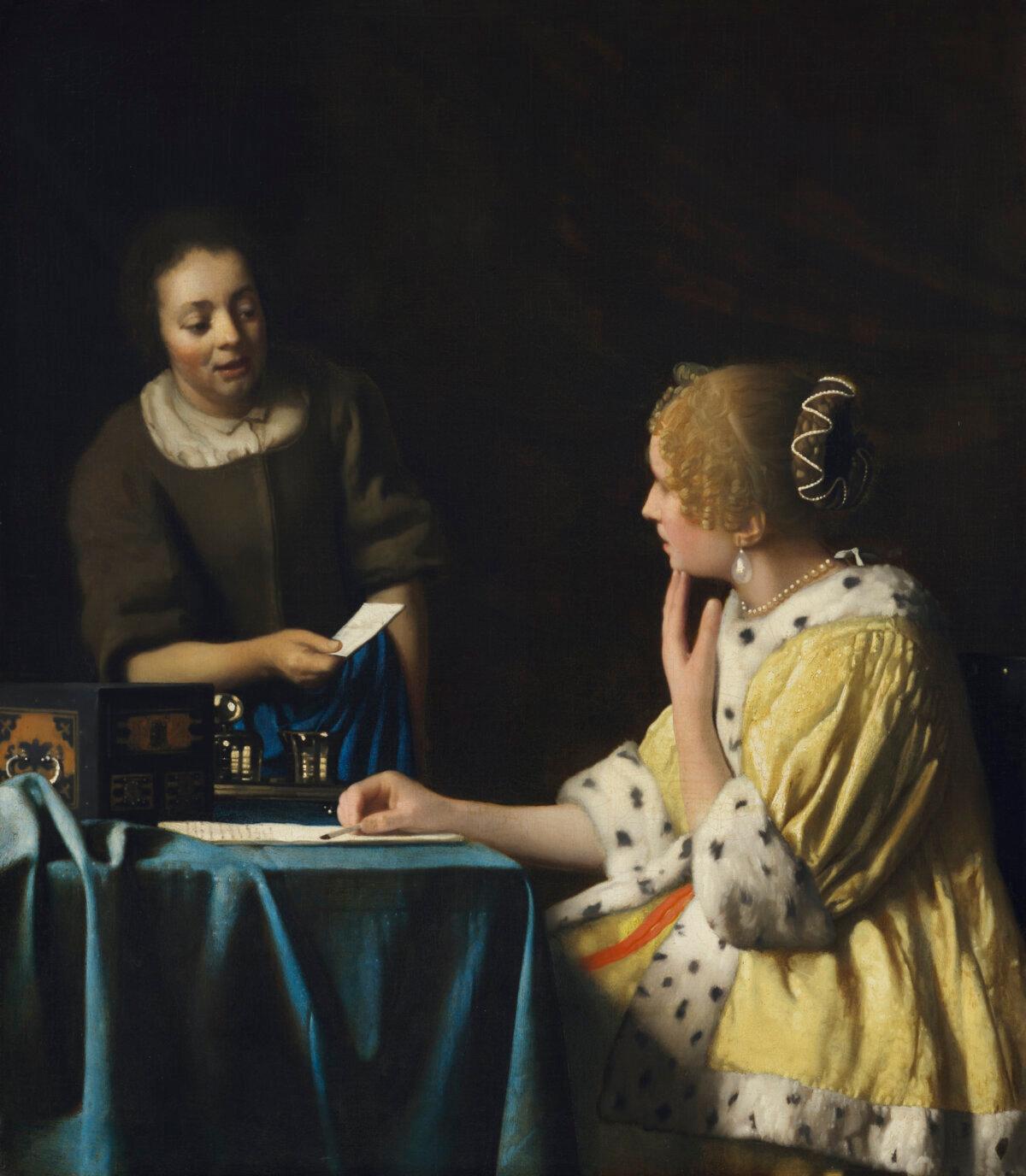
Scientific analysis revealed that Vermeer originally painted figures and a tapestry in the background of “Mistress and Maid.” That was more fitting with his style, before he decided on the dark background that intensifies the intimacy of the scene. The analysis also revealed that the blue tablecloth used to be green; the yellow pigment Vermeer used has faded over time.
In “The Love Letter,” Vermeer invites the viewer to peek through a doorway as a maid interrupts her mistress playing a cittern, since playing music symbolized love. The mistress appears to be the same woman as in “Mistress and Maid,” wearing the same ermine-trimmed, yellow satin jacket, pearl necklace and earrings. She looks apprehensive as she holds the unopened letter while listening to her smiling maid.
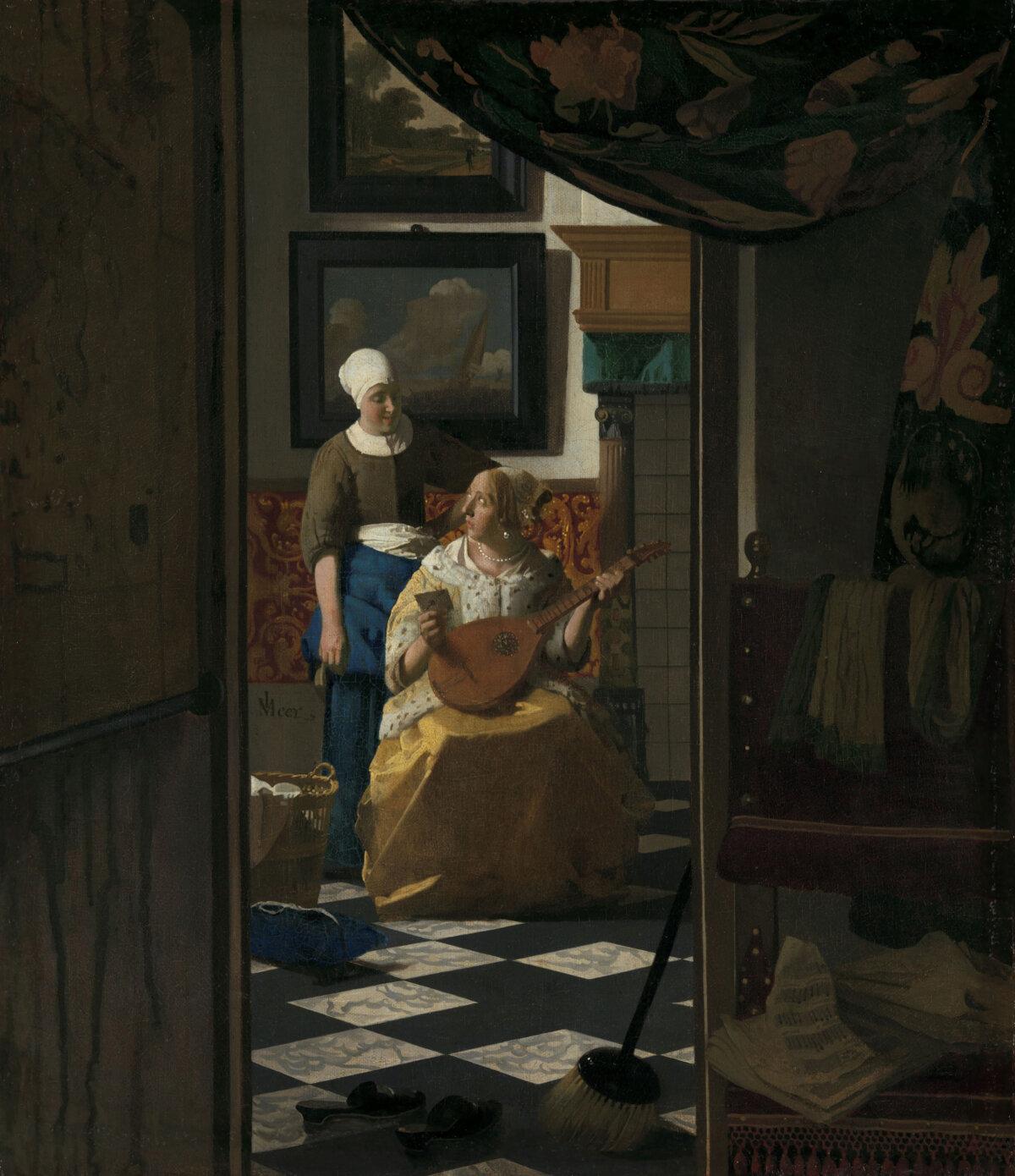
Vermeer rendered two paintings on the back wall, symbolizing the mood of the subjects.
According to the Rijksmuseum website, “in 17th-century poetry, a ship was compared to a lover and the sea to love.” The calm sea in the bottom painting indicates a good relationship, although the dark clouds hint of an incoming storm. In the top painting, Vermeer depicted a pastoral idyll.
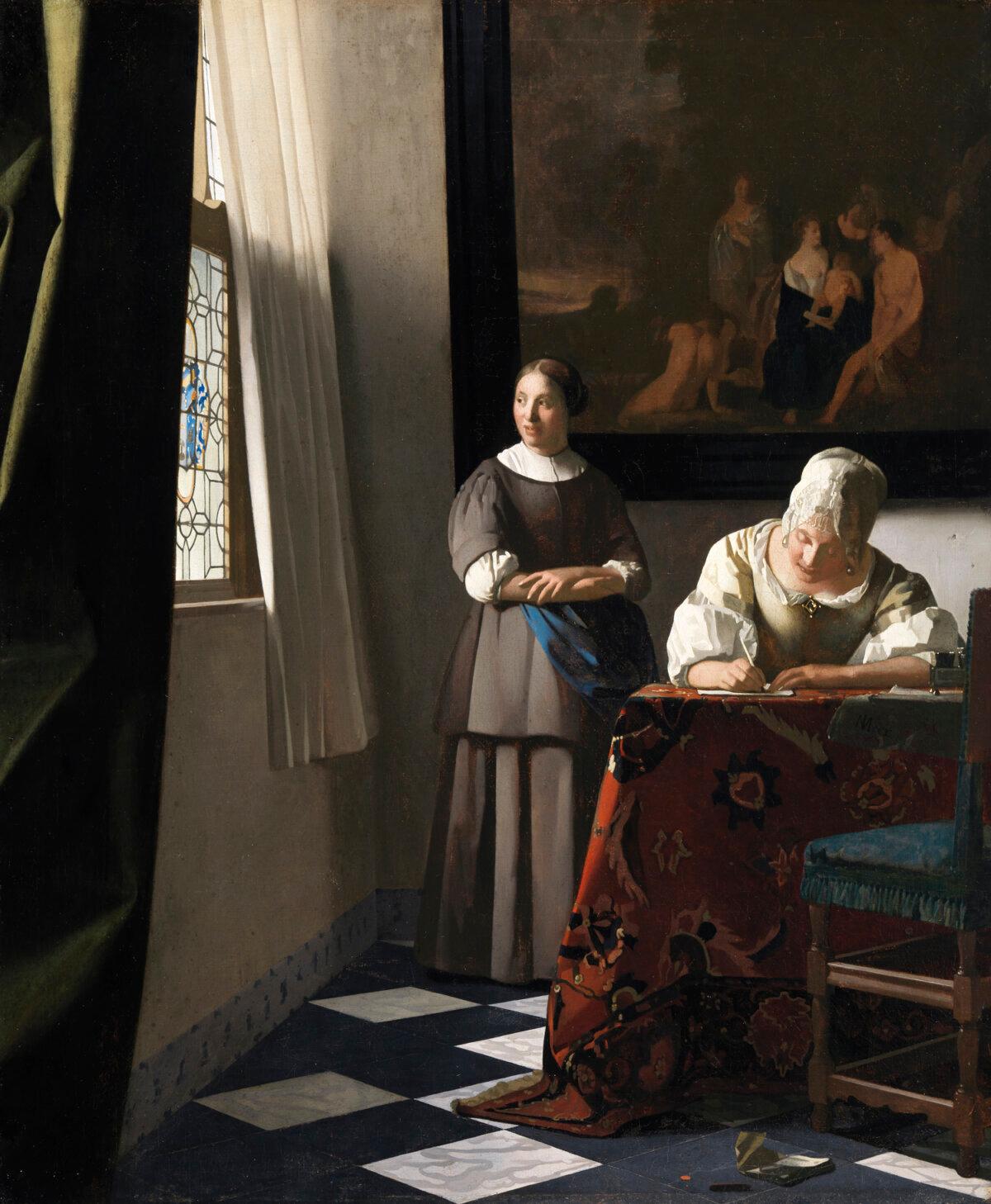
In “Lady Writing a Letter, With Her Maid,” Vermeer depicted a woman writing as her maid patiently waits. The mistress focuses on composing her letter, while her maid focuses on the window and the world outside. Every decorative detail allows the viewer to step into the scene like a detective. The empty seat indicates that the mistress waits for, or welcomes, romance. The blue and white Delft tiles, which skirt the bottom of the wall, may show Cupid, although the exact figures are hard to see; Vermeer included such a tile in “The Milkmaid.” The mistress has thrown a stick of sealing wax and a book, probably a letter-writing manual, on the floor. The large biblical painting in the background shows “The Finding of Moses,” a scene often used to illustrate divine intervention and predestined fate.
Enduring Love
Erasmus of Rotterdam (circa 1466–1536) wrote of letters: “As we write we seem to be carrying on a conversation with the dearest of friends in his very presence.” In the exhibition, Vermeer’s three love letter paintings visually convey such sentiments. He fluently used the language of art motifs and translated his astute understanding of the human psyche into paint.Vermeer made these quiet and reflective scenes palpable centuries later. The letters’ contents remain as private as his subjects’ thoughts, but their dreams of love endure.