When auctioneer and antiques expert Charles Hanson set off for work in the summer of 2018, little did he know that he’d stumble upon the find of a lifetime.
It was in his Hampton Court office in South West London that a well-heeled lady presented Hanson with a cardboard box containing two hardstone flower ornaments: a barberry twig and a convolvulus vine (morning glory). “Inside, wrapped in an old tea towel, was the holy grail of what an auctioneer can expect only in their wildest of dreams—not one, but two, Fabergé flowers,” Hanson said in a press release. “The enormity of such finds cannot be underestimated. Such works are the rarest of Fabergé’s craftsmanship and are very special.”
What made those Fabergé flowers especially rare is that they were unknown to scholars. Only around 80 Fabergé botanical studies survive today, and most are well documented.
The woman knew Fabergé had made the flowers, but she didn’t quite realize their rarity. She’d inherited them from her father, who, in the 1960s, had accepted a cottage and three Fabergé objects in lieu of work he’d completed on a Scottish estate. She’d kept the uninsured flower ornaments on display at home.
Crafting Botanical Gems
Marilyn Pfeifer Swezey’s book “Fabergé Flowers” explains the history of these botanical studies, including a comprehensive section about their creation.Fabergé first produced enamel flowers around 1890. Its hardstone flower creations came later, inspired by a bunch of hardstone chrysanthemums from the palace of the Chinese emperor that it was commissioned to repair. A Fabergé artisan repairing the chrysanthemums saw how the company could create similar hardstone flowers.
Fabergé artists studied live plant specimens and illustrations from botanical encyclopedias before designing the flowers. Peter Carl Gustavovich Fabergé, together with his team, decided which flower designs to reproduce. The senior artisan team oversaw every step of the process, with Fabergé and his designer approving even the raw materials, which were often sourced from the Ural Mountains, before they were sent to Finnish-born master goldsmith Henrik Wigstrom for further approval.
Wigstrom oversaw the creative process from start to finish. His small team of experts first worked out the technical process of turning the two-dimensional designs into objects. This not only included selecting the precious metals and stones to best reflect the fruits and flowers but also determining the techniques and the assembly process for each piece.
White flowers such as narcissi, white lilacs, and hyacinths were carved in white quartz, while colorful blooms such as sweet peas were fashioned from agate, quartz, and carnelian. Red flowers or berries such as bleeding hearts or raspberries were carved of rhodonite found in the Urals.
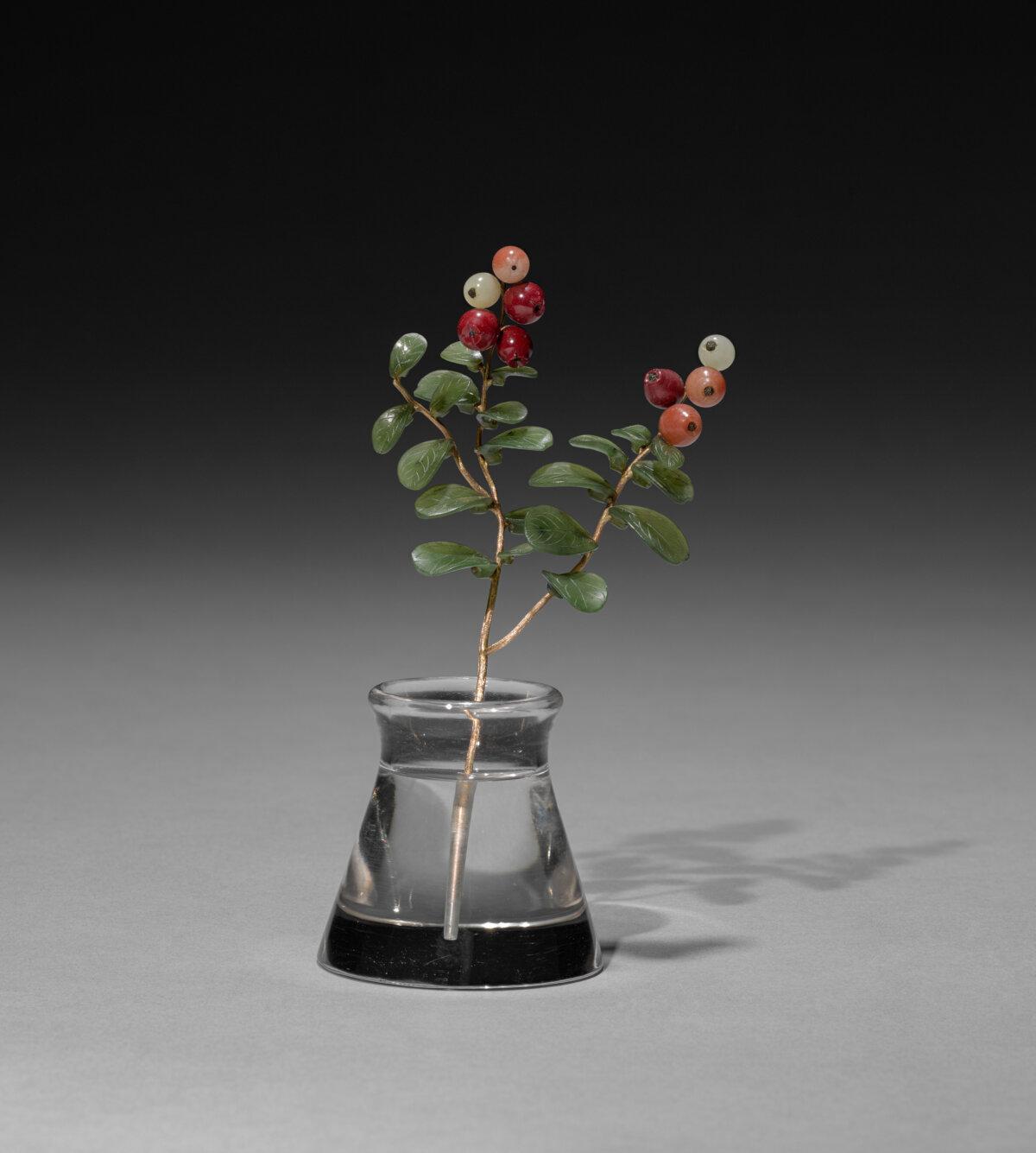
Artisans carved the leaves from Siberian nephrite (jade) and finely engraved each side to mimic leaf veins. According to the book “Fabergé Flowers”: “It was a great challenge for the craftsman to carve an extremely thin leaf from nephrite, sometimes with ridged edges, and often with natural veining and even twisted foliage curls.” Fabergé favored nephrite boulders near Lake Baikal in Siberia and the Sayan Highlands in the eastern reaches of the Altai Mountains bordering Mongolia.
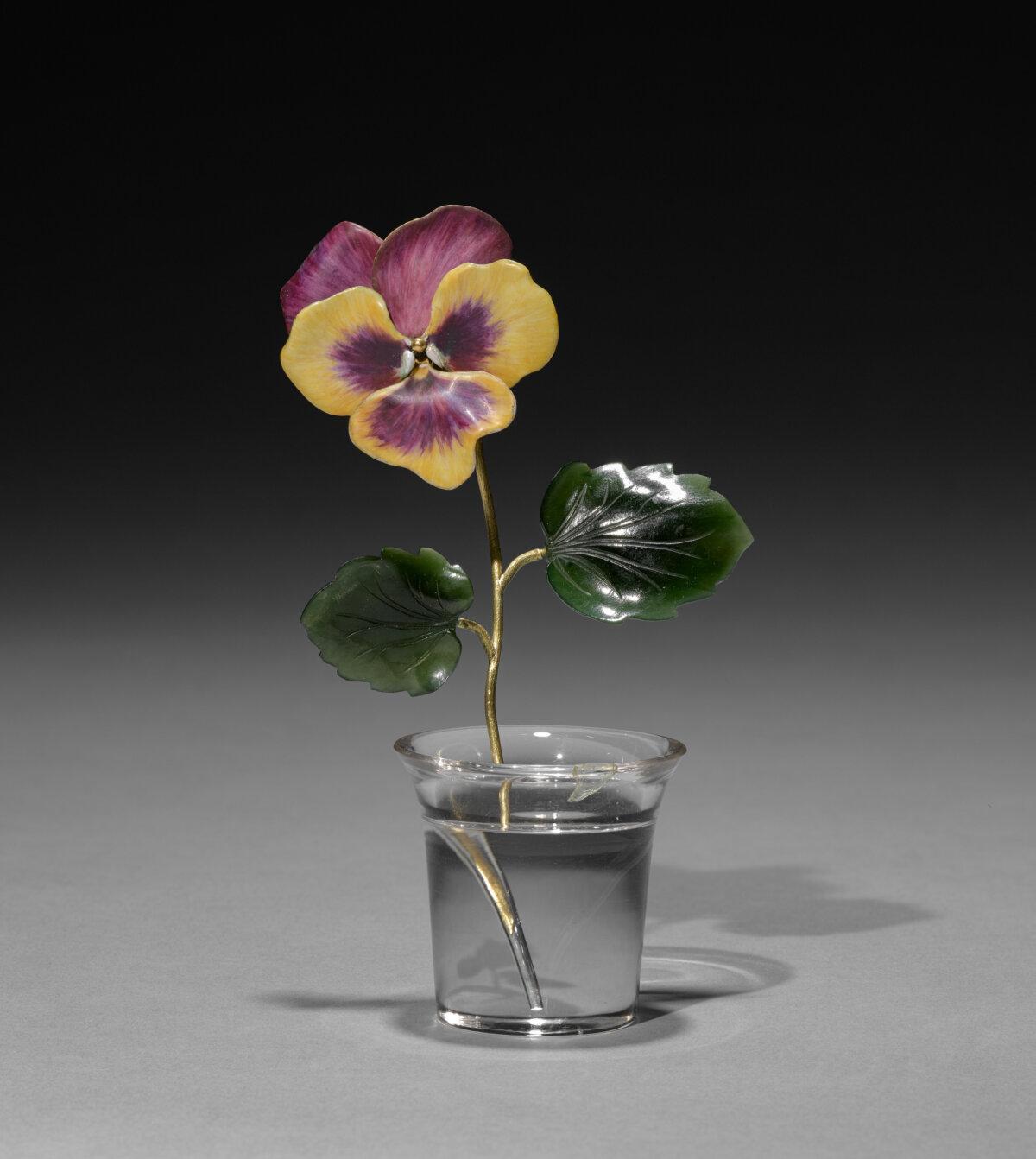
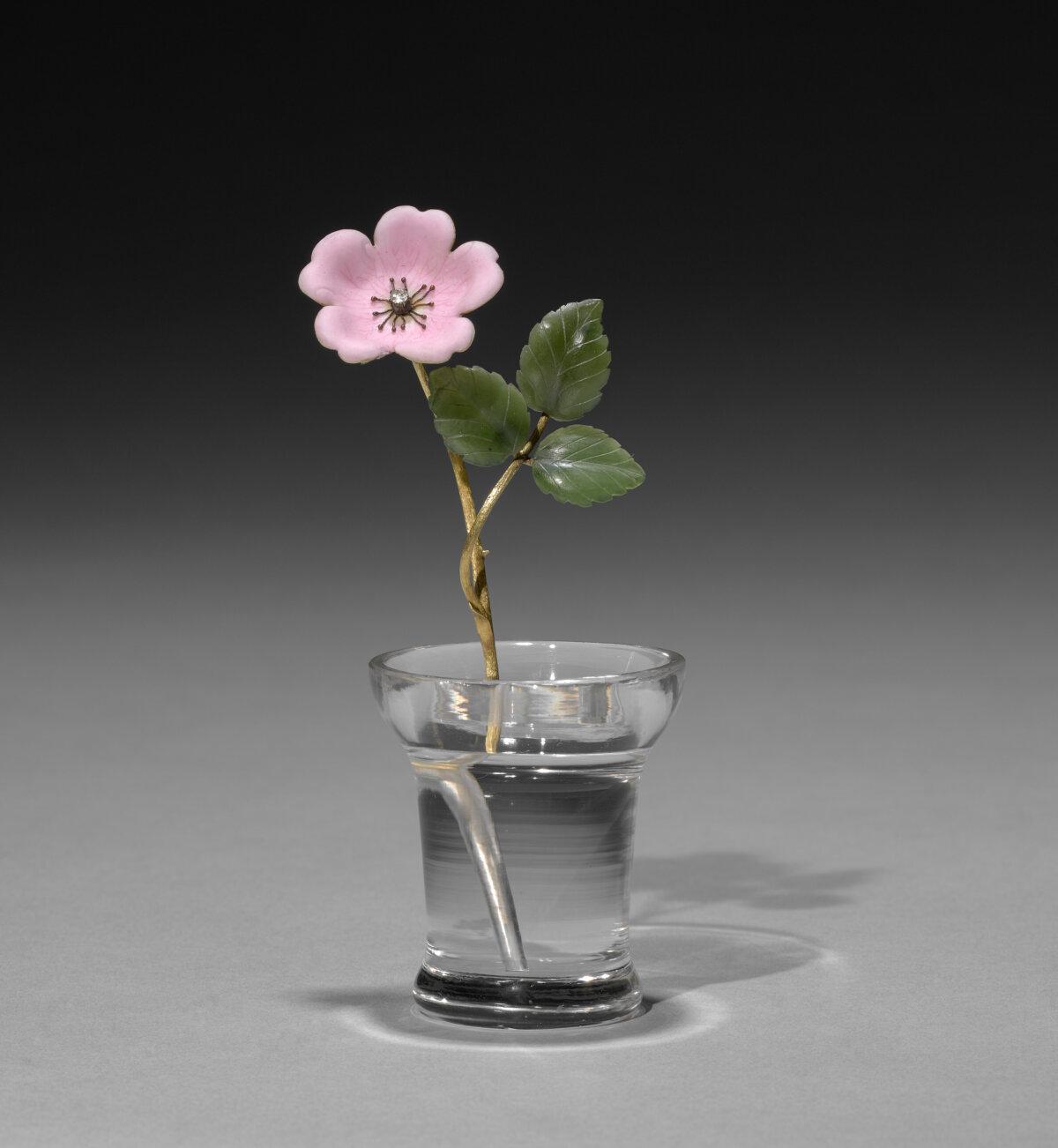
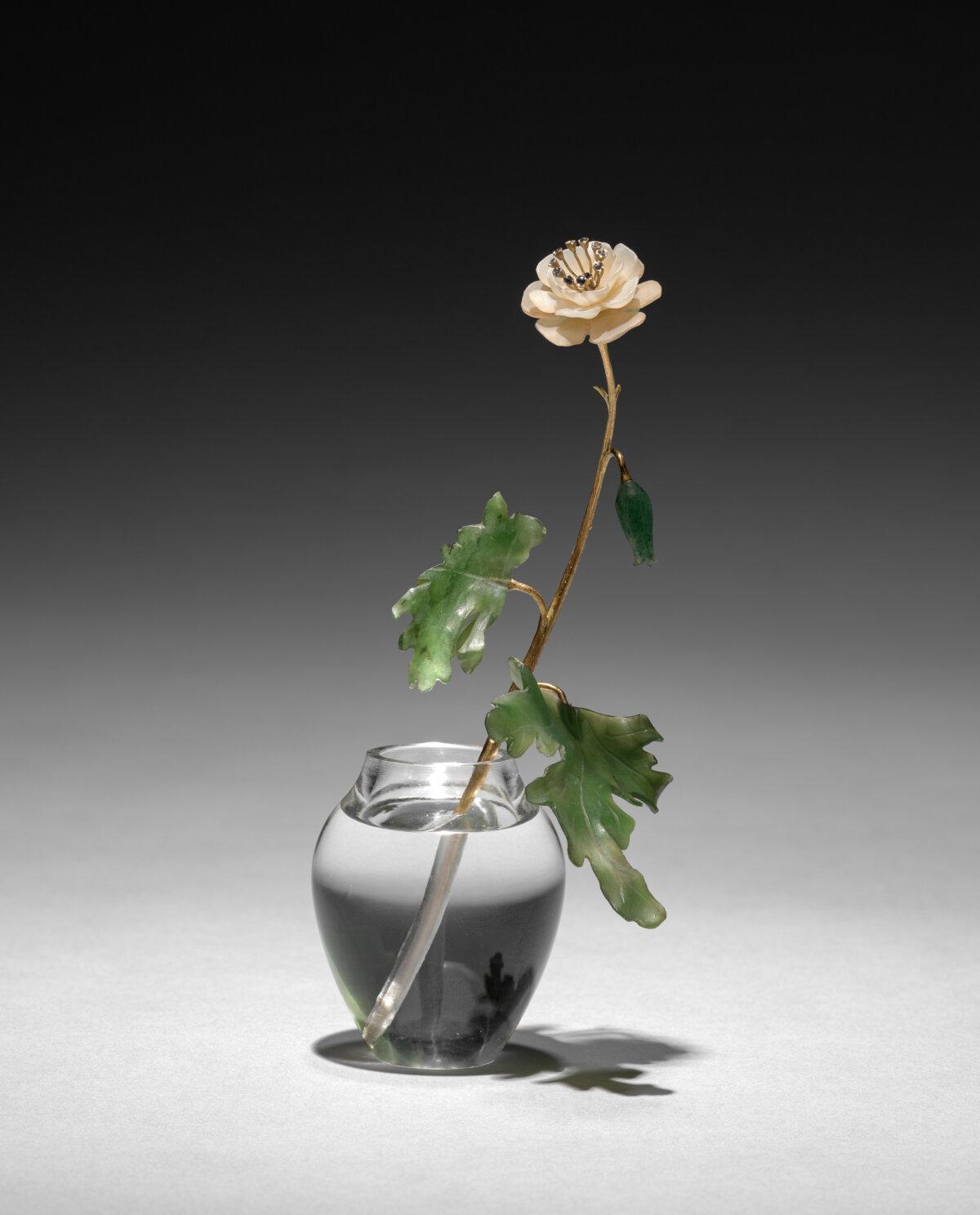
The artisans often arranged the flowers in rock crystal vases, cleverly carving the flawless rock crystal so it appeared like a vase full of water.
Wigstrom’s workshop created the metal pieces and assembled the flowers. They created different gold alloys for the various colored flower stems: Gold alloyed with copper made red-brown stems, and gold alloyed with silver made green stems. The goldsmiths embossed and engraved the metal to replicate the stem’s natural texture.
They soldered thorns or branches onto the stems, and secured the leaves on the stems either with gold pins or by inserting the leaves into special pockets in the stems and gluing them in place.
Flower heads made of many individual pieces were carefully sewn together with fine gold thread. If hardstone or precious metal couldn’t be found to color-match a flower, then a Fabergé enameler would replicate it.
Wigstrom’s team then set precious stones on the flower pistils or at the center of flowers. They’d often be tiny rose-cut diamonds or green demantoid garnets from the Middle Urals that had a high refractive index, even greater than diamonds, resulting in a dazzling dew-like effect.
A Fabergé Favorite
Fabergé used the lily of the valley motif the most. According to the University of Oxford Herbaria (the university’s botanical collections), lilies of the valley grew where the Virgin Mary’s tears fell to the ground at Christ’s crucifixion. Traditionally, the tiny blooms are set in bridal bouquets and button holes to symbolize the return of happiness.In Fabergé’s day, ladies loved its sweet fragrance, and wealthy Russians often imported blooms via train from the south of France.
Lily of the valley was also the favorite flower of one of Fabergé’s greatest patrons, Alexandra Feodorovna (wife of Czar Nicholas II, the last emperor of Russia). She loved Fabergé’s botanical studies, often gifting them to friends or surrounding herself with the ornaments in her winter palace.
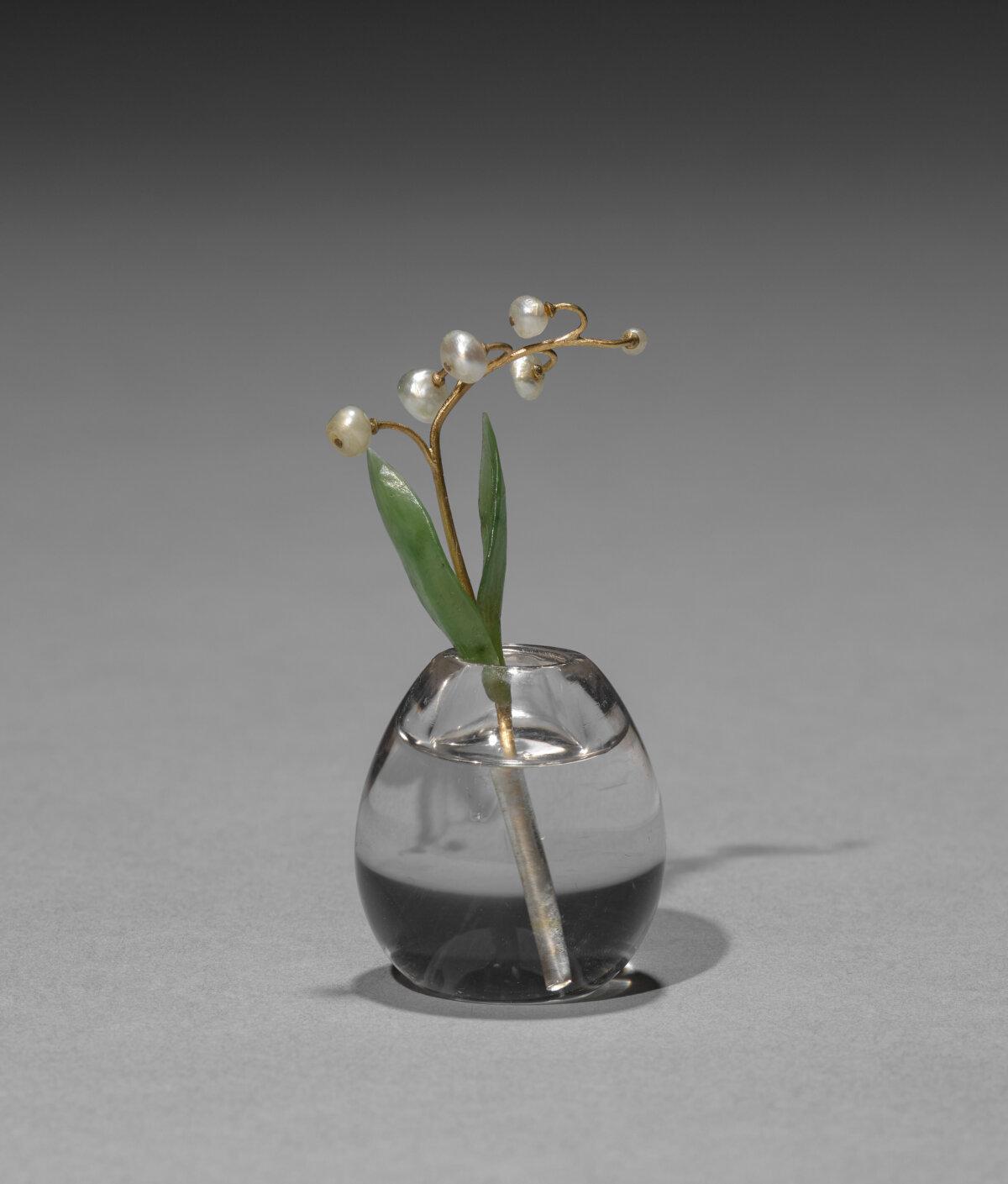
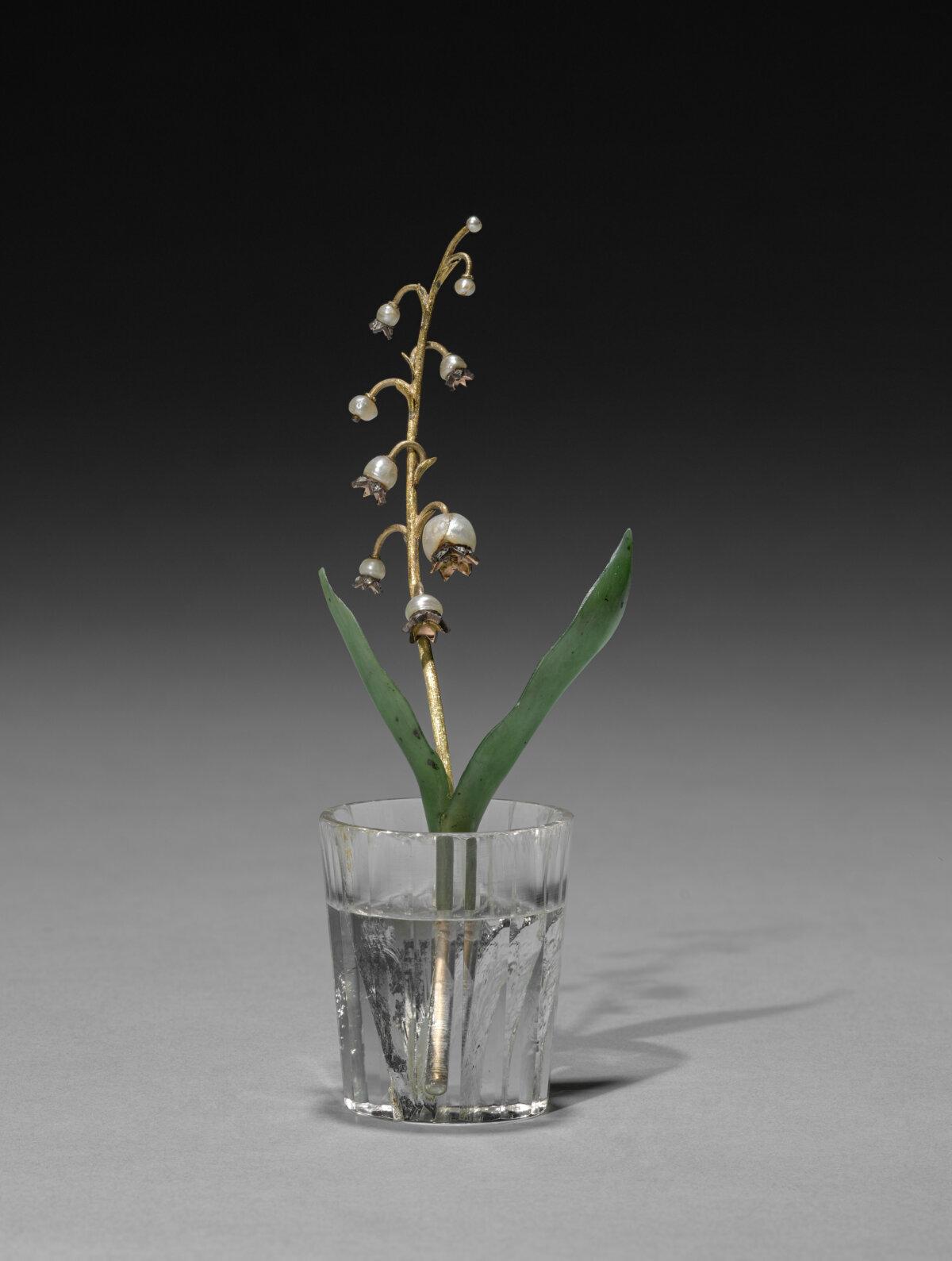
Two fine examples of Fabergé’s lily of the valley studies are displayed at the Cleveland Museum of Art. One shows a miniature lily of the valley with its pearl buds tightly closed and a smooth gold stem. The other study shows more detail. It has a textured gold stem, and its buds have opened: A crown-like piece of scalloped silver set with diamonds is attached to each pearl. This creates the lily of the valley’s distinctive bell-shaped blooms. These small flower motifs have been replicated throughout Fabergé’s collections.
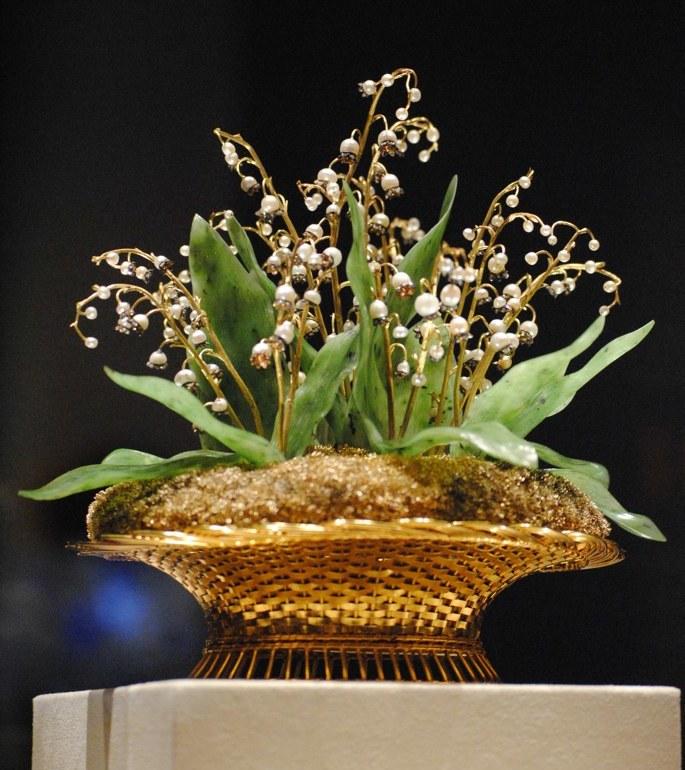
According to the Metropolitan Museum of Art in New York City, “the most important Fabergé piece in the United States” is the Imperial Lilies of the Valley Basket at the museum, on loan from the Matilda Geddings Gray Foundation. In his 1919 memoirs, Birbaum described the basket of 19 lily of the valley stems: “Woven in gold twigs and filled with moss in varicolored gold, the leaves were made of nephrite and the flowers of whole pearls scalloped in rose-cut diamonds.” In 1896, craftsmen presented the basket to Czarina Alexandra when she visited the All-Russia Industrial Conference and Art Exhibition in Nizhny, Novgorod.
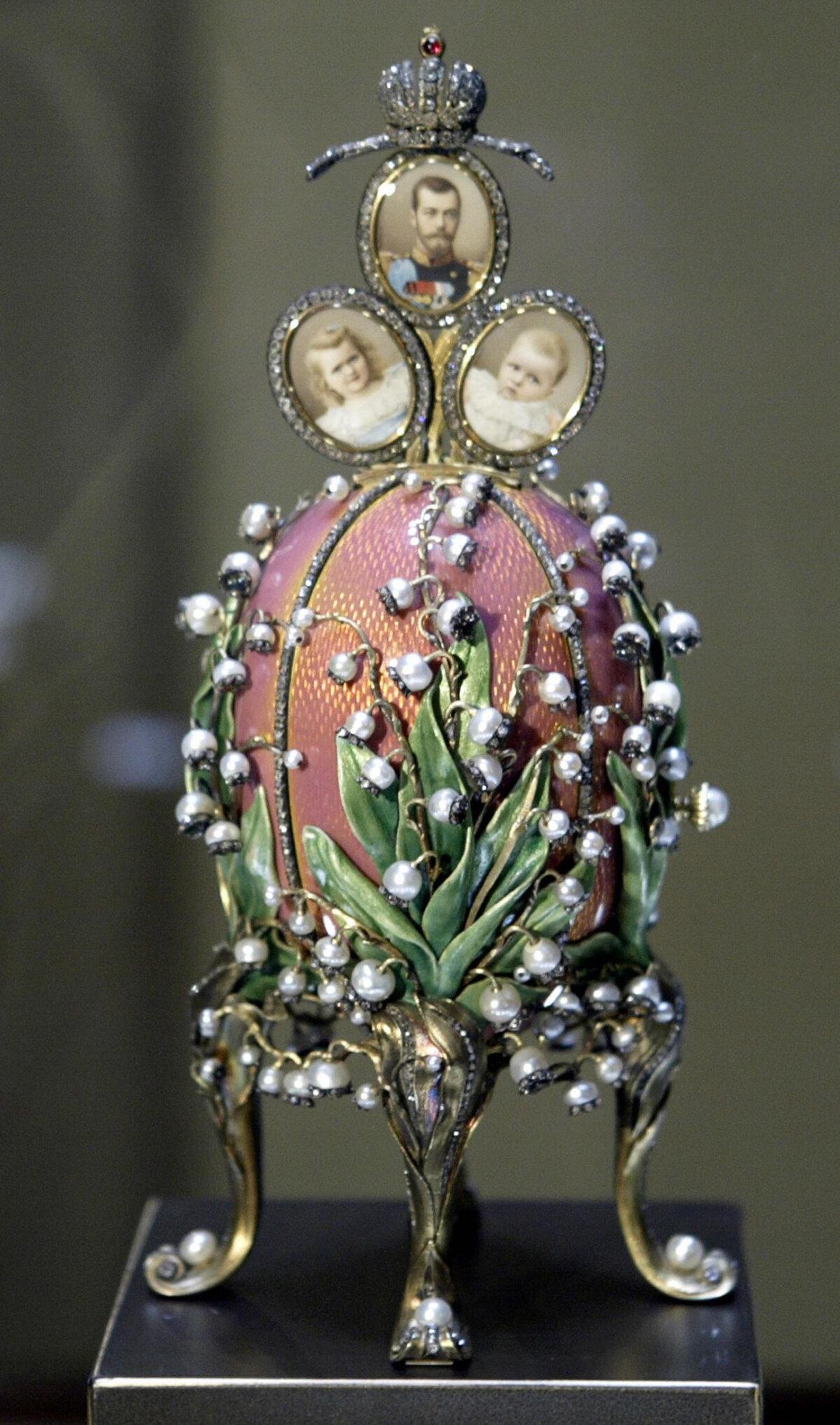
In 1898, Nicholas II presented his wife with the Lilies of the Valley Egg. It reflects the nature-inspired Art Nouveau (New Art) style that favored curved lines, flowing forms, and delicate tendrils. Carved nephrite leaves creep up the curvature of the egg, and gold flower stems support a cluster of tiny lily blooms made of pearls. As with all Fabergé eggs, it conceals a surprise: A trio of oval photo frames pop up from inside the egg. A photograph of Nicholas II peers out from the largest frame, and his daughters, the grand duchesses Olga and Tatiana, fill the two smaller frames below.
Each Fabergé botanical study is the epitome of fine craftsmanship, exemplifying luxury and Russia’s abundant wealth of natural minerals. Fabergé created exquisite fruit and flower studies that look as though they’ve just been plucked from the garden and arranged in a vase—only a sparkle of diamonds or garnets calls them out as imitating nature.