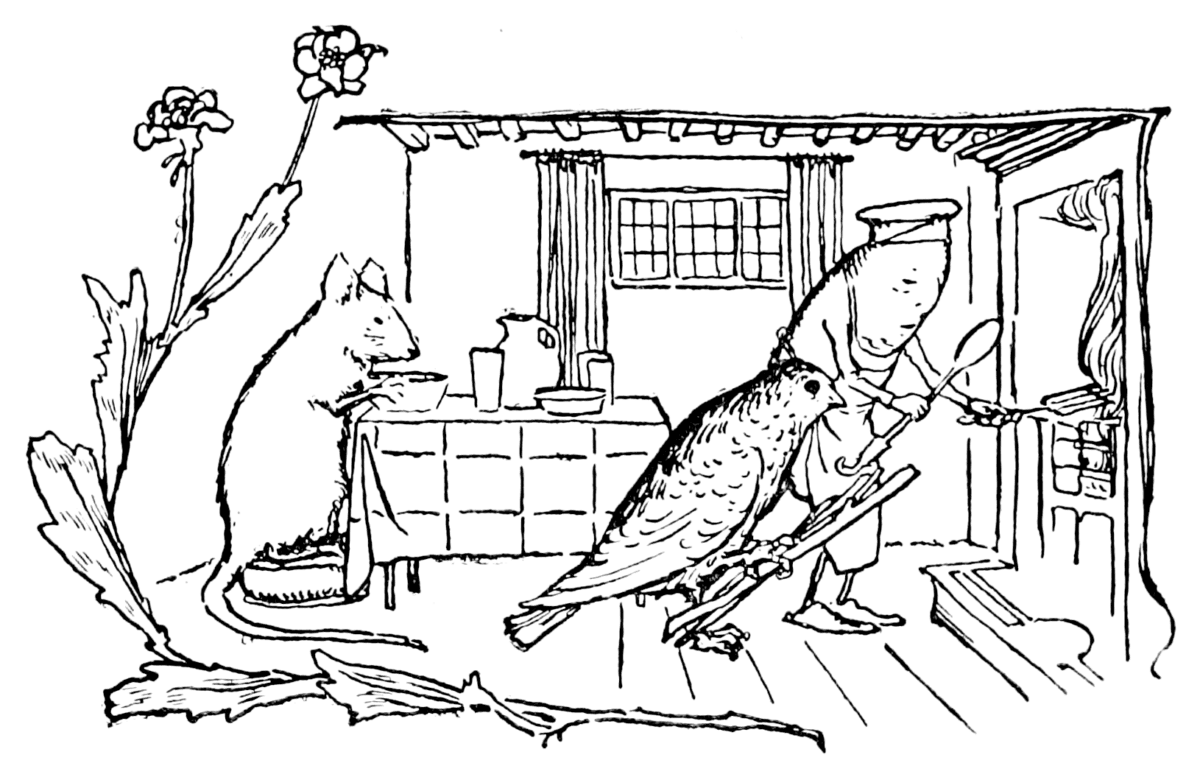
A mouse, a bird, and a sausage decide to live together and delve out different house duties, according to their individual talents and abilities. The bird fetches wood from the forest, the mouse brings water, and the sausage cooks. This arrangement, though odd, works out well for the benefit of all.
However, one day, everything changes when the bird meets another bird while gathering wood. The bird tells his fellow bird of the wonderful partnership that he shares with the mouse and the sausage. But the bird ridicules him “for being a poor simpleton, who [does] all the hard work, while the other two [stay] at home and [have] a good time of it.”
A Bird in Your Ear
The bird points out that the mouse and sausage have the easy lot. After making the fire and getting water from the well, the mouse relaxes the rest of the day, while the sausage only busies itself with the dinner. The bird, on the other hand, must journey into the woods and carry back firewood for the other two.Hearing his fellow bird’s words, the bird cannot help but be influenced and grows envious of his friends’ simpler tasks. He flies home and decides that he will no longer gather wood.
The next day, he announces to the sausage and mouse that he will not get wood for them. He refuses to be their slave anymore. He proclaims himself a fool for having allowed them to prey upon him in such a way and for so long. He declares that they must all switch roles, for they need a change.

The mouse and sausage try to reason and plead with the bird, but to no avail. The bird is determined that he will have as easy a life as his friends do.
In order to decide which task they will each take, they draw lots. Now, the sausage will fetch wood, the mouse will cook the food, and the bird will get water from the well.
With their lots drawn and duties assigned, they each set out to accomplish their jobs. The bird and mouse quickly complete their tasks, drawing water and cooking dinner. Yet the sausage takes a long time in completing its task. As time passes, the bird and mouse grow uneasy at their friend’s prolonged absence.
The bird flies out to find their missing friend. However, he quickly wonders whether switching tasks among themselves was a good idea.
Through this tale, children can see the dangers of envy, especially envy of another’s gifts and talents. When the bird begins envying his friends’ tasks, he not only creates discord in their friendship, but also places them all in danger by giving them tasks that they aren’t fit for.
This tale seeks to instill in children a spirit of gratitude, which allows them to see others’ wonderfully unique natures, as well as their own wonderful natures. Unlike envy, gratitude sees how diverse, individual natures, characteristics, and talents create a beautifully complex and balanced tapestry of humanity.