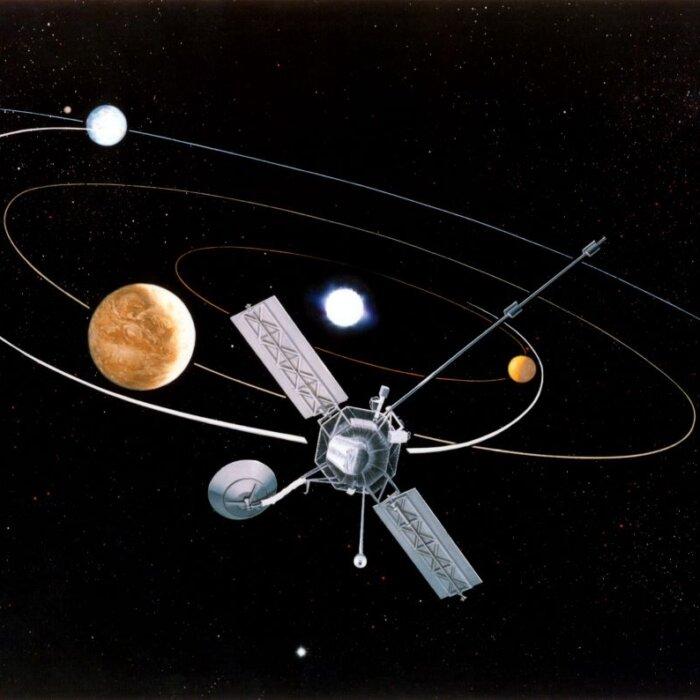
In November 2018, the space probe Voyager 2 broke beyond the boundary of the solar system, officially crossing into interstellar space. The legendary spacecraft had managed to slingshot along a “planetary parade” of giants—harnessing the gravity of Jupiter, Saturn, Uranus, and Neptune to gain immense velocity and escape the sun’s grip.
This “gravitational assist” from a planetary alignment bypassed the need for massive propulsion systems while saving NASA hundreds of millions of dollars in fuel costs.
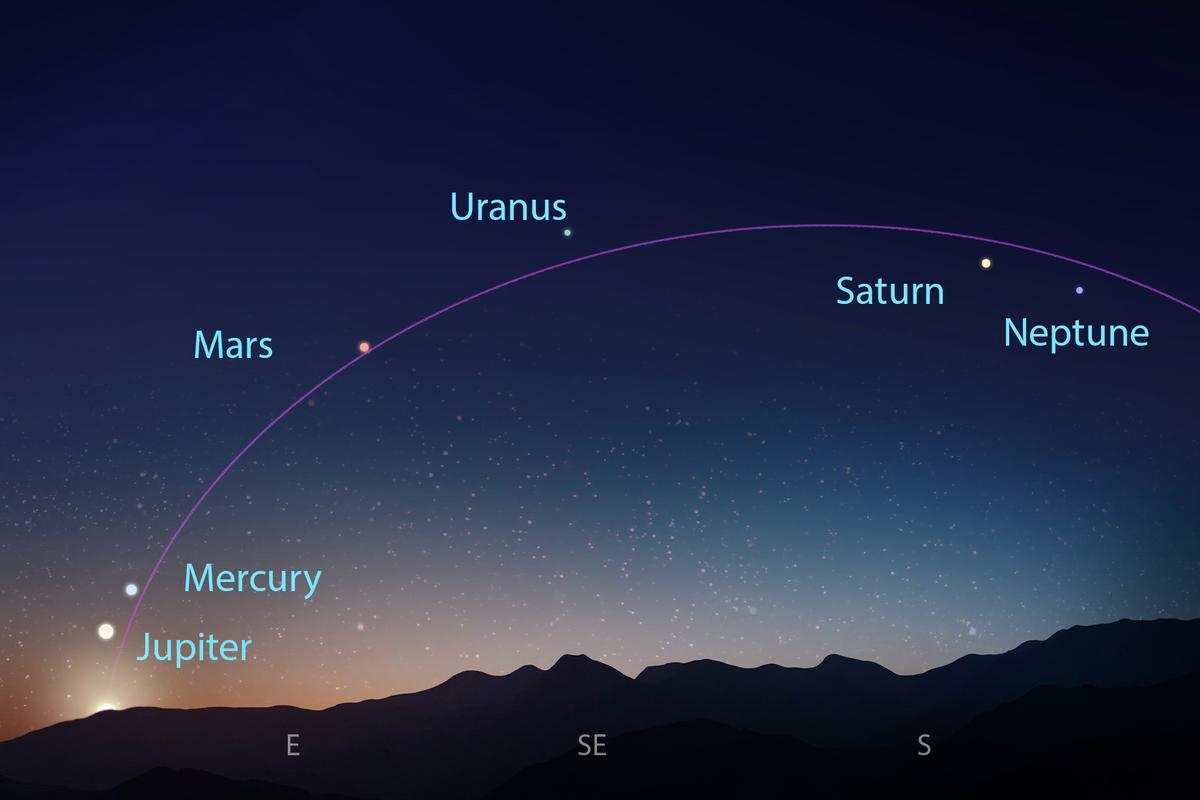
Planetary alignments are still instrumental tools for deep-space navigation, but they also offer stargazers an entirely different thrill. On Aug. 12, a six-planet “parade” will carve a diagonal path across the dawn sky, showcasing the beauty of celestial geometry. For a brief window, six planets—Jupiter, Mercury, Mars, Uranus, Saturn, and Neptune—will line up on the ecliptic, that invisible arc the sun traces across our sky.
The word alignment is deceptive. It implies the planets will form a perfectly straight line, an astronomical improbability in three-dimensional outer space. Instead, astronomers coined the term loosely: simply as a moment when three or more planets group together on one side of the sun, or when they group within a small sky sector as viewed from Earth.
Historically, it wasn’t the mathematical straightness of the planets that impressed human beings, but the realization that these wandering worlds were connected by a distinct cosmic path—like a loose thread tying together the beads of a necklace. Scientists discovered that the orbital planes of the planets are mostly flat relative to the ecliptic but never precisely so, meaning they zig-zag slightly across its path.
The point is this: the planets will frequently bunch together or spread out like racehorses along a grand circuit—which is exactly why people coined the term planet parade.
In New York, the window will be 5:18 to 5:34 a.m., while in Los Angeles it will be 5:28 to 5:46 a.m. (local time in both locations).
Londoners should look for all six planets between 4:54 to 5:03 a.m., while Parisians should search from 5:52 to 6:03 a.m.
Observers in New Delhi will need to watch between 5:04 to 5:24 a.m., and for those in Tokyo 4:15 to 4:31 a.m.
The window represents the time from when Mercury reaches 5 degrees above the horizon to civil twilight, when the faint planet will fade.
However, astronomers are offering a reality check: Mars and Saturn may be the only highlights visible to the naked eye. Still, those two alone make the early wake-up worth it. Simply searching for this duo will expand the window to two to three hours before sunrise. You’ll find the warm, reddish glow of Mars toward the east, moving from Taurus into Gemini. Saturn will appear higher toward the southwest in Pisces; its iconic rings won’t be hard to spot with a small backyard telescope.
Jupiter will also shine brightly, hanging out in Cancer, below Mercury. But the gas giant will hug the horizon just before sunrise. Don’t be surprised if it’s hidden from your location, as trees or buildings could easily block the view, while dawn will quickly obliterate all hopes of spotting it. Never point binoculars near the sun, as that could damage your eyes.
Aspiring astronomers will have fun searching with binoculars for the faint planet Uranus, located in Taurus between Mars and Saturn. The telescope challenge for the night will be Neptune, a faint blue point invisible to the naked eye, positioned in Pisces, right of Saturn.
So grab your binoculars if you have them. It’s wise to watch from open fields, coastlines, hilltops, rooftops, or balconies with a clear view of the east, and be sure to give your eyes a few minutes to adjust to the dark.
The Aug. 12 date isn’t firm; the planets will look basically the same the day before and after. But in either case, the window for viewing all six planets together is tight—the unforgiving curtain call of dawn looms. Those who can catch this fleeting event will glimpse the very same cosmic geometry that hurled Voyager 2 into the silence of interstellar space.