This copy is for your personal, non-commercial use only. Distribution and use of this material are governed by our Subscriber Agreement and by copyright law. For non-personal use or to order multiple copies, please contact The Epoch Times Reprints.
The Krämerbrücke (the Merchant’s Bridge) crosses the Breitstrom, a branch of the Gera River, in Erfurt, Germany. The 136-yard-2-foot-long medieval arch bridge consists of at least six barrel arches between 18 feet wide and 26 feet wide. A church once stood at each end of the bridge and people once entered the bridge via a gateway under each church. But now, only the Church of St. Giles survives. Thirty-two three-story houses, up to about 49 feet tall, overhang the bridge and are braced by a series of wooden trusses. Sina Ettma Photography/Shutterstock
Only four bridges lined with buildings on both sides exist—and they are all in Europe: the Rialto Bridge in Venice, Italy; the Ponte Vecchio (Old Bridge) in Florence, Italy; the Pulteney Bridge in Bath, England; and the Krämerbrücke (the Merchant’s Bridge) in Erfurt, Germany.
The Krämerbrücke
Pilgrims today cross the Krämerbrücke (the Merchant’s Bridge) when walking one route of the Camino de Santiago. The bridge was once part of an important Medieval trade route, called the Via Regia, which connected Rome with the Baltic Sea, and Moscow with the Cathedral of Santiago de Compostela in northwestern Spain.
A wooden bridge was first built on the site between the eighth and 11th centuries, and records show that market stalls have existed on the bridge since 1156. In 1325, the Krämerbrücke was rebuilt in limestone and sandstone as a medieval arch bridge. Between 1472 and 1486, 62 three-story half-timbered houses were built on the bridge. Over time, the houses merged to create 32 larger buildings, with shops occupying the ground floor level and living quarters in the upper levels.
People walk across the colorful Krämerbrücke (the Merchant’s Bridge) in Erfurt, Germany. Cafes, art galleries, and boutiques selling artisan crafts line the 18-foot-wide cobbled street. (Rigorius/CC BY-SA 4.0)
The Ponte Vecchio
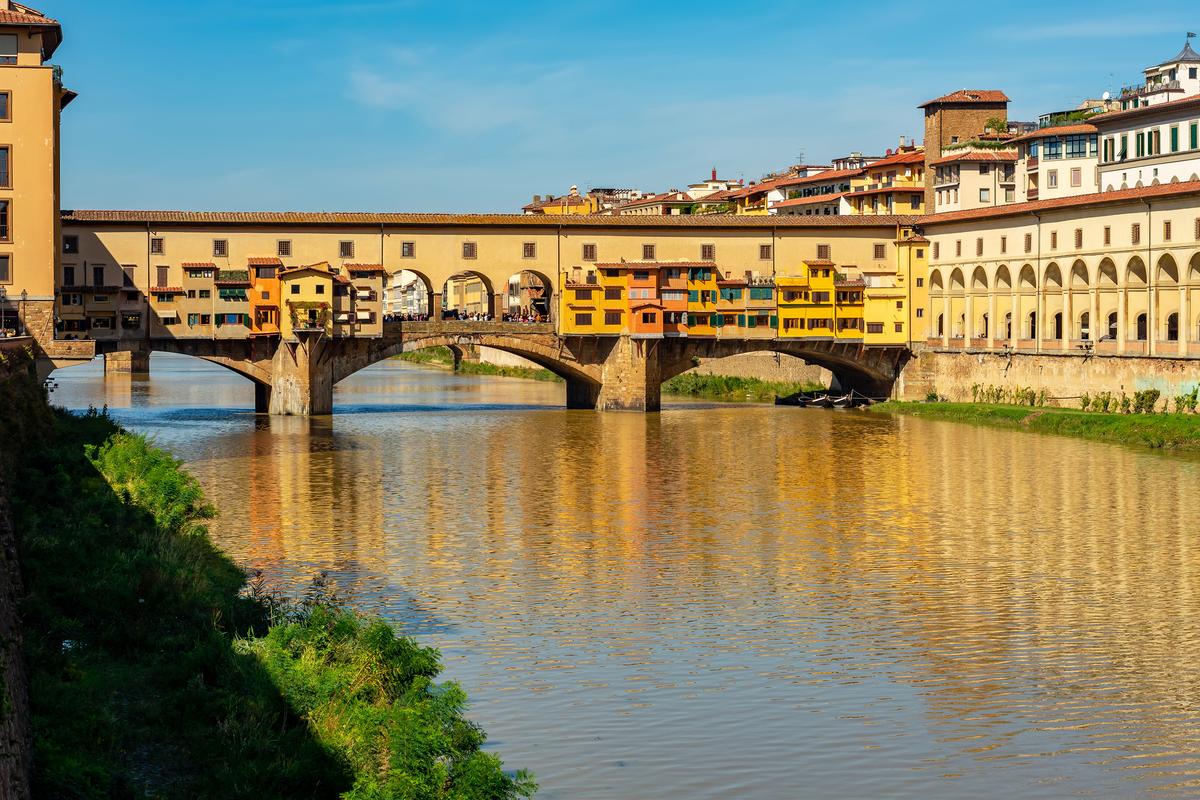
When architect Taddeo Gaddi completed Florence’s Ponte Vecchio in 1345, it was the first segmental arch bridge in the West. Its wide arches allow a freer flow of water and river traffic than the typical Roman semi-circular bridge with more piers.
A two-story gallery lines each side of the bridge roadway. The bridge’s upper gallery links the Palazzo Vecchio via the Uffizi Galleries to the Palazzo Pitti on the other side of the river. The lower gallery houses shops that were initially occupied by trades such as butchers until 1565, when Ferdinando I de' Medici decreed that the shops should be occupied by jewelers and goldsmiths. Now, it is full of jewelers, art dealers, and souvenir shops. A large piazza at the center of the bridge showcases a fountain-monument of Renaissance sculptor and goldsmith Benvenuto Cellini.
The Ponte Vecchio (Old Bridge) crosses the Arno River in Florence, Italy. It consists of three segmental arches with closed spandrels, which are the two triangles that create the top of each arch. The largest, middle arch spans about 98 feet wide, and the side arches span about 89 feet wide. The Vasari Corridor (R) runs from the Palazzo Vecchio (the Town Hall) via the Uffizi Gallery, across the Ponte Vecchio to the Palazzo Pitti. Mistervlad/Shutterstock
A panoramic photograph shows the Ponte Vecchio’s gallery of shops, with iron and wooden folding shutters, that line each side of the bridge in Florence, Italy. Medieval goldsmiths designed the shutters to best show their wares. Shopkeepers still use the shutters today. The Vasari Corridor (L) links the bridge to the Palazzo Vecchio (Town Hall) and the Palazzo Pitti. Giorgio Galeotti/CC BY 4.0
The Rialto Bridge
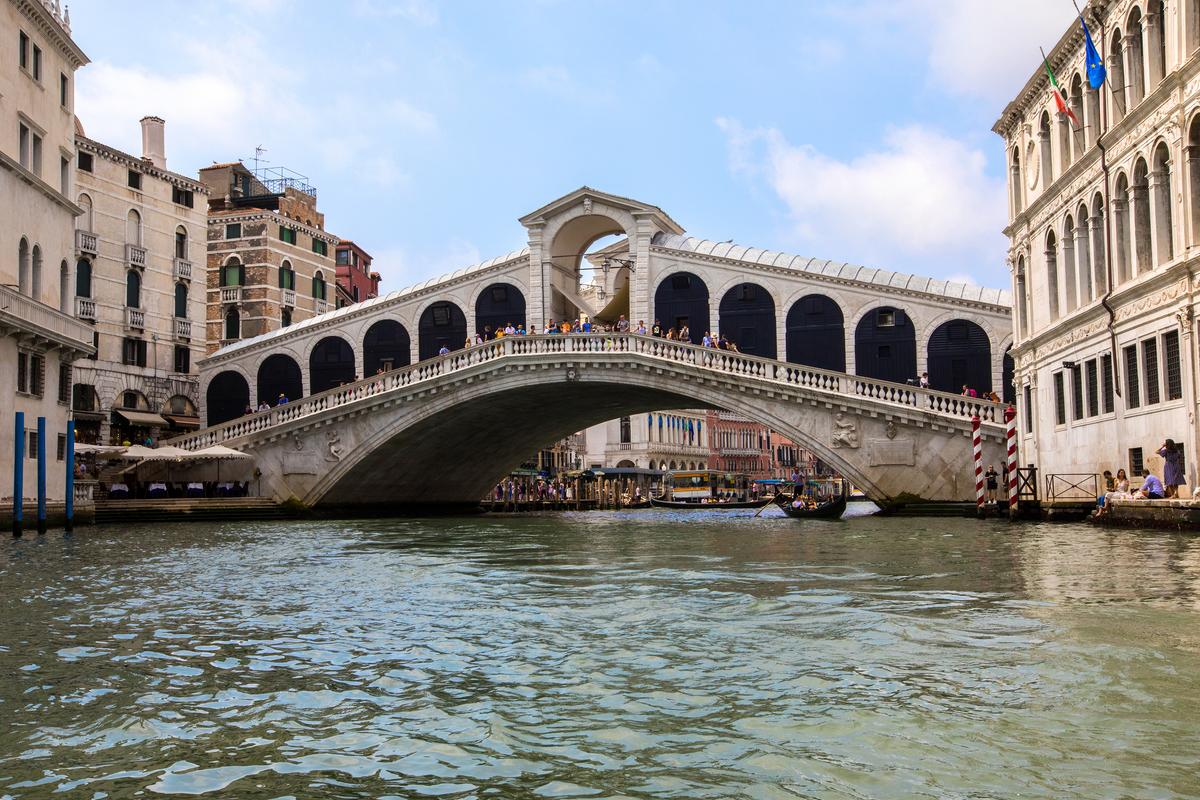
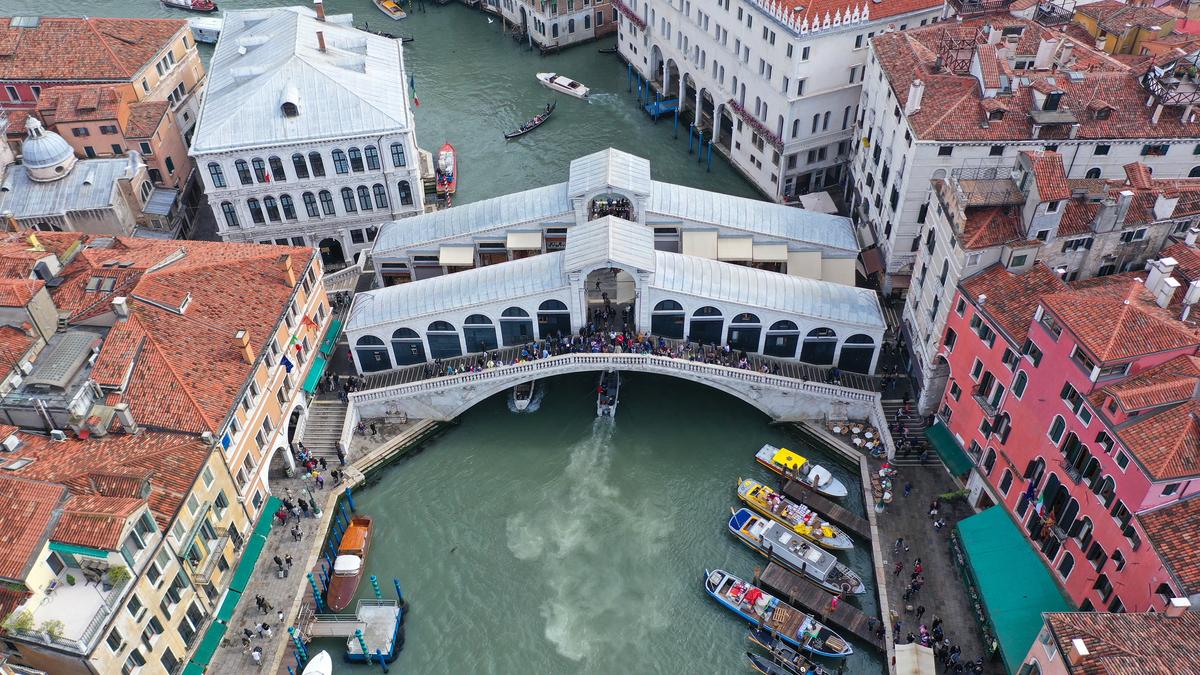
Venice’s Rialto Bridge spans the Grand Canal in the Rialto, the city’s financial center. In 1173, the crossing existed as a pontoon (floating) bridge, and it was the only way to cross the canal by foot. Since the first half of the 15th century, shops have lined both sides of the bridge. Between 1588 and 1591, architects Antonio da Ponte and Antonio Contino (da Ponte’s nephew) built the present 21-foot-tall stone arch pedestrian bridge with its arcade of shops. It remained the only permanent bridge in Venice until the 1850s.
The Rialto Bridge crosses the Grand Canal in Venice, Italy. Six thousand piles of timber support the marble and Istrian stone arch bridge that’s created by wedge-shaped, tapered stones called “voussoirs.” These were laid perpendicular to the arch thrust. Each side of the arcaded footbridge is 66 feet wide and 83 feet long and leads up to a rectangular deck. chrisdorney/Shutterstock
An aerial shot of Venice’s Rialto Bridge shows the arcaded gallery of shops that line both sides of the footbridge. Aerial-motion/Shutterstock
The Pulteney Bridge
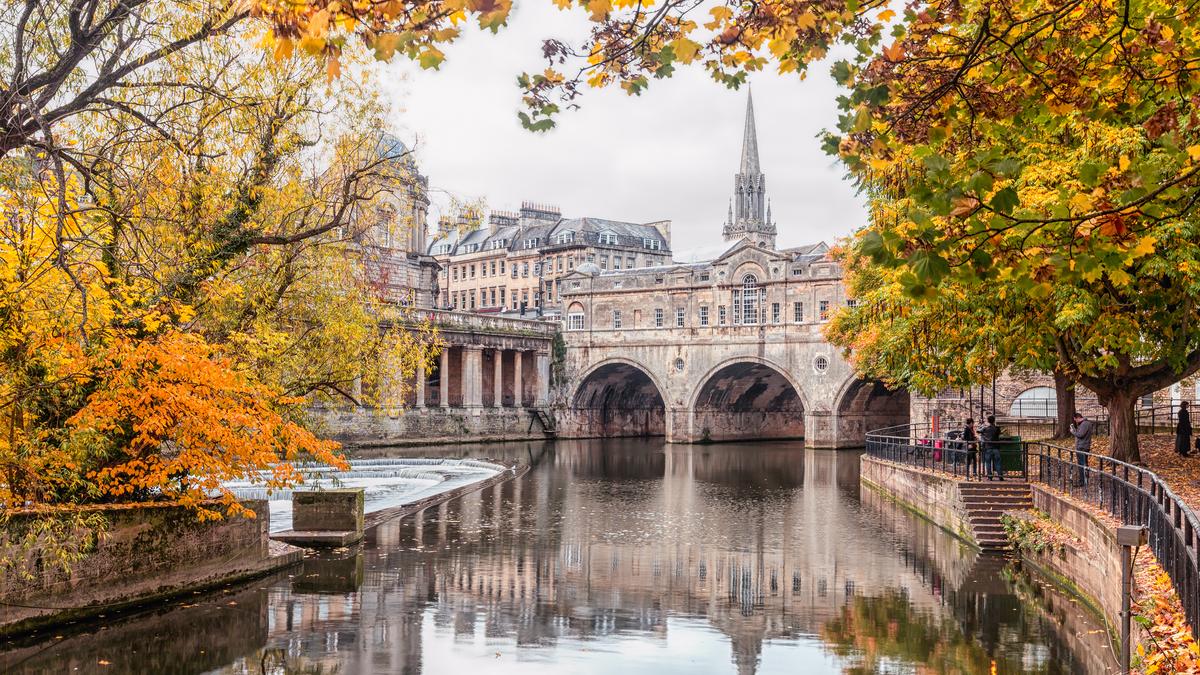
Lawyer and Scottish member of Parliament William Johnstone Pulteney commissioned renowned architect Robert Adam to design the Pulteney Bridge in Bath, England. Beginning in 1769 and completed in 1774, the segmental arch bridge is named after Pulteney’s wife. A rejected design by Renaissance architect Andrea Palladio for Venice’s Rialto Bridge influenced Adam’s design of the Pulteney Bridge. It is a brilliant example of Palladian architecture that harkens back to antiquity. Shops line both sides of the bridge road and traffic still flows across it today.
The 148-foot-long Pulteney Bridge crosses the Avon River in Bath, England. Architect Robert Adam’s Palladian design consists of three equidistant, segmental arches made of Bath stone, a local honey-colored limestone. Denny Friday Studio/Shutterstock
In the center of the Palladian-style Pulteney Bridge, architect Robert Adam added a Venetian window: an arched window flanked by columns and rectangular windows. The façade also includes leaded domes, pediments (triangular gables), and pilasters (flattened columns). Benjamin Smith/CC BY-SA 4.0
What arts and culture topics would you like us to cover? Please email ideas or feedback to [email protected].
Lorraine Ferrier writes about fine arts and craftsmanship for The Epoch Times. She focuses on artists and artisans, primarily in North America and Europe, who imbue their works with beauty and traditional values. She's especially interested in giving a voice to the rare and lesser-known arts and crafts, in the hope that we can preserve our traditional art heritage. She lives and writes in a London suburb, in England.