Love came down at Christmas, Love all lovely, Love divine; Love was born at Christmas; Star and angels gave the sign.
Rossetti’s poem reveres the essence of Christmas: the birth of Christ, who Christians believe is the Son of God, and who descended from heaven for humankind’s salvation. Nativity scenes and paintings traditionally mark the auspicious occasion.Many religious paintings now in art galleries and museums were once an important part of church architecture. Everything the artists depicted was meant to deepen the faith of churchgoers. Each biblical theme guided Christians to their salvation.
“Pictures and ornaments in churches are the lessons and the scriptures of the laity,” wrote French prelate William Durand in the “Rationale Divinorum Officiorum.” The treatise, written around 1286, was about liturgy and its sacred symbolism. Durand added: “It is one thing to adore a picture, and another by means of a picture to learn what should be adored.”
Christians instantly recognize the biblical scenes depicted and often the centuries-old traditional signs and symbols that were added throughout these sacred works. But many museum and gallery visitors today probably miss these cues.
Anyone admiring these paintings outside of their original religious context may be fascinated to discover that the age-old signs and symbols are hidden in plain sight.
In his comprehensive book “Signs & Symbols in Christian Art,” author George Ferguson wrote:
“A symbol resembles. It has acquired a deeper meaning than the sign, because it is more completely identified with what it represents, and its character is derived from what is known by it. ... It is in Christian symbolism that the universality of this unspoken language reaches its fullness.”
The Annunciation
Young Leonardo da Vinci (1452–1519) painted the moment when the Angel Gabriel descended from heaven and announced to the Virgin Mary that she had been chosen to bear the Son of God.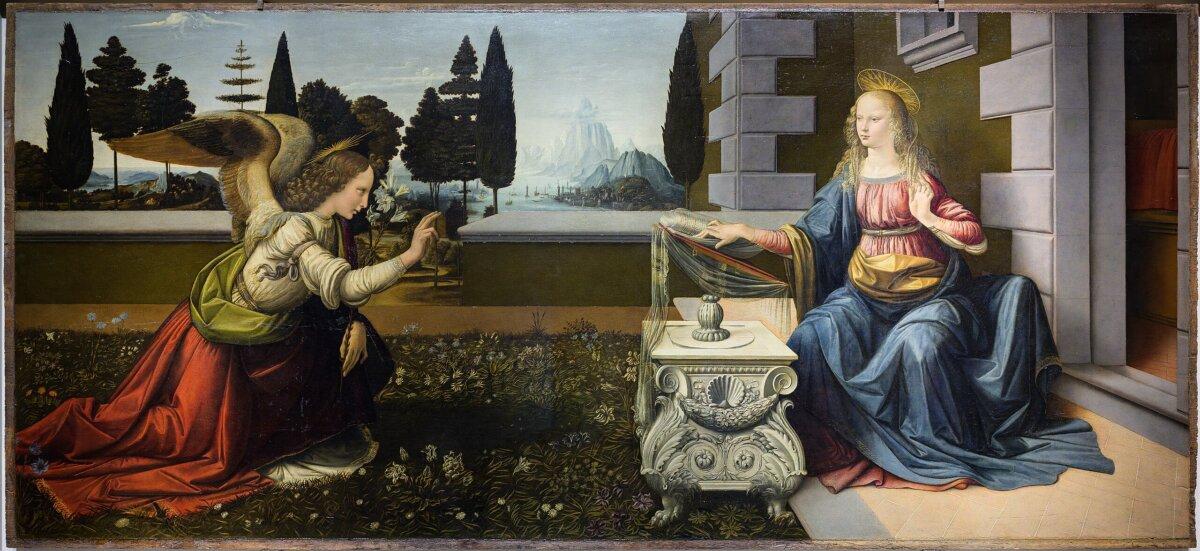
Mary’s fair complexion and long, curly, shoulder-length hair typify the Renaissance ideal of beauty. Both figures wear their hair loose—a medieval hairstyle that unmarried women wore as a sign of their purity and innocence.
Both figures emanate divine light. A halo encircles Mary’s head, and golden rays emit from Gabriel’s crown. The pair seem to be conversing through their hand gestures in a language familiar only to heavenly beings.
On a bed of flowers, Gabriel kneels before her in a walled garden or “hortus conclusus,” which is symbolic of Mary’s virginity. He interrupts her reading, but she remains poised and keeps her place in the open book.
Gabriel’s white robe represents his purity and innocence. The green fabric symbolizes hope, renewal, and spiritual rebirth, and his red mantle symbolizes sacrifice. His wings mirror birds’ wings. He holds a white lily, another symbol of purity, and a particular reference to the Virgin. He proffers Mary a blessing gesture with his other hand.
Mary’s blue mantle symbolizes her divinity. According to Ferguson, “Blue, the color of the sky, symbolizes Heaven and heavenly love. It is the color of truth, because blue always appears in the sky after the clouds are dispelled, suggesting the unveiling of truth.” The swathe of gold fabric across her womb area represents the divine, and it reaffirms Gabriel’s news of the virgin birth. The gold trim on her wrist could represent the sacred content of the book that it rests on. She raises the other hand in a sacred gesture.
The Visitation
During the Annunciation, the Angel Gabriel revealed another miracle. Mary’s elderly kinswoman Elisabeth was with child and in her sixth month of pregnancy. Having been unable to conceive for decades, Elisabeth and her husband, Zechariah, had all but given up on parenthood when she became pregnant with their son, St. John the Baptist. Gabriel exclaimed: “For with God nothing shall be impossible” (Luke 1:37). The news of Elisabeth’s pregnancy prompted Mary to travel to Judea and support Elisabeth until childbirth.Jacopo Carucci (1494–1557), commonly known as Pontormo, painted Elisabeth and the Virgin in a warm embrace, sharing the good news of their pregnancies. They meet with their attendants in a narrow street near Elisabeth’s house.
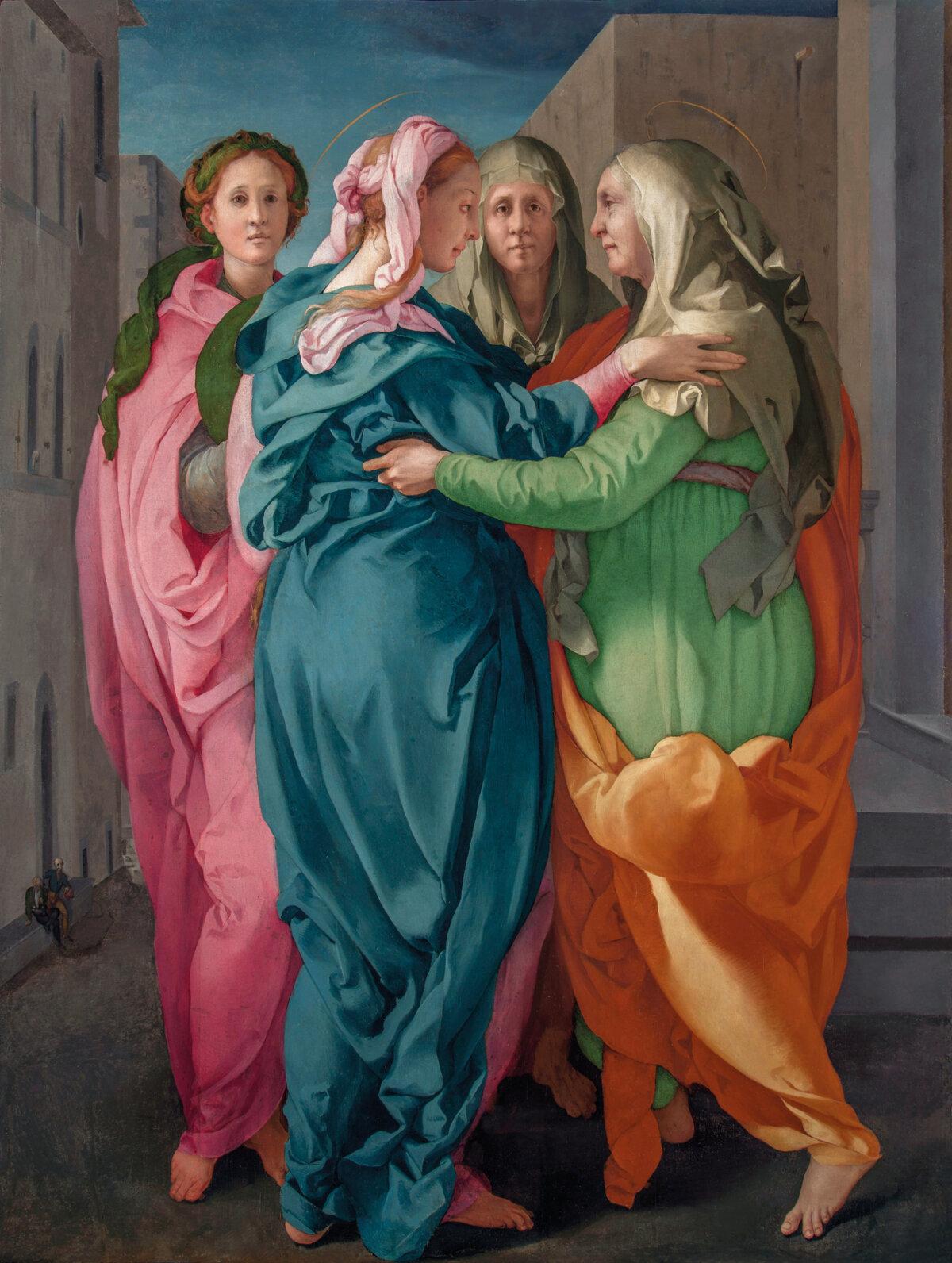
It’s a rich, colorful, and expressive scene. Faint halos mark their divinity. Elisabeth wears a white veil, the color of purity, and a green robe representing hope, renewal, and spiritual rebirth. Mary wears a pink headdress and a teal blue mantle rather than the traditional royal or lapis lazuli blue. However, the teal hue echoes the clear sky, representing the unveiling of truth.
Pontormo rendered the excitement of the moment. This is revealed in the figures’ expressive faces and their dynamic postures, such as evident in how Elisabeth lifts her foot off the ground. According to the Gospel of Luke, the Virgin’s visit blessed Elisabeth and the unborn St. John the Baptist, who recognized Christ’s presence.
The Nativity
According to “The Oxford Companion to Art,” the Nativity scene depicted in the visual arts originated from sources later than the Gospels. From the early fourth century, Roman sarcophagi showed the familiar Nativity scene of a barn with the Virgin seated (symbolizing the miraculous, painless birth), Christ in the manager, and the ox and donkey nearby. Shepherds were often in attendance and sometimes Magi.Artist Piero della Francesca (circa 1415–1492) based his Nativity painting on the revelations of St. Bridget of Sweden (circa 1304–1373), a late-medieval mystic whose works were popular in the 15th century. For his painting, he adopted classical poses for a choir of angels singing, with some playing lute-like instruments. Mary kneels in prayer, venerating the Christ Child who lies on her blue mantle—again symbolizing divinity and the unveiling of truth. Mary also wears red and white fabric, symbolizing sacrifice and purity, respectively. Throughout her hair and around her neck, she wears pearls, the gem of purity. Again, her pale complexion and fair hair represent the Renaissance ideal of beauty.
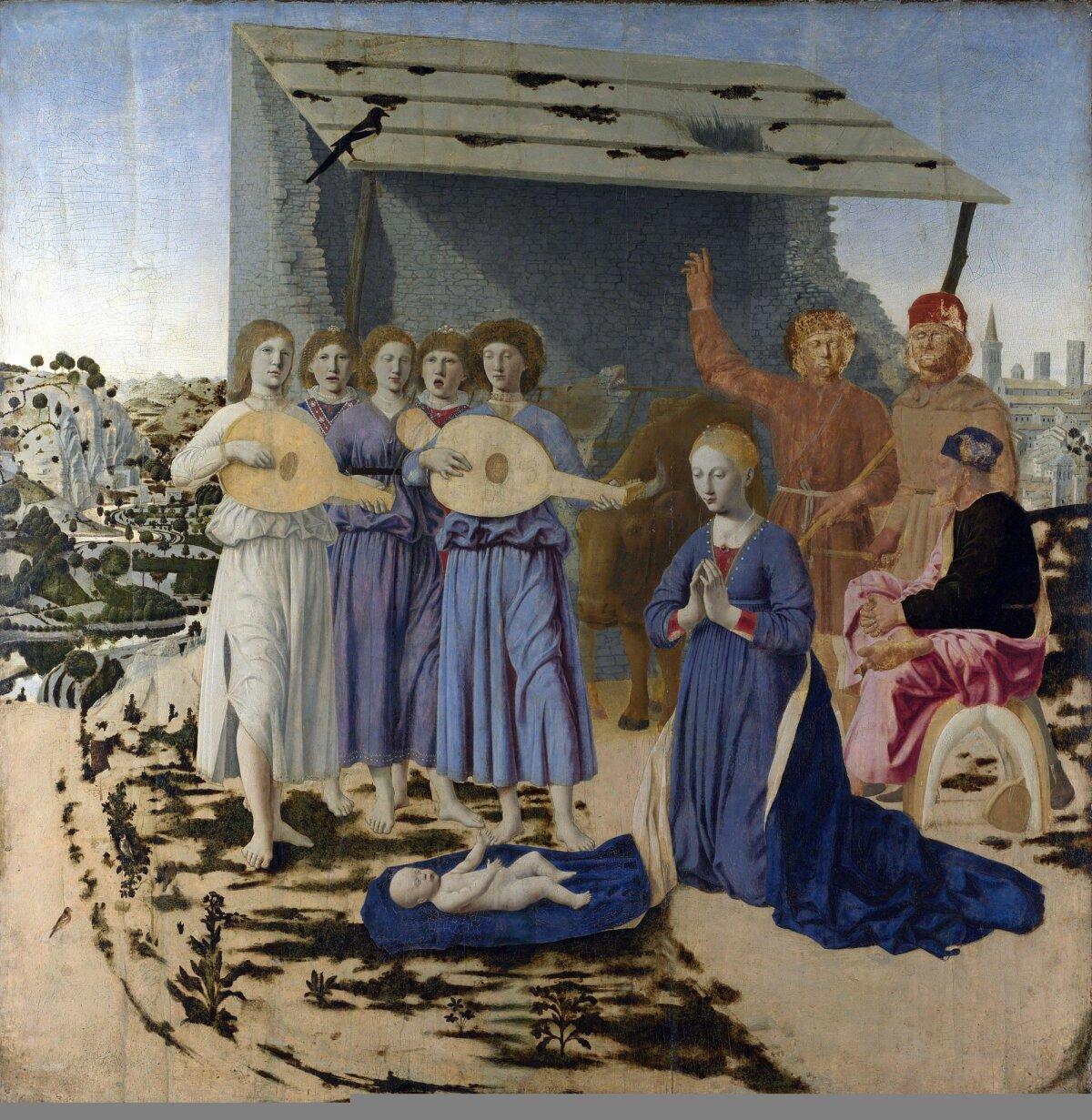
Joseph sits on the his saddle, talking to two shepherds. He wears a pink mantle over a dark robe. His pose mirrors that of the “Spinario,” a famous ancient Roman sculpture of a boy pulling a thorn from his foot. One shepherd points heavenward, while his crook points down toward Mary and Christ. Sheltering in the stable, the ox and braying donkey represent all creatures—great and small—that witnessed Christ’s birth and recognized him as the Son of God. The ox gazes upon Christ, perhaps emphasizing this point.
A magpie, often a symbol of death and mortality, perches on the stable roof. At the left of the painting, three finches perch on the rocky ground, one of which looks like a goldfinch, the symbol of Christ’s Passion and a sign of his ultimate sacrifice to come.
The absence of figurative shadows highlights the sacred nature of the subjects and the Nativity.
The artist created the work for his family palace in Tuscany, in the town of Borgo Santo Sepolcro, now known as Sansepolcro. It initially hung in the main bedchamber. Instead of setting the Nativity in Bethlehem, he painted the landscape of his hometown, making it a pertinent, daily reminder of the divine in his life. The painting remained in the palace until 1825.
The Adoration of the Magi
Artist Gentile da Fabriano (circa 1370–1427) created an opulent and action-packed altarpiece, the “Adoration of the Magi.” In the background, he depicted the Magi’s journey. The brilliant Star of Bethlehem lights the night sky, announcing the auspicious birth throughout the land. Golden halos embellished with heavenly script encircle the heads of the Holy Family: Mary, Joseph, and Christ. Mary wears a gold veil and a blue mantle over a red robe. Joseph wraps a golden mantle around his brown robe. Artists traditionally depict Joseph dressed in these colors: the brown symbolizes the renunciation of the world, and golden yellow symbolizes the sun and divinity.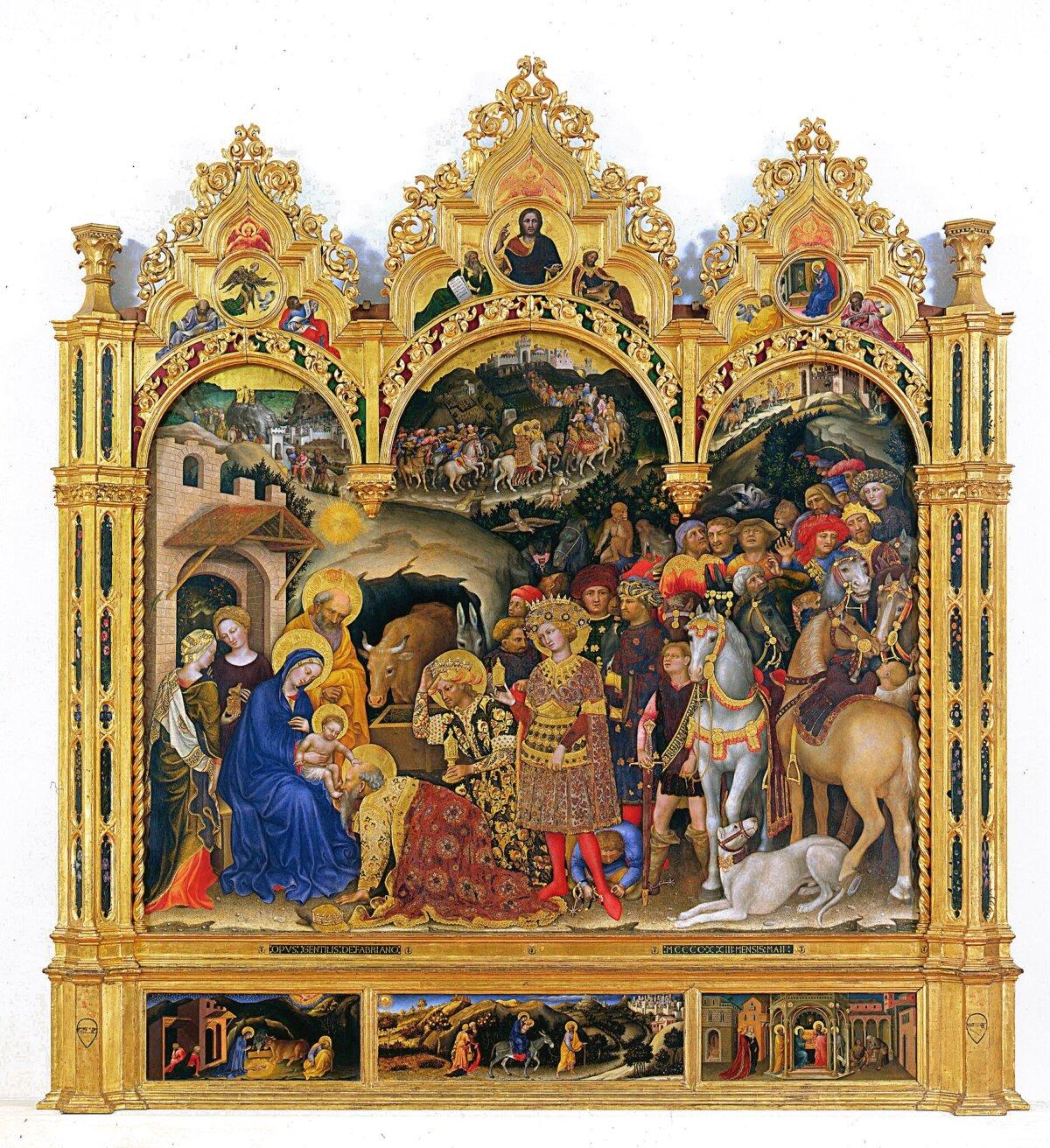
Simple halos encircle the Magi’s heads. They wear opulent crowns and rich fabrics. Pomegranate vines climb up one of their cloaks; blood-red fruits refer to the Resurrection.
Having humbly cast his crown aside, one of the Magi kneels in front of Christ. Christ’s pose echoes the natural curiosity of a baby reaching out to touch someone. Having not yet developed body control or strength, he propels his body forward. Mary supports her son, who places the palm of his hand on the crown of the Magus’s head. Christ’s solemn expression conveys that he’s fully aware of his sacred mission on Earth.
Birds and animals feature throughout the altarpiece, adding to its beauty and reinforcing its sacred content. The traditional ox and donkey appear prominently. But there are also exotic animals, such as a monkey in chains, symbolic of faith conquering sin and restoring virtue. Other sacred symbols include the dove, representing the Holy Spirit, and the pelican feeding its young. Both are synonymous with Christ’s sacrifice in the Crucifixion.
The bottom of the altarpiece shows three episodes of Christ’s childhood: the Nativity, the Flight into Egypt, and the Presentation at the Temple.
All four paintings show the universal visual language of Christian art that transcends time, spans continents, and exalts heaven.
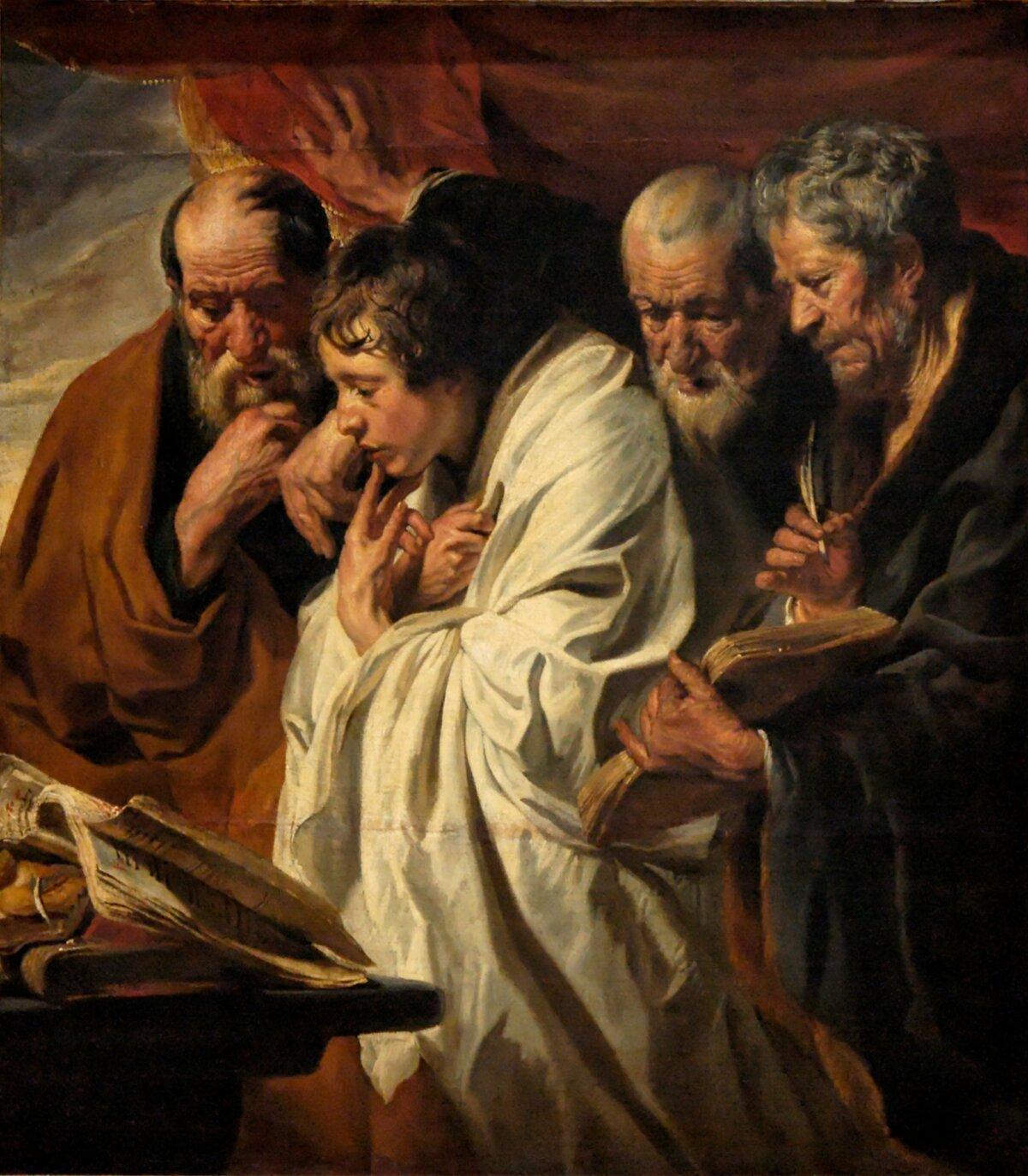
In the “Four Evangelists,” Flemish painter Jacob Jordaens (1593–1678) rendered the men studying Scripture and writing their Gospels. Although it isn’t related to the Nativity, the painting reminds Christians to live according to the word. Surely, that’s the spirit of Christmas.