Top Classical Chinese Dancers Grace New York

September 11, 2010 Updated: September 29, 2015

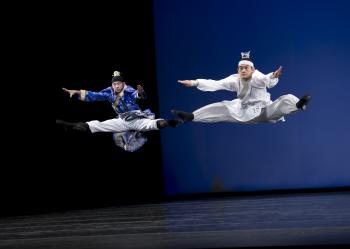
Rick Li (left) and William Li (right) performing 'Seven Step Poem.' (Dai Bing/The Epoch Times)
PURCHASE, N.Y.—The semifinals of New Tang Dynasty Television´s Fourth International Classical Chinese Dance Competition concluded on Sept. 11 at The Performing Arts Center at Purchase College, SUNY in Westchester County, N.Y.

The competition aims to provide a platform for qualified classical Chinese dancers from different parts of the world to share and improve.

This year, contestants from the United States, Canada, France, Australia, and New Zealand partook in the competition, each performing one dance routine they had choreographed themselves, and another piece showcasing required dance movements such as a series of turns, flips, and tumbling techniques.

“It was obvious that the many contestants did even better today. I think they learned a lot during the preliminary contest. I feel very glad to see their improvements,” said Chen Yung-Chia, principle dancer and spokesperson for the judging committee.

“This year´s contestants are very skilled dancers. The semifinals included splendid performances. I think tomorrow´s finals will be even better,” added judge Michelle Ren.

Judges of the competition announced the finalists after today´s session.

An Introduction to Classical Chinese Dance

China´s 5,000 years of civilization gives endless inspiration for classical Chinese dance.

Chinese classical dance was passed down from ancient China. Ancient cultures of different periods of time are infused into the genes of Chinese people, forming a kind of bearing that is associated with every move of a human being, called "yun."

At the same time, cultural heritage was passed on to dancers. Together, these two transmissions formed into a systematic way of instructing classical Chinese dance.

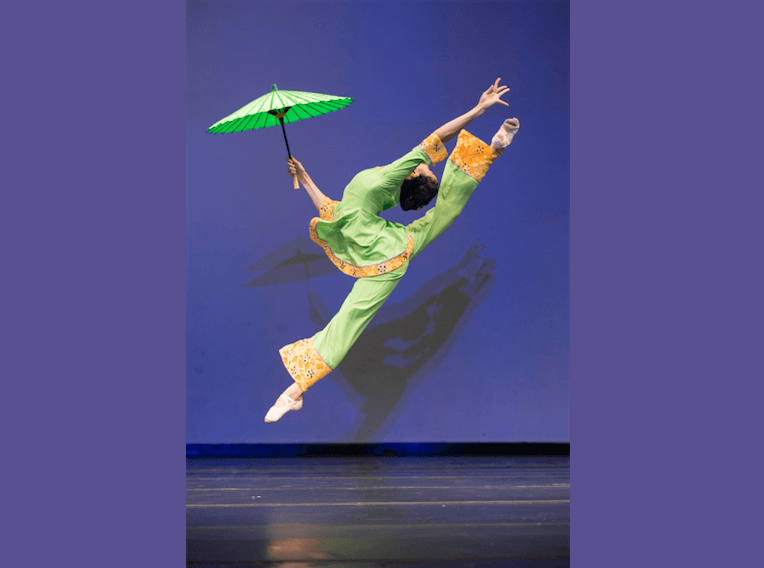
Angelia Wang from the junior female division performing 'Dawn of Spring' (Dai Bing/The Epoch Times)
The dance form therefore owns unique characteristics that allow a dancer to express the inner feelings of a character in great depth with the use of dance movements and techniques.

“The contestants displayed good use of techniques and, of course, that is very important. What´s even more precious is that they could use the techniques to portray the characters well,” said Ren.

Every piece of dance from the competition told a lively story. Through skilled artistic movements, contestants portrayed renowned historic figures, heavenly gods and beauties, and traditional characters in folk tales.

For example, William Li and Rick Li´s duet portrayed sons of Cao Cao, a powerful warlord from 1,500 years ago. One of the brothers composed a poem in seven footsteps to remind the other that violent power struggle between siblings would be regarded as ignoble in history.

“I got the inspiration during a history class. We learned about Chinese history and I did some research myself, too,” said Rick Li.

Alison Chen presented a childhood story of Ying Tai, a key character from a famous folk tale called the "Butterfly Lovers," also known as the Chinese version of "Romeo and Juliet."

Young Yingtai was born into a wealthy family in ancient China where girls were mostly brought up at home. She dressed up like a boy in order to be able to go to school.

Continued on the next page…