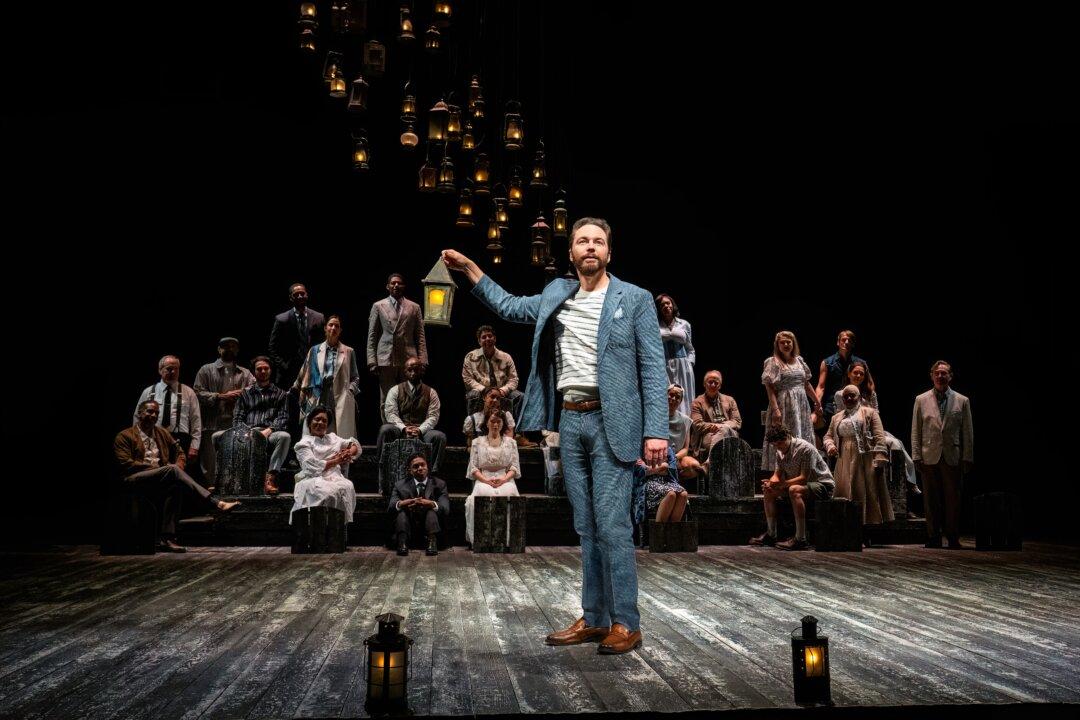
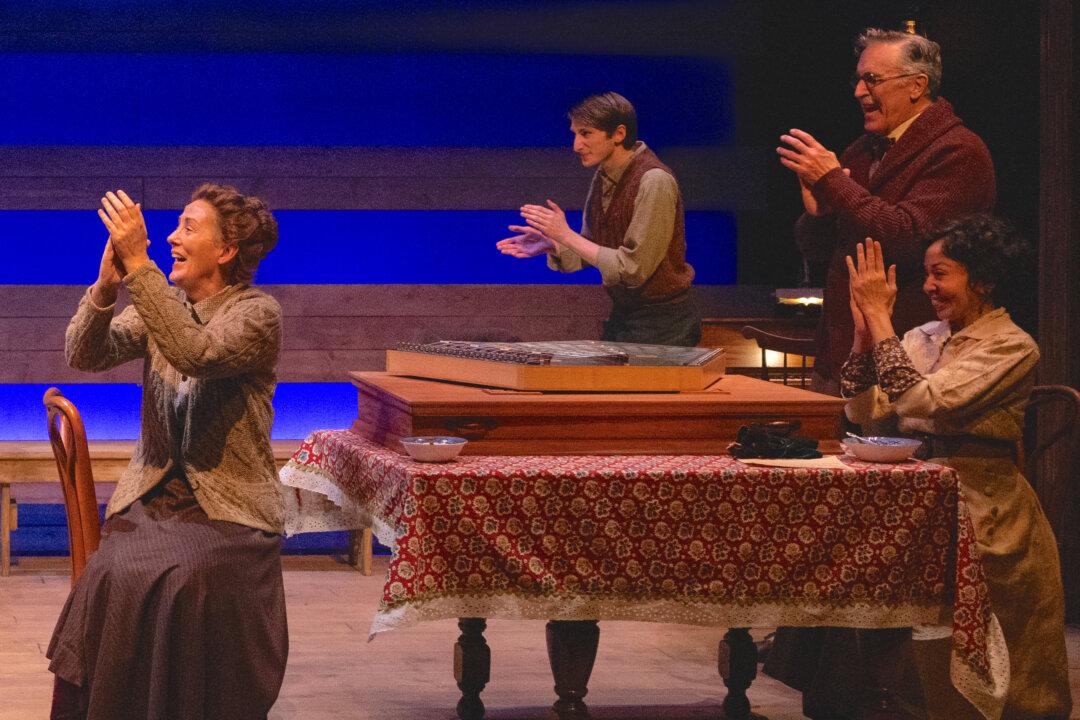
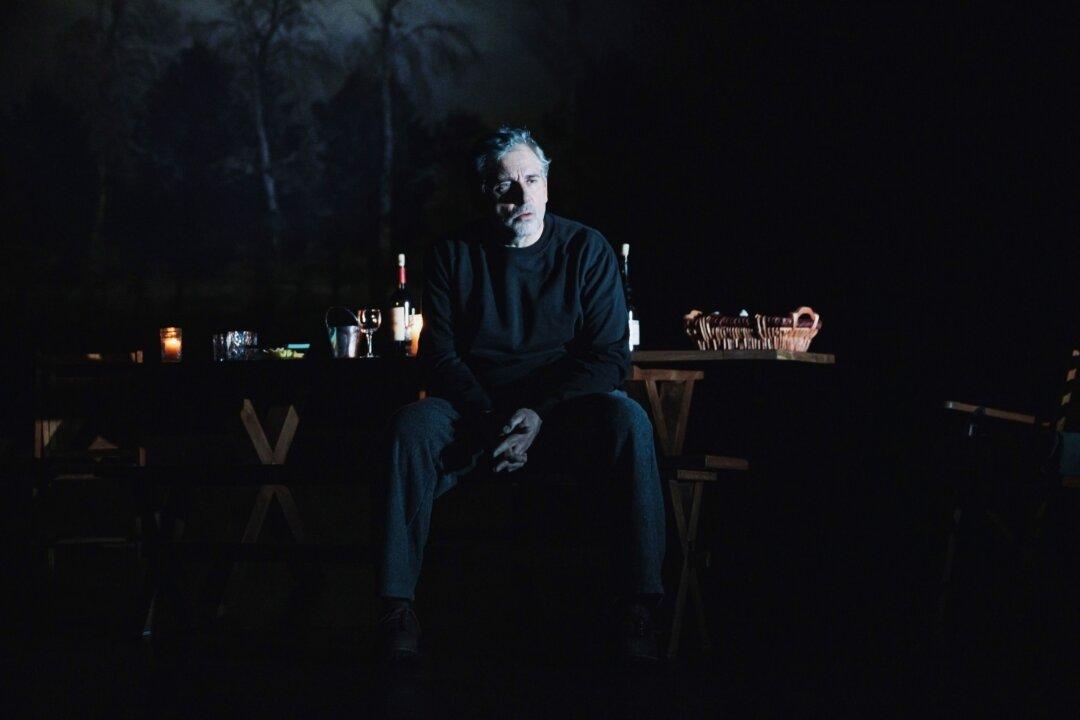
NEW YORK—Tennessee Williams’s classic is receiving an imposing production, its sixth Broadway revival since its initial presentation back in 1945. Now at the Booth Theatre, it is a transfer from the American Repertory Theater in Cambridge, Mass. Under John Tiffany’s direction, this memory play exerts strong emotional currents.
In this story of the Wingfield family of three, transplanted from the South to St. Louis, son Tom (Zachary Quinto) serves both as narrator and character. The trio’s drab apartment, entered via a fire escape, illustrates their position in life.
The evocative set by Bob Crowley, with a dark liquid pool, seems to enclose a deliberately sparse living room. That and the rather astonishing fire escape, which appears to ascend into infinity, create a powerful environment in which the events of the play can roll out—or fester.
Tom, an aspiring poet, suffers from having to hold a menial job at a warehouse in order to support the family, while his sometimes overbearing mother, Amanda (Cherry Jones), does her best to keep up the spirits of her two offspring. It is a tough battle.
Tom maintains his equilibrium by going to the movies virtually every night. His sister, Laura (Celia Keenan-Bolger), who suffers from mobility impairment—she is occasionally referred to as “crippled”— is chronically depressed and lacks self-confidence. To escape reality, she loses herself in her imagination, contenting herself to play with a menagerie of small glass animals.
Amanda, who almost superhumanly tries to hold the family together, senses Tom’s powerful desire to leave them and wants desperately to find a “nonalcoholic” husband for Laura before Tom goes. Her husband left the family long ago. As Tom remarks, “He was a telephone man in love with long distances.”
Tom finally does come through with a dinner invitation to his “best friend” at work, a former high school athletic star whom Laura remembers with terror, for she thinks she will be humiliated in the presence of this most popular boy.
When the fateful evening arrives, Laura becomes more withdrawn than ever, but Jim, the Gentleman Caller (Brian J. Smith), puts the girl at ease by encouraging her.
The Gentleman Caller scene is arguably the high point of the drama. However, I believe a few important lines were excised from this production. In Williams’s text, Jim accidentally breaks off the horn of Laura’s favorite glass animal, a unicorn, prompting her to say, “Now it is just like all the other horses.” And she gives it to him, as a gift. This is a particularly poignant moment, even when read.
The production features a well-orchestrated quartet of fine performers with consummate ensemble playing. Zachary Quinto’s Tom expresses all the pain and frustration that the character is bound to feel.
As his sister Laura, Celia Keenan-Bolger projects the sadness and fears of the character, although this is coupled with an interesting streak of stoicism.
Brian J. Smith brings to the Gentleman Caller an element of tremendous caring and sympathy toward Laura and admits that he has not attained the goals that were hinted at in his successful high school days.
Cherry Jones has elected to accent Amanda’s strength rather than her soft Southern belle side. In a recent television interview (Theater Talk, PBS, Oct. 11), Ms. Jones stated that she took the “strong” approach for Amanda to indicate that the woman, having left the protective environment of her Southern home, must fight for a rightful place for her family in the less welcoming North.
However, by solely taking this tack, Ms. Jones relinquishes the opportunity to show another side of the character: In the scene where Amanda enters, dressed in an old frilly wedding cake type gown, she has the opportunity to show the delicacy and flirtatiousness of her early social triumphs. This is, after all, a memory play.
The acting and production elements—Bob Crowley’s aforementioned set (he also did the costumes), lighting by Natasha Katz, and sound design by Clive Goodwin—are integrated seamlessly.
Also mentioned in the program is movement by Steven Hoggett. I don’t know if he was the person responsible for the frequent expansive raised arm movements of both Ms. Jones and Mr. Quinto, but in any case, it was a nice touch: like mother like son.
This production of “The Glass Menagerie” is without a doubt a major theatrical event of this season.
The Glass Menagerie
American Repertory Theatre production
Booth Theatre
222 West 45th Street
Tickets: 800-432-7250 or 212-239-6200 or visit www.telecharge.com
Running Time: 2 hours, 30 minutes
Closes: Feb. 23, 2014
Diana Barth also publishes New Millennium, an arts publication. For information: [email protected].