NEW YORK—Country doctor/playwright Anton Chekhov completed his last play, “The Cherry Orchard,” one year before his death in 1904 at age 44 by advanced tuberculosis.
In this new adaptation by Tom Stoppard, directed by Sam Mendes, the play reverberates, as always, with poignancy and yearning, with lost love, lost hope. Yet it is infused with beauty and renewed hopefulness. It is tragic yet has moments of comic relief.
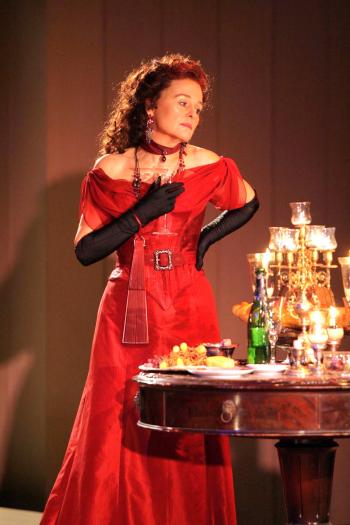
The eponymous orchard surrounds the home of Madame Ranevskaya (Sinéad Cusack) who returns to Russia from a five-year sojourn in Paris where she has had an unhappy love affair. She is accompanied by her daughter Anya (Morven Christie) and governess Charlotta (Selina Cadell). Immediately surrounded by family, friends, and employees, a strong feeling of home emanates.
However, the merchant Lopakhin (Simon Russell Beale), a family friend, soon informs Madame Ranevskaya of harsh news: The entire estate will soon be lost, due to nonpayment of the mortgage.
Yet in spite of Madame Ranevskaya being broke—in fact, she constantly throws her money away—Lopakhin offers a plan whereby she can save the estate. But the plan merely offends her sensitive, aristocratic sensibilities, for in saving the cherry orchard she must destroy it and that she cannot do.
Until that severe moment of truth comes to pass, life goes on. Ranevskaya still mourns the death of her young son by drowning, some years ago, in the nearby river. Her brother Gayev (Paul Jesson) is loving but ineffectual, particularly in money matters. Her adopted daughter Varya (Rebecca Hall), who runs the estate, may marry Lopakhin, but firm decisions appear not to be part of this group’s repertory.
The perennial student Trofimov (Ethan Hawke) and Anya are drawn to one another. But he claims to be “above love.” Now about 30 years old, he would welcome social progress to Russia, which is indicated in director Sam Mendes’s production by the occasional appearance, almost as an apparition, of a group of static but somehow sinister peasants. Later, when a Passer-by (Gary Powell) appears and begs for money, the chill of “progress” permeates the air. Ranevskaya, visibly frightened by the interloper, recklessly throws him a valuable gold piece to be rid of him.