Perhaps the most underrated travel opportunity, the stopover can be a rewarding experience. In Taiwan, this precious period of waiting, usually marked by impatience and boredom while anticipating a connecting flights, has been turned into a remarkable tourism draw.
Taiwan Tourism sponsors free half-day tours directly from the airport for passengers who have 7 to 24 hours before their connecting flights. From 7:00 a.m. to 11:30 p.m. you can sign up for ready-made tours by bus to local sights. With no more than a small fee to store luggage, these free trips offer a delightful diversion from stopover doldrums.
Morning Travel Break
The Morning Tour departs at 8:00 a.m. and returns by 1:30 p.m., depending on your terminal. The five-hour jaunt takes the rapid tourist on a short trip to the countryside southwest of Taipei to Yingge.

The second half of the tour takes you to historic Sanxia where the main attraction is the Zushi Temple. The temple was built in honor of a famed Song Dynasty general, Chen Chao-Ying, knighted for his valor as “Protector of the Country.” By the end of World War II, the temple was in ruins and has been undergoing restoration for over 40 years. The temple is known for its unique bird art, just a part of intricately carved stone columns and statues.
Afternoon Jaunt
The Afternoon Tour, 1:45 to 6:30 p.m., takes the short-term visitor on a historical photo op journey which includes several must-see sights in Taipei. It begins with the 101 Building, Taiwan’s tallest and the world’s second tallest at over 1,600 feet complete with an observatory. Next is the Longshan Temple, the oldest and probably most famous in Taiwan. It is known for its fine architecture, and it houses hundreds of statues of Buddhist, Daoist, and Confucian deities. The next stop is the Presidential Office Building, whose interior features an interesting mix of Renaissance, Baroque, and Neo-classical design. After restoration from war damage, the building has been used as the Office of the President since 1949.
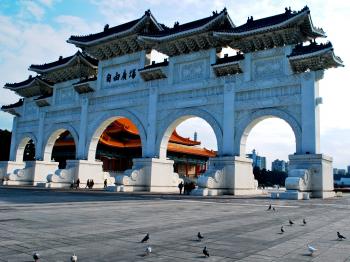
Following this grand sight is the impressive Chiang Kai-shek Memorial Hall, built in honor of the late President Chiang. The hall is surrounded by over 61acres of beautifully landscaped gardens, graceful pavilions, and ponds. Last but not least is a stop at the Martyrs' Shrine. The shrine, dedicated to fallen heroes in Chinese history, is a fine example of Ming Dynasty architecture.

History and Shopping
The final stopover opportunity is a six-hour tour of the Taoyuan area. This includes a visit to the Cultural Resort of the Chiangs (Former President Chiang Kai-shek and Chiang Ching-kuo). The resort features the Cihu Mausoleum, commemorated in 1975 when the former president’s remains were placed there. Surrounded by mountains and water, the mausoleum is built in a style reminiscent of courtyards in Fujian and Zhejiang in mainland China. The changing of the guard ceremony here is a great photo op.
The next stop is Daxi “Old Street,” where traditional crafts like woodcraft, iron mongering, stone working, and even dried bean curd making can be seen. The shops are built in Japanese “baroque” style with white-washed stone, and exquisite carvings of birds, animals, and flowers.
The last stop is a veritable shopping and recreational holiday at the Taimall Family Entertainment Shopping Center. The center features over 968,750 square feet of choices. There are counters offering designer products and a department store for the savvy shopper. It also houses a theater, an entertainment center, a sports stadium, and restaurants. With so much to do, this Taoyuan marvel is the perfect place for even all day family fun.
Plan your 'Stay'
Each tour is limited to 18 people and is on a first-come-first-served basis. It requires a visa and visa-exempt country eligibility (visit the website for a list). It will require some planning, though. Tour-goers must present a confirmation for the tours at check-in before boarding their flights to Taiwan.

Weronika Czapla captured these moments of Taiwan while participating in the Taiwan Field School organized by the University of Toronto in collaboration with the Taiwanese Ministry of Foreign Affairs in December 2009.
This article is sponsored by and published in cooperation with the Taiwan Tourism Bureau. For more information, please visit: http://admin.taiwan.net.tw.