Scientists working at the world’s biggest atom smasher say they have discovered a new kind of particle called “pentaquarks.”
In 1964, Belgian physicist François Englert proposed a solution to one of the universe’s central mysteries: how a particle gains mass.

Physicists are now almost certain the curious “Higgs-like particle” revealed at CERN last year is a Higgs boson.
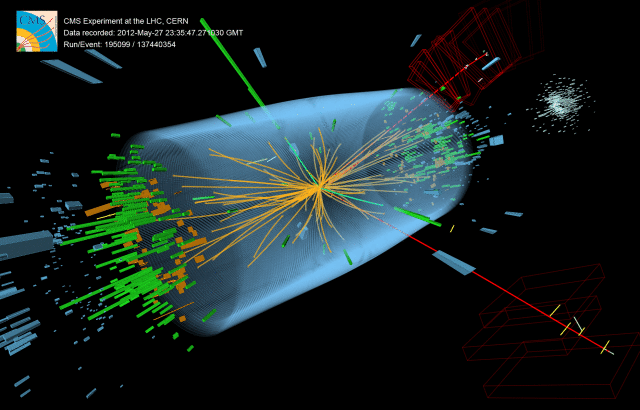
The European Organization for Nuclear Research (CERN) has shown a particle with a mass which matches that of the hypothesized Higgs boson or so-called god particle.
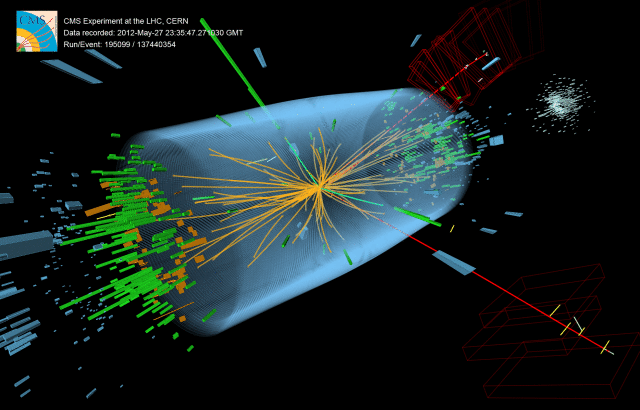
The laboratories that discovered neutrinos traveling faster than light now backtrack and state that they have found two possible glitches in their system that could account for this anomalous result.

Scientists analyzing data from the ATLAS experiment found a new particle—the Chi-b(3P). (ATLAS Experiment © 2007 CERN)

New research from the European Organization for Nuclear Research (CERN) shows significant progress in the hunt for the subatomic Higgs boson, yet its short-lived existence or non-existence still cannot be conclusively proven.